Museum of East Asian Art Cologne: Europe's First, Still Worth Your Time
Founded in 1913 as the first specialized museum of East Asian art in Europe, Cologne's Museum für Ostasiatische Kunst occupies a quietly striking 1977 building by Japanese architect Kunio Maekawa, set beside the Aachener Weiher pond. It rewards visitors who come curious and unhurried, with collections spanning Chinese, Japanese, and Korean art across centuries.
Quick Facts
- Location
- Universitätsstraße 100, 50674 Cologne
- Getting There
- Tram 1 or 7, Bus 142 — stop Universitätsstraße
- Time Needed
- 1.5 to 2.5 hours
- Cost
- Adults €9.50 / Concessions €5.50 / Free on first Thursday for Cologne residents (except public holidays)
- Best for
- Art lovers, Japan and China enthusiasts, architecture fans, quiet museum seekers
- Official website
- museum-fuer-ostasiatische-kunst.de/Start
What This Museum Actually Is
The Museum für Ostasiatische Kunst, known in English as the Museum of East Asian Art, holds a distinction that most visitors walk past without realizing: when it opened in 1913, it was the first museum in Europe dedicated exclusively to East Asian art. That is not a marketing claim. It is a fact about the history of how Western institutions chose to engage with Chinese, Japanese, and Korean visual culture, and it gives the collection a depth and seriousness that more generalist museums cannot match.
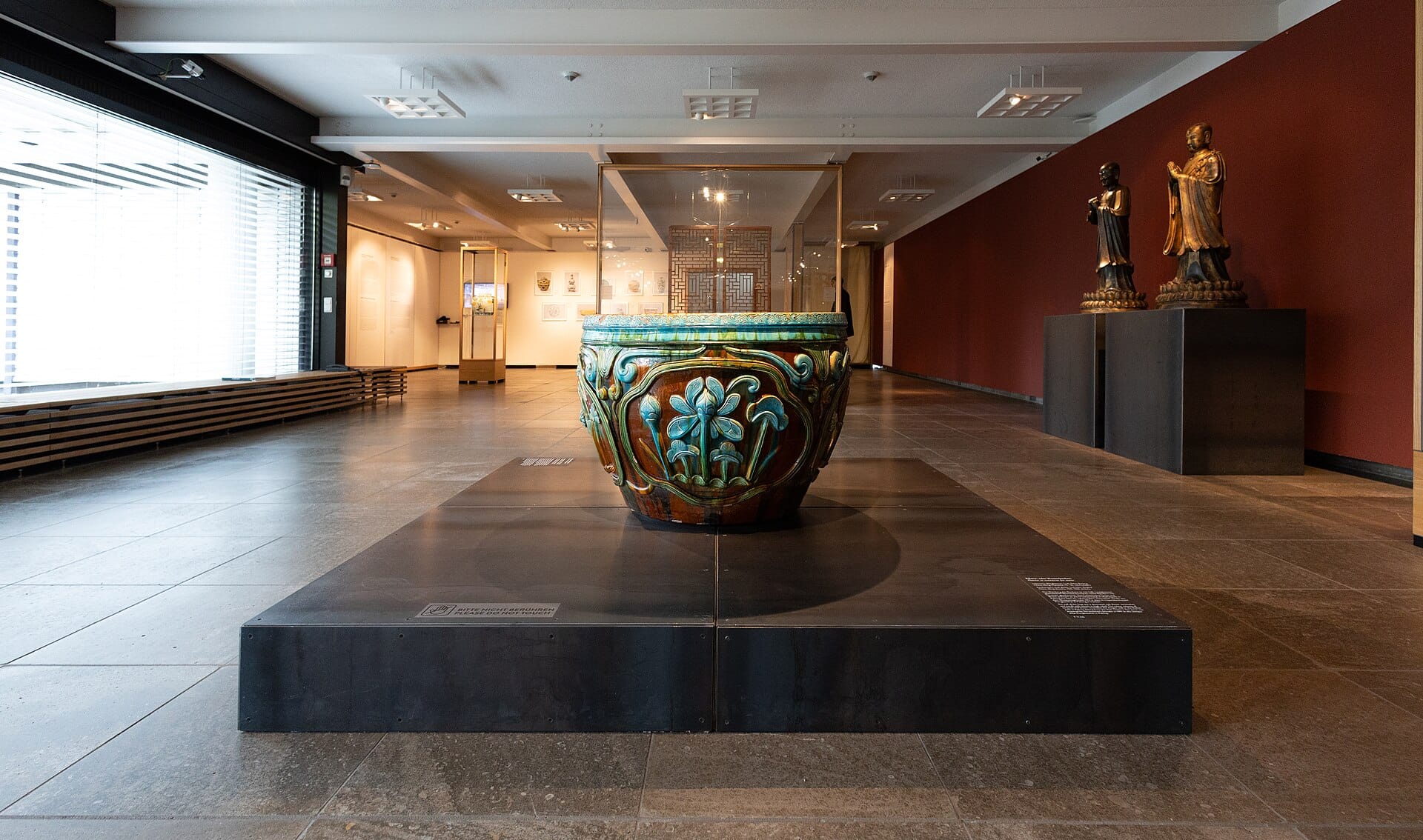
The collection covers paintings, sculpture, lacquerwork, ceramics, textiles, and decorative objects from China, Japan, and Korea, ranging from ancient antiquity through the 20th century. It is not a blockbuster institution. The galleries are calm, the crowds are manageable, and the works are displayed with enough space to actually look at them. For visitors exhausted by the sensory overload of larger museums, this is a genuine advantage.
💡 Local tip
On the first Thursday of each month (except public holidays), the museum stays open until 22:00 and admission is free for Cologne residents with proof of address. For everyone else, it is simply a good evening option when most of the city's other museums have closed.
The Building: Kunio Maekawa's 1977 Design
The current building is itself worth attention. Completed in 1977 and designed by Japanese architect Kunio Maekawa, the structure sits at the edge of the Aachener Weiher, an artificial pond in Cologne's Stadtwald area to the west of the city centre. Maekawa was one of the most important figures in post-war Japanese modernism, having trained under Le Corbusier in Paris and later under Antonin Raymond in Japan. His buildings typically work with concrete in a way that is austere but not cold, and the Cologne museum follows that logic.
From the outside, the building does not announce itself dramatically. It reads as a low, deliberate structure that defers to its surroundings rather than dominating them. The relationship to the water and trees is intentional: the framing of the natural environment is part of the architectural experience, consistent with aesthetic ideas drawn from Japanese spatial thinking. On grey winter days the building can feel severe. On a clear morning in May, with light reflecting off the Aachener Weiher, the setting is genuinely beautiful.
If you enjoy Maekawa's approach here, it is worth knowing that the Aachener Weiher itself is a pleasant green space to walk through before or after your visit, especially in warm weather.
Tickets & tours
Live prices and dates from our booking partner. If you book, we may earn a commission at no extra cost to you.
Cologne haunted places and ghost stories: interactive city game
From 8 €Instant confirmationFree cancellationFood Tour Cologne Sudstadt
From 44 €Instant confirmationFree cancellationCologne brewery tour including 3 Kolsch beer
From 28 €Instant confirmation2-hour afternoon cruise in Cologne at Christmastime
From 25 €Instant confirmationFree cancellation
Inside the Collection: What You Will Actually See
The permanent collection is organized roughly by culture and medium rather than strict chronology, which means you move between moods rather than through a linear narrative. Chinese Buddhist sculpture occupies some of the strongest gallery spaces, with stone and gilt-bronze figures that reward slow looking. The scale of some pieces is unexpected: these are not small devotional objects but substantial works that originally occupied temple or shrine settings.
Japanese works include ink paintings, lacquerwork, and objects from the Edo and Meiji periods. The lacquer pieces in particular are worth pausing over: the level of technical detail in the finest examples is difficult to absorb quickly, and most visitors move past them too fast. Korean ceramics are represented with particular strength in celadon ware, the grey-green glazed stoneware of the Goryeo dynasty, which has an understated elegance that photographs poorly but reads beautifully in person.
Temporary exhibitions rotate through the year and often focus on a specific artist, period, or theme with genuine scholarly depth. Checking the museum's website before you visit is worthwhile, both to see what is showing and to confirm hours, as special events can occasionally affect access to parts of the building.
ℹ️ Good to know
The museum is closed on Mondays, on 24, 25, and 31 December, on 1 January, and on specific special days such as the Cologne Marathon day (check the current year’s note on the official site). Plan accordingly if your trip overlaps with any of these dates.
How the Experience Changes by Time of Day
The museum opens at 11:00 and the first hour is consistently the quietest. Arriving close to opening means you will often have entire gallery rooms to yourself, which changes the quality of the experience considerably. By early afternoon, school groups and organized tours can arrive and fill the corridors with noise. If you are sensitive to that, a Tuesday or Wednesday morning is the most reliable time to find calm.
The first-Thursday evening opening until 22:00 is a different kind of visit. The galleries thin out after the post-work crowd passes through around 19:00, and by 20:30 you can often move through the rooms in near silence. The lighting in the building is controlled carefully, and the Japanese and Chinese works read differently under evening light than they do in the afternoon. If you have flexibility, an evening visit on the late Thursday is one of the more unusual museum experiences available in Cologne.
Practical Information for Getting There
The museum is located at Universitätsstraße 100, roughly two kilometres southwest of Cologne's city centre. Tram lines 1 and 7, along with bus line 142, all stop at Universitätsstraße, which is a short walk from the entrance. Journey time from the main railway station is around 10 to 15 minutes by tram. The museum also has a car park directly on site, which is useful if you are visiting with limited mobility or arriving from outside the city.
The museum sits within comfortable walking distance of the Botanical Garden Cologne, and combining both in a single afternoon is a reasonable and unhurried way to spend a day in this part of the city.
⚠️ What to skip
Specific accessibility details are partly confirmed: the museum states that it is barrier-free and has a disabled toilet, but further information (such as detailed step-free routes or lift locations) is not listed on the main information pages. If step-free access, lift availability, or other requirements are important to your visit, contact the museum directly before arriving.
Who This Museum Is For, and Who Might Skip It
This is not a museum that tries to entertain everyone. There are no interactive screens designed for children, no dramatic light shows, no gift shop packed with novelties. Visitors who find the most satisfaction in standing in front of a well-made object and thinking about it carefully will feel at home. Visitors looking for an accessible overview of Asian culture broadly, or for a family activity with young children, will likely find the pace frustrating and the interpretation too specialized.
If you are building a broader museum itinerary around Cologne, it is worth knowing that the city has a genuinely strong collection of institutions. The Museum Ludwig offers modern and contemporary art, while the Wallraf-Richartz Museum covers European art from the medieval period through the 19th century. The Museum of East Asian Art works well as a complementary stop rather than an isolated destination.
For a broader sense of how to structure your time across Cologne's museums, the best museums in Cologne guide gives a useful overview of what the city offers and how the institutions compare.
Admission, Discounts, and Free Entry
Standard adult admission is €9.50, with a concession rate of €5.50 for eligible visitors. Free admission applies to children and young people under 18, all schoolchildren (plus two accompanying adults per school class), ColognePass holders, and birthday children who are Cologne residents visiting on their actual birthday. On the first Thursday of each month, except public holidays, all Cologne residents with proof of address enter free under the KölnTag scheme. Prices are subject to change, so confirming current rates on the official website before your visit is advisable.
If you are travelling on a tight budget and trying to make the most of Cologne's cultural institutions, the Cologne on a budget guide covers free and discounted entry options across the city.
Insider Tips
- Arrive within the first 30 minutes of opening on a weekday to have the permanent collection largely to yourself. By 13:00, school groups can change the atmosphere significantly.
- The first Thursday evening opening until 22:00 is the least-known way to visit. By 20:30 the galleries are nearly empty and the lighting creates a noticeably different reading of the lacquer and ink-painting works.
- The Aachener Weiher lake immediately adjacent to the museum makes for a good 20-minute walk before you enter, particularly in spring and early autumn when the trees are at their best. It orients you to the building's relationship with its setting.
- The Korean celadon ceramics section is consistently undervisited compared to the Chinese and Japanese galleries. Budget extra time there if you have any interest in glazed stoneware traditions.
- Check the temporary exhibition schedule before you visit. The museum runs shows with genuine scholarly depth, and occasionally these are the most rewarding part of the visit, depending on the topic.
Who Is Museum of East Asian Art For?
- Art enthusiasts with specific interest in Chinese, Japanese, or Korean visual culture
- Architecture observers who appreciate the work of Kunio Maekawa and Japanese modernism
- Visitors seeking a genuinely quiet museum experience away from Cologne's busier institutions
- Travellers combining the museum with a walk around the Aachener Weiher and Stadtwald area
- Budget-conscious visitors who qualify for the KölnTag free Thursday or ColognePass discount
Nearby Attractions
Combine your visit with:
- Aachener Weiher
A 4-hectare artificial pond created in 1920, Aachener Weiher is where Cologne residents go to decompress. Surrounded by lawns, cycle paths, and a long-running beer garden, it offers a genuine slice of local life without an entrance fee or a tourist queue in sight.
- Flora Botanical Garden (Flora und Botanischer Garten)
Opened in 1864 to a design by Peter Joseph Lenné, the Flora und Botanischer Garten is Cologne's most refined public garden. Eleven and a half hectares of landscaped parkland, tropical greenhouses, and more than 10,000 plant species await — and admission is free every day of the year.
- Kölsche Riviera (Cologne Rhine Beaches)
The Kölsche Riviera is Cologne's answer to summer beach culture: a stretch of sandy riverbank bays along the Rhine in the southern Rodenkirchen district, free to access and beloved by locals looking to sunbathe, picnic, and watch the river traffic roll by. No sea, no surf, but a genuinely relaxed atmosphere that reveals a quieter, less touristy side of the city.
- RheinEnergieStadion (FC Köln)
Home to 1. FC Köln and one of Germany's most storied football venues, the RheinEnergieStadion seats up to 50,000 fans and hosted both the 2006 FIFA World Cup and UEFA Euro 2024. Whether you're catching a Bundesliga match or joining a stadium tour, this is where Cologne's football identity comes into sharp focus.
Planning a trip? Discover personalized activities with the Nomado app.