RheinEnergieStadion: Inside Cologne's Football Cathedral
Home to 1. FC Köln and one of Germany's most storied football venues, the RheinEnergieStadion seats up to 50,000 fans and hosted both the 2006 FIFA World Cup and UEFA Euro 2024. Whether you're catching a Bundesliga match or joining a stadium tour, this is where Cologne's football identity comes into sharp focus.
Quick Facts
- Location
- Aachener Straße 999, 50933 Cologne (Müngersdorf district, west Cologne)
- Getting There
- KVB Line 1 tram to RheinEnergieSTADION stop — approx. 15–18 min from Neumarkt
- Time Needed
- 2–3 hours for a match; 1–1.5 hours for a stadium tour
- Cost
- Match tickets vary by category and fixture; tour prices — check stadium directly
- Best for
- Football fans, sports architecture enthusiasts, families, event-goers
- Official website
- www.rheinenergiestadion.de/en
What Is the RheinEnergieStadion?
The RheinEnergieStadion is Cologne's principal football stadium and the permanent home of 1. FC Köln, a long‑standing Bundesliga club. Sitting in the western district of Müngersdorf, roughly 6.5 kilometres from the city centre, it holds around 50,000 spectators for domestic matches — making it one of the larger football venues in the country. The name comes from a naming-rights agreement with RheinEnergie, Cologne's municipal energy supplier, in place since the current structure opened in 2004.
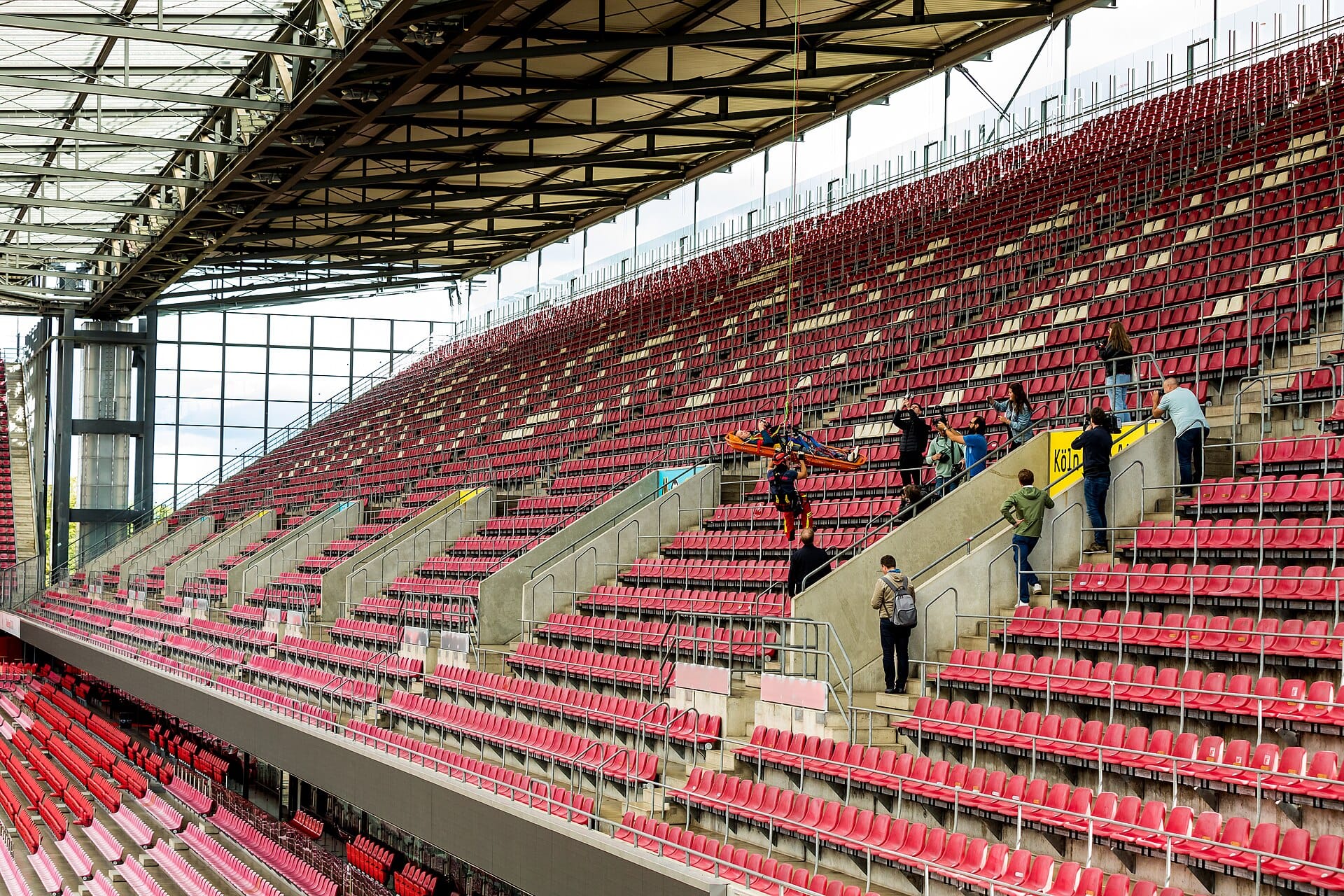
The site itself has a longer story. A stadium first opened here on 16 September 1923 under the name Müngersdorfer Stadion, and the ground hosted football across multiple generations of German sport. What stands today is not a refurbishment but a full rebuild, completed in 2004, that retained the oval footprint while introducing a continuous roof canopy, steep lower tiers, and a design that pulls the stands close to the pitch. The result is a venue that feels intimate relative to its capacity.
ℹ️ Good to know
The stadium is not a daily walk-in attraction. Access depends entirely on scheduled events or official tours. Check the stadium website or contact Kölner Sportstätten GmbH before visiting: +49 221 716 16 150 or info@koelnersportstaetten.de.
The Atmosphere on Match Day
Arriving at the stadium two hours before kick-off tells you a great deal about how seriously Cologne takes its football. The Aachener Straße fills gradually with supporters in red and white, many stopping at the kiosks and beer stalls that ring the outer concourse. The smell of bratwurst and Kölsch — the city's own pale ale, served here in the standard 0.2-litre Stangen glasses — mingles with the particular metallic cold of a German autumn evening. It is rarely silent.
Inside, the atmosphere tilts sharply toward the south stand, the Südkurve, which is the standing terrace and the loudest section of the ground. Drums start well before the referee's whistle. The acoustic design of the curved roof bounces crowd noise back onto the pitch in a way that genuinely contributes to the experience rather than simply reflecting it. Even attending a mid-table fixture on a wet Wednesday feels different here than at many other stadiums of comparable size.
If you plan to attend a match, arrive early enough to find the correct gate — the stadium is large and the external signage, while functional, is not always obvious to first-time visitors. Concourse queues for food and drink move slowly in the final 30 minutes before kick-off. Buying tickets in advance through the official 1. FC Köln channels is essential for high-demand fixtures; some away sections are allocated separately and have different access points.
💡 Local tip
For the loudest experience, look for tickets in or near the Südkurve. If you prefer a clear sightline and a seat, the Haupttribüne (main stand) offers the best viewing angle and slightly more amenities, though at a higher price.
Tickets & tours
Live prices and dates from our booking partner. If you book, we may earn a commission at no extra cost to you.
Cologne haunted places and ghost stories: interactive city game
From 8 €Instant confirmationFree cancellationFood Tour Cologne Sudstadt
From 44 €Instant confirmationFree cancellationCologne brewery tour including 3 Kolsch beer
From 28 €Instant confirmation2-hour afternoon cruise in Cologne at Christmastime
From 25 €Instant confirmationFree cancellation
Stadium Tours: Visiting Without a Match
Tours of the RheinEnergieStadion are operated by Kölner Sportstätten GmbH through the visitor centre on the east stand (Tribüne Ost). A typical tour passes through the player tunnel, the dressing rooms, the press area, and the pitch-side zone — the places that are off-limits during events. Light levels inside the stadium on a non-match day are noticeably different from a floodlit evening: the bowl looks larger and slightly more industrial without a crowd, and you get a clear sense of the engineering behind the roof structure.
Tour schedules are not fixed and change seasonally and around match periods. The visitor centre can confirm dates, languages available, and current pricing. Group tours can be arranged in advance. For those with a serious interest in stadium architecture or sports infrastructure, the tour is worthwhile; for casual visitors to Cologne with limited time, a match-day visit delivers significantly more.
A Venue With an International Footprint
The RheinEnergieStadion's profile extends well beyond domestic football. It was one of twelve venues used during the 2006 FIFA World Cup, hosting group-stage and a round-of-16 match, during which temporary seating adjustments brought the configuration in line with FIFA's all-seater requirements. Two decades later, it served as a UEFA Euro 2024 venue, hosting four matches across the group stage and knockout rounds. Significant infrastructure work preceded Euro 2024, updating connectivity, accessibility features, and media facilities.
This international track record places the stadium in a specific architectural and civic context. It is not simply a club ground but part of Germany's network of post-reunification sports infrastructure, built or rebuilt in the years between 1990 and 2010 to meet evolving UEFA and FIFA standards. For a broader look at how Cologne's public spaces and architecture fit together, the Cologne walking tour guide covers the city's urban fabric beyond the stadium precinct.
Getting There and Practical Logistics
The most reliable way to reach the stadium is by tram. KVB Line 1 (the red line) runs directly to the RheinEnergieSTADION stop from Neumarkt in the city centre, covering the distance in roughly 15 to 18 minutes. On match days, KVB runs additional capacity and the trams fill quickly after the final whistle. Expect a wait of 20 to 30 minutes to board heading back into the city; standing on the platform is preferable to walking into the street, which slows all traffic considerably.
By car, the stadium sits just off the A1 motorway, reachable via exit 103 followed by Aachener Straße eastward. Parking is available in the surrounding area, but match-day road closures and heavy congestion on the Aachener Straße itself make public transport a substantially better option. Cycling is feasible from the city centre, and the stadium has bike parking; the route along Aachener Straße is direct if not particularly scenic.
If you're planning a broader day in west Cologne, the Stadtwald — Cologne's large urban forest — begins not far from the stadium precinct and is easy to incorporate into the same trip. Details are in the Stadtwald guide. For those arriving from outside the city, the guide to getting around Cologne covers tram ticketing, zone structures, and day-pass options.
⚠️ What to skip
On match days, tram and road access around the stadium becomes congested in the 45 minutes before kick-off and immediately after the final whistle. Build in extra time and consider a post-match drink near the ground before attempting to leave — the crowd disperses considerably within an hour.
Accessibility and Visitor Services
As a venue that hosted UEFA Euro 2024, the RheinEnergieStadion meets contemporary accessibility standards, including wheelchair spaces, accessible entrances, and lift access to upper tiers. For specific requirements — barrier-free seating positions, companion ticket policies, or assistance services — the visitor centre is the correct point of contact. The Kölner Sportstätten team can be reached directly at +49 221 716 16 150 or by email at besucherzentrum@koelnersportstaetten.de. Do not rely on general online descriptions for accessibility details; these vary by event configuration and are best confirmed in advance.
Is This Worth Your Time in Cologne?
The honest answer depends entirely on why you're visiting Cologne. If football is a central interest — whether that's a live match, the atmosphere, or the history of the sport in Germany — then yes, attending a 1. FC Köln home fixture is a genuinely good use of an evening. German football culture at the mid-to-upper Bundesliga level has qualities that distinguish it from many other leagues: the standing terraces, the relatively lower average ticket prices, and the pre-match rituals around the ground all feel specific to a place rather than generic.
If football is not a draw and you're simply curious about the stadium as a structure, the tour is functional but not transformative. Cologne offers a dense concentration of genuinely exceptional attractions within a short radius of the city centre, from the Cologne Cathedral to the Museum Ludwig, that would take priority over a stadium visit for most non-football travellers. The stadium is not a cultural landmark in the way that some historic grounds are; its value is almost entirely event-dependent.
Travellers with very limited time in the city, no particular interest in football, or who are prioritising Cologne's history and art should note that the stadium sits well outside the Old Town and requires a deliberate journey. It will not appear on your sightseeing route by accident.
Insider Tips
- Tram Line 1 is the only sensible option on match days. Buy a return ticket before you leave the city centre — machines at the stadium stop can have queues after the match.
- The south stand (Südkurve) standing terrace is where the club's most vocal supporters gather. If atmosphere matters more to you than comfort, this is the section to target — but check ticket availability early, as it fills fast for popular fixtures.
- For stadium tours, contact Kölner Sportstätten directly rather than assuming schedules found on third-party sites are current. Tour availability drops significantly during busy match periods.
- The Aachener Straße between the city centre and the stadium has several local Kölsch pubs used by supporters before matches — a better pre-match option than the concourse inside, where queues are long and prices higher.
- During UEFA and FIFA tournaments, the stadium operates under different ticketing and access rules than a standard Bundesliga match. If you're visiting Cologne during a major international competition, check the tournament's official site for entry procedures.
Who Is RheinEnergieStadion (FC Köln) For?
- Football supporters attending a 1. FC Köln Bundesliga match
- Sports architecture enthusiasts interested in post-2000 German stadium design
- Families with children who enjoy live sports in a large-venue setting
- Visitors during major international tournaments (FIFA World Cup, UEFA Euros)
- Travellers wanting to experience authentic German football fan culture
Nearby Attractions
Combine your visit with:
- Aachener Weiher
A 4-hectare artificial pond created in 1920, Aachener Weiher is where Cologne residents go to decompress. Surrounded by lawns, cycle paths, and a long-running beer garden, it offers a genuine slice of local life without an entrance fee or a tourist queue in sight.
- Flora Botanical Garden (Flora und Botanischer Garten)
Opened in 1864 to a design by Peter Joseph Lenné, the Flora und Botanischer Garten is Cologne's most refined public garden. Eleven and a half hectares of landscaped parkland, tropical greenhouses, and more than 10,000 plant species await — and admission is free every day of the year.
- Kölsche Riviera (Cologne Rhine Beaches)
The Kölsche Riviera is Cologne's answer to summer beach culture: a stretch of sandy riverbank bays along the Rhine in the southern Rodenkirchen district, free to access and beloved by locals looking to sunbathe, picnic, and watch the river traffic roll by. No sea, no surf, but a genuinely relaxed atmosphere that reveals a quieter, less touristy side of the city.
- Cologne Zoo (Kölner Zoo)
Founded in 1860, Cologne Zoo is the third-oldest zoo in Germany, set across 20 hectares in the Riehl district. Open every day of the year, it draws families, school groups, and animal lovers with a wide range of species and well-maintained grounds. Here is what to expect, when to go, and how to make the most of your time.
Planning a trip? Discover personalized activities with the Nomado app.