Kölner Stadtwald: What to Know Before You Visit Cologne's City Forest
Stretching across 205 hectares in the western district of Lindenthal, the Kölner Stadtwald is Cologne's largest urban forest and one of its most quietly satisfying green spaces. Free to enter at any hour, it serves locals as a daily escape and rewards visitors who want something beyond the cathedral and the Rhine.
Quick Facts
- Location
- Dürener Straße, 50935 Köln, district of Lindenthal
- Getting There
- Tram lines 1, 7, 13 (Aachener Straße/Gürtel; Eupener Straße; Clarenbachstift; Maarweg; Wüllnerstraße/Dürener Straße-Gürtel); Bus 136/140
- Time Needed
- 1 to 3 hours depending on route
- Cost
- Free, no ticket required
- Best for
- Runners, families, cyclists, anyone needing a break from city sightseeing
- Official website
- www.parks.koeln/en/park/stadtwald
What the Stadtwald Actually Is
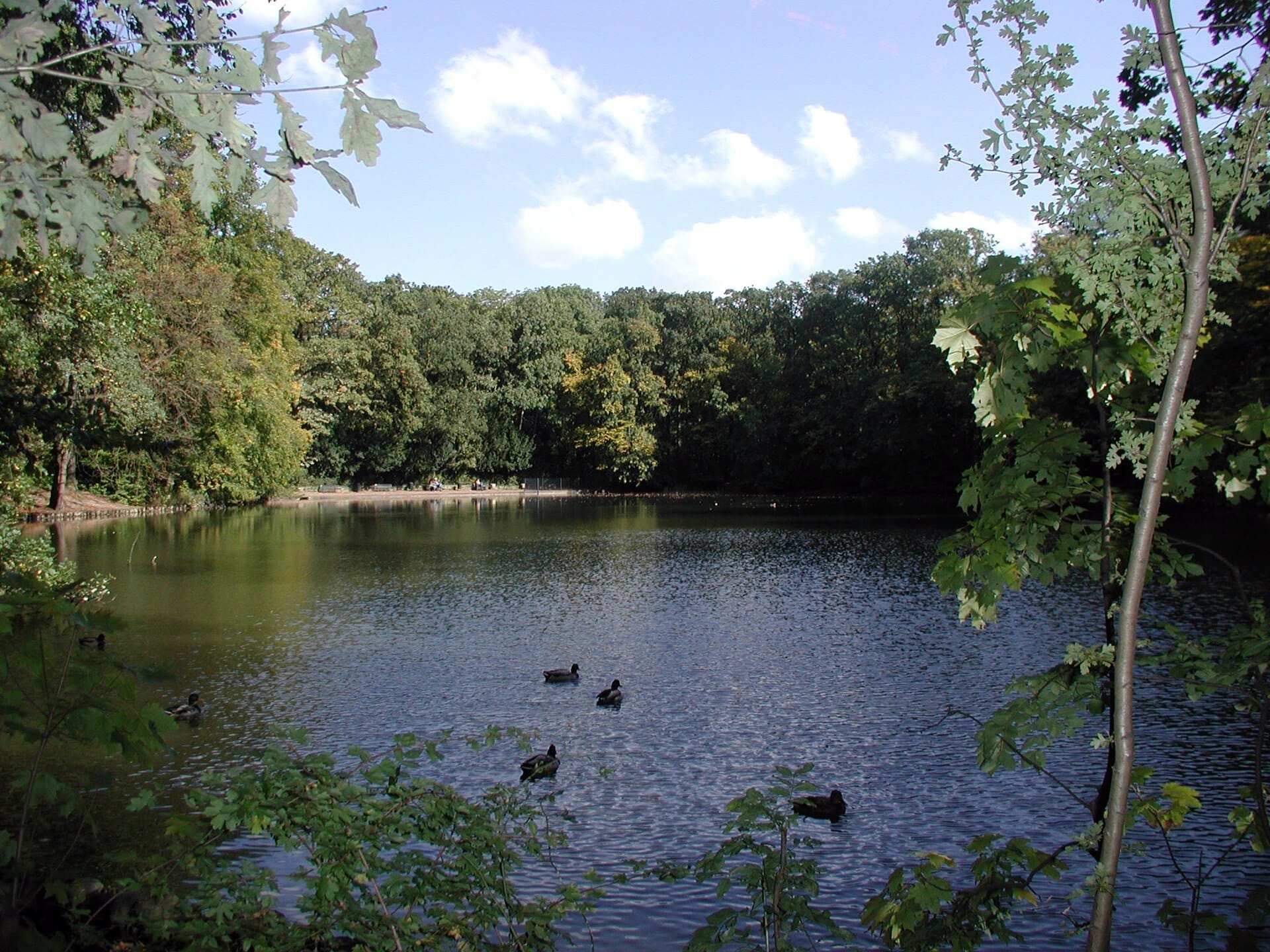
The Kölner Stadtwald is a 205-hectare urban forest in Cologne's western Lindenthal district, developed in stages from 1895 onward under plans by city garden director Adolf Kowallek, with most of the forest taking its current form by the 1920s. It is not a manicured park in the formal European tradition. The tree canopy is dense, the paths wind through genuine woodland, and on a weekday morning in autumn you can walk for twenty minutes without hearing traffic. That is a remarkable thing in a city of over a million people.
The forest is crossed by a dense network of paved and compacted-gravel paths used by joggers, dog walkers, cyclists, and families with pushchairs. Several clearings and meadows open up the interior, and the Lindenthal Tierpark, a freely accessible animal enclosure on Kitschburger Straße, sits within the forest boundary. There are no gates, no entry fees, and no posted closing hours. You can arrive at dawn or late on a summer evening and the forest is simply open.
ℹ️ Good to know
Dogs are not permitted inside the Lindenthal Tierpark animal enclosure, though they are welcome throughout the rest of the Stadtwald.
The Experience at Different Times of Day
Early mornings, particularly between 7 and 9 am, are when the forest is at its most atmospheric. The canopy holds moisture overnight and on cool mornings thin mist sits between the trunks at ground level. The sounds are almost entirely natural: wood pigeons, the occasional jay, the soft percussion of joggers on gravel. Cologne's running community treats the Stadtwald as its unofficial track, and you will almost always see people on the main loop regardless of the season.
Midday on weekends brings a different character. Families arrive with bicycles, groups of students spread picnic blankets in the clearings, and the Tierpark draws a steady queue of parents with small children. The noise level rises but remains pleasant, the kind of ambient hum that makes the space feel alive rather than overwhelming. On summer afternoons the forest canopy provides real shade, dropping the temperature several degrees below the surrounding streets.
In winter the forest is worth visiting for reasons the summer crowds rarely consider. Bare branches reveal the structure of the woodland and the scale of the older trees, many of which are oak, beech, and chestnut with trunks that suggest well over a century of growth. Frost along the path edges and low winter light filtering through the canopy make for surprisingly good photography with a phone camera, especially in the hour after sunrise.
Tickets & tours
Live prices and dates from our booking partner. If you book, we may earn a commission at no extra cost to you.
Cologne haunted places and ghost stories: interactive city game
From 8 €Instant confirmationFree cancellationFood Tour Cologne Sudstadt
From 44 €Instant confirmationFree cancellationCologne brewery tour including 3 Kolsch beer
From 28 €Instant confirmation2-hour afternoon cruise in Cologne at Christmastime
From 25 €Instant confirmationFree cancellation
History and Landscape Context
Cologne's rapid expansion in the late 19th century consumed much of the agricultural land around the old city. The decision to create the Stadtwald starting in 1895 was partly civic planning and partly public health thinking: urban greens were understood at the time as essential infrastructure for growing industrial cities. Kowallek's design drew on the naturalistic English landscape tradition, prioritising winding paths, varied terrain, and the feeling of being away from the city rather than within it.
The forest was extended and consolidated through the early 20th century, reaching its current extent of roughly 205 hectares by the 1920s. Today it sits within the Lindenthal district, one of Cologne's more residential western areas, surrounded by university buildings and prosperous streets rather than tourist infrastructure.
For visitors who want to understand how Cologne's green spaces connect, the Stadtwald pairs well with a visit to the Botanical Garden, which is also in the western part of the city. The two spaces have quite different characters: the Botanical Garden is curated and horticultural, while the Stadtwald is expansive and naturalistic.
Getting There and Moving Around
The most convenient approach from the city centre is by KVB tram. Lines 1, 7, and 13 serve Aachener Straße/Gürtel, while line 1 also stops at Eupener Straße, Clarenbachstift, or Maarweg, and lines 7 and 13 also stop at Wüllnerstraße or Dürener Straße/Gürtel. Bus lines 136 and 140 provide additional connections if you are coming from neighbourhoods not served by the tram network.
By bicycle the forest is especially well-suited: the path network is extensive, gradients are gentle, and cycling is permitted on the main routes. If you are coming from the Altstadt or the area around the cathedral, the ride west along Aachener Straße is mostly flat. Parking is available near the park for those arriving by car, though on sunny weekends spaces near the Dürener Straße entrances fill by mid-morning.
💡 Local tip
Enter from the Eupener Straße side rather than the main Dürener Straße entrance if you want to avoid the busiest sections on weekends. The northern paths tend to be quieter and the tree cover is thicker.
The Lindenthal Tierpark: Wildlife Inside the Forest
One of the Stadtwald's genuine draws for families is the Lindenthal Tierpark, an animal enclosure integrated into the forest on Kitschburger Straße. Entry is free, which makes it one of the better family options in Cologne without any admission cost. The enclosure houses sheep, donkeys, goats, fallow deer, and poultry in open paddock settings rather than cages, which feels appropriate to the forest surroundings.
For families planning a broader day around wildlife and nature, the Tierpark pairs naturally with the Cologne Zoo, which is a more extensive paid facility on the eastern edge of the Stadtgürtel. The two are not near each other, so most families choose one or the other rather than combining both on the same day.
Practical Details and What to Bring
There are no facilities inside the forest itself in the sense of cafes or visitor centres within the woodland. Several cafes and restaurants line Dürener Straße and Aachener Straße along the forest edge, so it is sensible to refuel before entering rather than planning on finding something inside. Bring water, especially in summer when the canopy traps warmth in the late afternoon.
Footwear makes a difference. The main paved paths are fine for city shoes, but many of the interior tracks become soft after rain. Sturdy trainers or light hiking shoes are the practical choice for anything beyond a straightforward loop on the main route. In wet weather the forest does not close, but the compacted gravel tracks can be muddy at the edges and the leaf litter underfoot in autumn can be slippery.
Cologne's weather is worth factoring in. The city has a temperate oceanic climate with no dry season; rain is possible in any month. For a broader overview of how weather affects what to do and when, the best time to visit Cologne guide covers seasonal conditions in detail.
⚠️ What to skip
After heavy rain the unpaved interior paths can be muddy and slippery. Stick to the main gravel routes if you are visiting shortly after rainfall or wear appropriate footwear.
Who This Is and Is Not For
The Stadtwald is genuinely one of the better urban forests in western Germany. At 205 hectares it is large enough to feel like real countryside rather than a municipal lawn. For runners, cyclists, and people who find city sightseeing exhausting, it is the obvious antidote. Families with children have the added pull of the free Tierpark. On a half-day in Cologne, the forest is a legitimate choice rather than a fallback.
That said, visitors on a short trip specifically to see Cologne's historic or cultural assets should calibrate expectations. The Stadtwald has no architectural highlights, no exhibitions, no river views, and no connection to the city's Roman or medieval history. If your time in Cologne is limited to a day or two and the cathedral, the museums, and the Rhine are your priorities, the Stadtwald competes with those rather than complementing them unless you are a committed walker or runner.
For travellers trying to plan a short trip efficiently, the 2 days in Cologne guide can help with sequencing. The Stadtwald works well as an early-morning start before moving east into the city, rather than as a standalone destination.
If green space is part of what you are looking for in Cologne, the Rheinpark on the right bank of the Rhine offers a completely different experience: open, flat, and with direct river views. The Stadtwald is enclosed and forested; the Rheinpark is wide and riverine. They suit different moods.
Insider Tips
- The northern entrance near Eupener Straße is consistently less crowded than the main Dürener Straße entrances, even on weekend afternoons. The path network connects seamlessly so you lose nothing by starting from the quieter side.
- Autumn, roughly late October through November, is when the Stadtwald is at its most visually interesting. The oak and beech canopy turns amber and gold, and the low-angle morning light through bare branches makes the older parts of the forest feel significantly more dramatic than they do in summer.
- If you are running the forest loop, most Cologne runners use the main perimeter path as a measured training circuit. Asking a local runner at the entrance about the standard route will get you reliable information and approximate distance faster than any map.
- The Lindenthal Tierpark keeps variable hours depending on season. Check the current schedule on the city's parks pages before planning a visit specifically around it, especially in winter when afternoon closing times are earlier.
- The forest is largely free of tourist infrastructure, which means no on-site signage in English. Download the KVB map app before you go if you want confidence about which tram stop gets you back toward the city centre from different parts of the perimeter.
Who Is Stadtwald (City Forest) For?
- Runners and cyclists looking for a traffic-free route close to the city
- Families with young children who want the free Lindenthal Tierpark wildlife enclosure
- Travellers who find city centres overstimulating and need a half-day reset
- Photographers interested in natural light through mature woodland canopy, especially in autumn and winter
- Anyone with an extra morning in Cologne who wants to see how the city's residents actually use their green space
Nearby Attractions
Combine your visit with:
- Aachener Weiher
A 4-hectare artificial pond created in 1920, Aachener Weiher is where Cologne residents go to decompress. Surrounded by lawns, cycle paths, and a long-running beer garden, it offers a genuine slice of local life without an entrance fee or a tourist queue in sight.
- Flora Botanical Garden (Flora und Botanischer Garten)
Opened in 1864 to a design by Peter Joseph Lenné, the Flora und Botanischer Garten is Cologne's most refined public garden. Eleven and a half hectares of landscaped parkland, tropical greenhouses, and more than 10,000 plant species await — and admission is free every day of the year.
- Kölsche Riviera (Cologne Rhine Beaches)
The Kölsche Riviera is Cologne's answer to summer beach culture: a stretch of sandy riverbank bays along the Rhine in the southern Rodenkirchen district, free to access and beloved by locals looking to sunbathe, picnic, and watch the river traffic roll by. No sea, no surf, but a genuinely relaxed atmosphere that reveals a quieter, less touristy side of the city.
- RheinEnergieStadion (FC Köln)
Home to 1. FC Köln and one of Germany's most storied football venues, the RheinEnergieStadion seats up to 50,000 fans and hosted both the 2006 FIFA World Cup and UEFA Euro 2024. Whether you're catching a Bundesliga match or joining a stadium tour, this is where Cologne's football identity comes into sharp focus.
Planning a trip? Discover personalized activities with the Nomado app.