Rheinpark Cologne: What to Know Before You Visit
A 40-hectare riverside park on the right bank of the Rhine, Rheinpark was built over WWII rubble for the 1957 Federal Garden Show and has been a protected monument since 1989. Free to enter year-round, it offers skyline views, an open-air concert stage, the Cologne cable car, and a thermal spa, all within easy reach of Deutz station.
Quick Facts
- Location
- Auenweg, 50679 Köln (Deutz/Mülheim, right bank of the Rhine)
- Getting There
- Köln-Deutz/Messe (S-Bahn, regional rail); bus stops 'Im Rheinpark' and 'Thermalbad' (bus 150)
- Time Needed
- 1–3 hours for a walk; half a day if you add the cable car or spa
- Cost
- Free entry. Cable car, miniature railway, and Claudius Therme spa charge separate fees.
- Best for
- Families, joggers, picnickers, and anyone who wants a clear view of the Cologne skyline
What Is Rheinpark?
Rheinpark is Cologne's main riverside park, occupying roughly 40 hectares along the eastern bank of the Rhine in the Deutz district. It is free to enter, and the park stretches between Deutz in the south and Mülheim in the north, giving it one of the longest uninterrupted riverfront promenades in the city.
The park looks designed because it is: every path, lawn, and flower bed traces back to deliberate planning for the first Federal Garden Show (Bundesgartenschau) held in Cologne in 1957. A second edition followed in 1971. Since 1989, the entire park has carried protected monument status, meaning the layout and character from that postwar era are legally preserved. For visitors interested in mid-century landscape design, this is genuinely notable. For everyone else, it simply means the park feels more considered than most urban green spaces. You can read more about the broader city context in this overview of things to do in Cologne.
ℹ️ Good to know
Rheinpark was built on cleared WWII rubble. The transformation of that wasteland into a showcase garden in just a few years was itself a statement about postwar rebuilding in West Germany.
The Setting: What You Actually See
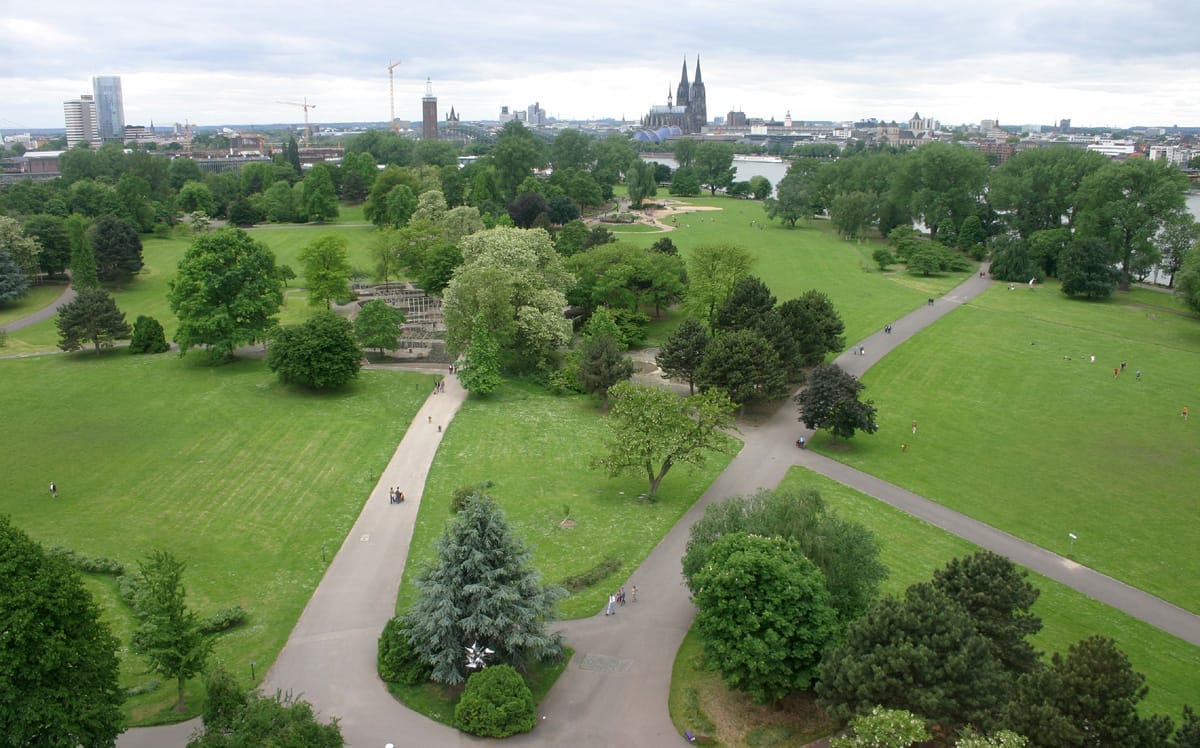
From the riverside path, the view west across the Rhine is one of the cleaner panoramas of Cologne's skyline available from ground level. The twin spires of Cologne Cathedral are visible to the southwest, the cranes of the Rheinauhafen sit further along the waterfront, and the curved façades of the Kranhäuser (crane houses) stand out against the skyline on the left bank. Because you are on the opposite bank, everything is at a moderate distance — close enough to read clearly, far enough to take in the full width of the scene.
The park itself alternates between manicured lawns, tree-lined allées, ornamental flowerbeds, and open meadows that slope gently toward the river. There is no single dramatic focal point — it reveals itself gradually as you walk north. The Tanzbrunnen, an open-air stage and event space near the southern entrance, is the main architectural landmark inside the park. On summer evenings it hosts concerts ranging from large pop events to classical performances; on quiet weekday mornings it sits empty and you can stand at its center and look straight down the Rhine. The Cologne cable car lifts off from the southern edge of the park, crossing the river to the Zoo/Flora side on the left bank — a route worth taking for the aerial perspective alone.
Tickets & tours
Live prices and dates from our booking partner. If you book, we may earn a commission at no extra cost to you.
Cologne haunted places and ghost stories: interactive city game
From 8 €Instant confirmationFree cancellationFood Tour Cologne Sudstadt
From 44 €Instant confirmationFree cancellationCologne brewery tour including 3 Kolsch beer
From 28 €Instant confirmation2-hour afternoon cruise in Cologne at Christmastime
From 25 €Instant confirmationFree cancellation
How the Park Changes by Time of Day
Early morning, between 7 and 9 am, the park belongs almost entirely to joggers and dog walkers. The light on the Rhine at that hour is flat and silver, the far bank is quiet, and the only sounds are birdsong and the occasional barge engine. This is the best window for photography: the grass is still damp, the flowerbeds are at their sharpest before midday heat softens the colors, and the promenade is clear of crowds.
By midday on a warm weekend, the picture changes entirely. Families spread picnic blankets on the main lawns, cyclists queue at the southern entrance, and the smell of food from the park's kiosks drifts across the paths. The meadows closest to the river fill up quickly in summer, so if you want a good spot with a Rhine view, arriving before noon makes a real difference.
Late afternoon and evening bring a different energy again. When there is no event at the Tanzbrunnen, the park quiets down into a pleasant walking temperature. When there is a concert, the southern section of the park fills with crowds from the mid-afternoon, and the area around the cable car station gets congested. Checking the Tanzbrunnen schedule before you visit is worth doing if you want to avoid that, or lean into it if outdoor concerts are your thing.
💡 Local tip
For the best Rhine skyline photographs, position yourself on the promenade in the early morning or around golden hour. Midday light is flat and the crowds obstruct the waterfront path.
What to Do Inside the Park
The main activities break into three categories: walking and cycling the riverside path, using the paid attractions, and simply settling on the grass. The riverside promenade running the full length of the park is suitable for pedestrians and cyclists, though it gets crowded near the Tanzbrunnen on busy days. Cycling is a reasonable way to cover the park north to south if you are connecting it to a longer ride along the Rhine. For context on cycling and moving around the broader city, the getting around Cologne guide covers options in more detail.
The Cologne cable car (Kölner Seilbahn) departs from the park's southern end and crosses the Rhine to the Zoo/Flora station on the left bank. It runs seasonally, not year-round, and charges a separate fare. The ride takes only a few minutes but the elevated view of the Rhine and the cathedral spires is genuinely striking. Check current operating dates and fares before building a visit around it.
Claudius Therme, a large thermal spa Claudius Therme, a large thermal spa near the park, is a separate paid facility with pools fed by thermal water. It operates independently of the park and has its own pricing and hours. It is a legitimate reason to extend a half-day park visit into a full-day one, particularly in cooler months when outdoor activity in the park is less appealing. It operates independently of the park and has its own pricing and hours. It is a legitimate reason to extend a half-day park visit into a full-day one, particularly in cooler months when outdoor activity in the park is less appealing.
A miniature railway operates within the park for younger visitors, again with its own seasonal schedule and fee. For families with small children, it is the kind of low-key attraction that earns disproportionate goodwill.
Getting There
The easiest approach from the city centre is via Köln-Deutz/Messe station, The easiest approach from the city centre is via Köln-Deutz/Messe station. From the station it is a manageable walk north along the riverbank to the park's southern entrance. Bus 150 stops at 'Im Rheinpark' and 'Thermalbad', placing you closer to the park's mid-section and northern end respectively. From the station it is a manageable walk north along the riverbank to the park's southern entrance. Bus 150 stops at 'Im Rheinpark' and 'Thermalbad', placing you closer to the park's mid-section and northern end respectively.
Arriving on foot from the Deutz side is straightforward: cross the Deutzer Brücke or the Hohenzollern Bridge from the old town and follow the right bank north. The Hohenzollern Bridge route adds a few minutes but the walk along the right bank promenade is pleasant and gives you the Rhine to your left the entire way. By bicycle, the same route works well and the park's wide paths accommodate bikes comfortably.
💡 Local tip
If you are coming from the west bank and want a scenic approach, cross via the Hohenzollern Bridge and walk north along the right bank promenade. You will reach the park's southern entrance in about 15 minutes from the bridge.
Practical Considerations
Weather matters more here than at enclosed attractions. The park is at its best from May through September, when temperatures allow for extended outdoor time and the flowerbeds are at peak condition. In winter, the park is still walkable and the riverfront views remain clear, but the lawns are sparse and most of the paid attractions are closed. Bring a layer regardless of the season: the river generates its own microclimate and afternoon temperatures along the promenade can drop faster than expected.
Wheelchair access is good throughout the main park paths, which are paved and level. Dogs are permitted in the park but must remain on a leash at all times. The park has toilet facilities and several food kiosks that operate in warmer months, but do not assume consistent availability outside of summer. For a broader look at Cologne's green spaces and how Rheinpark fits among them, the free things to do in Cologne guide is a useful companion.
Is It Worth the Trip?
Rheinpark is not the kind of attraction that competes with the cathedral or a museum for your attention. It rewards visitors who want to understand the city at ground level: where Cologne residents actually spend their weekends, what the Rhine looks like from the quieter bank, and how postwar urban design shaped a city that lost much of its pre-war fabric. As a free, open, and accessible park with genuine historical significance and strong river views, it earns a place on a thoughtful itinerary without needing to oversell itself.
Visitors who are short on time and focused on compact sightseeing in the Altstadt may find the transit time to Deutz hard to justify for a park visit alone. But anyone spending two or more days in Cologne, or pairing it with the cable car, the Claudius Therme, or a longer Rhine walk, will find it a worthwhile half-day. The 2-day Cologne itinerary suggests how to combine it efficiently with the right-bank attractions.
⚠️ What to skip
If you are visiting primarily for the cable car or the thermal spa, confirm their seasonal operating dates before the trip. Both shut down during parts of the year and operate independently of the park itself.
Insider Tips
- The stretch of promenade between the Tanzbrunnen and the cable car station offers the clearest unobstructed view of the Cologne Cathedral from the right bank. It is best photographed in early morning light from around 7–8 am when the path is nearly empty.
- Check the Tanzbrunnen concert schedule before visiting on a summer weekend. Events draw large crowds that fill the park's southern section from mid-afternoon onward and make the cable car queues significantly longer.
- Claudius Therme is less crowded on weekday mornings than on weekend afternoons. If you want a quiet thermal spa experience after a walk through the park, a Tuesday or Wednesday morning visit makes a noticeable difference.
- The park's northern section near the Thermalbad bus stop sees far fewer visitors than the southern Tanzbrunnen end. If you want a quiet riverfront spot for an hour on the grass, entering from the north and walking south is a better strategy than the reverse.
- Combining Rheinpark with the cable car crossing over to Zoo/Flora and a walk back south along the left bank via the Rheinauhafen makes for a logical loop: cross by cable car, walk down along the river, and return via the Deutzer Brücke. It is a self-contained half-day with minimal backtracking.
Who Is Rheinpark For?
- Families with children who want open space, a miniature railway, and a low-stakes half-day outdoors
- Joggers and cyclists looking for a long, flat riverside route with good scenery
- Visitors who want to photograph the Cologne skyline from the right bank without climbing anything
- Anyone pairing a park walk with the cable car crossing or a session at Claudius Therme
- Travelers on a budget who want a full afternoon in the city without spending money on entry fees
Nearby Attractions
Other things to see while in Deutz:
- Cologne Cable Car (Kölner Seilbahn)
The Kölner Seilbahn stretches roughly 930–935 meters across the Rhine, linking the Cologne Zoo side with Rheinpark in Deutz. Open seasonally from April to October, it offers some of the most unusual aerial views of the city at a genuinely modest price. Here is everything you need to decide if it belongs on your itinerary.
- Cologne Triangle Panorama
Standing roughly 100 metres above the Rhine's right bank, the KölnTriangle Panorama observation deck delivers a direct, unobstructed sightline to the Cathedral, the river, and the Altstadt. At €5 per adult, it offers more clarity and less crowding than most of Cologne's elevated viewpoints.
Planning a trip? Discover personalized activities with the Nomado app.