Cologne Cable Car (Kölner Seilbahn): A Gondola Ride Over the Rhine
The Kölner Seilbahn stretches roughly 930–935 meters across the Rhine, linking the Cologne Zoo side with Rheinpark in Deutz. Open seasonally from April to October, it offers some of the most unusual aerial views of the city at a genuinely modest price. Here is everything you need to decide if it belongs on your itinerary.
Quick Facts
- Location
- Riehler Straße 180, 50735 Köln (left bank near Cologne Zoo; right bank at Rheinpark, Deutz)
- Getting There
- Tram 18 or Bus 140 to Zoo/Flora (left bank); Bus 150, 250 or 260 to Thermalbad (right bank)
- Time Needed
- 30–60 minutes for a visit including a return crossing; longer if combining with Rheinpark or Cologne Zoo
- Cost
- From €4.80 adult single / €7.00 adult return; €2.70 child single / €4.00 child return (ages 4–12; current prices, subject to change)
- Best for
- Families, couples, first-time visitors wanting a different perspective on the Rhine skyline
- Official website
- www.koelner-seilbahn.de/en
What the Cologne Cable Car Actually Is
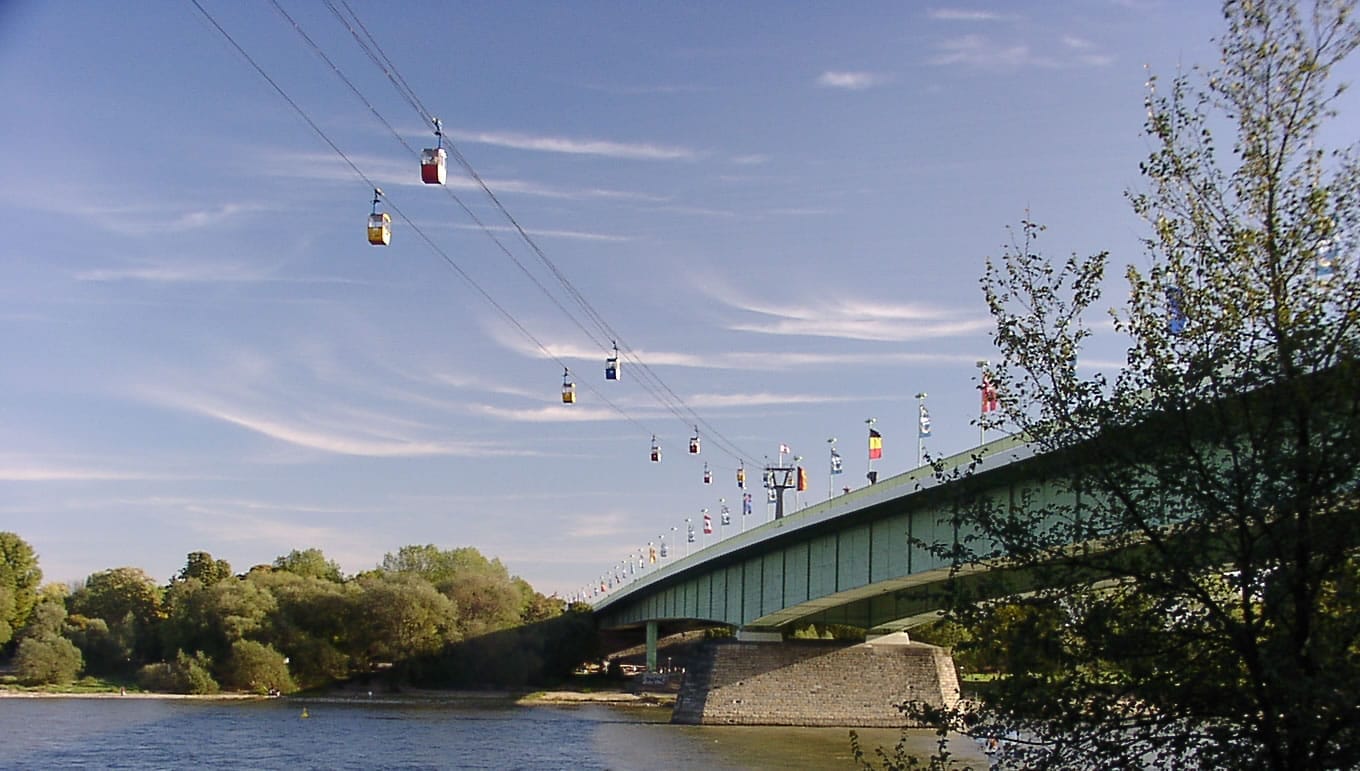
The Kölner Seilbahn is a gondola cable car that crosses the Rhine River at a height of roughly 40 meters, spanning roughly 930–935 meters between its two terminal stations. It is not a mountain cable car, and it is not a thrill ride. What it offers is something more specific and arguably more interesting: a slow, gliding crossing of one of Europe's great rivers, with Cologne's cathedral towers on the horizon and the broad green bend of the Rhine directly beneath you.
It was built in 1957 for the Federal Garden Show (Bundesgartenschau), which explains why the right-bank terminal sits inside Rheinpark, one of Cologne's most pleasant riverside green spaces. The show came and went, but the cable car stayed, eventually becoming a fixture of the city's summer landscape. In normal years it operates seasonally, running daily from April to October, typically from 10:00 to 18:00, with the last round trip departing shortly before closing; check the current timetable as operations can be suspended for technical reasons or special events.
⚠️ What to skip
The cable car is generally closed over the winter months outside its spring–autumn season. If you are visiting Cologne outside the April–October operating period given on the official site, this attraction may not be available. Check the official site before planning your day around it.
The Experience: What It Feels Like to Cross
The gondolas are small, enclosed cabins holding a handful of passengers each. As yours detaches from the boarding platform and swings out over the river, the city drops away with a quiet mechanical hum. There is no dramatic lurch or speed. The pace is unhurried, which gives you genuine time to look.
Looking west, the twin spires of Cologne Cathedral are clearly visible on a clear day, rising above the low Altstadt roofline. The Hohenzollern Bridge sits to the south, its arches reflecting in the river. Below, the Rhine carries barge traffic year-round, and watching a slow-moving cargo vessel pass directly beneath your gondola is one of those small, oddly satisfying travel moments. The water's color shifts from grey-green on overcast days to a deep slate blue in direct sunlight.
The crossing takes roughly six minutes one way. It is quiet inside the cabin, apart from the mechanical cable noise and, usually, conversation from other passengers. On busy summer afternoons, you may share the gondola with families. In quieter morning windows, particularly on weekdays in May or early June, a cabin to yourself is realistic.
Tickets & tours
Live prices and dates from our booking partner. If you book, we may earn a commission at no extra cost to you.
KolnCard with public transport for 24h or 48h
From 38 €Instant confirmationKolnCard with public transport for 24h or 48h
From 19 €Instant confirmationCologne haunted places and ghost stories: interactive city game
From 8 €Instant confirmationFree cancellationFood Tour Cologne Sudstadt
From 44 €Instant confirmationFree cancellation
How the Experience Changes by Time of Day
Morning crossings, especially between 10:00 and 11:30, tend to be the quietest. The light at this hour comes from the east, which means the right-bank (Deutz/Rheinpark) side is well lit and the cathedral silhouette is in partial shadow. Photographers working with a wide-angle lens will find the morning less useful for the cathedral shot but better for the river texture and barge detail.
Midday and early afternoon are the most crowded periods, particularly on weekends between late June and August. Queues can develop at the left-bank station near the zoo, and the wait time may add 15 to 20 minutes to your visit. The afternoon sun, from roughly 14:00 onward, moves into a position that catches the cathedral spires from the gondola at an angle that photographs well. Late afternoon, in the final hour before the usual 18:00 closing time, sees crowd numbers drop again.
💡 Local tip
Arriving at 10:00 when the cable car opens, or after 16:30 in the afternoon before the usual 18:00 closing time, gives you the best chance of a short queue and a less crowded cabin.
Getting There: Both Banks Explained
The left-bank terminal is at Riehler Straße 180, directly adjacent to the Cologne Zoo and the Flora botanical garden. Tram line 18, direction Thielenbruch or Kalk Post, and bus line 140 stop at Zoo/Flora, a one-minute walk from the terminal. This is the more convenient starting point if you are coming from the city centre or the main train station (Köln Hauptbahnhof), as the tram connection is direct.
The right-bank terminal sits inside Rheinpark in Deutz. Bus lines 150, 250 and 260 stop at Thermalbad, which is a short walk through the park to the station. Rheinpark itself is worth noting: it is a spacious, well-maintained riverside park that makes a good destination in its own right, especially if you are traveling with children or want a relaxed afternoon by the water. For more on the surrounding area, the Rheinpark guide covers the park in detail.
A practical note on direction: most visitors board at the left-bank (zoo) side because it fits naturally into a combined visit with the Cologne Zoo or the Flora gardens. If you board on the Deutz side first, you arrive at the zoo end with a natural option to continue into the zoo or walk back toward the city along the riverside path.
Historical Context: A 1957 Garden Show Legacy
The Kölner Seilbahn was constructed for the 1957 Bundesgartenschau, a large-scale horticultural exhibition that used Rheinpark as its main venue on the right bank and drew visitors from across West Germany. Cable cars were a popular feature of postwar German exhibitions, offering a theatrical mode of transport while framing the landscape below as spectacle. The Cologne installation was designed to remain after the show, and it has operated in broadly the same form ever since.
This 1957 heritage places the cable car in an interesting architectural and cultural moment: postwar West Germany was investing heavily in public leisure infrastructure, and Cologne, significantly damaged during World War II, was rebuilding its public spaces. Rheinpark was part of that reconstruction of civic life. The cable car is, in a small way, a document of that era.
The area around the Deutz terminal has continued to develop since then. Today, the Deutz district is home to the Koelnmesse trade fair grounds and the Lanxess Arena. The Cologne Triangle observation deck is also located in Deutz, on the top floor of a modern office tower, and offers a fixed aerial perspective on the city that complements the moving view from the cable car.
Photography and Practical Preparation
For photographs, the most useful moment is the midpoint of the crossing, where you have clear sightlines in both directions along the river. The gondola windows are glass, so reflections can be a problem on bright days. Pressing your lens gently against the glass, or holding it at a slight angle, reduces this significantly. A wide-angle setting captures more of the river and both banks simultaneously.
The cable car view of the cathedral is atmospheric but not as unobstructed as the views from the Hohenzollern Bridge or from the Rhine riverbank itself. Treat the photography here as a bonus rather than the primary reason to visit.
Weather matters more here than at ground-level attractions. On overcast or rainy days, the views are significantly reduced, and the experience becomes more about the mechanical novelty of the crossing than the scenery. Strong wind can also cause the gondolas to sway noticeably. If you or anyone in your group is sensitive to heights or motion, this is worth factoring in. The height, at roughly 40 meters above the river, is not extreme, but the open swing of the cabin in a gust is perceptible.
ℹ️ Good to know
Detailed accessibility information is not published on the operator's public pages. If accessibility is a priority, contact the operator directly via the official website before visiting.
Combining the Cable Car With Other Attractions
The logical pairing on the left bank is the Cologne Zoo, which sits immediately next to the cable car terminal. Buying a zoo ticket and a cable car return ticket in the same visit is a natural combination, particularly for families. The zoo is one of Germany's oldest and covers a substantial area, so allow at least two to three hours if you plan to do both.
On the right bank, Rheinpark leads toward the rest of the Deutz district. The Cologne Triangle panorama is a 20-minute walk from the Rheinpark cable car terminal. Combining both in one afternoon gives you two very different aerial perspectives: one moving and low over the river, one static and high above the city.
If you are trying to plan a full day in this part of the city, the Cologne with kids guide outlines how to sequence the zoo, cable car, and Rheinpark into a single family day without doubling back unnecessarily.
Insider Tips
- Buy a return ticket rather than two singles. The saving is small but the convenience is real, as you do not queue at the ticket window on the far bank.
- The left-bank (zoo side) queue is almost always longer than the right-bank (Rheinpark) queue. If you have flexibility, boarding from Deutz and crossing to the zoo side first means a shorter initial wait.
- Weekday visits in May and early June, before school summer holidays begin across Germany, offer the shortest queues and most comfortable conditions overall.
- The gondolas rotate continuously, so you will not wait long for the next one once you are at the front of the queue. The wait is in the queue itself, not at the boarding gate.
- If a child in your group is nervous about heights, the enclosed cabin design and relatively slow speed make this more manageable than an open chair lift. The windows are fixed, so there is no sensation of open air.
Who Is Cologne Cable Car (Kölner Seilbahn) For?
- Families with children who want an easy, engaging activity near the Cologne Zoo
- First-time visitors to Cologne looking for an unusual perspective on the city's skyline and the Rhine
- Couples wanting a short scenic interlude that does not require hours of commitment
- Photographers building a set of varied viewpoints of the cathedral and river
- Anyone combining a visit to Rheinpark with the rest of the Deutz district
Nearby Attractions
Other things to see while in Deutz:
- Cologne Triangle Panorama
Standing roughly 100 metres above the Rhine's right bank, the KölnTriangle Panorama observation deck delivers a direct, unobstructed sightline to the Cathedral, the river, and the Altstadt. At €5 per adult, it offers more clarity and less crowding than most of Cologne's elevated viewpoints.
- Rheinpark
A 40-hectare riverside park on the right bank of the Rhine, Rheinpark was built over WWII rubble for the 1957 Federal Garden Show and has been a protected monument since 1989. Free to enter year-round, it offers skyline views, an open-air concert stage, the Cologne cable car, and a thermal spa, all within easy reach of Deutz station.
Planning a trip? Discover personalized activities with the Nomado app.