Muséum d'Histoire Naturelle du Havre: What to Expect Before You Visit
One of Le Havre's oldest public scientific collections, the Muséum d'Histoire Naturelle du Havre holds over 250,000 objects spanning zoology, paleontology, mineralogy, archaeology, and ethnology. Housed in central Le Havre at Place du Vieux Marché, it is a serious natural history institution with an overlooked backstory and genuinely impressive scope.
Quick Facts
- Location
- Place du Vieux Marché, 76600 Le Havre (centre-ville)
- Getting There
- LiA bus and tram network; bus lines C2, 4 and 7 serve nearby stops Muséum, Cathédrale or Videcoq
- Time Needed
- 1.5 to 2.5 hours for a thorough visit
- Cost
- 7 € full price; 5 € reduced; free for under-26s on all days and for everyone on first Saturday of the month
- Best for
- Science-curious adults, families with older children, rainy-day visits
- Official website
- http://www.museum-lehavre.fr
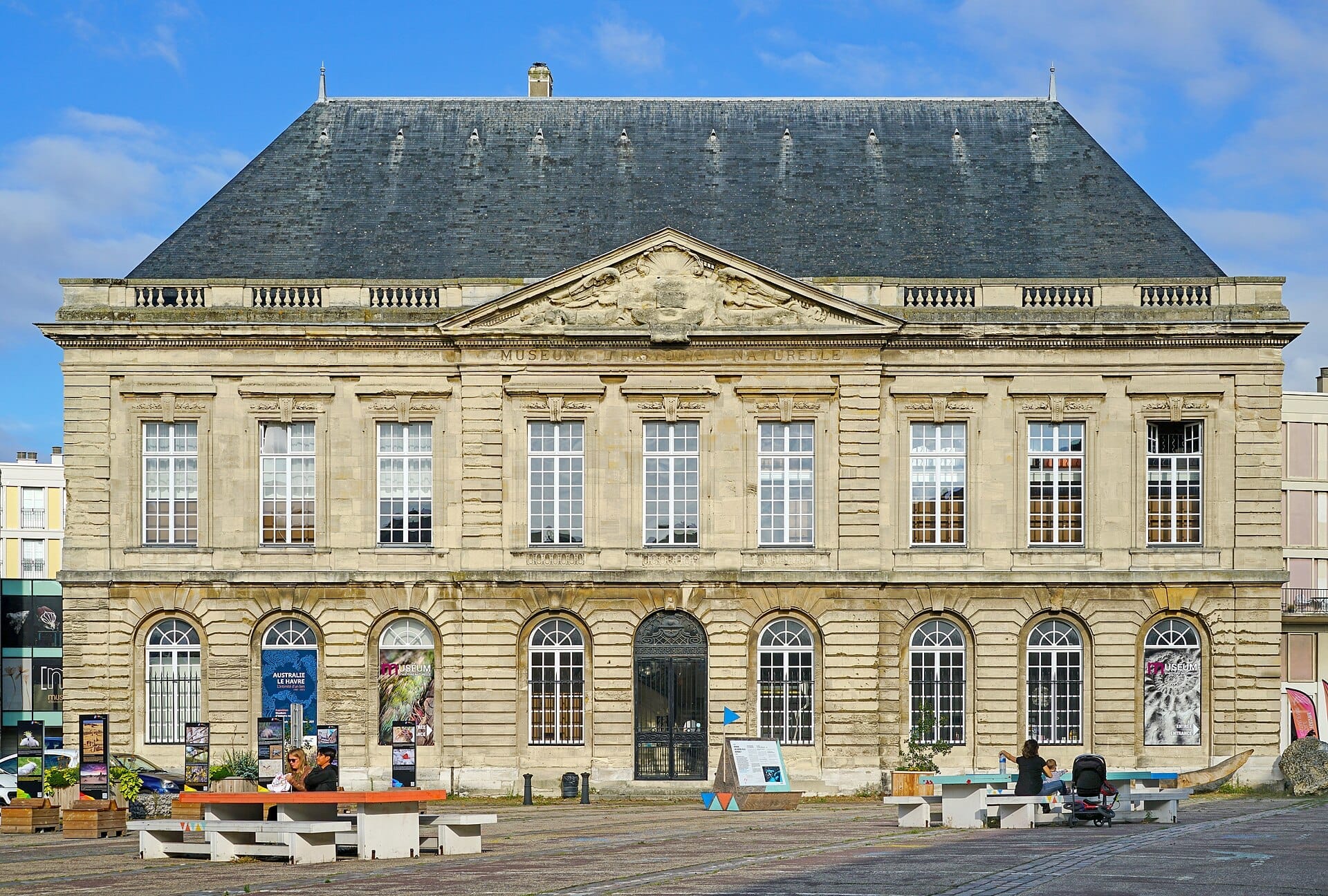
What This Museum Actually Is
The Muséum d'Histoire Naturelle du Havre is a municipal natural history museum with over 250,000 objects across six collecting areas: zoology, paleontology, mineralogy, ethnology, archaeology, and graphic arts. That breadth is not typical for a city of Le Havre's size. The institution traces its origins to 1833, when the explorer and artist Charles-Alexandre Lesueur donated part of his extensive scientific collections to the city. What began as a research collection for naturalists eventually opened to the public as a museum in 1881.
The collection was partially destroyed during World War II, a fate shared by much of the city centre. After decades of reconstruction and reorganisation, the museum reopened in 1973 with reconstituted collections. That history of loss and revival gives the institution a particular depth: many objects are irreplaceable, and the scientific community that helped rebuild the collection after the war brought renewed rigour to what is on display.
ℹ️ Good to know
The museum carries the official French designation 'muséum d'histoire naturelle', which distinguishes it from general museums and indicates a recognised scientific collection under national cultural heritage standards.
The Collections: What You Will Actually See
The zoology halls are typically the most visually immediate: taxidermied mammals and birds arranged in taxonomic or thematic displays, skeletal specimens, and preserved invertebrates in jars and cases. The scale and variety of the zoological collection reflects the port city's historical connections to global trade and exploration. Sailors, merchants, and naturalists passing through Le Havre contributed specimens from around the world across two centuries.
The paleontology section covers local and regional fossil finds alongside specimens of broader scientific interest. Given that the Normandy coast and the Seine valley have historically been productive areas for geological and fossil material, the regional holdings carry real scientific weight. Mineralogy is represented with mineral and rock specimens, including material with local provenance from the chalk cliffs and estuary geology of the Seine-Maritime area.
The ethnology and archaeology holdings add a dimension that separates this museum from a strictly natural science institution. Objects connected to maritime cultures, exploration-era collecting, and archaeological finds from the Le Havre region sit alongside the scientific specimens. The graphic arts collection, linked in part to Lesueur's own artistic output as a naturalist-illustrator, is a quieter but distinctive corner of the museum.
💡 Local tip
If you are visiting specifically for a temporary exhibition, call or check the museum website in advance. Admission drops to 5 € (or 3 € reduced) when the museum is only partially accessible for exhibition installation, which can affect which permanent collections are accessible.
Tickets & tours
Hand-picked options from our booking partner. Prices are indicative; availability and final rates are confirmed when you complete your booking.
Customized private D-day Normandy landing excursion from Le Havre
From 1.300 €Instant confirmationFree cancellationFull-day trip to Giverny and Rouen from Le Havre
From 1.200 €Instant confirmationFree cancellation
The Building and Its Setting
The museum sits at Place du Vieux Marché in central Le Havre, one of the older squares in the city centre. This location puts it within easy walking distance of the Perret-designed architecture that defines the post-war city, yet the museum itself occupies a building with a pre-war character. Arriving from the UNESCO-listed grid of concrete modernism that surrounds much of Le Havre's centre, the scale and texture of the museum building offers a contrast worth noticing.
The Place du Vieux Marché is quieter than the main pedestrian axes of the city centre. On weekday mornings, the square has a local, unhurried pace, with little of the tourist foot traffic that moves along the seafront or near the Hôtel de Ville. On weekends, when the museum is open all day, the surrounding streets are more active, and the first-Saturday-of-the-month free entry draws a noticeably broader, more local crowd.
Opening Hours: What You Need to Know Before Arriving
The museum's schedule is more fragmented than most visitors expect, so check it carefully before you go. Monday is closed entirely. Thursday opens only in the afternoon, from 14:00 to 18:00. Tuesday and Friday split the day into morning and afternoon slots: 10:00 to 12:00, then 14:00 to 18:00, with a two-hour midday closure. Wednesday, Saturday, and Sunday are the most visitor-friendly days, with continuous opening from 10:00 to 18:00, with special openings on Ascension Thursday, 15 August and 1 November.
- Monday: closed
- Tuesday: 10:00–12:00 and 14:00–18:00
- Wednesday: 10:00–18:00 (uninterrupted)
- Thursday: 14:00–18:00 only
- Friday: 10:00–12:00 and 14:00–18:00
- Saturday: 10:00–18:00 (uninterrupted)
- Sunday: 10:00–18:00 (uninterrupted)
- Closed on: 1 January, 1 May, 8 May, 14 July, 11 November, 25 December (open on Ascension Thursday, 15 August and 1 November)
The midday closing on Tuesdays and Fridays is a practical consideration if you are combining this visit with other stops in the city. Arriving just before noon on those days means you will get less than two hours before the museum closes for lunch. Wednesday or Saturday are the best days if you want maximum flexibility without timing pressure.
⚠️ What to skip
Do not arrive at 13:30 on a Tuesday or Friday expecting to enter. The museum does not reopen until 14:00 on those days. This is easy to overlook when planning a walking itinerary through the city centre.
Admission and Who Gets In Free
Standard admission is 7 euros. A reduced rate of 5 euros applies to holders of large-family cards, disability cards, members of the association of friends of the museum, certain partner organisations, and participants in identified national or local programmes. When the museum is partially accessible for exhibition installation, prices drop to 5 euros full and 3 euros reduced.
Free admission applies to a broad range of visitors: anyone under 26 (including students with valid ID), job seekers, recipients of social minima, and the companion of a disability card holder. Professionals including journalists, teachers, ICOM and ICOMOS card holders, and accredited guides also enter free, as do holders of the Culture card or Muséo Pass and certain partners or programme participants.
The first Saturday of every month is free for all visitors, regardless of age or status. If your schedule is flexible, this is worth planning around. It also tends to draw a more mixed, local crowd, which can make the visit feel less like a tourist experience and more like spending time in a working cultural institution.
Practical Considerations for Your Visit
The museum is located in central Le Havre, served by the LiA bus and tram network. Use the LiA journey planner or check current route maps for stops near Place du Vieux Marché. If you are already exploring the Perret architecture quarter, the museum is walkable from most central landmarks. The Maison du Patrimoine and Atelier Perret are both within the same central area and can be combined in a half-day circuit.
The museum does not publish detailed step-free or lift information in its publicly available materials. Visitors with specific mobility requirements should contact the museum directly before visiting, as accessibility can vary depending on which galleries are open. The reduced tariff for disability card holders and the free companion entry are confirmed; physical access details are not fully documented in public sources. For broader accessibility planning in the city, the Le Havre walking tour guide covers terrain and surface conditions across the main visitor routes.
There is no on-site cafe documented at the museum. Plan accordingly if you are visiting on a Tuesday or Friday and want food before the afternoon session. The city centre has several options within a few minutes' walk of Place du Vieux Marché.
Photography policies inside natural history museums vary by collection and exhibition. If photography matters to you, confirm the current policy at the entrance desk. For those combining this visit with the broader art and culture circuit in Le Havre, the Musée d'Art Moderne André Malraux (MuMa) is the city's flagship fine arts institution and offers a very different experience, focused on Impressionist and modern French painting.
How It Fits Into a Le Havre Itinerary
Le Havre's visitor identity is dominated by two things: its UNESCO-listed Perret architecture and its Impressionist art connections. The natural history museum occupies a third register that fewer visitors engage with, which means it is rarely crowded and tends to reward those who seek it out. It works particularly well as a morning activity on a rainy day, or as a complement to an afternoon walk through the Perret-designed city centre.
Families with children who have moved past the toddler stage and have some interest in science will find the zoology and paleontology halls engaging. For younger children, the scale of some specimens creates immediate visual impact. The Le Havre with kids guide covers the broader family-friendly landscape across the city, including outdoor and interactive options that complement a museum visit.
Visitors with a specific interest in natural history, evolutionary biology, or the history of scientific collecting will find the museum worth a dedicated visit rather than a quick pass-through. The combination of pre-war collecting, wartime loss, and post-1973 reconstruction gives the collection a layered character that repays close attention.
Who should probably skip it: visitors with only a few hours in Le Havre who are focused primarily on architecture or art will find their time better spent at MuMa or walking the Perret grid. The natural history museum is not the most immediately dramatic attraction in the city, and if it is not a genuine interest area, the 7 euro entry and time investment may not feel proportionate to a short trip.
Insider Tips
- The first Saturday of every month is free for all visitors, no conditions, no ID required. If you are in Le Havre on that date, there is no reason not to stop in.
- Wednesday and Saturday give you uninterrupted access from 10:00 to 18:00. On Tuesdays and Fridays, the midday closure means arriving soon after the 10:00 opening gives you a genuine time window before the noon cutoff.
- Ask at the entrance desk about the Charles-Alexandre Lesueur connection. The founding collector was not just a donor; he was a significant naturalist-explorer whose voyages produced scientifically important drawings and specimens, some of which are in the collection.
- If admission prices seem lower than expected (5 € instead of 7 €), ask staff which galleries are closed. Reduced prices indicate partial closure, so you should know in advance whether the area you came to see is accessible.
- Combine the visit with the Maison du Patrimoine a few blocks away to build a half-day around the city's lesser-discussed cultural institutions, both of which close on Mondays.
Who Is Musée d'Histoire Naturelle du Havre For?
- Science and natural history enthusiasts who want more than surface-level displays
- Families with children aged 7 and above who respond well to specimens, skeletons, and taxidermy
- Visitors on a rainy afternoon in the city centre looking for a genuine indoor cultural experience
- Travellers interested in the history of scientific exploration and the role of port cities in natural history collecting
- Anyone in Le Havre on the first Saturday of the month who wants a free, substantive museum visit
Nearby Attractions
Other things to see while in Centre Ville Perret (UNESCO District):
- Bassin du Commerce
The Bassin du Commerce is a 500-metre historic dock at the centre of Le Havre's UNESCO-listed rebuild, where post-war concrete architecture meets open water. Free to visit during public hours, it serves as the city's most photogenic public space and a genuine crossroads of daily life.
- Cathédrale Notre-Dame du Havre
Standing on rue de Paris in central Le Havre, the Cathédrale Notre-Dame du Havre is a rare pre-war survivor in a city rebuilt almost entirely from concrete after 1944. Its layered Gothic and Renaissance architecture tells a longer story than the modernist grid surrounding it. Entry is free, and the contrast with Auguste Perret's rebuilt city makes it one of the most thought-provoking stops in the centre.
- Église Saint-Joseph
Designed by Auguste Perret and structurally completed in 1957 (with consecration in 1964), Église Saint-Joseph is the defining monument of Le Havre's UNESCO-listed city centre. Its 107-metre lantern tower and 12,768 panels of coloured glass make it one of the most architecturally significant post-war churches in Europe. Entry is free.
- Halles Centrales
Built between 1958 and 1960 as part of Auguste Perret's post-war reconstruction, the Halles Centrales is Le Havre's working food market. Free to enter and open seven days a week, it offers fresh produce, local traders, and a ground-level view of everyday city life inside a landmark modernist concrete shell.