Munttoren (Mint Tower): Amsterdam's Medieval Gate Tower on the Singel
The Munttoren, or Mint Tower, is one of Amsterdam's most recognizable historic structures, rising above the point where the Amstel River meets the Singel canal. Originally part of a medieval city gate dating to 1487, the tower was later used to mint coins and now stands as a free, street-level landmark at the heart of the Canal Ring. No tickets, no queues — just one of the city's best-preserved pieces of 17th-century urban architecture.
Quick Facts
- Location
- Muntplein 12–14, 1012 WR Amsterdam, Canal Ring
- Getting There
- Multiple tram lines stop at Muntplein (including trams 4, 14 and 24)
- Time Needed
- 15–30 minutes to view and photograph; pair with nearby sights for a half-day walk
- Cost
- Free — viewed from the street and canal
- Best for
- Architecture lovers, photographers, history walkers, and anyone crossing central Amsterdam
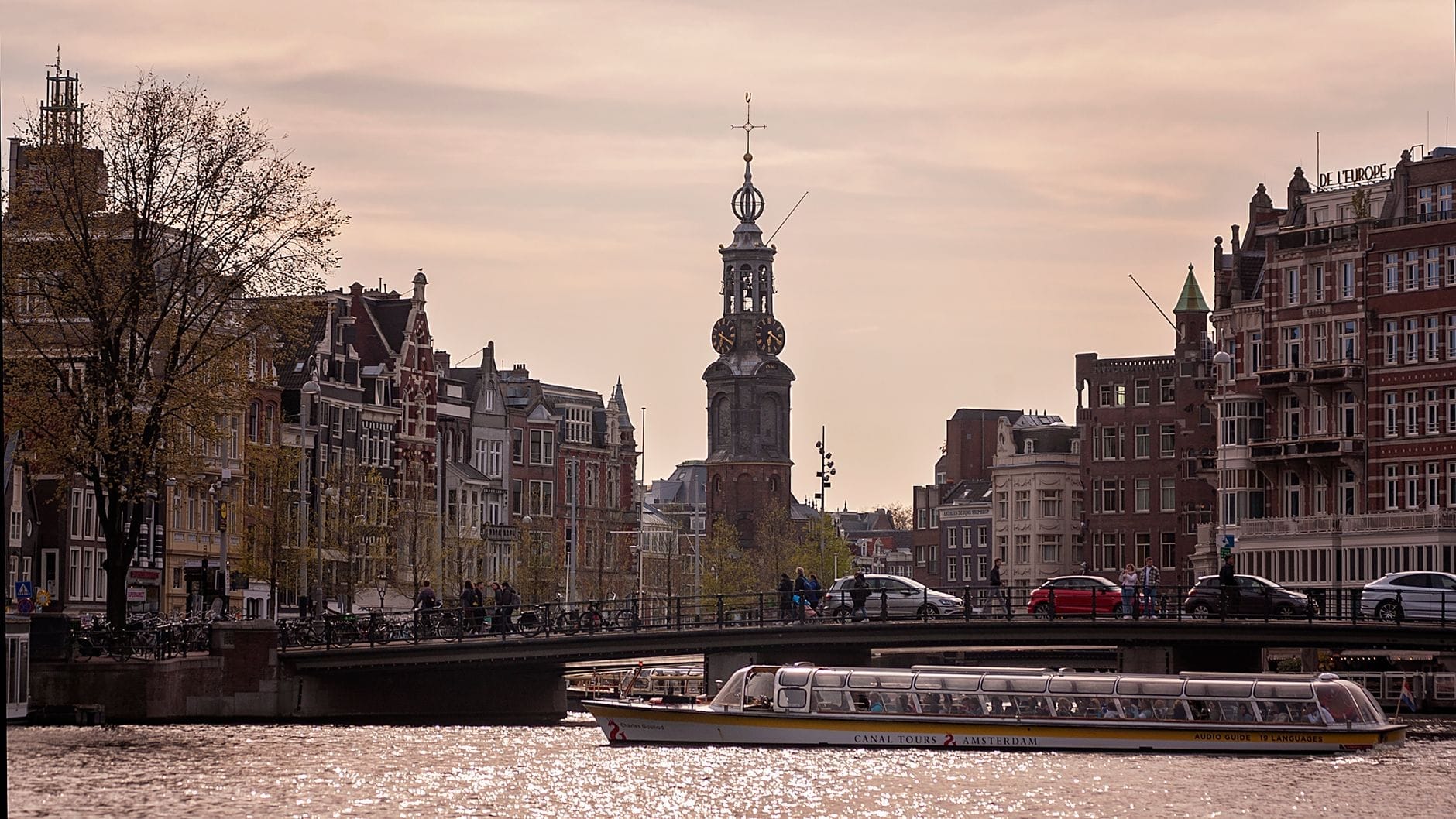
What Is the Munttoren?
The Munttoren, known in English as the Mint Tower, stands at Muntplein — a small square at the southern tip of the Canal Ring where the Amstel River and the Singel canal converge. It is one of the few surviving remnants of Amsterdam's medieval fortifications, and its profile—a squat stone base topped by a tapering spire ringed with clocks, is one of the most photographed silhouettes in the city centre.
Despite its central position and strong visual presence, the Munttoren is not a museum. The interior is not open to the public in the conventional tourist sense. There are no tickets to buy, no waiting lines, and no audio guides. The entire visit happens outside, on the pavements and bridges around Muntplein. This makes it both accessible and easy to underestimate — but for travelers who take a moment to stop and look up, the tower rewards attention.
ℹ️ Good to know
The Munttoren interior is not open for general public visits. Viewing is entirely from street level. Plan your time accordingly — this is a walk-by landmark, best combined with a longer route through the Canal Ring.
A History Built in Layers
The site has been a point of civic significance since at least 1487, when a city gate stood here as part of Amsterdam's original defensive walls. The gate controlled one of the main entrances to the city from the south, and its position at the junction of two waterways made it strategically and commercially important. That original structure no longer exists in its full form.
In 1618, a fire tore through the gatehouse and destroyed much of the medieval structure. What was rebuilt in the years that followed reflects the Dutch Golden Age style that now defines so much of Amsterdam's architectural character: a relatively plain stone base with restrained ornament, topped by a spire rebuilt in 1620 by the architect Hendrick de Keyser—the same designer behind the Westerkerk and the Zuiderkerk towers. His vertical rhythm and decorative stonework are visible in the spire; the carillon bells were cast later by the Hemony brothers in the 17th century.
The name Mint Tower came later, in the 1670s, during the Franco-Dutch War. When French forces occupied much of the southern Netherlands and disrupted normal coin production, Amsterdam temporarily minted coins in the guardhouse attached to this tower. The minting operation was short-lived, but the name stuck permanently.
For context on how this fits into the wider story of Amsterdam's 17th-century urban planning, the Amsterdam architecture guide covers the major periods and styles in detail.
Tickets & tours
Live prices and dates from our booking partner. If you book, we may earn a commission at no extra cost to you.
Gray Line Canal Cruise with snackbox & Heineken Experience
From 48 €Instant confirmationFree cancellationAmsterdam evening canal cruise
From 18 €Instant confirmationFree cancellationJewish Museum and Portuguese Synagogue entrance ticket
From 20 €Instant confirmationFree cancellationAdmission ticket for Artis Royal Zoo and Micropia
From 39 €Instant confirmationFree cancellation
The Carillon: Every Quarter-Hour, Without Fail
One of the Munttoren's most underappreciated features is its carillon, a set of tuned bells cast by the Hemony brothers — François and Pieter Hemony — who were the foremost carillon makers in 17th-century Europe. Their instruments were installed in towers across the Low Countries, and the Munttoren's set is among the finest surviving examples of their work.
The carillon chimes every 15 minutes throughout the day. If you are nearby when the bells sound, the effect is more resonant than most visitors expect: the tones are full and warm, not tinny or mechanical, and they carry across the surrounding canal and square in a way that cuts through the general city noise. Traditionally, a carillon musician also plays the instrument live on a regular weekly basis; the schedule can vary. If you hear something more than a standard chime, you may be listening to a live performance.
💡 Local tip
Position yourself on the Muntbrug bridge (the small bridge just south of the tower, over the Singel) a minute or two before the quarter-hour for the clearest view and best acoustics when the carillon rings.
What the Visit Actually Feels Like
Muntplein is a working city square, not a pedestrianized tourist zone. Trams cross it continuously, bicycles weave through, and the eastern end of Kalverstraat — Amsterdam's main shopping street — feeds a constant flow of people into the area. The square can feel chaotic during peak hours, roughly 11:00 to 17:00 on weekends and throughout summer afternoons. The tower itself can be hard to appreciate when you are being jostled by foot traffic and waiting for trams to clear your sight line.
The experience changes significantly in the early morning and in the evening. Early in the morning, Muntplein is generally quieter. The light from the east catches the pale stone of the spire cleanly, the canal below is still, and the carillon chimes with almost no background noise to compete with. This is when the tower is easiest to photograph and easiest to appreciate as a piece of architecture rather than just a backdrop for a busy junction.
At dusk and into the evening, the Munttoren is illuminated. The tower and spire are lit against the darkening sky, and the reflection on the Singel canal can be striking on calm nights. Evening also brings fewer cyclists and trams crossing your view. If your schedule permits, a five-minute detour here after dinner in the Canal Ring area is consistently more rewarding than a midday visit.
The Munttoren sits directly adjacent to the Bloemenmarkt,Bloemenmarkt, Amsterdam's famous floating flower market, which runs along the Singel just west of the tower. The two are natural companions on the same short walk.
Getting There and Navigating the Area
Muntplein is one of the best-connected points in central Amsterdam. Multiple tram lines stop at or very close to the square, and it is within a short walk of both Dam Square to the north and Rembrandtplein to the east. From Amsterdam Centraal station, the walk south through the city centre takes roughly 15–20 minutes, passing through the core shopping and canal areas.
The area around Muntplein is almost entirely flat, and the pavements are standard urban sidewalks. There are no steps, barriers, or uneven surfaces specific to viewing the tower. However, the square is busy with trams and bikes, and navigation requires attention — particularly for visitors who are not used to sharing space with cyclists and tram infrastructure. Tram tracks can be slippery when wet.
If you are planning a walking route through the historic centre, the Munttoren works naturally into a loop that includes Dam Square and Rembrandtplein. The Amsterdam walking tours guide has several route options that cover this corridor.
Photography Notes
The Munttoren is compact enough that most of it fits into a standard smartphone frame without needing a wide-angle lens. The best angles are from the Muntbrug bridge (looking north-northwest at the tower and spire with the Singel canal in the foreground) and from the far side of the Amstel, looking back toward the tower with the canal houses framing either side.
Midday light in summer is harsh and flat, washing out the stone detail. Early morning golden hour, particularly in spring and autumn, produces the warmest tones on the pale spire. Overcast days, which are common in Amsterdam, can actually work well here — diffuse light eliminates glare and brings out the texture of the 17th-century stonework.
⚠️ What to skip
Tram lines cross directly in front of the best viewing angles. Watch your footing when stepping back for a wider shot — tram tracks are active throughout the day and into the late evening.
Honest Assessment: Is It Worth a Dedicated Stop?
The Munttoren is not an attraction that justifies a special journey on its own. If you are already in central Amsterdam — visiting the Bloemenmarkt, walking between Kalverstraat and Rembrandtplein, or crossing toward the Canal Ring — then yes, stopping for 10–15 minutes to look at the tower, listen for the carillon, and take in the canal view is worth the small detour. The history is genuinely interesting when you know the context.
Travelers expecting to enter the tower, climb for a view, or engage with any kind of interpretive experience will find nothing here. The Munttoren is purely a visual and acoustic landmark, experienced from the street. It belongs to a category of Amsterdam sights that reward curiosity and punish expectation — go with the right mindset and it is a satisfying moment; treat it as a primary destination and it will disappoint.
Those with limited time in Amsterdam and a full itinerary of major museums and attractions should treat it as a walk-by rather than a stop. First-time visitors focused on the Rijksmuseum, Van Gogh Museum, or Anne Frank House are better served prioritizing those sites, with the Munttoren noted as something to glance at in passing.
Insider Tips
- Visit before 09:00 or after 20:00 for dramatically reduced foot traffic and tram activity around Muntplein — the tower is far easier to appreciate without the midday crowd.
- Stand on the Muntbrug bridge at a quarter to or quarter past the hour to hear the Hemony carillon from the best acoustic position. The sound carries differently over water than from the pavement.
- The tower is reflected in the Singel canal on still days and evenings. Walk 30 metres south along the canal bank for a reflection shot that most visitors miss entirely.
- The Bloemenmarkt runs directly along the Singel just west of the tower. Combining both in the same 30-minute visit makes far more sense than treating them as separate stops.
- If you are visiting in autumn or winter and the light fades early, the illuminated tower against a dark sky with canal reflections is genuinely striking — more so than many midday visits.
Who Is Munttoren (Mint Tower) For?
- Architecture and history enthusiasts who appreciate Dutch Golden Age design and want to understand Amsterdam's medieval origins
- Photographers looking for a canal-and-tower composition in the heart of the city centre, especially at golden hour
- Walkers combining multiple Canal Ring sights in a single route, where the Munttoren adds historical context without requiring extra time
- Travelers passing through Muntplein for the Bloemenmarkt or Kalverstraat shopping who want to make a quick stop count
- Anyone who enjoys listening to live or mechanical carillon bells — the Hemony instrument here is a well-known Hemony carillon
Nearby Attractions
Other things to see while in Canal Ring (Grachtengordel):
- Anne Frank House
The Anne Frank House on Prinsengracht 263 preserves the hidden rooms where Anne Frank and seven others lived in concealment from 1942 to 1944. One of the most significant memorial sites in Europe, it requires advance planning but rewards visitors with an experience that stays with them long after they leave Amsterdam.
- Bloemenmarkt (Floating Flower Market)
The Bloemenmarkt sits on a row of fixed barges along the Singel canal, operating since 1862 as the world's only floating flower market. Free to enter and open daily, it sells tulip bulbs, cut flowers, and souvenirs in the heart of Amsterdam's Canal Ring. Here is what you will actually find there.
- Amsterdam Canal Cruises
A canal cruise is one of the most efficient ways to understand Amsterdam's layout and its 17th-century heritage. This guide covers the main operators, departure points, what you'll actually see, and how to pick the right cruise for your trip.
- FOAM Photography Museum
Housed in a 17th-century canal house on Keizersgracht, FOAM Photography Museum (Fotografiemuseum Amsterdam) has been one of Europe's leading photography institutions since it opened in December 2001. Four floors of rotating exhibitions cover documentary work, fine art photography, fashion, and emerging talent, making it a serious cultural stop that rewards repeat visits.
Planning a trip? Discover personalized activities with the Nomado app.