The Morgan Library & Museum: Where Rare Books Meet Gilded Grandeur
One of Midtown Manhattan's most underrated cultural institutions, the Morgan Library & Museum holds roughly 350,000 items spanning medieval manuscripts, original musical scores, and master drawings. The historic rooms of J. Pierpont Morgan's private library remain among the most ornate interiors in New York City.
Quick Facts
- Location
- 225 Madison Avenue (at 36th Street), Midtown Manhattan, NY 10016
- Getting There
- Subway 6 to 33rd St; 4/5/6/7 to Grand Central; B/D/F/Q to 42nd St; PATH to 33rd St
- Time Needed
- 1.5 to 3 hours depending on exhibitions
- Cost
- Adults $25 | Seniors $17 | Students $13 | Children under 12 free | Free Fridays 5–8 PM
- Best for
- Book lovers, history enthusiasts, architecture admirers, and anyone seeking calm in Midtown
- Official website
- www.themorgan.org
What Is the Morgan Library & Museum?
The Morgan Library & Museum is a research library, rare book repository, and public museum occupying a full block of Madison Avenue in Midtown Manhattan. It began as the private collection of John Pierpont Morgan, the financier and industrialist who spent decades acquiring some of the world's most significant manuscripts, drawings, prints, and early printed books. When Morgan commissioned architects McKim, Mead & White to build a dedicated library adjacent to his home between 1902 and 1906, the result was one of the finest Neoclassical structures in the United States. The building opened to the public on March 28, 1924, more than a decade after Morgan's death in 1913.
Today the institution holds approximately 350,000 items. The collection includes medieval and Renaissance illuminated manuscripts, letters and documents signed by historical figures from Mozart to Thomas Jefferson, original musical scores by Beethoven and Brahms, and an extraordinary archive of literary papers. It is not a survey museum that tries to cover everything; it is a place of depth and specificity, and visitors who come with that expectation tend to leave genuinely moved.
💡 Local tip
Free Fridays: Museum admission is free every Friday from 5 to 8 PM. Tickets must be reserved in advance and are released on the prior Friday. If you miss the release window, paid tickets are always available.
The Architecture: McKim's Palazzo and Renzo Piano's Addition
The original library building, completed in 1906, was designed by Charles Follen McKim of McKim, Mead & White in a classical Renaissance palazzo style. The exterior is Tennessee pink marble, cut and laid with such precision that no mortar was used in the construction of the main facade, a technique borrowed from ancient Greek architecture. The restraint of the exterior does nothing to prepare you for the interiors.
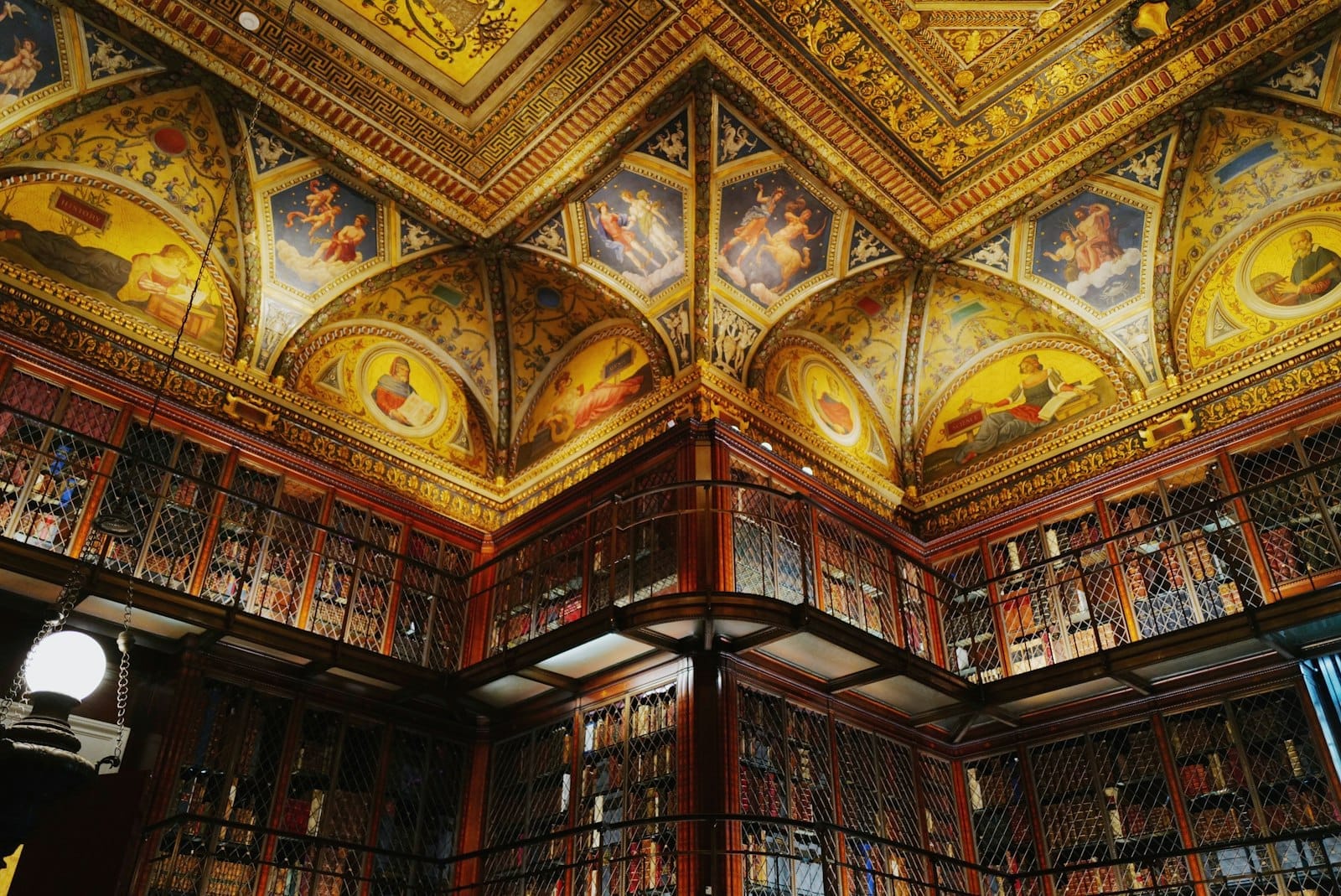
Morgan's private study and the main library room, known as the East Room, are among the most spectacular indoor spaces in New York. The East Room rises three tiers high, its walls lined floor to ceiling with red damask and leather-bound books. The ornamented ceiling, the inlaid marble floor, and the overall sense of careful accumulation create an atmosphere that feels less like a museum and more like a cabinet of wonders that has been preserved in amber.
In 2006, architect Renzo Piano completed a major expansion that doubled the museum's footprint by connecting the original buildings with a new steel-and-glass central court. The addition is thoughtful rather than intrusive: transparent walls allow natural light to flood the gathering space, and the contrast between Piano's modernist geometry and McKim's classical stonework is deliberately legible rather than hidden. The new galleries, reading rooms, and the Morgan's place within Midtown's architectural landscape all benefited from this intervention.
Tickets & tours
Hand-picked options from our booking partner. Prices are indicative; availability and final rates are confirmed when you complete your booking.
New York Public Library self-guided audio tour
From 9 €Instant confirmationStatue of Liberty, Ellis Island, and Brooklyn Bridge Happy Hour Cruise
From 49 €Instant confirmationFree cancellationSpirit of New York Dinner Cruise
From 161 €Instant confirmationFree cancellationNew York City Highlights bike tour
From 70 €Instant confirmationFree cancellation
What You Will See: The Collection and Galleries
Permanent highlights rotate, but several elements remain consistently accessible. The Gutenberg Bible on display is one of only three perfect vellum copies known to survive. Nearby cases typically hold medieval Books of Hours, their pigments still saturated after five centuries. The drawings collection includes work by Leonardo, Rembrandt, Dürer, and Rubens, though not all are on view simultaneously due to light sensitivity.
Special exhibitions change every few months and tend to focus on literary archives, musical manuscripts, or thematic explorations of the collection. Past exhibitions have examined the correspondence of Charles Dickens, the visual language of the Surrealists, and the history of children's book illustration. The temporary galleries are compact but well-curated, with label copy that explains context without condescension.
Access to the historic rooms of J. Pierpont Morgan's Library, meaning the East Room, the West Room study, and the Rotunda, is free every Tuesday and Sunday from 3 to 5 PM. This access does not include special exhibitions, but it is the best way to experience the building's most extraordinary spaces without paying full admission, and the rooms are significantly less crowded during these windows than on weekend afternoons.
ℹ️ Good to know
Free College Sundays: Graduate and undergraduate students with a current ID visit free on the first Sunday of every month. Reservations are encouraged and tickets become available one month in advance.
How the Experience Changes by Time of Day
Weekday mornings, especially Tuesday through Thursday between opening at 10:30 AM and noon, are the quietest periods. The galleries hold maybe two dozen visitors at a time, and the acoustic softness of the carpeted floors and high ceilings means you can stand in front of a Rembrandt drawing in near silence. The quality of attention this allows is rare in any New York museum.
Weekends bring a different crowd: families with children, couples on afternoon outings, and occasional tour groups. The East Room and Morgan's study attract the most attention and can feel crowded around early afternoon. If you are visiting on a weekend, arriving at opening time is the clearest way to see the historic rooms without people constantly moving through your field of view.
Friday evenings have their own character. The free admission brings in a younger, more socially-oriented crowd, and the central court, with its glass ceiling and café seating, fills with conversation. If you want a contemplative experience with the collection, Free Friday is worth the effort of booking early, but be prepared for a livelier atmosphere than you would find on a Tuesday morning.
Practical Walkthrough: Getting In and Getting Around
The museum entrance is on Madison Avenue at 36th Street. Admission is by timed ticket, though entry windows are spaced broadly enough that the experience does not feel regimented. Buying tickets in advance online is advisable for weekend visits and essential for Free Fridays. Coat check is available, and the security process involves bag screening but no metal detector.
The nearest subway stop is the 6 train to 33rd Street, about a five-minute walk north on Park Avenue and then one block west on 36th Street. The 4, 5, 6, and 7 trains at Grand Central Terminal provide another convenient option if you are coming from the East Side or Queens. From Grand Central, the walk to the Morgan is about 10 minutes heading south and west along 42nd or 40th Street.
The museum is a single, mid-size building and does not require significant walking. Most visitors cover the permanent collection and a temporary exhibition in 90 minutes to two hours. Photography is permitted in most areas without flash; the Morgan's objects are visually compelling and worth the time you would spend composing a shot. Low light in the historic rooms makes sharp images challenging without a stabilized lens.
💡 Local tip
The Morgan's café and restaurant occupy the Renzo Piano-designed central court. The lunch menu is reasonably priced by Midtown standards, and the space is a calm place to pause between galleries. The gift shop stocks a well-edited selection of facsimile editions, art books, and stationery.
Who Should Consider Skipping This Attraction
The Morgan is not the right museum for visitors who want expansive, walk-all-day galleries. It covers a defined territory: books, manuscripts, drawings, and prints, and it does so with great depth. Travelers whose interests center on contemporary art, decorative arts, or natural history will find more range at other New York City museums better matched to those interests.
Children under 10 may find the experience difficult to sustain unless they have a particular interest in illustrated manuscripts or storytelling. The objects are small, the text-heavy labels require patience, and the quiet atmosphere makes it hard for energetic kids to feel comfortable. Families with older children, particularly those interested in art or history, tend to have a more rewarding time.
Visitors who come expecting a major blockbuster experience comparable to the Metropolitan Museum of Art will find the Morgan underwhelming in scale. That is a category error. The Morgan is intimate by design, and its scale is a feature rather than a deficiency.
The Morgan in Context: Murray Hill and the Surrounding Area
The Morgan sits in the Murray Hill neighborhood of Midtown Manhattan, a residential and commercial area that lacks the tourist density of Times Square or Fifth Avenue. The streets around the museum are relatively calm, which contributes to the sense of stepping out of the city's usual pace when you enter.
Madison Avenue between 30th and 40th Streets offers a range of cafés and restaurants for before or after your visit. The neighborhood is also walking distance from the New York Public Library on 42nd Street, another architecturally significant Beaux-Arts institution that pairs well with a Morgan visit on the same afternoon. Together, they form one of Midtown's most satisfying cultural itineraries for anyone interested in architecture and the history of the written word.
Insider Tips
- Historic room access on Tuesday and Sunday afternoons from 3 to 5 PM is free and requires no ticket reservation. This is the most efficient way to see Morgan's East Room and private study without paying for full admission, and crowds at those specific times are noticeably lighter than weekend afternoons.
- Free Friday tickets are released exactly one week in advance and go fast. Set a reminder for the same time every Thursday evening and check the reservation system. The window between 5 and 6 PM on Fridays is the best balance of free admission and manageable crowds before the post-work rush builds.
- The Morgan's garden, open from May through early November on Fridays, Saturdays, and Sundays, is a small but genuinely peaceful space behind the museum. Most visitors do not realize it exists. On a warm Friday evening it is one of the more unexpected pleasant spots in Midtown.
- If you are interested in a specific object or manuscript in the collection, the Morgan's online catalogue allows you to check what is currently on view before your visit. Not everything is displayed at once, and some drawings are only shown for limited periods due to light sensitivity.
- Coat check is efficient and free. In winter, checking a bulky coat before entering the galleries makes the experience significantly more comfortable, particularly in the narrower cases areas where backpacks and large bags become obstacles.
Who Is Morgan Library & Museum For?
- Readers, writers, and book collectors who want to see original manuscripts and rare printed works up close
- Architecture enthusiasts interested in both Beaux-Arts classicism and Renzo Piano's modern interventions
- Travelers who want a quieter, less-crowded alternative to New York's larger art museums
- Art history students and researchers with access to one of the world's great drawing collections
- Couples looking for an understated, genuinely interesting afternoon in Midtown
Nearby Attractions
Other things to see while in Midtown Manhattan:
- Broadway Theater District
The Broadway Theater District in Midtown Manhattan is the center of American live theater, home to 41 official Broadway houses spanning nearly a century of performance history. Whether you're booking months in advance or hunting same-day discount tickets, this guide covers everything from curtain times to architectural details.
- Bryant Park
Tucked behind the New York Public Library on Sixth Avenue, Bryant Park is an 8-acre public park that holds its own against the surrounding skyscrapers. Free to enter year-round, it shifts character dramatically by season, from a winter ice rink to a summer outdoor cinema — and remains one of the most functional and well-managed public spaces in New York City.
- Carnegie Hall
Carnegie Hall has anchored Midtown Manhattan's cultural life since 1891. With three auditoriums ranging from 268 to 2,790 seats, it hosts everything from orchestral premieres to intimate recitals. This guide covers the halls, the history, and exactly how to make the most of a visit.
- Chrysler Building
Completed in 1930 and briefly the tallest building on earth, the Chrysler Building remains the finest example of Art Deco architecture in New York City. Visitors generally can't go inside beyond the main lobby, but the experience of standing beneath its gleaming stainless steel crown is genuinely unforgettable.