Migration Museum: Adelaide's Migration Stories on Kintore Avenue
Housed inside the former Destitute Asylum on Kintore Avenue, the Migration Museum traces the stories of people who left everything to start again in South Australia. Entry is free, the building is historically loaded, and the exhibitions are far more personal than anything you'd expect from a state institution.
Quick Facts
- Location
- 82 Kintore Avenue, Adelaide CBD (behind the State Library of South Australia)
- Getting There
- 8-minute walk from Adelaide Railway Station and the North Terrace tram stop; buses serve the area
- Time Needed
- 1.5 to 2.5 hours for a thorough visit; 45 minutes if you're short on time
- Cost
- Free general entry (AUD); donations welcome
- Best for
- History-focused visitors, anyone with family migration stories, school groups, solo travellers seeking depth over spectacle
- Official website
- migration.history.sa.gov.au
What the Migration Museum Actually Is
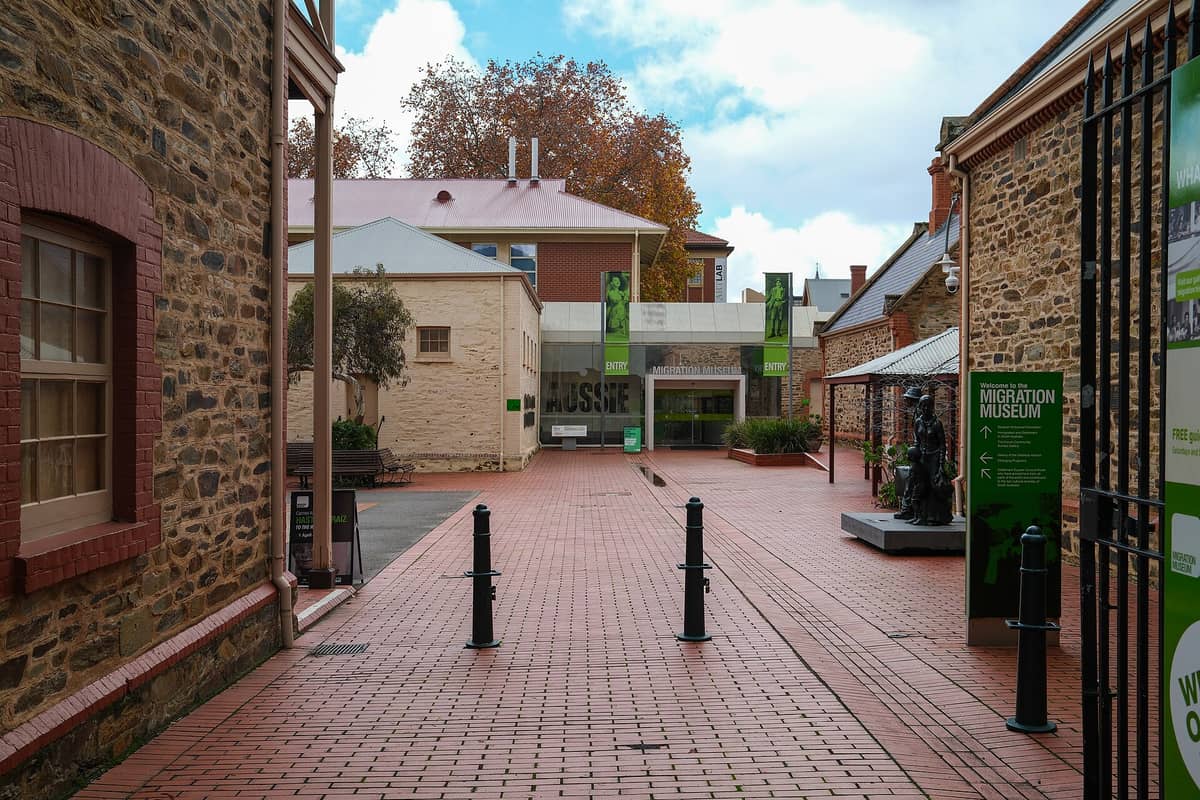
The Migration Museum is a state-run history museum dedicated to the human experience of migration to South Australia. It sits on Kintore Avenue in the Adelaide CBD, tucked behind the State Library in a cluster of 19th-century buildings that most visitors walk past without realising what's inside. General entry is free, the galleries are calm and genuinely well-considered, and the whole experience takes most people between 90 minutes and two and a half hours depending on how deeply they engage.
The museum is not a broad sweep of Australian immigration policy. It is something more granular and more affecting: a record of individual people who left places they knew to come to a place they didn't. The voices throughout the exhibitions are specific. You read names, see photographs, handle reproductions of documents. For anyone whose own family arrived in Australia from somewhere else, or who has ever made a significant life move themselves, the effect can be unexpectedly strong.
⚠️ What to skip
Important: The Migration Museum will temporarily close from 3 July 2026 for a period of two years for structural and conservation works. Check the official site at migration.history.sa.gov.au before planning your visit, especially if you're travelling in mid-2026 or later.
The Building Itself: A History Before the History
The museum occupies historic buildings on the site of Adelaide's Destitute Asylum, including the former Lying-in Home, purpose-built in 1878. That context matters. The Destitute Asylum was a colonial welfare institution, a place where people without resources, often newly arrived migrants who had not yet found footing, came when they had nowhere else to go. Walking through galleries in buildings associated with the site’s history adds a layer of meaning that a purpose-built museum space could never replicate.
The stone and brick construction of the buildings is immediately apparent when you arrive via the courtyard. The walls are thick, the ceilings high in a way that traps cool air in summer, and the proportions are institutional rather than inviting. The museum has worked with this atmosphere rather than against it. It does not feel like a sanitised heritage site. It feels like a place where difficult things happened, and where someone decided those things deserved to be remembered properly.
The North Terrace precinct around the museum is one of Adelaide's most architecturally rich corridors. If you approach from the railway station end, you'll pass the South Australian Museum and the Art Gallery of South Australia on the way. Together, these institutions form a cultural precinct that can fill a full day for someone interested in history, art and science.
Tickets & tours
Live prices and dates from our booking partner. If you book, we may earn a commission at no extra cost to you.
Ultimate Adelaide and Hahndorf full-day tour
From 94 €Instant confirmationFree cancellationHalf-day Lofty Descents tour by bike
From 89 €Instant confirmationFree cancellationAdelaide kayak tour with expert instructors
From 51 €Instant confirmationFree cancellationTrue Crime Tour in Adelaide
From 21 €Instant confirmationFree cancellation
What You'll See Inside
The permanent collection works chronologically and thematically, covering migration waves from the earliest European arrivals in South Australia through to recent decades. There are displays covering British and Irish migrants, the Gold Rush-era arrivals, southern European communities who came in the mid-20th century, and more recent arrivals from Southeast Asia, the Middle East and sub-Saharan Africa. The breadth is real, not tokenistic.
What distinguishes the curation is the emphasis on objects and personal testimony rather than policy and statistics. A pair of worn leather shoes. A tin box used to carry savings on a ship voyage. A letter in Italian that a migrant wrote home and never sent. These objects are accompanied by the stories of the specific people who owned them, drawn from the museum's extensive oral history archive. The effect is cumulative: by the time you've moved through three or four of these cases, you're no longer reading about migration in the abstract.
The museum also addresses migration's darker chapters honestly, including policies that restricted entry based on race and nationality, and the experiences of those who arrived as refugees. This willingness to present uncomfortable history without euphemism lifts the museum well above standard celebratory heritage presentations.
When to Go and What to Expect at Different Times
The museum opens at 10 am daily except Christmas Day and closes at 5 pm. Weekday mornings, particularly from Tuesday through Thursday, are the quietest periods. School groups tend to arrive in the morning on weekdays during school terms, so if you prefer a contemplative pace, avoid 10 to 11:30 am on weekdays between February and December. School groups tend to move through specific sections, so it's usually possible to navigate around them.
Weekends draw a mix of families and independent travellers. Saturday mornings are busier than Sunday mornings. The museum has no peak-season crowds to speak of in the way that outdoor attractions do, since it is indoors and free. On hot Adelaide summer days, when temperatures can climb above 35°C, the museum becomes genuinely attractive as a cool refuge, and visitor numbers reflect that.
💡 Local tip
Late afternoon on a weekday, roughly 3 to 4:30 pm, tends to be the quietest window for adult visitors. The school groups are gone and the after-work crowd hasn't arrived. The light in the courtyard is also better for photographs at this hour.
Adelaide's Mediterranean climate means summer visits (December to February) involve heat outside but comfort inside. If you're planning a broader day out in the CBD, check the best time to visit Adelaide for seasonal guidance that covers both weather and event calendars.
Getting There and Getting Around
The address is 82 Kintore Avenue, and the most practical approach is on foot from North Terrace. From Adelaide Railway Station, walk east along North Terrace for roughly eight minutes until you reach the State Library of South Australia, then turn right into Kintore Avenue. The museum entrance appears on your left within 60 metres. The signage is modest; look for the stone gateway rather than an obvious museum frontage.
The North Terrace tram stop is equally close. Adelaide Metro trams run on King William Street and connect the CBD to Glenelg, making this a straightforward stop for visitors based in the city centre or travelling from the beach suburbs. Buses also serve North Terrace. Metered street parking is available on Kintore Avenue and surrounding streets, though spaces fill quickly during business hours.
For a broader picture of public transport options in Adelaide, the getting around Adelaide guide covers trams, buses and trains in detail, including how to load an Adelaide Metro card.
Accessibility, Facilities and Practical Notes
Most galleries are wheelchair-accessible and suitable for mobility scooters. Accessible toilet facilities are available on-site. Guide and assistance dogs are welcome throughout the museum. The museum advises checking its official access information for current details on accessible parking, since spaces are limited and the Kintore Avenue location has no dedicated car park.
Photography is generally permitted in the permanent galleries for personal use; individual exhibitions may have different rules, and signage within each space makes this clear. The museum has a small gift shop near the entrance that sells books, prints and objects related to migration history and South Australian heritage. There is no dedicated cafe on-site, but North Terrace and the nearby Rundle Mall precinct have plenty of options within a five-minute walk.
Who This Museum Is and Is Not For
The Migration Museum rewards visitors who are willing to slow down and read. The exhibitions are text-heavy by design, because the stories are the point. Visitors who prefer visual spectacle, interactive technology-driven experiences, or large-scale dramatic displays will likely find the presentation underwhelming. This is not a blockbuster museum. It is a careful, human-scale one.
For families with young children, the museum is accessible and staff are welcoming, but the content is pitched primarily at adults and older teenagers. Children under about ten may find the exhibitions slow unless they have a specific family history connection to explore. Families visiting Adelaide with younger kids might find Adelaide Zoo or Cleland Wildlife Park a better fit for that age group.
For solo travellers, history enthusiasts, anyone researching South Australian family history, or visitors interested in how Australia constructed its sense of national identity through the people it let in and kept out, this is one of the most genuinely worthwhile free hours you can spend in the CBD. It is not overhyped precisely because it doesn't shout for attention.
ℹ️ Good to know
The museum holds a significant oral history and photographic archive. If you have South Australian family history you're researching, contact the museum in advance, as staff can sometimes assist with specific inquiries or point you to relevant resources beyond the public exhibitions.
Insider Tips
- The courtyard between the museum buildings is often overlooked but worth spending a few minutes in. The original stonework of the Destitute Asylum buildings is best appreciated from here, and it's a useful space for quiet reflection between galleries.
- Check the museum's events calendar before visiting. The Migration Museum hosts regular talks, community evenings and special exhibitions that are often free and can significantly deepen the visit experience, particularly if your own heritage connects to a specific community being featured.
- The museum's entrance on Kintore Avenue is easy to miss if you approach from North Terrace without knowing to turn off. Walk past the State Library entrance and watch for the stone gateway on your left, not a prominent sign at street level.
- If you're combining this with other North Terrace institutions in one day, visit the Migration Museum first. It tends to require more emotional energy and slower reading than a gallery or natural history museum, and it's better experienced fresh.
- Donations at the entrance are genuinely appreciated. As a free state-run institution, the museum operates on a lean budget, and even a small contribution helps maintain the oral history archive and community programs that don't show up in the public galleries.
Who Is Migration Museum For?
- Travellers with personal or family migration histories who want to see that experience reflected and honoured
- History and social history enthusiasts who appreciate object-led storytelling over digital interactives
- Solo visitors who want depth and quiet on a hot afternoon in the CBD
- Students and researchers interested in Australian immigration history and policy
- Anyone building a full North Terrace cultural precinct day alongside the Art Gallery and South Australian Museum
Nearby Attractions
Other things to see while in Adelaide CBD:
- Adelaide Arcade
Opened in December 1885, Adelaide Arcade is one of Australia's oldest and best-preserved Victorian-era shopping arcades. Free to enter and located opposite Rundle Mall's fountain, it offers a rare combination of architectural beauty, specialty retailers, and a genuine sense of Adelaide's commercial history.
- Adelaide Botanic Garden
Open daily and completely free, Adelaide Botanic Garden covers 50 hectares on the northern edge of the CBD. From a 19th-century palm house to a full-scale tropical rainforest glasshouse, it rewards a slow morning or a purposeful afternoon walk.
- Adelaide Central Market
Adelaide Central Market has operated continuously since 1869, making it one of the largest undercover fresh produce markets in the Southern Hemisphere. Spread across 5,720 square metres in the heart of the CBD, it draws locals, chefs, and curious visitors to its mix of produce stalls, specialty food traders, and casual eateries. This guide covers everything you need to plan a worthwhile visit.
- Adelaide Festival Centre
Opened in 1973, Adelaide Festival Centre is South Australia's flagship performing arts complex, anchoring the northern edge of the CBD along King William Road. From major theatre productions to intimate performances, it draws both locals and visitors year-round — and its riverside location makes it as much a place to linger as to attend a show.
Planning a trip? Discover personalized activities with the Nomado app.