Rundle Mall: Adelaide's Central Shopping Strip Explained
Rundle Mall is Adelaide's main pedestrian shopping precinct, stretching 520 metres through the heart of the CBD. Free to enter, open seven days a week, nearly every day of the year, and lined with department stores, indie retailers, food courts, and public art, it functions as both a commercial hub and an everyday gathering place for locals and visitors alike.
Quick Facts
- Location
- Between King William Street and Pulteney Street, Adelaide CBD
- Getting There
- Free City Loop Bus (99C) stops at the mall; Adelaide Railway Station ~5-min walk; trams on King William St
- Time Needed
- 1–3 hours depending on how seriously you shop
- Cost
- Free to enter; shops set individual prices
- Best for
- Shoppers, people-watchers, first-time visitors getting their bearings in the CBD
- Official website
- www.rundlemall.com
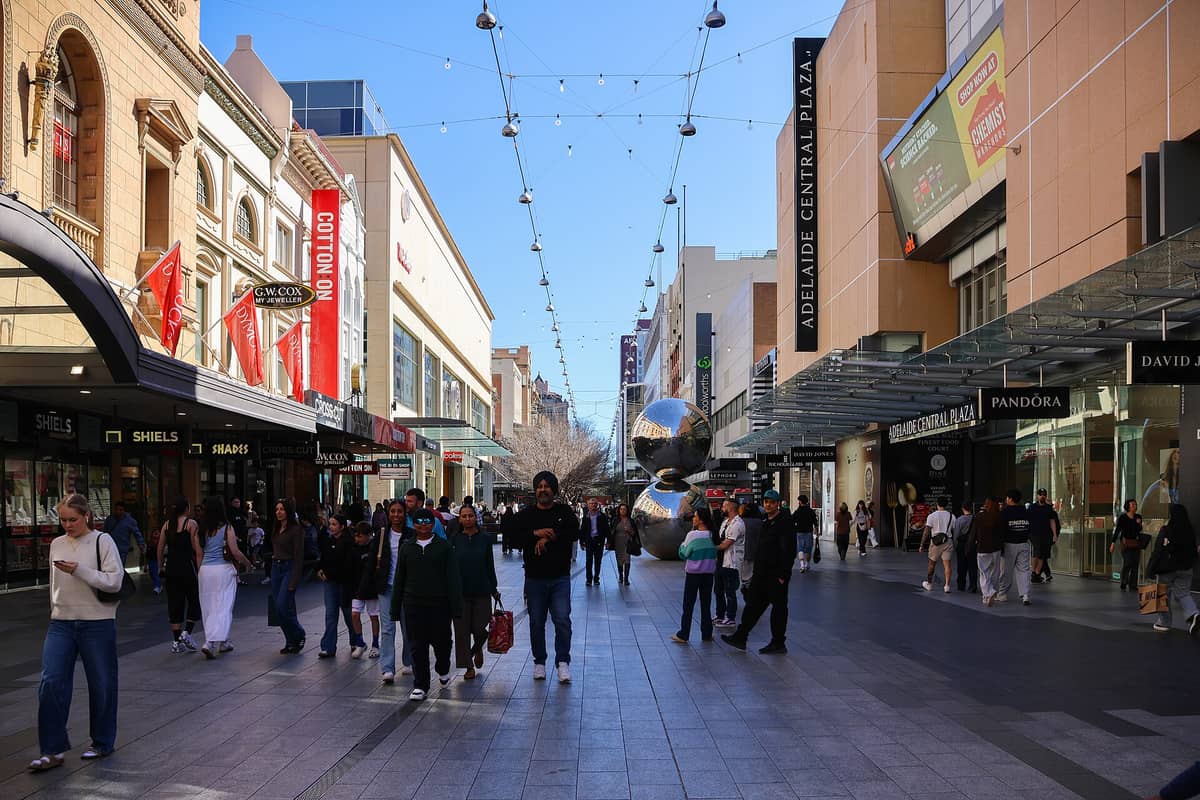
What Is Rundle Mall, Exactly?
Rundle Mall is Adelaide's primary pedestrian shopping precinct, running roughly 520 metres through the centre of the CBD from King William Street in the west to Pulteney Street in the east. It opened on 1 September 1976, making it one of Australia's earliest city-centre pedestrian malls, and it has been the commercial backbone of central Adelaide ever since. The street itself is car-free and paved in a broad promenade format, with seating, public sculptures, and a visitor information centre embedded into the street furniture.
The mall is not a single building or enclosed shopping centre but an open-air street flanked by a mix of retail formats: full-scale department stores, national chain retailers, independent boutiques, food courts, cafes, and several enclosed arcades that branch off the main spine. Think of it as the connective tissue of Adelaide's CBD retail scene rather than a destination in itself.
ℹ️ Good to know
The pedestrian mall is open nearly every day of the year, but individual store hours vary. Standard precinct hours: Monday–Thursday 9am–5:30pm, Friday 9am–9pm, Saturday–Sunday 9am–5pm. Friday evenings are the best time to catch the widest range of shops open simultaneously.
How the Mall Changes Through the Day
Early morning, from around 8am to 9am, Rundle Mall belongs almost entirely to commuters cutting through on foot and hospitality workers prepping nearby cafes. The main strip is quiet enough that you can walk it end to end without breaking stride, and the granite paving and surrounding architecture are easiest to appreciate without the crowd. The smell of fresh bread and coffee drifts out from the food court entrances before the retail shutters go up.
By mid-morning on weekdays, the mall fills steadily with a mix of shoppers, office workers on breaks, and school groups. Street performers and musicians often take up positions near the central Pigs sculpture, the four bronze pigs (officially titled 'The Pigs') that have become the mall's most-photographed landmark since their installation. The ambient noise rises to a consistent murmur of conversations, trolley wheels, and occasional buskers.
Saturday mornings see the highest foot traffic of the week. Families with prams, groups of teenagers, and visitors from regional South Australia converge on the mall in numbers that can make the central stretch feel genuinely congested between 11am and 2pm. If you dislike dense crowds in a narrow outdoor corridor, Saturday lunchtime is the window to avoid. Friday evening, by contrast, offers a calmer but still lively version of the mall, with later-trading stores and a noticeably different, younger demographic.
Tickets & tours
Live prices and dates from our booking partner. If you book, we may earn a commission at no extra cost to you.
Ultimate Adelaide and Hahndorf full-day tour
From 94 €Instant confirmationFree cancellationHalf-day Lofty Descents tour by bike
From 89 €Instant confirmationFree cancellationAdelaide kayak tour with expert instructors
From 51 €Instant confirmationFree cancellationTrue Crime Tour in Adelaide
From 21 €Instant confirmationFree cancellation
The Layout: What You'll Actually Find Here
Walking from the King William Street end eastward, the first major anchors you pass are the large department stores, which occupy multi-level buildings set back slightly from the main walking surface. The western portion of the mall is generally wider and more open, which makes it the preferred spot for temporary market stalls, promotional activations, and community events. Buskers tend to cluster here because the acoustics and foot traffic density make it the most rewarding pitch.
Mid-mall, the covered arcades begin to appear. Several glass-roofed Victorian-era and Edwardian-era shopping arcades cut perpendicular to the main street, connecting Rundle Mall to Grenfell Street and other parallel lanes. The most architecturally significant of these is the Adelaide Arcade, built in 1885 and listed on the South Australian Heritage Register. Its mosaic tiled floor, ornate shopfronts, and central atrium ceiling are worth a slow walk-through even if you have no intention of buying anything.
The eastern end of the mall, approaching Pulteney Street, tends to be less crowded and houses a mix of smaller specialty stores, phone repair shops, and fast-food outlets. The Mobile Visitor Service operates near the King William Street entry point on weekends and public holidays; the Adelaide Visitor Information Centre is at 25 Pirie Street.
Historical Context and Urban Significance
The decision to pedestrianise Rundle Street in the mid-1970s followed a broader international trend of reclaiming inner-city streets from car traffic to revitalise retail precincts. When it opened in September 1976, it was a significant urban planning statement for Adelaide, signalling a commitment to the CBD as a people-first space at a time when suburban shopping centres were pulling retail investment outward.
The mall sits in Adelaide's CBD grid, which was designed by Colonel William Light in 1836. Light's plan established wide streets, a central square (Victoria Square), and a belt of parklands surrounding the entire city centre. Rundle Mall's east-west orientation connects to that wider grid logic. Walking the full length of the mall and into the surrounding streets gives you a tangible sense of Light's original plan. For a broader understanding of how the parklands tie into this design, the Adelaide Park Lands are within easy walking distance.
The mall has undergone significant investment over the decades, most recently with major redevelopment work to upgrade paving, street furniture, lighting, and accessibility features. The refurbishments have kept the precinct competitive against the newer enclosed shopping centres that have opened in the CBD fringe, though the debate about Rundle Mall's long-term retail health relative to suburban malls is an ongoing one in local planning discussions.
Practical Walkthrough: Getting There and Getting Around
Rundle Mall is as central as it gets in Adelaide. The free City Loop Bus (route 99C) stops at Rundle Mall. Adelaide Railway Station is nearby, and the tram and bus stop near the mall's western entrance on King William Street. If you are staying anywhere in the CBD, you can almost certainly walk to the mall without needing public transport at all.
For visitors combining a mall visit with broader CBD exploration, North Terrace is a short walk to the north and gives access to the Art Gallery of South Australia, the South Australian Museum, and the Botanic Gardens. The mall effectively anchors the retail and cultural sides of the CBD to each other.
💡 Local tip
Adelaide Metro's metroCARD works on all city buses and trams. If you're arriving by train from the suburbs or airport buses, tap on and off with the card to avoid paying cash fares. The City Loop Bus (99C) is completely free and stops at Rundle Mall.
Photography in the mall is straightforward during off-peak hours. The open paving and relatively wide central corridor make architectural shots easy in the morning light. The bronze pig sculptures are an obvious focal point, but the arcade interiors, particularly the Adelaide Arcade's atrium, reward photographers who venture off the main strip. Avoid weekend afternoons if you want clean shots without heavy foot traffic in the foreground.
Accessibility along the main mall strip is good: the paved surface is flat and wide, with no stairs on the principal route between King William and Pulteney streets. The enclosed arcades vary in accessibility. Consult the City of Adelaide Access Guide, available through the official Rundle Mall Visitor Information Centre page, for detailed access information before planning a visit with specific mobility requirements.
What to Know: What the Mall Is and Isn't
Rundle Mall is a functional, well-maintained city shopping street. It is not a boutique retail experience, and it is not an architectural spectacle in its own right (the arcade interiors are the exception). If you are visiting Adelaide primarily to shop, the mall will satisfy standard retail needs, from major department stores to mid-range fashion chains, with a handful of independent stores tucked into the arcades and side streets.
Visitors specifically seeking food culture will find more depth a short walk away at the Adelaide Central Market, which is arguably Adelaide's most compelling retail food experience. The mall has food courts and cafes, but they are convenience options rather than destinations.
Travellers who prefer outdoor markets, heritage architecture, or independent retail will find the mall somewhat generic compared to other parts of Adelaide's CBD. The East End, running east along Rundle Street beyond Pulteney Street (where the pedestrian mall ends and the street reopens to cars), has a denser concentration of independent restaurants, bars, and specialty shops and is worth exploring as a complement to the mall rather than a substitute.
⚠️ What to skip
Summer heat in Adelaide (December–February) can make the open-air mall uncomfortable during the hottest part of the day. Temperatures regularly exceed 35°C and occasionally approach 40°C. Plan mall visits for the morning or late afternoon in summer, or duck into the enclosed arcades and department stores for air-conditioned relief.
For travellers on a limited budget, Rundle Mall itself is free to walk and worth crossing as part of a broader CBD loop. Pair it with the free-entry public spaces along what's free in Adelaide for a full day without major expenditure.
Insider Tips
- The Adelaide Visitor Information Centre at 25 Pirie Street stocks free Adelaide maps; a mobile visitor service operates near the King William Street entry point on weekends and public holidays.
- The historic Adelaide Arcade, branching off the main mall, has two storeys and internal staircases linking shops to workrooms above.
- Friday evenings are the quietest time to walk the full length of the mall with the shops still open. The post-work crowd has mostly thinned by 7pm, and the later trading hours mean you can browse without the Saturday crush.
- The bronze pig sculptures are at mid-mall, but the most interesting public art is often the rotating temporary installations near the King William Street end. Check the Rundle Mall events calendar before visiting to see if anything is scheduled during your stay.
- Street performers require permits to busk on the mall. If you hear something genuinely good, it has been vetted — the quality level is generally higher than unregulated busking zones in many other cities.
Who Is Rundle Mall For?
- First-time visitors to Adelaide who want a quick orientation to the CBD and need to pick up basics
- Shoppers seeking department stores, national chain retailers, and mid-range fashion under one connected precinct
- Architecture enthusiasts who want to explore the Victorian-era shopping arcades branching off the main strip
- Families needing a flat, accessible, car-free route through the city centre with food courts and public seating nearby
- Budget travellers who want to people-watch, browse freely, and use the visitor centre without spending anything
Nearby Attractions
Other things to see while in Adelaide CBD:
- Adelaide Arcade
Opened in December 1885, Adelaide Arcade is one of Australia's oldest and best-preserved Victorian-era shopping arcades. Free to enter and located opposite Rundle Mall's fountain, it offers a rare combination of architectural beauty, specialty retailers, and a genuine sense of Adelaide's commercial history.
- Adelaide Botanic Garden
Open daily and completely free, Adelaide Botanic Garden covers 50 hectares on the northern edge of the CBD. From a 19th-century palm house to a full-scale tropical rainforest glasshouse, it rewards a slow morning or a purposeful afternoon walk.
- Adelaide Central Market
Adelaide Central Market has operated continuously since 1869, making it one of the largest undercover fresh produce markets in the Southern Hemisphere. Spread across 5,720 square metres in the heart of the CBD, it draws locals, chefs, and curious visitors to its mix of produce stalls, specialty food traders, and casual eateries. This guide covers everything you need to plan a worthwhile visit.
- Adelaide Festival Centre
Opened in 1973, Adelaide Festival Centre is South Australia's flagship performing arts complex, anchoring the northern edge of the CBD along King William Road. From major theatre productions to intimate performances, it draws both locals and visitors year-round — and its riverside location makes it as much a place to linger as to attend a show.
Planning a trip? Discover personalized activities with the Nomado app.