Merchandise Mart Chicago: The Giant on the River
The Merchandise Mart is one of the largest buildings in the world by floor area, a 25-story Art Deco landmark straddling two full city blocks along the Chicago River. Free to enter on weekdays, it blends architectural history with working design showrooms, a riverfront plaza, and a front-row seat to Chicago's commercial story.
Quick Facts
- Location
- 222 Merchandise Mart Plaza, Chicago, IL 60654 (River North, bounded by the Chicago River to the south)
- Getting There
- Merchandise Mart station (Brown & Purple Lines) — about 2 min walk; Clark/Lake station (Blue, Green, Orange, Pink, Purple, Brown Lines) — about 6 min walk
- Time Needed
- 45 minutes to 2 hours depending on interest in architecture, design showrooms, or riverfront views
- Cost
- Free to enter public areas (weekdays only); some showrooms and events require trade registration or paid tickets
- Best for
- Architecture enthusiasts, design professionals, history buffs, and anyone doing the Chicago Riverwalk
- Official website
- www.themart.com
What Is the Merchandise Mart?
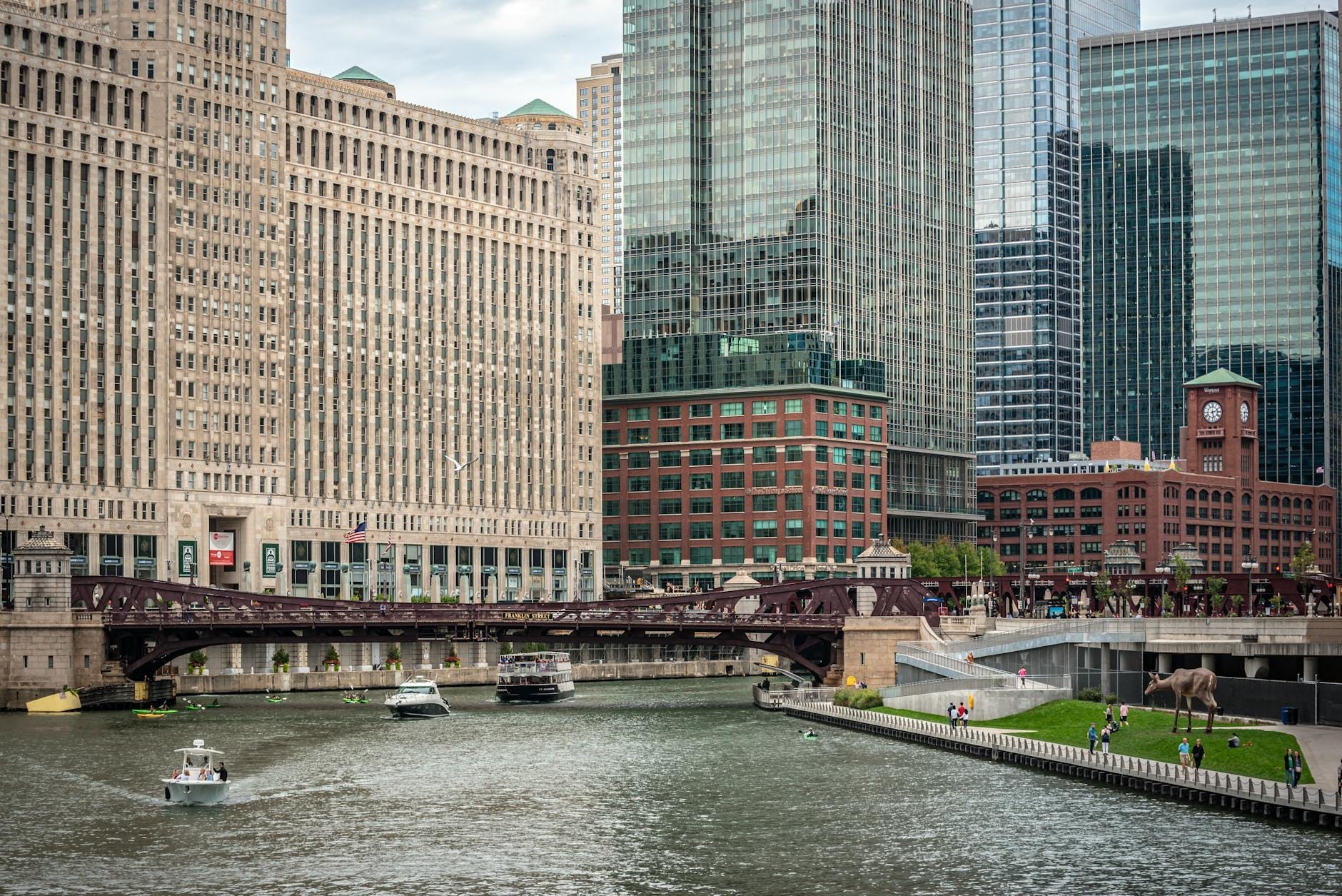
The Merchandise Mart is, simply put, one of the most remarkable buildings in the United States. Opened in 1930 and designed by the firm Graham, Anderson, Probst & White, this 25-story Art Deco tower spans two full city blocks along the north bank of the Chicago River in River North. Its floor area of roughly 4 million square feet made it the largest building in the world when it opened, a title it held until the Pentagon was completed in 1943. Today, officially rebranded as THE MART, it remains one of the largest commercial buildings on the planet and draws close to 10 million visitors per year.
Marshall Field & Company developed the building as a centralized wholesale marketplace, meant to consolidate the city's fragmented trade showroom industry under one enormous roof. The concept worked so well that by the 1940s the Mart had essentially become its own small city, complete with its own ZIP code. The Kennedy family purchased it in 1945 and owned it for over five decades before Vornado Realty Trust acquired it. Today the building houses design and trade showrooms, office space, tech companies, and retail, drawing around 30,000 people on a typical business day.
ℹ️ Good to know
Public access is generally available Monday through Friday during business hours, but the building is not open to the public on weekends. Plan accordingly — a Saturday stroll past the exterior and along the Riverwalk is still worthwhile, but you won't be able to enter.
The Architecture: What You're Actually Looking At
Approaching the Merchandise Mart from the south, whether on foot across the Wells Street Bridge or from a boat on the Chicago River, the sheer scale of the structure takes a moment to register. The limestone-clad facade rises in a series of setbacks typical of late 1920s commercial architecture, with Art Deco detailing concentrated at the upper floors and entrance portals. The two primary facades, the riverfront elevation and the street-facing north side, are monumental in a way that most Chicago skyscrapers are not: instead of competing for height, the building dominates through sheer horizontal mass.
The building pairs well with a broader architectural walk through the area. For context on how it fits into Chicago's larger design story, the Chicago Architecture Center on the south side of the river offers walking tour maps and docent-led programs. If you're arriving by water taxi or on one of the river cruises, the Mart's south facade is one of the most photographed views from the water.
At street level, the building's lobby corridors are wide and high-ceilinged, with original terrazzo floors and bronze fixtures that have survived successive renovations. The proportions give the interior a civic quality, closer to a train station or government building than a conventional office tower. This is intentional: the Mart was conceived as a destination in itself, a place you travel to rather than simply pass through.
Tickets & tours
Hand-picked options from our booking partner. Prices are indicative; availability and final rates are confirmed when you complete your booking.
Go City | Chicago All-Inclusive Pass
From 127 €Instant confirmationFree cancellationiFLY Chicago Lincoln Park indoor skydiving experience
From 126 €Instant confirmationFree cancellationiFLY Chicago Rosemont indoor skydiving tickets
From 117 €Instant confirmationFree cancellationChicago lakefront neighbourhood bike tour
From 18 €Instant confirmationFree cancellation
What You Can Actually See and Do Inside
For most visitors without trade credentials, access inside the Merchandise Mart is limited to the ground-floor public corridor, the lobby, and the riverfront plaza. That said, these areas are genuinely worth exploring. The main entrance on the north side opens into a broad atrium corridor lined with current tenant directories, building history displays, and rotating art installations. The signage and finishes reflect different eras of renovation, but the bones of the 1930 interior are legible throughout.
The design showrooms on upper floors are primarily reserved for trade professionals — interior designers, architects, and contract buyers. If you work in a design-related field, the MART hosts hundreds of permanent showrooms covering furniture, textiles, lighting, and kitchen and bath fixtures. Some floors are open during major trade events, including NeoCon, the annual commercial interiors trade show held each June, which temporarily expands public access considerably.
💡 Local tip
If you're a design professional or visiting during a trade event like NeoCon, register in advance on the official site. Pre-registered visitors often gain access to upper floors that are otherwise restricted to the public.
The ground-floor retail tenants change over time but have included food vendors and coffee shops oriented toward the building's large daily workforce. On weekday mornings, the main corridor functions almost like a transit hub, with thousands of office workers and showroom staff moving through. This is actually one of the more interesting times to visit if you're interested in how the building functions as a working urban organism.
The Riverfront Plaza and Surrounding Context
The south side of the Merchandise Mart faces the Chicago River directly, and the exterior plaza along the water is one of the more understated viewpoints in the city. Eight bronze busts mounted on pedestals line the facade at river level. Known as the Merchandise Mart Hall of Fame, they were installed in 1953 and depict retail industry figures including Marshall Field, Edward Filene, and others chosen by polling at the time. It's an odd and specific piece of public art that most passersby miss entirely.
The plaza connects directly to the Chicago Riverwalk, which runs east toward Michigan Avenue and the Loop. In warm weather, the section of Riverwalk immediately south of the Mart is a good spot to photograph the building's river facade with decent light in the afternoon. The Wells Street Bridge overhead is a functional bascule bridge and adds texture to the urban scene.
Looking across the river from this vantage point, you get a compressed view of the River North skyline and the transition toward the Loop. The surrounding blocks are dense with office towers and mixed-use development, but the Mart's horizontal scale still sets it apart visually from everything around it.
Best Time to Visit and What to Expect
Weekday mornings between 9:00 am and 11:00 am offer the most activity inside the building, with the main corridor at its most purposeful energy. If a quieter exploration is the goal, midday on a Tuesday or Wednesday tends to thin out. Avoid arriving close to 5:00 pm; building access ends promptly and evening commuter traffic around the Merchandise Mart CTA station can be heavy.
Weather affects the exterior experience more than the interior. In winter, the riverfront plaza can be very cold and windy, given the building's orientation. The Riverwalk sections nearby may have limited activation in January and February. For a full picture of how this stretch of the river behaves seasonally, the Chicago lakefront and riverfront guide has practical seasonal advice.
Summer and early fall are ideal for combining a Merchandise Mart visit with the Riverwalk and surrounding River North streets. The light on the river-facing facade is best in the mid to late afternoon when the sun swings west. Photographers should note that the full south elevation is difficult to capture without a wide-angle lens given the building's horizontal span.
⚠️ What to skip
The building is generally not open to the public on weekends or public holidays. If your Chicago trip falls on a weekend-only schedule, plan to see the exterior and riverfront plaza, but don't expect interior access.
Getting There and Practicalities
The Merchandise Mart CTA station sits directly adjacent to the building's north entrance, served by the Brown and Purple Lines. This is one of the few elevated rail stations in Chicago that deposits you almost at a building's front door. From the Loop, the ride on the Brown Line takes about four to six minutes between Clark/Lake and Merchandise Mart. Rideshare drop-off works well on Kinzie Street to the north or Wells Street to the east.
The building is walkable from many River North hotels and from the Magnificent Mile corridor to the east. For a first-time visitor combining several downtown attractions in a day, pairing the Merchandise Mart with the Riverwalk and nearby landmarks like Marina City makes for a compact and architecturally rich half-day route.
Parking garages are located within the building and nearby, but given the direct rail access, driving is rarely the most practical option. There are no bag check facilities in the public areas, so travel light if you're combining this stop with a full day of sightseeing.
Accessibility: As a continuously occupied major commercial building, the Mart has elevator access and modern infrastructure throughout the publicly accessible areas. Visitors with specific mobility or accessibility requirements should contact building management in advance to confirm routes to specific showrooms or events, as individual tenant spaces vary.
Insider Tips
- The eight bronze busts in the Merchandise Mart Hall of Fame on the river-facing plaza are a genuinely unusual piece of American retail history. Read the plaques — the selection criteria from the 1953 voting process are printed there and tell you a lot about mid-century American commerce.
- The Brown Line Merchandise Mart station has one of the better elevated views of the river from its platform as trains curve in from the north. It's a brief but memorable urban panorama before you descend to street level.
- If you're visiting during NeoCon in June, register in advance at themart.com. The trade show opens multiple design floors that are otherwise inaccessible, and it's one of the most concentrated exposures to contract interior design available anywhere in North America.
- For the best exterior photograph of the river-facing facade, cross to the south bank of the Chicago River and shoot from the Riverwalk looking north, ideally 90 minutes before sunset in summer when the limestone picks up warm light.
- The ground-floor corridor connects through the building from north to south, making it a useful shortcut between Kinzie Street and the Riverwalk during business hours — and a chance to take in the building's scale without any particular agenda.
Who Is Merchandise Mart For?
- Architecture enthusiasts who want to understand Chicago's commercial building heritage beyond the skyscraper catalog
- Design professionals seeking access to showrooms or planning a NeoCon visit
- History travelers interested in how a single building shaped American wholesale trade in the 20th century
- Riverwalk walkers looking for a natural midpoint with real architectural context
- Photographers working on Chicago's river corridor and looking for foreground scale against the skyline
Nearby Attractions
Other things to see while in River North:
- House of Blues Chicago
Tucked inside the iconic Marina City complex on North Dearborn Street, House of Blues Chicago is one of the city's most recognizable live music venues, hosting up to 1,400 guests across multiple event spaces. From intimate club nights to full-scale concerts, it draws a wide range of acts and crowds in the heart of River North.
- Intuit Art Museum
The Intuit Art Museum (IAM) is one of Chicago's only institutions dedicated entirely to intuitive, outsider, and self-taught art. After a $10 million renovation, the museum reopened on May 23, 2025 with expanded galleries and a sharper identity. It's a quieter, more contemplative stop than the city's blockbuster institutions, and that's precisely its appeal.
- River North Gallery District
The River North Gallery District is Chicago's densest concentration of commercial art galleries, occupying converted warehouses and loft buildings around Superior and Franklin Streets. Born from a 1970s real estate reinvention, it once rivaled Manhattan as the top gallery hub in the country and remains a serious destination for art collectors and curious visitors alike.