Luna Park Stadium: Buenos Aires' Grand Art Deco Arena
Standing since 1932, Luna Park Stadium is one of South America's most storied indoor arenas. Its art deco facade, central location, and capacity of around 9,300 make it the setting for major concerts, boxing matches, and theatrical productions. The venue is currently undergoing renovation, so checking current status before any visit is essential.
Quick Facts
- Location
- Av. Eduardo Madero 420/470, San Nicolás, Buenos Aires
- Getting There
- Subte Line B (Leandro N. Alem) or Line E (Correo Central); multiple bus lines on Av. Madero and Corrientes
- Time Needed
- 1–3 hours for an event; exterior viewing typically takes under 5 minutes
- Cost
- Ticket prices vary by event and are listed in ARS on TicketPortal. No general admission while the venue is in recess.
- Best for
- Architecture lovers, live music fans, boxing history, and those curious about Buenos Aires' cultural heritage
- Official website
- lunapark.com.ar
What Is Luna Park Stadium?
Luna Park Stadium, known officially as Estadio Luna Park, is a large-format indoor arena at Av. Eduardo Madero 420/470 in the San Nicolás district of central Buenos Aires. Opened in 1932, it holds roughly 9,200 people and sits at the crossroads of the city's financial core and its waterfront, placing it within easy reach of most of the centro area.
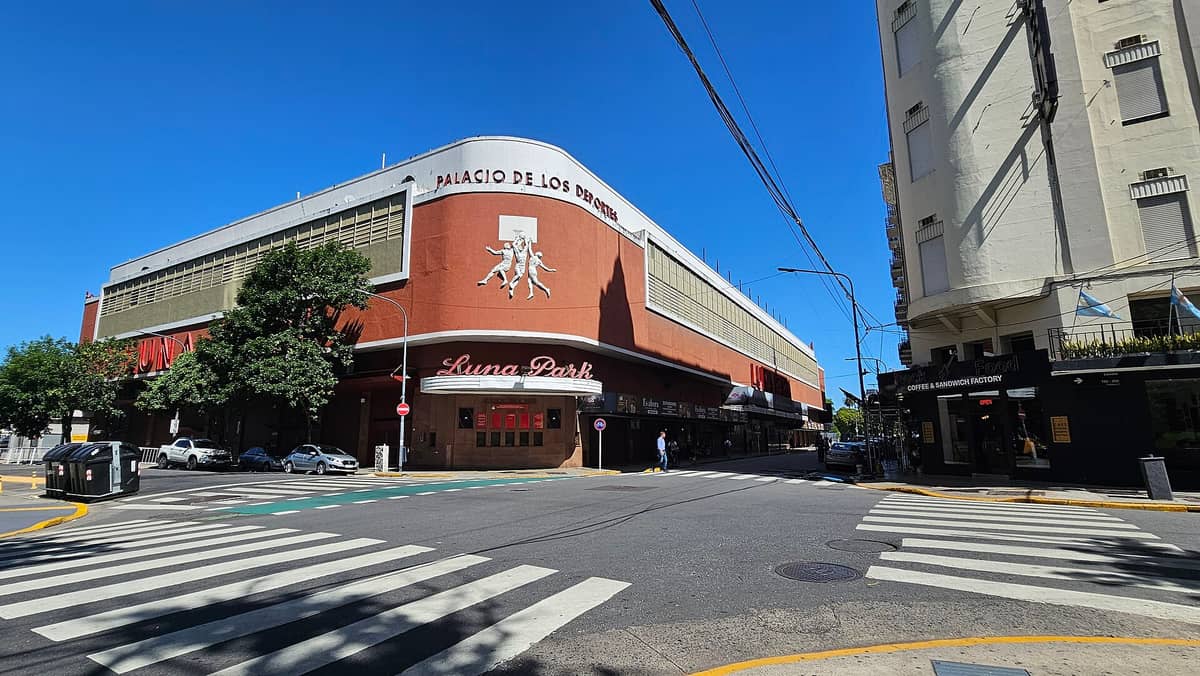
The building is frequently compared to New York's Madison Square Garden, not just in function but in form: its restrained art deco exterior, with geometric mouldings and a strong horizontal silhouette, reads as serious and purposeful rather than decorative. It occupies an entire city block, and its sheer mass is noticeable even in a neighborhood of large buildings.
Luna Park is not a museum or a tourist attraction in the conventional sense. It is a working events venue, or was until it closed for renovation in January 2025. Anyone arriving with the expectation of wandering freely inside will be disappointed. The exterior, however, is worth a few minutes of attention, particularly if you are already walking along Avenida Corrientes or heading toward Puerto Madero.
⚠️ What to skip
Luna Park closed for a recess period on 14 January 2025, with no confirmed reopening date published at the time of writing. Check the official site at lunapark.com.ar before planning any visit or purchasing tickets.
A History Worth Knowing
Luna Park was built in 1932, during a decade when Buenos Aires was investing heavily in large-scale public infrastructure and commercial architecture. The city was growing fast, its middle class was expanding, and there was appetite for large entertainment venues that could host sport and spectacle under one roof. The stadium filled that gap immediately.
For most of the 20th century, Luna Park was the premier indoor venue in Argentina. Boxing was central to its identity: some of the most significant fights in Argentine boxing history took place here, and the venue became shorthand in popular culture for high-stakes competition. Later it absorbed rock concerts, classical performances, wrestling events, and theatrical productions, making it genuinely cross-genre in a way few venues achieve.
One detail that surprises many visitors: this is where Juan Perón first met Eva Duarte in January 1944, at a charity event organized for earthquake victims in San Juan. That encounter, now part of Argentine political mythology, happened in the same building you are looking at. For anyone following the story of Evita across the city, Luna Park is a quietly significant stop.
The broader Buenos Aires architecture scene from this period is worth understanding if you want to read the building correctly. The city has an unusually high concentration of early 20th-century European-influenced design, and Luna Park fits into that arc. For more context, the Buenos Aires architecture guide covers the wider picture.
Tickets & tours
Live prices and dates from our booking partner. If you book, we may earn a commission at no extra cost to you.
Tour to La Boca Jrs and River Plates Stadiums and museums
From 99 €Instant confirmationFree cancellationRiver Stadium and Museum Official Guided Tour
From 33 €Instant confirmationFree cancellationBuenos Aires Stadiums tour Boca Juniors and River Plate
From 54 €Instant confirmationFree cancellationMadero Tango Show tickets with optional dinner
From 32 €Instant confirmationFree cancellation
The Exterior: What You See From the Street
The building wraps around a full city block between Av. Eduardo Madero, Bouchard, Lavalle, and Av. Corrientes. Seen from the Corrientes end, the facade has the weight of something designed to endure. The art deco detailing is not exuberant: you will not find the gilded flourishes of, say, a Parisian department store. Instead it is about proportion, clean lines, and the visual effect of a building that knows exactly what it is.
At midday, when the light comes from the north and catches the stone facade head-on, the relief work above the main entrances reads clearly. Early mornings and late afternoons produce longer shadows that give the geometric mouldings more depth. On event nights, exterior lighting and the gathering crowd transform the block into something considerably more animated: queues form along Bouchard, vendors work the sidewalk, and you can hear the low, contained roar of crowd noise from outside.
The accessible entrances are located at Av. Madero 470, Bouchard 499, Bouchard 465, and Bouchard 412, which means the building can be observed from multiple street angles. Walking the perimeter takes roughly five minutes and gives a complete picture of the structure's scale.
Attending an Event: What to Expect
When Luna Park is operating, events range from international touring acts and Argentine rock legends to boxing nights and theatrical productions. The seating configuration changes by event: some shows use the floor for standing, others assign all seats, and the sightlines from the upper tiers vary considerably depending on the stage position. Checking the specific event map when buying tickets is not optional; it genuinely affects your experience.
Acoustics inside the venue are decent for a space of this age and size, though the building was not designed with modern concert amplification in mind. Mid-tier seats in the fixed bleachers generally offer a better balance of sound and sightlines than extreme floor positions. The venue gets warm during packed events, particularly in Buenos Aires' summer months from December to February, when temperatures outside already sit in the high 20s Celsius.
💡 Local tip
Buy tickets through the official site or TicketPortal to avoid inflated resale prices. The ticket office at the stadium (when active) operates Monday to Friday 10:00–19:00, Saturday 12:00–19:00, and Sunday and holidays from 16:00 only if an event is scheduled. Service fees apply online.
Doors typically open 60 to 90 minutes before the listed start time for major events. Arriving at door-open rather than show-start saves queuing time and gives you a chance to find your section without the crowd pressure. The neighborhood around the venue has several cafes and bars on Corrientes within a short walk, making a pre-show drink straightforward.
Getting There
Luna Park sits in one of the most accessible parts of Buenos Aires. The nearest metro stops are Leandro N. Alem on Subte Line B and Correo Central on Line E, both within a comfortable five-to-ten minute walk. Multiple bus lines serve Av. Madero and the surrounding streets. If you are staying anywhere in the Microcentro or Monserrat area, the stadium is walkable from most locations.
Ride-hailing apps and radio taxis drop off easily on Bouchard or Av. Madero, though post-event pickups require moving a block or two away from the main exits to find clear road space. The SUBE card covers all Subte and bus journeys; picking one up on arrival in Buenos Aires is strongly recommended. More detail on moving around the city is in the getting around Buenos Aires guide.
The Renovation: Current Status and What It Means for Visitors
Luna Park shut its doors on 14 January 2025 for a full renovation. The official website describes this as a recess period before a complete reopening ('periodo de receso para volver pronto totalmente renovado'), but no confirmed date for resumption of events has been announced publicly at the time of writing.
This matters practically: if you are in Buenos Aires and hoping to attend an event here, check lunapark.com.ar and local event listings before adding this to your itinerary. The exterior remains viewable from the street and is worth seeing on a walk through the centro, but the experience of actually being inside the stadium is not currently available.
If live music or large-scale events are a priority during your trip, Buenos Aires has other major venues operating in the interim. The renovation is also a reasonable reason to return to the city once completed: a fully restored Luna Park, with 90 years of cultural weight behind it, will likely be a significantly improved experience compared to its pre-closure state.
ℹ️ Good to know
Luna Park is located near the boundary between the Microcentro and Puerto Madero. A walk from the stadium to the waterfront takes about ten minutes and makes for a natural extension of any visit to this part of the city.
Who Should Skip This Attraction
Travelers with no interest in live events, boxing history, or 20th-century urban architecture will find little reason to go out of their way for Luna Park. The building is not open for guided tours, and the interior is only accessible on event nights. If you are in the area anyway, the five-minute exterior walk-around is low-cost and informative. If you would need to divert from your route specifically to see it, save that energy for something with a guaranteed payoff.
Visitors primarily interested in architectural history will find richer, more accessible examples nearby, including Palacio Barolo and Galería Güemes, both of which allow interior access.
Insider Tips
- The corner of Av. Corrientes and Bouchard gives the clearest unobstructed view of the building's full scale and is the best position for exterior photography, especially in the late afternoon when the light hits the stone facade at an angle.
- Event nights in Buenos Aires often start later than the listed time. Argentine audiences typically arrive 20 to 40 minutes after the official opening, so the 'doors open' window is genuinely useful rather than just formality.
- Ticket resellers operate around the block before popular events. Prices are higher than face value and there is no recourse if the ticket is invalid. Stick to the official box office or TicketPortal.
- The Perón-Evita connection to this building is not marked with any plaque or signage, but knowing it changes how the building reads. If that history interests you, the Museo Evita in Palermo covers the broader story in detail.
- After an event, the fastest exit from the neighborhood is the Subte rather than trying to hail a cab on the main streets, which fill quickly with departing crowds. Head one block away from the main exit before looking for a ride.
Who Is Luna Park Stadium For?
- Live music and concert-goers wanting to experience a venue with genuine South American history
- Architecture enthusiasts with an interest in 1930s art deco design in urban contexts
- Fans of Argentine boxing or sports history
- Travelers following the Perón and Evita trail through Buenos Aires
- Anyone already exploring the Microcentro or walking toward Puerto Madero who wants context for a significant building on their route
Nearby Attractions
Other things to see while in Microcentro & Monserrat:
- Avenida Corrientes
Avenida Corrientes is the cultural backbone of central Buenos Aires, a long avenue lined with independent bookshops, mid-century theatres, and late-night pizzerias. Free to walk at any hour, it rewards visitors who linger past midnight as much as those who arrive at noon.
- Avenida de Mayo
Stretching 1.35 km through the heart of Buenos Aires, Avenida de Mayo connects the seat of government at Plaza de Mayo to the National Congress. Inaugurated in 1894 and declared a National Historic Site in 1997, it remains the city's most architecturally dense corridor — free to walk, open at all hours, and best explored at a deliberate pace.
- Cabildo de Buenos Aires
Standing at the western end of Plaza de Mayo, the Cabildo de Buenos Aires is where Argentina's independence process began in May 1810. Today it operates as the Museo Nacional del Cabildo de Buenos Aires y de la Revolución de Mayo, offering free admission and a carefully curated look at colonial-era governance and revolutionary history. Few buildings in the country carry this much political and architectural weight.
- Café Tortoni
Founded in 1858 on Avenida de Mayo, Gran Café Tortoni is the oldest continuously operating café in Buenos Aires. Its marble counters, stained-glass ceilings, and literary history make it one of the city's most photographed interiors — though the lines outside and tourist-oriented service mean expectations need calibrating before you walk in.
Planning a trip? Discover personalized activities with the Nomado app.