Lou Kau Mansion: Inside Macau's Most Elegant Qing-Era Courtyard House
Built in the late 19th century and free to enter, Lou Kau Mansion is one of Macau's finest examples of traditional Chinese courtyard architecture. Located steps from Senado Square, this two-storey grey-brick residence offers a rare glimpse into the domestic world of a wealthy Macanese merchant family, away from the crowds of the main heritage trail.
Quick Facts
- Location
- No. 7, Travessa da Sé, Macau Peninsula (Sé/Cathedral district)
- Getting There
- 2–5 min walk from Senado Square; numerous bus routes stop nearby at Largo do Senado
- Time Needed
- 30–60 minutes
- Cost
- Free admission
- Best for
- Architecture lovers, history enthusiasts, travellers seeking quiet heritage sites
- Official website
- www.wh.mo/LouKau/en/content.aspx?page=visitInfo
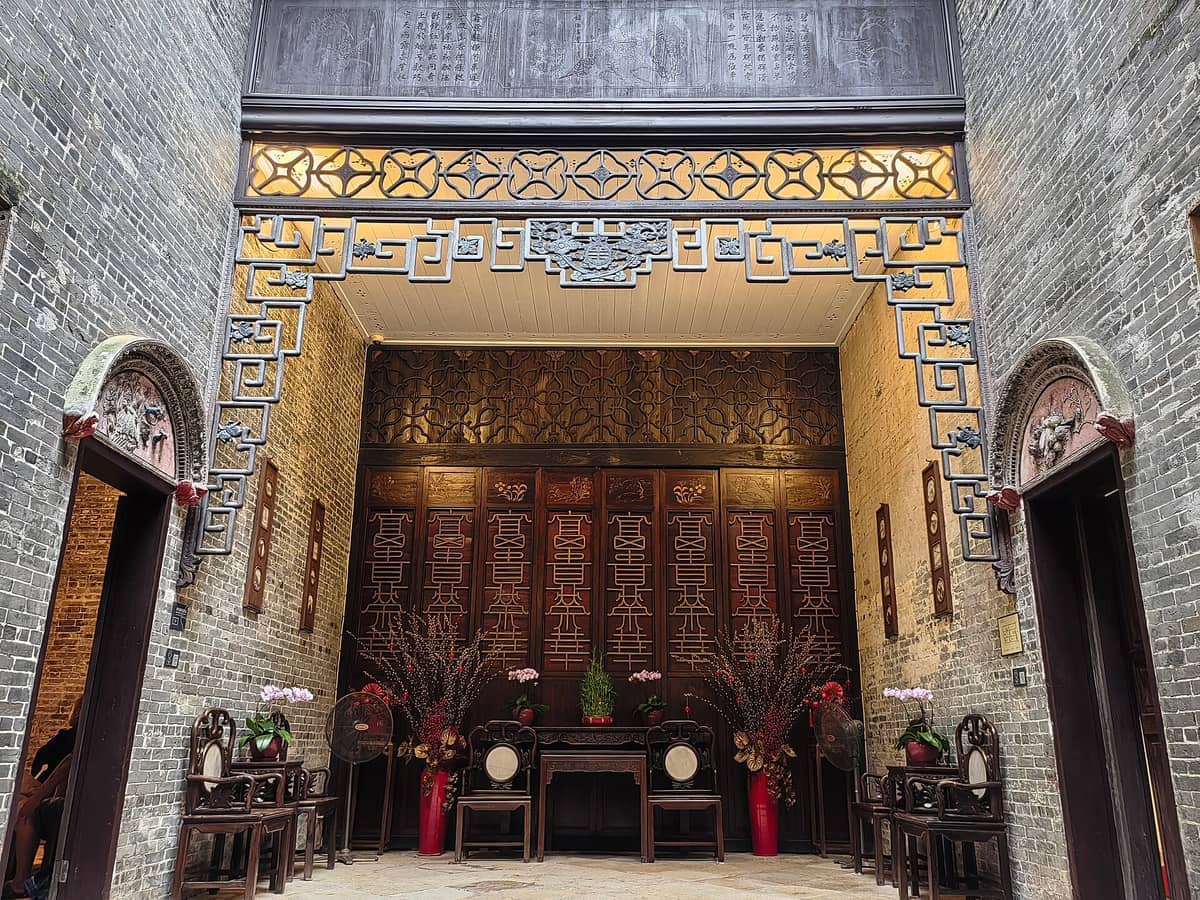
What Lou Kau Mansion Actually Is
Lou Kau Mansion, officially known as Casa de Lou Kau, is a two-storey, traditional grey-brick courtyard house dating from the late 19th century, built as the private residence of the Lou Wa Sio (Lou Kau) family, a prominent merchant family in late Qing-dynasty Macau. It sits at No. 7, Travessa da Sé, a narrow lane in the Sé district of the Macau Peninsula, a short walk from Senado Square but far enough removed from the main tourist corridor to feel genuinely quiet.
The mansion is part of Macau's UNESCO-listed Historic Centre and is managed by the Cultural Affairs Bureau. Admission is free, and guided public tours in Cantonese and Mandarin are available on-site on weekends and public holidays in groups of up to ten visitors. It opens Tuesday through Sunday, 10:00 to 18:00, with last admission at 17:30, and is closed on Mondays except on public holidays.
💡 Local tip
Arrive between 10:00 and 11:30 on weekdays if you want the courtyard largely to yourself. By early afternoon on weekends, guided tour groups from the main heritage trail begin to filter through.
The Architecture: What You're Actually Looking At
The mansion is a textbook example of traditional Cantonese domestic architecture, specifically the courtyard-house typology common among prosperous merchant families in the Pearl River Delta region during the late 19th century. The exterior is characterised by plain grey brick, deliberately understated in the Cantonese tradition where wealth was rarely displayed outwardly. The contrast with Macau's Portuguese Baroque churches nearby is striking and intentional: this is a building that operated by entirely different aesthetic rules.
Inside, the spatial logic unfolds around a central skywell, an open courtyard that funnels light and ventilation into the interior rooms. Carved timber screens partition the main reception hall from the family quarters. The decorative vocabulary mixes southern Chinese motifs with subtle European flourishes, a quiet architectural reflection of Macau's colonial reality at the time. Look carefully at the lattice screens and the painted friezes near the ceiling: the craftsmanship repays close attention rather than a quick scan.
The two-storey structure follows a hierarchical room arrangement typical of its period: formal spaces for receiving guests at the front, more private family quarters receding toward the rear. The proportions feel intimate rather than palatial, which makes it easier to understand as a home rather than a monument.
The Experience at Different Times of Day
The mansion's interior lighting changes significantly across the day. In the morning, natural light drops through the skywell and reaches the stone floor of the courtyard at a low angle, picking out the texture of the carved stonework in a way that afternoon light does not. This makes the first two hours after opening the best time for photography and for understanding the architectural intentions of the building.
By midday, the courtyard fills with direct overhead light. The rooms flanking it become comparatively dim, and the contrast between sunlit and shaded areas becomes harsh. Afternoon visits are still worthwhile but the interior feels flatter. Late afternoon, particularly in the hour before last admission, sees the light warm again and visitor numbers typically thin out after tourist groups have moved on.
Sound matters here more than at most historic buildings. Travessa da Sé is a quiet lane. Once inside, the ambient noise from central Macau drops away entirely. What you hear instead is the occasional murmur from the guided tour group, footsteps on stone, and the particular silence of a courtyard designed to hold it. That quality of quiet, rare anywhere in Macau's urban core, is one of the mansion's genuine assets.
Practical Walkthrough: Navigating the Site
The mansion is a short walk from St. Dominic's Church and Senado Square. From the square, head toward the Cathedral (Sé) and follow the lane signs. The entrance is modest and easy to miss: look for the dark-brick facade and the heritage signage at street level.
Entry is free. If a guided tour is running when you arrive, you may need to wait for a slot, as groups are capped at ten visitors. The tours are conducted in Cantonese or Mandarin. If you do not speak either language, the visual and architectural experience is fully accessible without commentary, and the site is compact enough to navigate independently in under an hour.
There are no cafes, shops, or luggage facilities on-site. The rooms are not heavily furnished: interpretation is provided through informational panels and, where available, period objects and reproductions. Wear comfortable shoes with flat soles. The stone floors in the courtyard can be uneven in places, and the interior staircases are original and steep by modern standards.
⚠️ What to skip
The official page for Lou Kau Mansion does not confirm wheelchair accessibility. Visitors with mobility limitations should contact the site directly before visiting, as the historic structure may present barriers.
Historical Context: Who Was Lou Kau?
The Lou (or Luo) family were among the significant Chinese merchant families operating in Macau during the late colonial period. The mansion was built in 1889, a decade when Macau was still formally a Portuguese overseas territory and the Pearl River Delta was in the final decades of Qing rule. Wealthy Chinese merchants in this era occupied an interesting social position: prosperous enough to build substantial family compounds, operating within a colonial administrative system, and navigating cultural pressures from both Chinese tradition and European influence.
That dual cultural pressure is readable in the architecture itself. The house follows the spatial logic of Cantonese domestic tradition, but the decorative details show awareness of the colonial visual environment. It is a smaller-scale but more intimate version of the kind of cultural negotiation you see in grander form at the Mandarin House, another historic residence on the Peninsula that belonged to the family of Chinese literary figure Zheng Guanying.
Understanding Lou Kau Mansion alongside other heritage sites on the Peninsula gives a richer picture of Macau's social history. The Macau heritage walk connects several of these sites in a logical sequence, and Lou Kau Mansion fits naturally into that route.
Photography and What to Focus On
The mansion photographs well in the morning. The skywell is the compositional anchor: stand at the rear of the courtyard looking toward the entrance to frame the latticed screens, the stone floor, and the rectangle of sky above. A wide-angle lens or a phone camera in standard mode handles the space without distortion. Avoid using flash; the ambient light is sufficient and flash flattens the texture of the timber and stone.
The carved timber screens reward close-up work. The interplay of shadow within the lattice is different at every hour. If you are carrying a longer lens, use it on the painted friezes near the upper walls, where the detail is too fine to read clearly from floor level. Tripods are a practical option if you visit early and the rooms are empty, but check with staff on arrival as policies can vary.
ℹ️ Good to know
Macau's autumn months, October through December, offer lower humidity and softer light. If architectural photography is a priority, these months produce noticeably better results than the hazy summer period.
Who This Is and Isn't For
Lou Kau Mansion is not a large or dramatic attraction. If you are expecting the grand scale of the Ruins of St. Paul's or an immersive museum experience with extensive English-language interpretation, this site will feel modest. The rooms hold limited furnishings, and the absence of English-language guided tours means some context is lost for international visitors.
What the mansion offers is something harder to find in Macau's historic centre: a quiet, well-preserved domestic space that makes the human scale of 19th-century merchant life tangible. For travellers with an interest in architecture, material culture, or Chinese domestic history, that is a meaningful experience. For travellers primarily interested in sightseeing spectacle or entertainment, the thirty to forty minutes here could reasonably be allocated elsewhere.
The site pairs well with other free or low-cost heritage attractions nearby. The Leal Senado Building and Holy House of Mercy are both within easy walking distance and together form a coherent half-day heritage circuit in the Sé district without spending anything on admission.
Insider Tips
- The lane outside, Travessa da Sé, is quieter than the main heritage routes and worth walking slowly in both directions. The surrounding block has several well-preserved grey-brick shophouses that most visitors walk past without stopping.
- Guided tours are capped at ten people. If you arrive and a tour is about to begin with space available, joining it even without full Cantonese or Mandarin comprehension allows access to areas that may not be self-guided, and the architectural gestures the guide points to are readable without language.
- The courtyard skywell is the best spot in the mansion in terms of light and composition. Take time to stand still there rather than moving quickly through the rooms. The space is designed to be experienced from that central position.
- Closed on Mondays except on public holidays. This is when most government-managed heritage sites in Macau take their rest day. Plan your heritage walk route around this if you are visiting on a Monday, and prioritise the mansion on any other day of the week.
- Combine this visit with the nearby Na-Tcha Temple and the section of the old city wall immediately behind St. Paul's for a morning that covers both the Portuguese colonial and traditional Chinese layers of the UNESCO Historic Centre without backtracking.
Who Is Lou Kau Mansion For?
- Architecture and design enthusiasts interested in Cantonese domestic building traditions
- Travellers building a free heritage day in Macau's historic centre
- Photographers looking for interior architectural subjects with natural light
- History-focused visitors who want context beyond the Portuguese colonial narrative
- Couples or solo travellers seeking a quieter alternative to the main tourist sites
Nearby Attractions
Other things to see while in Macau Peninsula:
- A-Ma Temple (Ma Kok Miu)
A-Ma Temple, known locally as Ma Kok Miu, is the oldest temple in Macau, with origins traced to 1488. Part of the UNESCO-listed Historic Centre of Macao, this atmospheric complex blends Taoist, Buddhist, Confucian, and folk traditions across six distinct halls climbing Barra Hill. Entry is free, and the site remains an active place of worship year-round.
- Camões Grotto and Casa Garden
Tucked into the northwest of the Macau Peninsula, Camões Grotto and Casa Garden form one of the city's most layered heritage sites. The park honors Portugal's greatest poet in a setting of banyan trees and rocky outcrops, while the adjacent 18th-century mansion carries the architectural weight of colonial trade history. Both are free to enter and rarely crowded.
- Dom Pedro V Theatre
The Dom Pedro V Theatre (Teatro Dom Pedro V) is the oldest Western-style performance venue in East Asia, completed in 1860 and — though normally a working venue — temporarily closed for renovation until early October 2026. Its pale green neoclassical facade on Largo de Santo Agostinho is one of the most photogenic and historically layered corners of the Macau Peninsula, and admission is free when it is open to visitors
- Fortaleza do Monte (Mount Fortress)
Fortaleza do Monte, built between 1617 and 1626, rises above the historic centre of Macau with cannon-lined ramparts, sweeping 360-degree views, and the acclaimed Macao Museum within its walls. For the price of a cup of coffee, or nothing at all on free days, this UNESCO-listed site delivers more history per square metre than almost anywhere else in the city.