Little Venice, London: The Calm Canal Quarter Worth Seeking Out
Little Venice is the peaceful junction where the Regent's Canal meets the Paddington Arm of the Grand Union Canal, forming a wide lagoon lined with moored narrowboats and white Regency stucco. Free to visit and easy to reach from Paddington or Warwick Avenue, it rewards anyone looking for a quieter side of central London.
Quick Facts
- Location
- City of Westminster, north of Paddington — centred on Browning's Pool at the junction of the Regent's Canal and the Grand Union Canal (Paddington Arm)
- Getting There
- Warwick Avenue (Bakerloo line, ~5-min walk) or Paddington (multiple lines, ~10-min walk via canal exit)
- Time Needed
- 45 minutes to 2 hours, depending on whether you add a boat trip or canal walk
- Cost
- Free to explore; canal boat trips and the puppet theatre charge their own fares — check operators for current prices
- Best for
- Leisurely walks, canal photography, a calm break from central London crowds
- Official website
- www.visitlondon.com/things-to-do/place/401228-little-venice
What Little Venice Actually Is
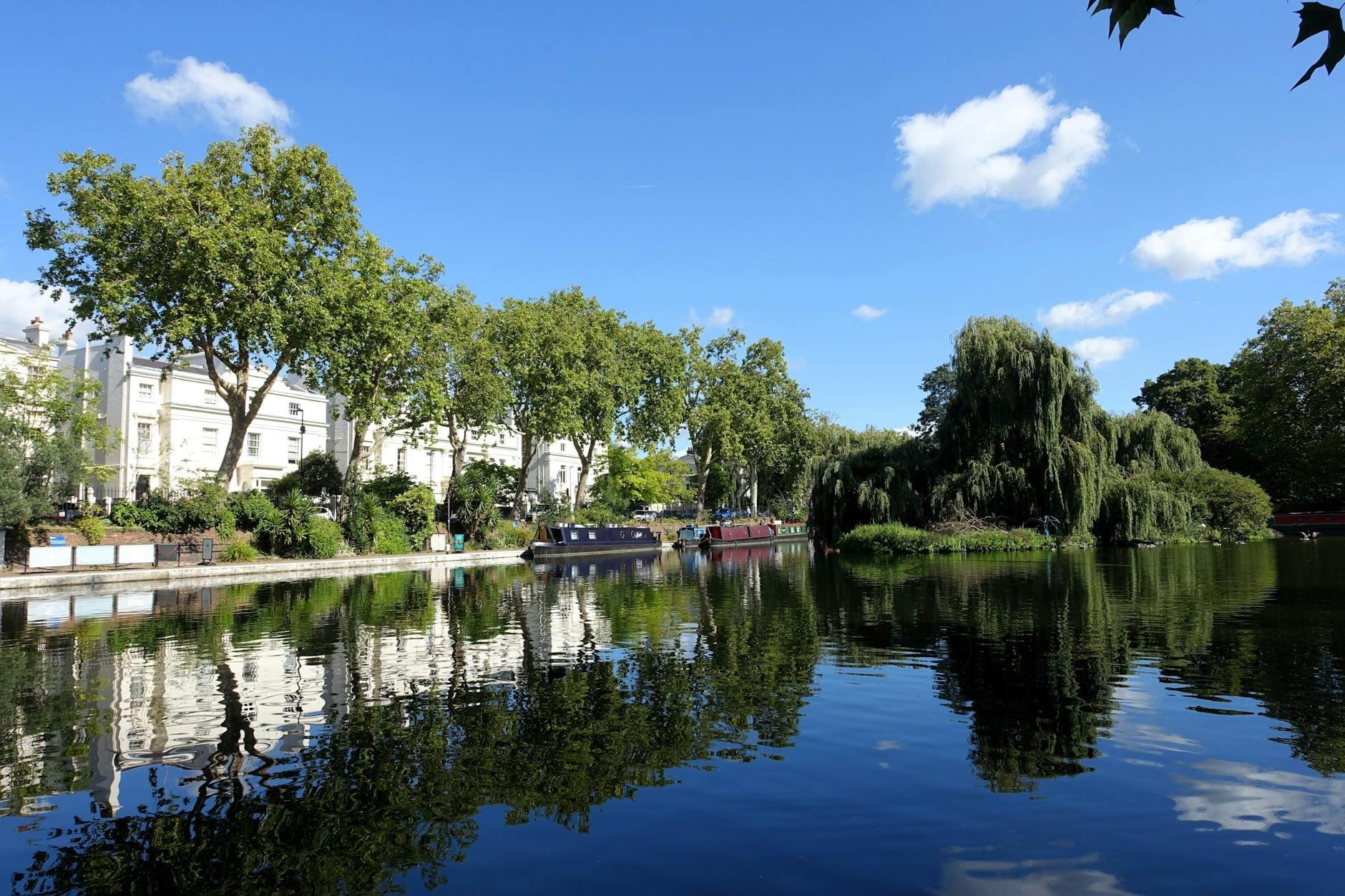
Little Venice is the informal name for a residential canal quarter in the City of Westminster, where the Regent's Canal and the Paddington Arm of the Grand Union Canal converge into a broad tree-fringed lagoon known officially as Browning's Pool. The name only entered popular use in the 1950s, despite the area's distinctive character having been established long before that, as the surrounding Regency white stucco terraces and mansion blocks were built mainly in the 19th century.
The comparison to Venice is more poetic than architectural: there are no grand palazzi here, and the waterway is modest in scale. What earns the nickname is mood rather than grandeur — the reflections of painted narrowboats on still water, weeping willows trailing the surface, and the almost conspicuous absence of traffic noise once you step down onto the towpath. For a neighbourhood sitting within a ten-minute walk of Paddington station, the quiet is surprising.
💡 Local tip
Get off at Warwick Avenue (Bakerloo line) rather than Paddington for the most atmospheric approach — you arrive via a broad tree-lined avenue that deposits you almost directly onto Rembrandt Gardens and the water's edge.
The Sensory Experience: What to Expect on the Ground
The first thing you notice walking down Warwick Avenue toward the canal is a shift in the air quality, a slight coolness rising from the water even in summer, carrying a faint smell of damp stone and rope. The narrowboats — many of them permanent residences rather than hire boats — are painted in deep greens, reds, and navy blues, decorated with hand-painted roses and geometric panels in a tradition that goes back to working canal boats of the 18th and 19th centuries.
Rembrandt Gardens, the small public park on the western bank of the lagoon, provides the classic view: a curve of moored boats reflected in the pool, white stucco facades rising beyond the trees on the opposite bank. There are benches here, and on weekday mornings you share them mainly with dog walkers and people reading the paper. The sounds are water lapping against hulls, occasional birdsong from the willows, and the distant rumble of Paddington — far enough away to feel theoretical.
The towpaths on both the Regent's Canal side and the Grand Union Arm are walkable and largely flat, though surfaces can be narrow and uneven in places. Some sections have low bridges requiring you to duck. Cyclists also use the paths, so pay attention, particularly on the wider Regent's Canal stretch heading east toward Camden.
Tickets & tours
Hand-picked options from our booking partner. Prices are indicative; availability and final rates are confirmed when you complete your booking.
London Little Venice exploration game and tour
From 12 €Instant confirmationFree cancellationSoho Instagram a self-guided walking tour to top photo spots
From 6 €Instant confirmationFree cancellationTootbus London by Night: Bus tour
From 32 €Instant confirmationFree cancellationIFS Cloud Cable Car Ride and Uber Boat Hop-on Hop-off 1 Day Ticket
From 38 €Instant confirmationFree cancellation
How the Area Changes Through the Day
Early mornings, roughly 7am to 9am, are the best time to photograph the lagoon. The light is low and golden, the water often flat calm before any boat movement disturbs the surface, and the area is almost entirely empty of tourists. You may see boat residents starting their day, putting out a kettle, or tending a rooftop plant box. This is when Little Venice feels most like a neighbourhood rather than an attraction.
By mid-morning on weekends, particularly in spring and summer, the area sees a noticeable uptick in visitors. Delamere Terrace, the canal-side walkway on the north bank, fills with brunch crowds heading to the cafés and pubs that line it. The towpath toward Rembrandt Gardens becomes a stream of strollers, photographers, and families waiting for the canal boat trips that operate from the area. It is never overwhelmingly crowded by central London standards, but the solitude of the early hours disappears.
Autumn afternoons bring a different quality entirely. The plane trees along the towpaths turn a deep amber-yellow, leaves settling on the water's surface, and the lower afternoon sun catches the painted boat sides at a flattering angle. The light fades quickly past 4pm in October and November, but the lamplit towpath in early evening has its own character. Winter mornings, particularly after frost, when the moored boats carry a light icing of ice on their roofs, are worth the cold for photographers willing to make the effort.
Canal Boat Trips and the Puppet Theatre
Several operators run canal boat trips from Little Venice, with a popular route running east along the Regent's Canal through Regent's Park to Camden Lock. The journey takes you through the long Maida Hill Tunnel — a narrow, low-ceilinged Victorian bore where the boat's engine echoes loudly and the only light comes from the far end — before emerging into the open stretches toward the park. It is a different perspective on central London, seen from water level through a cutting in the urban fabric.
Check individual operator websites for current fares and timetables, as these vary by season. If you plan to continue to Camden, the boat trip pairs naturally with exploring Camden Market before returning by Tube — a satisfying half-day loop.
Moored on the water at the pool is the Puppet Theatre Barge, a converted narrowboat that has operated as a floating puppet and marionette theatre since the 1980s, running performances primarily for children and families during the October-to-June season. It moves to different Thames moorings in summer, so check current scheduling before planning a visit around it. When it is present, it adds considerably to the area's atmosphere: the sight of a boat with a marquee sign advertising a marionette show does not get less charming on repeat viewing.
Walking the Towpaths: Where to Go from Here
Little Venice functions well as a starting point for a longer canal walk rather than a standalone destination. Heading east along the Regent's Canal, you pass through Regent's Park and reach Camden Lock in roughly 3 to 4 kilometres — a flat, largely traffic-free route that shows a side of London entirely different from the tourist centre. The towpath is publicly accessible and free throughout.
Heading west along the Paddington Arm takes you away from the tourist circuit entirely, into quieter residential stretches of west London, eventually connecting to the broader Grand Union Canal network. This direction is less visited and more industrial in character as you move further out, but the first kilometre or two, past well-tended garden boats and converted canalside buildings, is pleasant walking.
For those building a full day in the area, Paddington itself is a ten-minute walk south and connects easily to west London destinations. If you are travelling with children, the walk east toward London Zoo in Regent's Park, reached via the canal towpath, makes for an excellent low-effort route that sidesteps the Tube entirely.
Historical and Cultural Context
The junction at what is now Little Venice was formed when the Regent's Canal opened in 1820, connecting the Paddington Arm of what is now the Grand Union Canal (opened to Paddington in 1801) east to the Thames at Limehouse. At its peak, the canal carried freight through the heart of London, including coal, building materials, and goods for the capital's markets. By the late 19th century, railway competition had begun to undermine commercial canal traffic, and the waterway shifted gradually toward pleasure use.
The poet Robert Browning lived near the pool during the second half of the 19th century, and the lagoon's informal name Browning's Pool reflects that association. The term Little Venice itself has often been (probably mistakenly) attributed to Browning, although there is no firm evidence he used it, and the name only became widely used in London vernacular from the 1950s onward.
The surrounding residential streets of Maida Vale and the stucco terraces of Warwick Avenue represent some of the finest intact late-Regency and early-Victorian townscape in London. If you appreciate this period of domestic architecture, the area forms a natural companion to Kensington Palace and its surrounding streets, where similar stucco architecture dominates.
Practical Information: Getting There, Getting Around
The simplest approach is Warwick Avenue station on the Bakerloo line — a five-minute walk south along Warwick Avenue brings you directly to the canal at Rembrandt Gardens. From Paddington, the walk takes closer to ten minutes: exit toward the canal using the Grand Union Canal exit (clearly signed) and follow the towpath north. Buses 6, 46, and 187 all serve the area.
There is no parking lot or dedicated visitor facility. The area is a working residential neighbourhood with street parking subject to Westminster City Council restrictions. Arriving by Tube or on foot from Paddington is more practical, not just more environmentally sound.
The towpaths are step-free for the most part, making them accessible for pushchairs and wheelchair users, though surfaces are occasionally uneven and narrow sections exist near some bridges. Individual venues — boat trip operators, the Puppet Theatre Barge, waterside cafés — will have their own accessibility arrangements, so check directly with them if this is a concern.
⚠️ What to skip
In wet weather, the towpath surfaces become slippery, particularly on older brick and stone sections. Wear shoes with grip if visiting after rain, and be aware that low bridges over the canal path require ducking in a few places.
Little Venice is a pleasant stop on a broader west-central London day. Consider combining it with Hyde Park to the south or building it into a canal walk that ends at Camden — a route covered in various London walking tour itineraries.
Who Might Not Enjoy It
Visitors expecting grand visual spectacle or a densely packed list of things to see inside should look elsewhere. Little Venice has no museum, no ticketed landmark, and no single unmissable sight. The appeal is entirely ambient: water, boats, trees, white stucco, relative calm. Travellers on a short London trip who are prioritising major historic attractions will likely find the journey-to-payoff ratio uncompelling compared to Westminster or the South Bank.
The area also works better in reasonable weather. On a grey, wet November afternoon, the towpaths lose much of their charm, the café terraces are empty, and the boats are simply boats in the rain. Morning visits in good weather, or the golden light of a late spring or early autumn afternoon, are when Little Venice earns its name most convincingly.
Insider Tips
- Walk the ten minutes from Paddington rather than taking the Tube to Warwick Avenue — the approach through the canal-exit corridor at Paddington station and the first stretch of towpath are themselves worth seeing, and you avoid the backtrack to the station afterward.
- The north bank walkway along Delamere Terrace gets sun in the morning; Rembrandt Gardens on the opposite bank catches the afternoon light. Plan your visit time accordingly for the best photography angles.
- Several of the moored narrowboats operate as floating cafés and shops. These are informal and vary — some are open only on weekends or intermittently — but stopping at one for a coffee is a more memorable experience than the café chains on Warwick Avenue above.
- The Maida Hill Tunnel, encountered on the eastbound canal boat trip, is a canal engineering structure completed in 1816. It is around 272 metres long, low-ceilinged, and dark inside — a brief but atmospheric experience that is easy to miss if you only explore the area on foot.
- If you visit during the Canalway Cavalcade festival, typically held on the May Bank Holiday weekend, the lagoon fills with decorated and dressed narrowboats and the area hosts waterborne activities, live music, and craft stalls — the busiest and most colourful the area gets all year.
Who Is Little Venice For?
- Photographers looking for calm water reflections, painted narrowboat details, and Regency street scenes away from standard tourist circuits
- Families combining a canal boat trip with a walk to Regent's Park or the Zoo via the towpath
- Walkers using Little Venice as the western starting point for the Regent's Canal towpath route to Camden
- Travellers arriving at or departing from Paddington with an hour to spare before their train
- Anyone wanting a genuine residential neighbourhood atmosphere rather than a curated attraction
Nearby Attractions
Combine your visit with:
- Abbey Road
The Abbey Road zebra crossing in St John's Wood is one of the most photographed stretches of tarmac in the world, immortalised by the Beatles on the cover of their 1969 album. Entry is free, it's accessible around the clock, and the Grade II listed studios next door still operate as a working recording facility. Here's everything you need to know before you visit.
- Alexandra Palace
Perched on one of north London's highest ridges, Alexandra Palace is a Grade II-listed Victorian landmark that combines a 196-acre park, a restored theatre, a year-round ice rink, and a live music venue. Entry to the park is free, and the views across the city stretch further than almost anywhere else at ground level.
- Dulwich Picture Gallery
Opened in 1817, Dulwich Picture Gallery is Britain's first purpose-built public art gallery, designed by Sir John Soane and housing over 600 European masterpieces. Set in the quiet streets of Dulwich Village, it offers a rare combination of architectural beauty, world-class paintings, and a unhurried atmosphere that larger central London galleries rarely manage.
- Hampton Court Palace
Hampton Court Palace stands on the banks of the River Thames in East Molesey, Surrey, roughly 30 minutes by train from central London. With Tudor kitchens, baroque state apartments, a famous hedge maze, and 60 acres of formal gardens, it offers more depth than almost any other royal site in England. This guide covers everything you need to plan a visit well.