Lake Merritt: Oakland's Historic Tidal Lagoon and Urban Park
Lake Merritt is a 155-acre tidal lagoon in the heart of Oakland, designated in 1870 as the United States' first official wildlife refuge. Free to explore, circled by a mostly flat paved path, and easily reached by BART, it offers a genuine cross-section of East Bay life that no curated attraction can replicate.
Quick Facts
- Location
- Lakeside Park & Wildlife Refuge, central Oakland, CA (just east of Downtown Oakland)
- Getting There
- Lake Merritt BART station, then a short walk northwest toward the lake
- Time Needed
- 1.5 to 3 hours for the full loop; longer if you visit gardens or rent a boat
- Cost
- Free to walk the perimeter; boat rentals and some facility fees apply
- Best for
- Joggers, picnickers, birdwatchers, families, and day-trippers from San Francisco
- Official website
- www.lakemerritt.org/
What Lake Merritt Actually Is
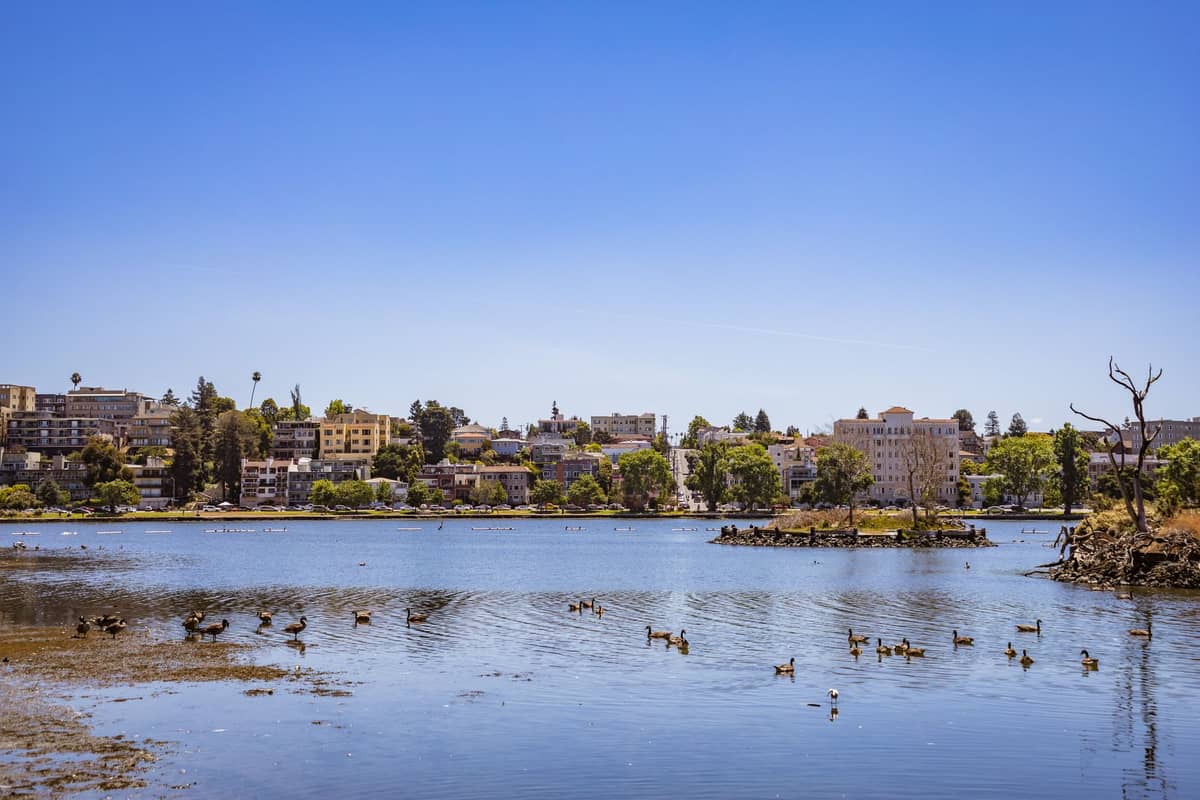
Lake Merritt is not a lake in the conventional sense. It is a tidal lagoon, connected to San Francisco Bay by a narrow channel, which means the water level shifts with the tides and the shoreline has a salt-tinged edge rather than the muddy softness of a freshwater shore. The lagoon covers roughly 155 acres in central Oakland, placing it squarely in the middle of a dense urban grid. The neighborhoods of Grand Lake, Lakeshore, and Adams Point press in from the north and east. The effect is that of a natural pause inside a city, rather than a park bolted onto its edge.
In 1870, Lake Merritt was designated the United States' first official wildlife refuge, a fact that still carries weight when you see the Canada geese waddling along the grass or a great blue heron standing motionless in the shallows. The lagoon itself was shaped in the late 1860s when Oakland's mayor, Samuel Merritt, had the former San Antonio Slough dammed to create a more defined salt-water body. The lake bears his name to this day.
ℹ️ Good to know
Lake Merritt is in Oakland, not San Francisco. From downtown SF, take BART to Lake Merritt station (roughly 20-25 minutes). The lake is a short walk northwest of the station. No car needed.
The Experience: What You Actually Encounter
The 3.4-mile perimeter path around the lake is almost entirely paved and flat, which makes it approachable for nearly everyone. On a weekend morning, the path fills with a genuine cross-section of Oakland: runners with earbuds, older couples walking in pairs, parents pushing strollers, people doing tai chi in the grass at the northern end near Lakeside Park. The pace is easy and unhurried. On weekday mornings, the crowd thins considerably and the birds become more conspicuous.
The light on the water changes significantly depending on the time of day and season. Early morning, particularly in autumn when the fog burns off quickly, produces a glassy surface that reflects the line of trees at Lakeside Park. By midday in summer, the glare off the water can be stark and the path gets busy. Late afternoon, especially in September and October, is when the light turns amber and sits low on the downtown skyline to the west, making the walk around the southern edge particularly rewarding for photographers.
The wildlife is not incidental. Migratory birds use the lagoon as a stopover during Pacific Flyway migrations, and resident populations of geese, ducks, cormorants, and herons are visible year-round. The northern section near the wildlife refuge area sees the most bird activity. Do not expect a remote wilderness experience; the birds here are habituated to people, which actually makes for better close observation.
Tickets & tours
Hand-picked options from our booking partner. Prices are indicative; availability and final rates are confirmed when you complete your booking.
Sonoma and Napa Valley wine tour from San Francisco
From 127 €Instant confirmationFree cancellationGo City | San Francisco Explorer Pass
From 76 €Instant confirmationFree cancellationMuir Woods and Sausalito guided tour with transportation
From 82 €Instant confirmationFree cancellationSan Francisco CityPASS
From 77 €Instant confirmationFree cancellation
Navigating the Perimeter: A Practical Walkthrough
Most visitors start near the southern end of the lake, either arriving from the Lake Merritt BART station or parking along Lakeside Drive. The southern shore is the most urban-feeling section, with the downtown skyline close behind you. Walking counterclockwise puts Lakeside Park on your right as you round the northern end.
Lakeside Park, along the northern shore, is where most of the park infrastructure sits. The Lake Merritt Boating Center rents small boats when conditions allow (fees apply; verify current hours and rates directly with the center before visiting). Nearby, the Rotary Nature Center offers a small natural history exhibit relevant to the lagoon's ecology. The garden areas here are planted and maintained, offering shade on warm days.
The eastern side of the lake passes through quieter residential neighborhoods. The path remains paved and level throughout. The Grand Lake neighborhood, at the northeastern corner, has a cluster of cafes and restaurants along Grand Avenue, which makes for a natural mid-walk rest stop. If you time it right, the Grand Lake Farmers Market runs on Saturday mornings nearby at Splash Pad Park.
💡 Local tip
For the best combination of light, cooler temperatures, and thinner crowds, arrive at the lake between 7am and 9am on a weekday. The southern end near Lakeshore Avenue also has street parking that fills quickly on weekends.
Historical and Cultural Context
The designation of Lake Merritt as the country's first wildlife refuge in 1870 is an important piece of American conservation history and predates the establishment of the National Wildlife Refuge System by more than three decades. That early protection still shapes how the lagoon is managed and tends to get overlooked in favor of more dramatic landscapes elsewhere in California.
The lake and its surrounding neighborhoods have long been central to Oakland's civic identity. Lakeside Park has served as a public gathering space for well over a century, hosting community events, protests, and everyday recreation. The necklace of lights strung around the lake perimeter, illuminated at night, has been a visual landmark for generations of Oakland residents. The combination of history, ecology, and urban character gives the lake a layered quality that rewards attention.
Oakland sits across the bay from San Francisco, and visitors exploring the wider Bay Area sometimes underestimate how much the East Bay offers. Lake Merritt is a practical argument for crossing the bay. For those building an itinerary that includes both cities, the day trips from San Francisco guide covers the Oakland side of the bay in more detail.
Getting There from San Francisco
BART is the most direct connection from San Francisco to Lake Merritt. Trains from downtown SF stations (Montgomery, Powell, Civic Center) on the Blue or Green lines reach Lake Merritt station in roughly 20-25 minutes, depending on origin. From the station, the lake is a short walk northwest, reachable in under 10 minutes on foot. Verify current BART fares and schedules at bart.gov, as prices are distance-based and subject to change.
Driving is an option but adds the complication of finding parking around the lake on weekends, when street spots along Lakeshore Avenue and Grand Avenue fill quickly. There is some parking along Lakeside Drive, but it is not guaranteed. For a day trip from San Francisco, BART is the more reliable choice.
If you are coordinating a broader East Bay or Bay Area visit, the guide to getting around San Francisco includes practical information on using BART across the bay.
Weather, Seasons, and When to Visit
Oakland's climate is generally warmer and sunnier than San Francisco's, with less marine fog due to its position east of the bay. September and October are typically the warmest and clearest months across the Bay Area, and this holds for Lake Merritt as well. Autumn light on the lagoon is particularly good, with lower sun angles and less midday haze.
Summer (June through August) is mild but can be overcast, especially in the morning. The lake path is popular year-round, but summer weekends bring the largest crowds, particularly to Lakeside Park. Winter visits between November and March are entirely viable; rainfall is more likely, but the lake itself has its own atmospheric quality under grey skies, and the birdwatching is often excellent during migratory periods. Bring a layer regardless of season, as the waterfront can be breezy.
⚠️ What to skip
After heavy rain, some low-lying sections of the path near the tidal channel can be muddy or temporarily flooded. The main paved perimeter path generally drains well, but check conditions if visiting during or shortly after significant rainfall.
Who Should Manage Their Expectations
Lake Merritt is an urban park, not a wilderness retreat. If you are seeking solitude or a remote natural experience, this is not it. The path is shared with cyclists, joggers, and dog walkers. The surrounding neighborhood is visible and audible throughout the walk. On sunny weekends, the southern lawn areas near the Grand Avenue end get crowded with picnickers and amplified music.
It is also worth noting that, like many urban parks in American cities, Lake Merritt has seen periodic issues with litter, particularly after large weekend gatherings, and visitors should approach it with realistic expectations for a city park rather than a manicured attraction. The city and local organizations including the Lake Merritt Institute actively work on maintenance and restoration, but conditions vary.
For visitors who want a more structured outdoor experience with dramatic scenery and greater solitude, the Lands End Trail and San Francisco's hiking options offer compelling alternatives within the broader Bay Area.
Insider Tips
- The necklace of lights encircling the lake is switched on at dusk and creates a distinct visual effect after dark. A short evening walk along the southern path, with the lights reflecting on the water and the downtown skyline behind them, is worth the trip on its own.
- The Grand Lake Farmers Market on Saturday mornings runs along Grand Avenue at the northeastern edge of the lake. Timing your walk to end there gives you a practical reason to stop and a good selection of local food vendors.
- Birdwatching is best in the early morning at the northern end near the wildlife refuge area. Bring binoculars if you have them. The mix of migratory and resident species is genuinely impressive for a city setting.
- The Lake Merritt BART station has multiple exits. Use the exit most directly oriented toward the lake if you want the shortest walk to the southern end.
- Avoid the lake path on Sunday afternoons in warm weather if you prefer a quieter experience. The crowds around the southern lawn area near Splash Pad Park can be significant and the noise level rises accordingly.
Who Is Lake Merritt (Oakland) For?
- Joggers and walkers who want a flat, paved 3.4-mile loop with consistent scenery
- Birdwatchers, particularly during autumn and spring migration periods
- Families with young children looking for open green space and the option of boat rentals
- Day-trippers from San Francisco wanting a genuine neighborhood experience in the East Bay
- Photographers interested in urban landscape work, especially in early morning or late afternoon autumn light
Nearby Attractions
Combine your visit with:
- 16th Avenue Tiled Steps
The 16th Avenue Tiled Steps Project is a community-made mosaic staircase of 163 steps stretching through San Francisco's Golden Gate Heights neighborhood (a sub-area of the Inner Sunset), depicting a journey from the ocean floor to the night sky. It's free, photogenic, and connects to one of the city's best lesser-known hilltop viewpoints.
- Angel Island State Park
Angel Island State Park sits in the middle of San Francisco Bay, offering miles of hiking trails, layers of military and immigration history, and 360-degree views of the city skyline, Marin headlands, and beyond. Getting there requires a ferry, which is part of the appeal — the island feels removed from city life, even though San Francisco is visible the entire time.
- Asian Art Museum of San Francisco
One of the largest Asian art collections in the Western world, housed in a transformed Beaux-Arts landmark at Civic Center. From ancient Chinese bronzes to contemporary Southeast Asian installations, the museum rewards careful visitors who know what to look for.
- UC Berkeley Campus
The University of California, Berkeley sits on a hillside above San Francisco Bay, offering free access to striking Beaux-Arts architecture, landmark museums, and open green spaces. A short BART ride from San Francisco, it rewards curious visitors with history, intellectual energy, and some of the best campus scenery in the country.