Kouter Square and the Sunday Flower Market: Ghent's Living Tradition
Every Sunday morning, Kouter Square transforms into a sea of cut flowers, potted plants, and seasonal blooms that spill across one of Ghent's oldest public squares. Free to enter, relaxed in pace, and rooted in centuries of market tradition, it offers a side of Ghent that medieval towers and museum queues cannot.
Quick Facts
- Location
- Kouter, 9000 Ghent (Gent), Belgium — within the historic centre low-emission zone
- Getting There
- Walkable from Graslei and Korenmarkt (10–12 min on foot); served by De Lijn tram and bus network. Single ride €3, contactless payment accepted.
- Time Needed
- 30–60 minutes for the flower market; longer if you linger at terrace cafés
- Cost
- Free to enter. You pay only for flowers or plants you buy.
- Best for
- Slow-travel mornings, photography, local atmosphere, budget-friendly sightseeing
- Official website
- visit.gent.be/en/calendar/flower-market
What Kouter Square Is
Kouter Square sits in the southern edge of Ghent's historic centre, a broad, paved oblong that today serves as a public promenade, café terrace strip, and weekly market ground. Its early modern role as a formal promenade for the bourgeoisie dates from the 17th century, when the square was increasingly used as a walking space. Before that, the area was called Peerdenkouter and hosted horse markets during Lent from at least the 14th century, alongside Sunday livestock sales. In the 18th and early 19th centuries, military activities were held here and the square was known as Place d'Armes, reflecting a harder-edged phase in its history.
Today, none of that tension survives. The Kouter is unhurried and civic in character. Café terraces line the western and southern edges. On most days, local florists maintain stalls that open from around 07:00 and often run into the early afternoon, giving the square a gentle commercial pulse even outside the main Sunday market. The real event, though, is Sunday.
The Sunday Flower Market: What to Expect
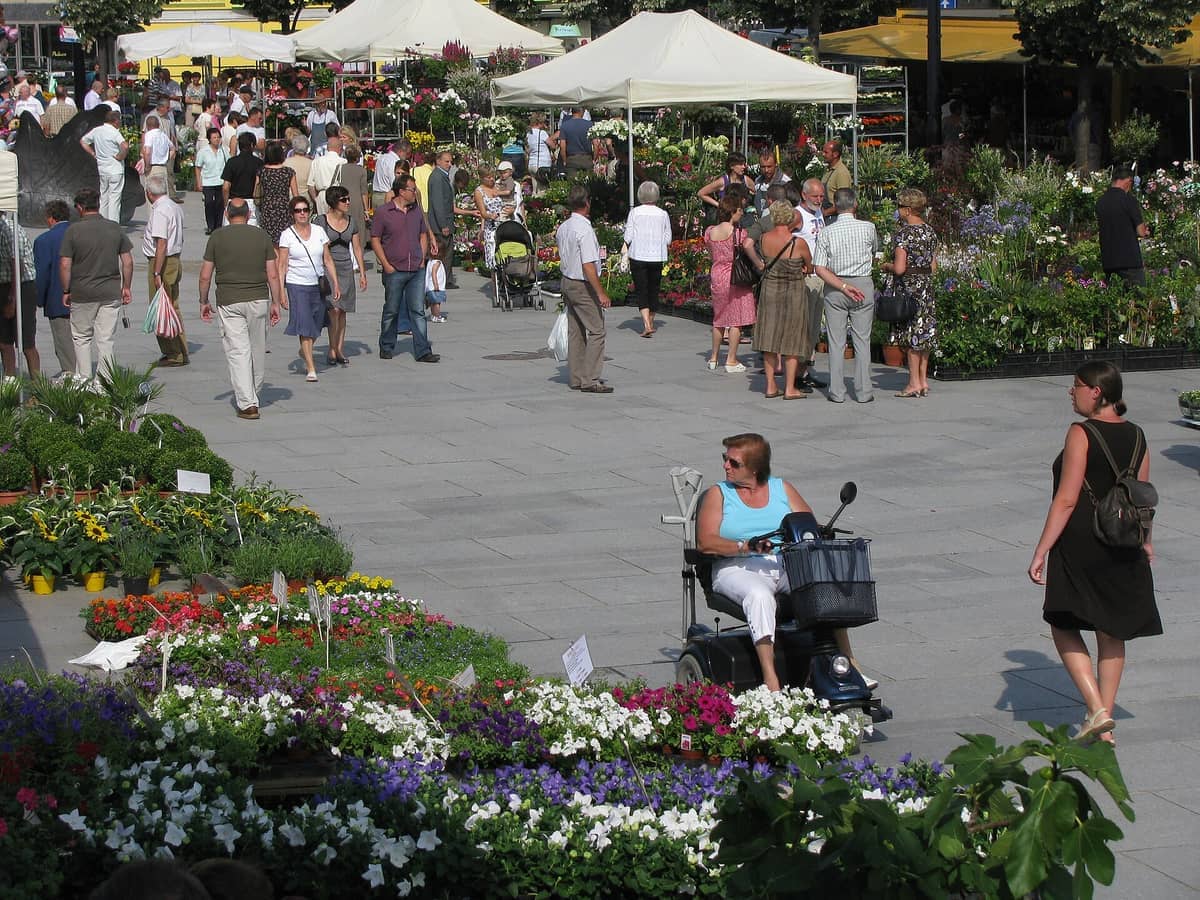
The Bloemenmarkt Kouter runs every Sunday morning, typically from around 07:00 to 13:00. Stalls fill the square from its northern end southward, sellers arriving well before opening to arrange their displays. By 09:00, the scene is in full swing: buckets of cut flowers organized by color, flat-back trucks with open sides loaded with potted seasonal plants, and vendor stalls offering everything from houseplants to herb seedlings. In spring, tulips and hyacinths dominate. In summer, the palette shifts toward sunflowers, dahlias, and hanging baskets. Autumn brings chrysanthemums and ornamental cabbages.
The smell is one of the market's more immediate pleasures. Fresh-cut stems, damp soil, and the faint green tang of bruised foliage combine into something that reads as genuinely plant-world rather than floral-perfume-counter. On cooler mornings, vendors' breath mists in the air around the outdoor displays. There is nothing particularly curated or Instagram-staged about it. This is a working market for Ghent residents who want flowers for the week.
💡 Local tip
Arrive between 08:30 and 09:30 for the best selection and before the square fills with strollers. By 11:30, vendors begin packing some unsold stock and the atmosphere thins. The market largely winds down around 13:00.
The flower market tradition at Kouter has been documented since 1772, making it one of the oldest continuous market customs in the city. That context is easy to miss when you are standing among tables of pansies, but it is worth holding onto: this square has been a place of commerce and public gathering for over 600 years.
Tickets & tours
Hand-picked options from our booking partner. Prices are indicative; availability and final rates are confirmed when you complete your booking.
Historic Ghent city exploration game
From 10 €Instant confirmationFree cancellationBelgian waffle making workshop and beer tasting in Ghent
From 45 €Instant confirmationFree cancellationTaste of Ghent private chocolate walking tour
From 256 €Instant confirmationFree cancellationSips and stories, a private beer tour in Ghent
From 373 €Instant confirmationFree cancellation
The Square Beyond the Market
On non-market days, the Kouter reads differently. Without stalls filling the open space, the square's physical proportions become more apparent. It is genuinely wide and flat, which is slightly unusual by Ghent standards — most of the city's historic centre works on a more compressed medieval scale. The surrounding architecture is predominantly 18th and 19th century townhouses and commercial buildings, built during the periods when the square served as a promenade for the professional classes.
The café terraces along the perimeter operate year-round, with outdoor seating taking over the pavement in warmer months. In summer, the terrace activity extends into the early evening and the Kouter functions as an informal outdoor living room for the neighbourhood. This is not primarily a tourist destination on weekday afternoons: you will find more Ghent residents than visitors, more grocery bags than camera straps.
From the Kouter, it is a 10-minute walk north to Graslei and Korenlei, the medieval waterfront that forms Ghent's most recognizable skyline. To the east, the Vrijdagmarkt is another large historic square with its own distinct market history. The Kouter and Vrijdagmarkt together give a good sense of how Ghent's public life has historically organized itself around a handful of large open spaces rather than a single central plaza.
Photography at Kouter
For photography, the Sunday flower market offers accessible material that does not require any particular skill with crowds or low light. The best light falls in the earlier part of the morning, particularly in spring and autumn when the sun angle is low enough to give warmth and shadow to the flower arrangements. Overcast days can work equally well for close-up shots: the soft diffusion removes harsh shadows from petals and shows color saturation at its fullest.
The square itself is mostly flat and open, which limits dramatic compositional depth unless you use the surrounding buildings as backdrop. Wider shots work well from the northern end of the square, with the rows of stalls receding into the mid-ground. For tips on photographing Ghent's squares, markets, and canal views, the Ghent photography guide covers the best angles across the city.
💡 Local tip
Ask vendors before photographing close-up portraits. Most are friendly and unbothered by cameras pointed at their displays, but direct eye-contact shots of people at work are courteous to request first.
Getting There and Practical Notes
Kouter Square is in Ghent's historic centre within the city's low-emission zone (LEZ). If you are arriving by car, check whether your vehicle qualifies under the current LEZ regulations before driving in — non-compliant vehicles face fines. For most visitors, arriving by foot or tram is easier. De Lijn trams and buses serve the surrounding streets; Ghent's tram network connects the main railway station, Gent-Sint-Pieters, to the city centre in roughly 10 to 15 minutes. Single tickets cost €3, and contactless payment via bank card, phone, or smartwatch is accepted on board.
From the Graslei waterfront, the walk to Kouter takes about 10 to 12 minutes through quiet backstreets south of the medieval core. If you are combining the flower market with a broader morning in the historic centre, a Ghent walking tour itinerary can link the Kouter to Gravensteen, the Belfry, and the waterfront in a logical half-day loop.
The square is paved and level, making it straightforwardly accessible for pushchairs and wheelchair users. Market stalls are typically arranged with enough space between rows for comfortable movement, though on busy Sunday mornings some gaps narrow. The daily market generally starts around 07:00 and can run into the afternoon, but stall hours can vary by vendor and season — check locally if you are making a specific trip on a non-Sunday.
⚠️ What to skip
The Sunday flower market runs from approximately 07:00 to 13:00. Arriving after 12:00 means catching vendors in pack-up mode and a much reduced selection. Public transport frequency can be lower on Sunday mornings, so factor in extra travel time from the station.
Weather, Seasons, and Honest Caveats
Ghent has an oceanic climate. Rain is possible in any month, and Sunday mornings in October through February can be cold, wet, and grey. The flower market runs regardless of weather, and vendors are practiced at staking down wrapping paper and covering arrangements against wind and drizzle. For visitors, a light waterproof jacket and comfortable walking shoes are more useful than an umbrella at a crowded outdoor market.
The best experience tends to come in the shoulder seasons: April through June, and September into early October. Temperatures are manageable, flower variety is at its widest, and the café terraces are open without the summer peak crowds that concentrate near Ghent's more famous medieval sights. For a fuller picture of seasonal timing across the city, the best time to visit Ghent guide breaks down each month with practical context.
The Kouter flower market is genuinely enjoyable in winter too, provided you dress for it. Cold air sharpens the floral scent, the stalls have a particular stillness, and the surrounding café interiors provide immediate warm retreats. What it is not, in any season, is a spectacular set-piece attraction. It is modest in scale and requires no effort to see. Whether that represents good value for limited time depends entirely on what kind of travel you prefer.
Is the Kouter Worth Your Time?
The honest answer is: it depends what you are looking for. If you have one day in Ghent and need to prioritize, the Kouter flower market is a pleasant addition rather than an anchor attraction. It will not compete with the Ghent Altarpiece, the Gravensteen castle, or the Graslei waterfront for the title of unmissable sight. What it does offer is something those places cannot: ordinary Ghent life, conducted at walking pace, with no admission queue and nothing to read.
For travelers who build itineraries around local rhythms — market mornings, neighbourhood cafés, street-level texture — the Kouter on a Sunday fits naturally into a broader morning in the historic centre. It pairs well with a walk to St Michael's Bridge for the classic Ghent skyline view, or with the quieter corners covered in the free things to do in Ghent guide. Travelers focused exclusively on medieval architecture, museum collections, or a tightly compressed one-day schedule may find it easier to pass through Kouter en route to something else rather than treating it as a destination in itself.
Insider Tips
- Buy a small bunch of seasonal cut flowers and keep them in your hotel room water glass — tulips and Dutch-grown blooms from the market are substantially fresher and cheaper than anything from a city-centre florist.
- The café terraces on the western edge of the Kouter are noticeably cheaper than those clustered around Korenmarkt and the tourist waterfront. A coffee and a croissant before or after the market makes for a reasonable and unhurried start to a Sunday in Ghent.
- The square hosts occasional evening events and concerts in summer, particularly during the Gentse Feesten in late July. During festival week, Kouter's character changes completely — check event listings before assuming a quiet market-morning experience.
- The market brings a smaller but consistent set of flower stalls on most days (roughly 07:00 to early afternoon). If Sunday timing does not work for your schedule, a weekday visit still captures some of the market atmosphere with far smaller crowds.
- The low-emission zone covers Kouter. If you are driving a rental car, check the LEZ vehicle category restrictions on the Ghent city website before assuming you can park nearby — fines apply automatically to unregistered vehicles.
Who Is Kouter Square & Flower Market For?
- Slow-travel visitors who prioritize local atmosphere over landmark density
- Photography enthusiasts looking for natural color, texture, and unposed street scenes
- Budget-conscious travelers: the entire experience costs nothing beyond whatever flowers you choose to buy
- Families with young children who appreciate an open, low-pressure outdoor space with visual interest
- Repeat visitors to Ghent who have already covered the major medieval attractions and want to see the city at a different register
Nearby Attractions
Other things to see while in Ghent Historic Centre:
- City Pavilion (Stadshal)
Completed in 2012 by Ghent architects Robbrecht & Daem and Marie-José Van Hee, the Stadshal is a free, open public structure spanning roughly 40 metres at Emile Braunplein, surrounded by the Belfry, Town Hall, and St Nicholas' Church. Whether you pass through at noon or after dark, this latticed wooden canopy changes character with the light and the crowd beneath it.
- Design Museum Gent
Design Museum Gent, founded in 1903 and located in Ghent's historic centre, holds a collection of approximately 22,500 objects tracing applied arts and design from the 18th century to the present day. The museum is currently closed for a major expansion and renovation, but its permanent collection and architectural setting make it one of Ghent's most distinctive cultural institutions., holds a collection of approximately 22,500 objects tracing applied arts and design from the 18th century to the present day. The museum is currently closed for a major expansion and renovation, but its permanent collection and architectural setting make it one of Ghent's most distinctive cultural institutions.
- Castle of Gerald the Devil (Geeraard de Duivelsteen)
Built in the 13th century in Scheldt Gothic style, Geeraard de Duivelsteen is one of the most architecturally striking medieval structures in Ghent. From knight's residence to madhouse to event venue, its layered history is as dramatic as its stone facade. The building is not open for regular walk-in visits, but its exterior and occasional scheduled openings make it essential context for understanding Ghent's medieval character.
- Ghent Altarpiece (Adoration of the Mystic Lamb)
Completed in 1432 by Hubert and Jan van Eyck, the Ghent Altarpiece is a 12-panel polyptych (with paintings on both sides of most wings) housed in St Bavo's Cathedral in Ghent's historic centre. It is one of the most technically advanced and historically significant paintings ever made, and seeing it in person requires a ticket, a timed slot, and some preparation.