Wiener Konzerthaus: Vienna's Premier Concert Hall
Built between 1911 and 1913, the Wiener Konzerthaus is one of Europe's great concert venues, housing four performance halls and a programming calendar that spans classical orchestras, chamber music, contemporary works, and jazz. Unlike the grander Vienna State Opera, the Konzerthaus rewards visitors with a more intimate, less tourist-heavy atmosphere and a genuinely eclectic artistic vision.
Quick Facts
- Location
- Lothringerstraße 20, 1030 Vienna (3rd District, near Schwarzenbergplatz)
- Getting There
- U4 Stadtpark or U1/U2/U4 Karlsplatz; tram lines serve Schwarzenbergplatz and Am Heumarkt
- Time Needed
- 2–3 hours for a concert; allow 30 minutes before doors open to explore the foyer
- Cost
- Varies by event; check konzerthaus.at for current ticket prices. Ticket & Service Center open Mon–Fri 10:00–14:00
- Best for
- Classical music lovers, architecture admirers, couples seeking a refined evening out
- Official website
- konzerthaus.at
What the Konzerthaus Actually Is
The Wiener Konzerthaus is a purpose-built concert complex in Vienna's 3rd district, opened on 19 October 1913. It was designed in the Viennese Secession-influenced late Historicist style by architects Ferdinand Fellner and Hermann Helmer, who also built theaters across the Habsburg Empire. The building sits on a footprint of roughly 70 by 40 meters, and its exterior, with its pale stone facade and decorative ironwork, announces itself as a serious cultural institution without the overwrought pomp of some of its Ringstrasse neighbors.
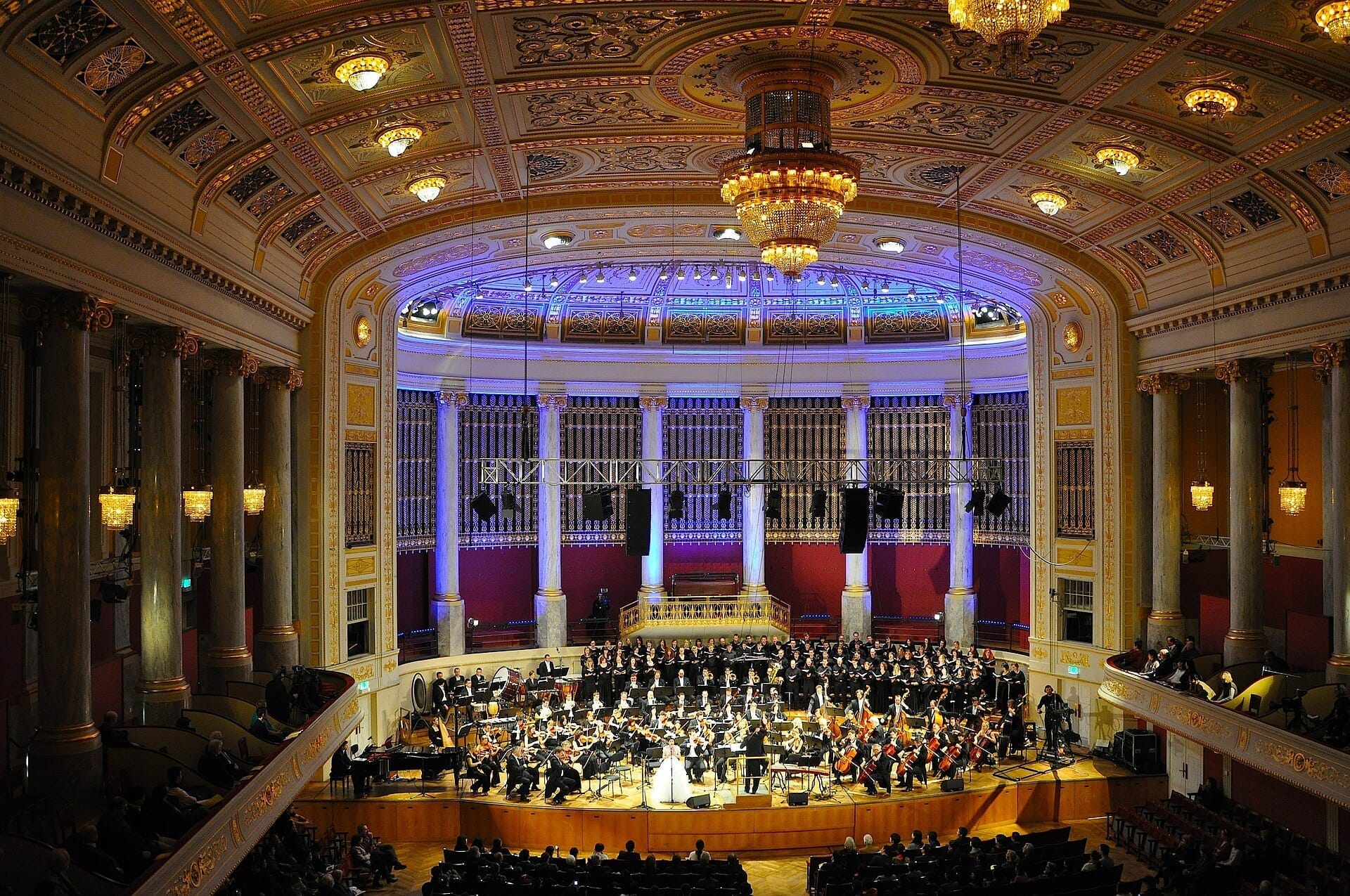
Inside, the complex contains four performance halls: the Großer Saal (Great Hall, 1,865 seats), the Mozart-Saal (704 seats), the Schubert-Saal (366 seats), and the Berio-Saal (around 400 seats, 340 m²). This variety is part of what distinguishes the Konzerthaus from single-hall venues. On any given evening, a symphony orchestra might be performing in the Great Hall while a string quartet plays in the Mozart-Saal and a contemporary music ensemble occupies the Berio-Saal. The programming is intentionally diverse, which means the audience on any night is a mix of season subscribers, curious tourists, and serious music students.
The building underwent a major renovation between 1998 and 2000 that updated acoustics, accessibility, and backstage facilities while preserving the original interior character. The Konzerthaus is distinct from the Vienna State Opera, which focuses on opera and ballet. The Konzerthaus is primarily a concert venue, though its program extends well beyond the classical canon.
💡 Local tip
Ticket prices and availability vary significantly by event. The Ticket & Service Center is open Monday to Friday, 10:00–14:00, and is closed on weekends and public holidays. The evening box office opens one hour before each performance. Book in advance via konzerthaus.at for popular concerts, especially during peak season.
Arriving: The Building Before the Music
The approach to the Konzerthaus from the Schwarzenbergplatz side gives you the cleanest view of the facade. In the early evening, when the lights inside begin to warm the tall arched windows, the building has a particular glow that draws attention even from across the street. Concertgoers tend to gather outside from about 30 minutes before the performance, dressed in a range of styles from formal to smart-casual, which signals something important: this is not a venue with a strict dress code, though many regulars treat it as an occasion to dress well.
The main foyer is worth arriving early to experience. Marble floors, tall ceilings, and the low murmur of conversations in several languages create a particular kind of pre-concert anticipation. The cloakroom fills quickly in winter, so factor that into your timing. The bars inside serve wine and soft drinks both before the concert and during the interval, and the interval itself is a social institution in Vienna, with many audience members heading straight for a glass of Grüner Veltliner and resuming mid-sentence conversations with people they apparently know from previous concerts.
Tickets & tours
Hand-picked options from our booking partner. Prices are indicative; availability and final rates are confirmed when you complete your booking.
Vienna Mozart and Strauss concert with ballet at Konzerthaus
From 55 €Instant confirmationFree cancellationImperial Vienna 72-hour hop-on hop-off bus
From 55 €Instant confirmationFree cancellationSkip-the-Line Entrance with Guide to Schonbrunn Palace and Gardens
From 45 €Instant confirmationFree cancellationLuggage Storage in Vienna
From 6 €Instant confirmationFree cancellation
The Halls: Four Different Experiences
Großer Saal
The Great Hall is the visual anchor of the building: a traditional horseshoe-shaped concert hall with three tiers of balconies, warm wood tones, and ornate detailing that stops short of being distracting. The acoustics in the main floor stalls are notably clear, with good separation between instruments. Upper balcony seats offer a different experience, with slightly more reverb and a more atmospheric, enveloping sound. If you are attending a large orchestral concert, the Großer Saal is genuinely one of the better-sounding halls in Europe for that repertoire.
Mozart-Saal and Schubert-Saal
The Mozart-Saal is the mid-sized hall, used primarily for chamber orchestras, recitals, and smaller ensemble concerts. With 704 seats, it feels considerably more intimate than the Great Hall, and the performer-to-audience proximity changes the dynamic noticeably. The Schubert-Saal, at 366 seats, is where the most focused listening tends to happen: solo piano recitals, song cycles, and chamber music benefit from its enclosed scale. Sightlines in both rooms are generally good from most seats.
Berio-Saal
Named after Italian composer Luciano Berio, this flexible 340 m² space seats around 400 and is used for contemporary music, experimental performances, and interdisciplinary events. The configuration changes depending on the program. If you have any interest in 20th or 21st century music, checking what is scheduled in the Berio-Saal is worth doing separately from the main program listings.
Programming and What to Expect
The Konzerthaus programs its own season independently and also serves as a primary home for the Wiener Symphoniker (Vienna Symphony Orchestra). The season typically runs from September through June, with the summer months seeing a reduced but still active schedule. Programming covers the standard orchestral and chamber music repertoire, but the Konzerthaus has a stronger reputation for contemporary and 20th-century music than some comparable European venues. For more context on Vienna's wider classical music scene, the Vienna classical music guide gives a useful overview of how the Konzerthaus fits alongside the Opera, the Musikverein, and the Volksoper.
Visiting the Musikverein for comparison is something many serious listeners choose to do, and the two venues are distinct in character. The Musikverein's Goldener Saal is more baroque in its decoration and is primarily associated with the Vienna Philharmonic. The Konzerthaus has a somewhat more open curatorial identity, which some visitors find more interesting.
ℹ️ Good to know
The Konzerthaus offers reduced-price tickets for students and young people for many performances. These are typically released closer to the concert date. Check the official website or ask at the Ticket & Service Center.
Getting There and Practical Notes
The building is located at Lothringerstraße 20 in the 3rd district. The most straightforward metro route is U4 to Stadtpark, from which the Konzerthaus is a short, flat walk of about five minutes along the park's southern edge. Alternatively, U1, U2, or U4 to Karlsplatz works well, adding a few minutes to the walk past the Schwarzenbergplatz. Multiple tram lines serve Schwarzenbergplatz and Am Heumarkt, which are both within easy walking distance.
The Konzerthaus sits between the Stadtpark and the Schwarzenbergplatz, which means an evening concert can be combined with a pre-performance walk through one of Vienna's most pleasant green spaces, particularly attractive in spring and early autumn when the light holds into the evening.
Accessibility: The Vienna Tourist Board lists dedicated accessibility information for the Konzerthaus, including wheelchair access. The 1998–2000 renovation addressed a number of accessibility requirements, and the building has lift access to the various hall levels. Contact the box office directly if you have specific access needs, as arrangements for wheelchair spaces and companion seating vary by hall configuration.
⚠️ What to skip
Latecomers are typically not seated until a suitable break in the program, which for some concerts can mean waiting 30–45 minutes. Arrive at least 20 minutes before the stated start time to allow for cloakroom and seating without stress.
Photography and the Surrounding Area
Photography inside the halls during performances is not permitted at the Konzerthaus, as at virtually all professional concert venues. The foyer and exterior are generally photographable when not disrupting the flow of visitors. The exterior is best photographed in the late afternoon or early evening when the facade catches warm light from the west. The surrounding area, with Schwarzenbergplatz, the Stadtpark, and the edge of the Ringstrasse all within a short walk, makes for an architecturally rich stroll.
The broader neighborhood forms part of the Belvedere area, which also contains the Upper Belvedere and its gardens a short distance to the southeast. If you are visiting for an evening concert, arriving in the area in the late afternoon allows time to explore before the performance.
Is It Worth Your Time?
For anyone with a genuine interest in classical music or contemporary concert music, an evening at the Wiener Konzerthaus is one of the most satisfying things you can do in Vienna. The programming is consistently high-quality, the halls are acoustically strong, and the experience of attending a concert here feels embedded in a real Viennese musical culture rather than staged primarily for tourists.
For visitors who are not particularly drawn to live classical music and are looking primarily at the building as an architectural sight, the Konzerthaus is interesting but not exceptional when compared to Vienna's more overtly dramatic architectural landmarks. In that case, a visit to a concert is still a better use of your time than simply walking past. A shorter, cheaper recital in one of the smaller halls can serve as a genuine introduction to the venue and to this form of live performance for around the price of a restaurant dinner.
Those planning a longer stay in the city and wanting to understand how the Konzerthaus fits into Vienna's cultural geography will find the 3 days in Vienna itinerary helpful for spacing out major cultural experiences across the visit.
Insider Tips
- The Schubert-Saal piano recitals often feature younger or less internationally famous performers at considerably lower ticket prices than the Great Hall program. The acoustic quality is excellent and the experience is frequently more memorable than a crowded orchestral concert.
- Standing room (Stehplätze) is available for some performances in the Great Hall at reduced prices. Check the website when booking: if you are comfortable standing for 90–120 minutes, this is one of the best-value ways to experience a major concert in the building.
- The interval bar fills very quickly. If you want a drink during the break, move towards the bar as soon as the applause begins rather than waiting for the hall to empty fully.
- For the best orchestral sound in the Großer Saal, the main floor stalls in the central section (Parkett Mitte) are generally preferred by regular attendees. Front-row balcony seats offer a great visual perspective but can sometimes feel acoustically detached from the lower strings.
- The Konzerthaus website publishes its full season program well in advance, typically from late spring for the following autumn–summer season. Booking early gives access to the widest seat selection and is especially important for high-profile guest conductor or soloist appearances.
Who Is Konzerthaus For?
- Classical and contemporary music enthusiasts seeking a serious, non-touristy concert experience
- Couples looking for a genuinely Viennese evening out beyond the standard Opera visit
- Architecture and interiors admirers interested in early 20th-century Viennese design
- Visitors staying several days who want to engage with Vienna's living cultural scene rather than only its historical monuments
- Students and younger travelers willing to seek out reduced-price tickets for smaller hall performances
Nearby Attractions
Other things to see while in Belvedere & Landstraße (3rd District):
- Albertina Modern
Opened in 2020 inside the landmark Künstlerhaus building at Karlsplatz, Albertina Modern is Vienna's dedicated space for modern and contemporary art. Across 2,500 square metres, it offers a counterpoint to the Habsburgs-and-Old-Masters narrative that dominates so many of the city's museums.
- Belvedere Gardens
Stretching between two palaces built for Prince Eugene of Savoy, the Belvedere Gardens form one of Central Europe's finest Baroque garden compositions. Entry to the main gardens is free, and the grounds shift dramatically in character from early morning calm to afternoon crowds and golden evening light.
- Heeresgeschichtliches Museum (Museum of Military History)
Housed in a striking Moorish-Byzantine arsenal building from the 1850s, the Heeresgeschichtliches Museum is one of the oldest purpose-built military history museums in the world. At just €3.50 admission, it offers an unexpectedly deep dive into Austria's military and political past, including the actual car in which Archduke Franz Ferdinand was assassinated in 1914.
- Hundertwasserhaus
Hundertwasserhaus is a municipal apartment block in Vienna's 3rd district that looks like it was painted by a child and designed by a forest. The exterior is free to view any time, and the adjacent Hundertwasser Village gives you a place to linger. Here is what a visit actually involves.