Keats-Shelley House: Rome's Intimate Tribute to the Romantic Poets
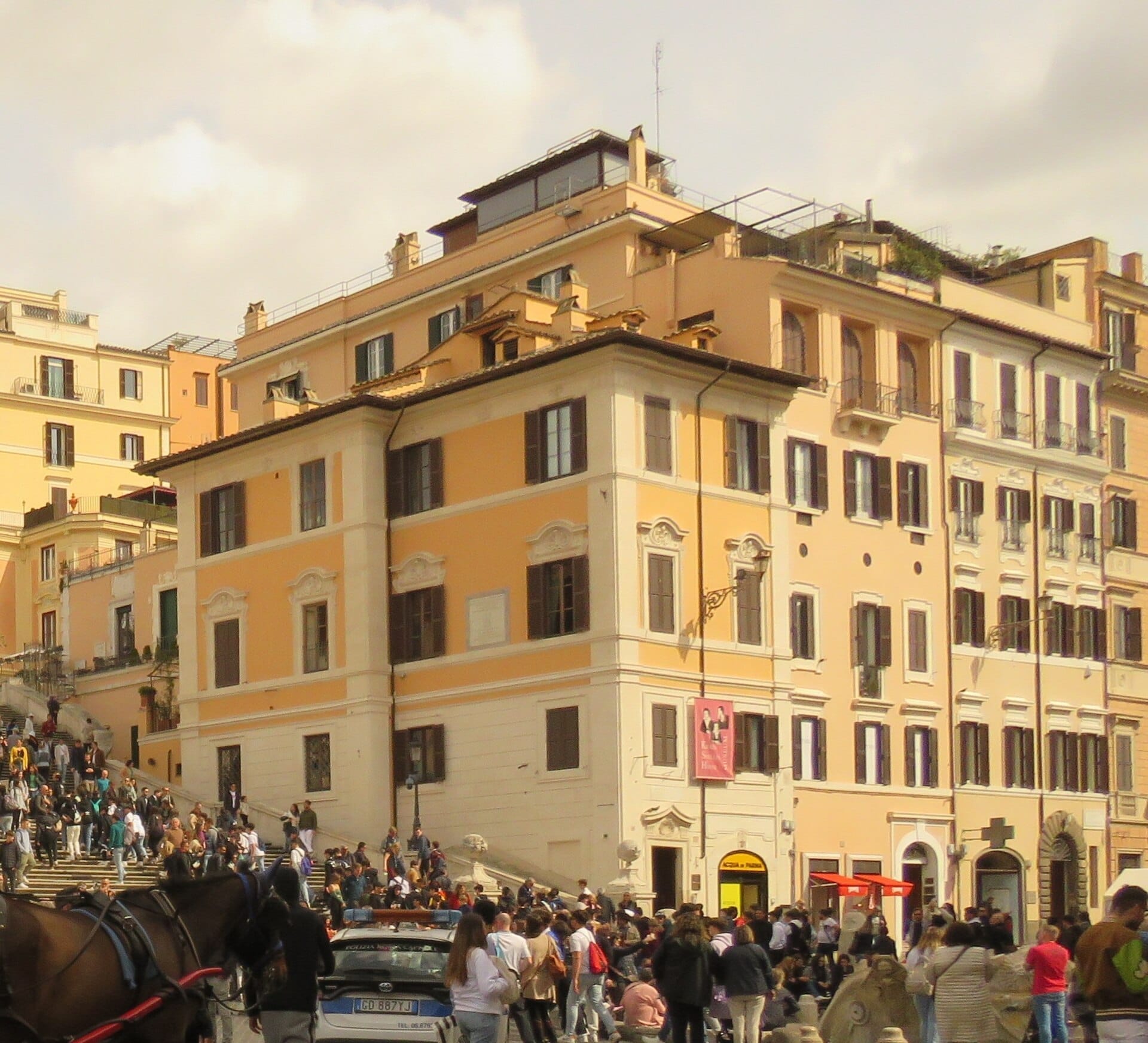
Tucked into the pink building at the foot of the Spanish Steps, the Keats-Shelley House is where John Keats spent his final months and died in 1821, aged 25. Today it operates as a small but carefully curated literary museum dedicated to the second-generation Romantic poets, drawing readers, scholars, and curious travelers who want something quieter than the spectacle outside.
Quick Facts
- Location
- Piazza di Spagna 26, 00187 Rome (at the foot of the Spanish Steps)
- Getting There
- Metro Line A – Spagna station (2-minute walk)
- Time Needed
- 45–90 minutes
- Cost
- €10 general; reduced for students and seniors
- Best for
- Literature lovers, Romantic poetry fans, travelers seeking quiet amid the chaos of the Spanish Steps
- Official website
- ksh.roma.it
What Is the Keats-Shelley House?
The Keats-Shelley House, known in Italian as Casa di Keats e Shelley or Casina Rosa (the little pink house), sits at Piazza di Spagna 26, pressed against the base of the Spanish Steps. From the outside, it is easy to miss: a modest pink facade in a row of buildings that most tourists walk straight past on their way up the stairs. That oversight is, honestly, their loss.
Inside, the museum occupies the second-floor apartment where the English Romantic poet John Keats lived from November 1820 until his death on 23 February 1821. He was 25 years old, already renowned for Ode to a Nightingale and Ode on a Grecian Urn, and had come to Rome hoping the warmer climate would help his tuberculosis. It did not. His close friend Joseph Severn nursed him through those final months and was with him at the end.
The house was purchased in 1906 by a group of Anglo-American admirers and officially opened to the public in 1909, with King Vittorio Emanuele III in attendance. The building itself dates to around 1725, predating Keats by nearly a century. Since opening, it has expanded its scope to cover not just Keats but the broader circle of second-generation British Romantics, including Percy Bysshe Shelley, Lord Byron, and Leigh Hunt.
The Rooms: What You Actually See
The museum is small. Four main rooms, a library, and a handful of display cases. Anyone expecting grand gallery halls will be surprised by the scale. But that intimacy is exactly the point. You are standing in the actual apartment where one of English literature's most celebrated voices fell silent, and the rooms have been arranged to make that feel real rather than theatrical.
The entrance room and main library hold the collection's depth: manuscripts, portraits, death masks, and letters. There is a lock of Keats's hair in a reliquary-style case, a copy of the volume of Shakespeare Keats carried everywhere, and correspondence between him and Fanny Brawne that remains moving even at a glance through glass. The library itself holds thousands of volumes related to the Romantics, used by scholars who apply for research access.
The final room, the death room, is deliberately spare. It is where Keats died. The ceiling is painted with small flowers, the same pattern that Keats reportedly stared at for weeks during his last illness. There are no furnishings from the original period, the room was stripped and burned to prevent spread of disease, but the proportions, the light from the window, and the low ceiling combine to create a stillness that is genuinely affecting.
💡 Local tip
Pick up the laminated room guide at the entrance. It is more detailed than the wall labels and explains the provenance of key objects, especially the portrait collection.
Tickets & tours
Live prices and dates from our booking partner. If you book, we may earn a commission at no extra cost to you.
St. Peter's Basilica, Vatican Museums, Sistine Chapel reserved entry
From 81 €Instant confirmationFree cancellationGuided tour of Galleria Borghese and of Villa Borghese gardens
From 69 €Instant confirmationFree cancellationVatican: Basilica, Dome and underground early bird tour
From 50 €Instant confirmationFree cancellationPasta-making class, tasting and prosecco with local chef in Rome
From 79 €Instant confirmationFree cancellation
Time of Day and Crowd Patterns
The Spanish Steps, directly outside, attract enormous crowds from mid-morning through early evening, peaking between 11:00 and 16:00. The Keats-Shelley House functions as an almost complete counterpoint to that noise. The moment you step inside and the door closes behind you, the roar from the piazza drops away. The rooms are quiet, kept at a controlled temperature, and rarely crowded.
Morning visits, shortly after the 10:00 opening, are the quietest. You may have entire rooms to yourself. Midday is when a light trickle of visitors arrives, often people sheltering from the heat in summer. Afternoons after 14:00 bring a second wave, though numbers remain modest compared to any major Roman museum. Saturday mornings can be slightly busier, particularly when temporary exhibitions are running.
The museum is closed on Sundays, which is worth checking if your Rome itinerary is tight. The midday closure (13:00–14:00) is also observed, so plan accordingly if you want to see the full collection in one go rather than splitting your visit.
Literary and Cultural Significance
The Keats-Shelley House is not just a memorial to one poet. Its collection spans the full circle of British Romanticism's second generation, the poets who defined a turn toward emotion, individual experience, and nature as counterforce to industrialization. Keats, Shelley, and Byron all spent time in Italy, drawn by its classical history, its light, and the relative freedom it offered. Shelley drowned off the coast of Tuscany in 1822 and is buried at the Protestant Cemetery in Testaccio, a short trip from the house. Byron was a collector of obsessions and left an outsized paper trail; several of his letters and personal items are held here.
The house is also the base of a functioning literary prize, the Keats-Shelley Prize, awarded annually for poetry and essays in the Romantic tradition. This is not a museum operating purely on nostalgia. It has an active scholarly and cultural program, with temporary exhibitions, lectures, and events that give it a contemporary relevance beyond the relics.
For visitors with even a passing familiarity with Keats's work, the experience carries a particular weight. Reading his letters on the walls, you encounter a young man who knew he was dying, who wrote about it with clarity and without sentimentality, and who was also furious about it. The combination of the objects, the room where he died, and the view from the window over a piazza that has barely changed gives the visit a texture that most literary museums, spread across purpose-built spaces, cannot replicate.
Practical Walkthrough: Getting There and Getting the Most From It
Getting here is straightforward. Metro Line A stops at Spagna station, which deposits you directly at the base of the Spanish Steps. The museum entrance is at Piazza di Spagna 26, on the right side of the staircase as you face it. If you are coming from the Trevi Fountain, it is a pleasant 10-minute walk west through narrow streets.
Admission runs €10 for general entry, with reduced rates for students and seniors. Check the official website before visiting, as prices can vary slightly during special exhibitions. The visit itself takes between 45 and 90 minutes depending on how thoroughly you read the materials. People who linger over letters and portraits often find themselves staying the full 90 minutes without noticing.
There are no audio guides currently offered as standard, so if you are not already familiar with the Romantic poets, a little reading before you arrive will make the visit significantly richer. The museum shop at the exit stocks a good range of scholarly editions, poetry collections, and postcards.
⚠️ What to skip
The museum is closed Sundays, and observes a midday closure from 13:00 to 14:00. The building has no elevator access, which may limit entry for visitors with mobility restrictions.
Photography and the Sensory Experience
Photography is generally permitted in the main rooms, though flash is discouraged around the older manuscripts and portraits. The light inside is soft and warm, particularly in the late morning when sun comes through the south-facing windows. The death room photograph, with that flower-painted ceiling and the window framing the piazza below, is the image most visitors take away with them.
The smell of the place is worth noting: old paper, wood polish, and something faintly floral from the fresh flowers placed near some of the display cases. The floors creak softly underfoot. These are not criticisms. They are part of what makes the experience feel genuinely historic rather than curated into lifelessness.
After your visit, step outside and look up at the Spanish Steps with fresh eyes. The Spanish Steps were completed in 1725, the same decade the building housing the museum was constructed. Keats would have had this same view. That continuity between the page and the place is what separates this museum from a mere archive.
Who This Is Not For
Travelers with no interest in literature or the Romantic period will find the Keats-Shelley House a slow hour. The objects are significant but require context to resonate. Families with young children will find little to engage restless visitors. If you are working through Rome's major sights on a tight schedule, the Pantheon and Capitoline Museums offer broader historical scope and may use your limited hours better. The Keats-Shelley House rewards visitors who come specifically for it, not those who wander in hoping to be convinced.
Insider Tips
- Visit on a weekday morning, ideally Tuesday through Thursday, when the Spanish Steps crowd is manageable and the museum is at its quietest. You may have the death room entirely to yourself for several minutes.
- Ask the staff about the research library if you have a scholarly interest in the Romantics. The library holds thousands of volumes and access is available by appointment.
- Combine this visit with a walk up the Spanish Steps to the Trinità dei Monti church, then continue to the Pincio Terrace for one of Rome's best panoramic views. It makes a natural literary-to-scenic half-day loop.
- The museum shop stocks scholarly editions that are difficult to find elsewhere in Rome, including critical editions of Keats's letters. Worth browsing even if you are not buying.
- Check the museum's website before your visit for temporary exhibitions. These sometimes bring in significant loans from British institutions and add substantially to what is on view.
Who Is Keats-Shelley House For?
- Readers and literature enthusiasts with a grounding in British Romantic poetry
- Travelers seeking a calm, unhurried counterpoint to Rome's major monuments
- Students of English literature, history, or 19th-century European culture
- Visitors interested in the Grand Tour tradition and Anglo-Italian cultural history
- Anyone who appreciates small, serious museums over large, overwhelming ones
Nearby Attractions
Other things to see while in Centro Storico:
- Ara Pacis
Commissioned in 13 BC to celebrate Augustus's campaigns in Gaul and Spain, the Ara Pacis Augustae is one of the best-preserved monuments of ancient Rome. Today it sits inside a striking modern pavilion on the Tiber's east bank, offering an unusually intimate encounter with imperial-era marble carving at near eye level.
- Campo de' Fiori
Campo de' Fiori is one of Rome's most recognizable piazzas, running a daily produce and flower market Monday through Saturday before reinventing itself as a lively social square after dark. Its paving stones have witnessed public executions, papal power, and centuries of commerce.
- Capitoline Hill
Capitoline Hill sits at the symbolic center of Rome, where Michelangelo's perfectly proportioned piazza crowns a site inhabited since the Bronze Age. Today it holds the world's oldest public museums, Rome's city hall, and some of the most striking views over the Roman Forum in the city.
- Capitoline Museums
Perched atop Capitoline Hill overlooking the Roman Forum, the Musei Capitolini hold some of antiquity's greatest sculptures and paintings across three interconnected palaces. Founded in 1471, they predate the Louvre by more than three centuries and reward visitors with both iconic works and panoramic views that few Rome attractions can match.
Planning a trip? Discover personalized activities with the Nomado app.