John Forrest National Park: Perth Hills Trails, Waterfalls, and a Historic Railway Tunnel
Proclaimed in 1900, John Forrest National Park is Western Australia's oldest national park and the Perth Hills' most accessible wilderness escape. Jarrah and marri forest, seasonal waterfalls, and the atmospheric Swan View Tunnel sit just 26 kilometres from the city centre.
Quick Facts
- Location
- Park Road, Hovea WA 6056 — approx. 26 km east of Perth CBD via Great Eastern Highway
- Getting There
- Train to Midland Station (Transperth Midland Line), then bus toward Hovea; check current Transperth routes before travel
- Time Needed
- 2–5 hours depending on trails chosen
- Cost
- Entry fees apply; check current park-entry fees with DBCA before visiting.
- Best for
- Day hikers, families with children, waterfall seekers, history enthusiasts
Why John Forrest National Park Matters
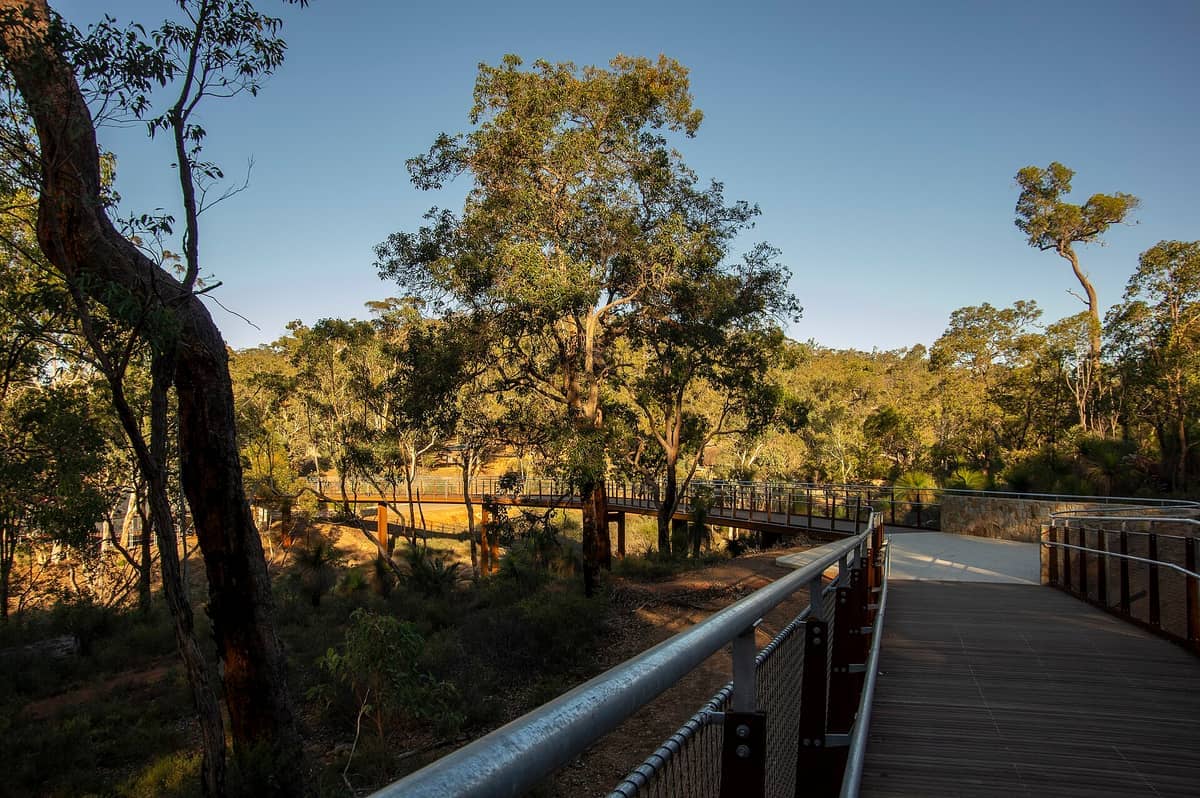
Most visitors to Perth spend their days at the beach or in Fremantle, never realising that a genuine bushland escape sits less than half an hour east. John Forrest National Park was reserved in 1898 and proclaimed in 1900, making it Western Australia's first national park. It took its current name in 1947, honouring Sir John Forrest, the state's first premier. That heritage is not just administrative: the park preserves a landscape of jarrah and marri forest that once stretched continuously across the Darling Scarp, the ridge of ancient granite that marks the eastern edge of the Swan Coastal Plain.
The park covers a compact area but packs in genuine geological variety: exposed granite outcrops, a perennial creek running through a narrow valley, and seasonal cascades that appear after winter rain. It is not a wilderness expedition, but it is legitimately wild country in the sense that kangaroos graze at the picnic area's edges at dusk, black cockatoos move through the canopy in noisy squadrons, and the forest floor carries the sharp eucalyptus-and-damp-earth smell that defines the Perth Hills in winter.
💡 Local tip
The entrance opposite Bilgoman Pool closes daily at 4 p.m. A second entrance farther east on Great Eastern Highway stays open later. Plan your exit accordingly, especially on shorter winter days.
The Lay of the Land: What You Actually See
The heart of the park is the Jane Brook valley. The brook runs year-round at its lower reaches, and in winter and spring the upper sections fill with runoff from the scarp, feeding a series of cascades. The main picnic area sits near the valley floor, shaded by large marri trees. From here, several signed trails branch out: some follow the brook upstream, others climb toward exposed granite ridgelines with views back across the coastal plain toward the city.
The most distinctive single feature is the Swan View Tunnel, a 340-metre railway bore cut through solid granite in the 1890s as part of the original Eastern Goldfields Railway. The tunnel carried trains until a bypass was built in 1945; the line closed in 1966. Today it forms a centrepiece of the Heritage Trail, a longer linear path that runs along the old rail corridor. Walking through the tunnel is a specific sensory experience: temperature drops noticeably, water drips from the curved granite ceiling, and at the midpoint the entrance circles behind you into darkness while the exit is still a small pale disc ahead. Bring a torch.
The park's vegetation is predominantly jarrah-marri forest, the dominant forest type of the Darling Range. In spring, the understorey produces wildflowers including banksias, grevilleas, and a range of ground orchids. If you are timing a visit around Western Australia's famous wildflower season, thePerth wildflower season guide explains what to expect across the region and when different species peak.
Tickets & tours
Live prices and dates from our booking partner. If you book, we may earn a commission at no extra cost to you.
The Bell Tower chiming experience
From 11 €Instant confirmationFree cancellationPinnacles and Swan Valley Full-day Guided Tour
From 201 €Instant confirmationFree cancellationPerth and Fremantle Guided Tour and Swan River Cruise
From 110 €Instant confirmationFree cancellationPerth and Fremantle Tour in German with Hotel Pickup
From 84 €Instant confirmationFree cancellation
Trails: Choosing the Right Walk
The trail network ranges from a flat, pram-friendly promenade along Jane Brook to multi-hour circuit walks with moderate elevation gain. The Jane Brook Promenade is the accessible option: a paved 300-metre loop around Jane Brook Weir, suitable for prams and wheelchairs with assistance. It gives a genuine sense of the forest without requiring any significant fitness.
For walkers who want more, The Railway Reserves Heritage Trail is a 41-kilometre loop, with 6 kilometres passing through the park and reaching Swan View Tunnel. The trail is well-marked and mostly shaded, but sections involve loose gravel and uneven ground. Solid closed-toe shoes are a practical minimum; lightweight trail runners or hiking shoes are better. In summer, the exposed granite sections above the valley floor reflect heat intensely: start early, carry at least a litre of water per person, and factor in the return distance.
The upper ridge trails offer the park's best views. On a clear winter morning, the coastal plain stretches west from the scarp edge, and the city skyline is visible 26 kilometres away. Midday summer heat makes these exposed sections uncomfortable, but the same walks in the cooler months, with the low winter light hitting the granite, produce some of the best photography conditions available within easy reach of Perth.
⚠️ What to skip
Summer temperatures in the Perth Hills regularly exceed 35°C. The park carries a Total Fire Ban risk on hot days, which can restrict barbecue use and affect access. Check the Department of Fire and Emergency Services (DFES) warnings before visiting between December and March.
When to Visit: Season by Season
Winter (June to August) is when the park earns the most praise from those who know it well. The waterfalls are running, the air carries the smell of wet granite and eucalyptus, the forest is at its greenest, and the trails are uncrowded. Temperatures typically sit between 8°C and 18°C, which is comfortable walking weather. The trade-off is that the picnic area can be muddy after heavy rain and some of the upper tracks become slippery.
Spring (September to November) is the other peak period. The cascades may still be flowing in September and October, wildflowers are out across the understorey, and the weather is warm without being punishing. This is when the park draws the most visitors, particularly on weekends. Arriving before 9 a.m. on a weekend spring morning means you may have the creek trail largely to yourself; arriving at 11 a.m. means competing for picnic tables.
Summer is an honest challenge. The creek slows to a trickle by January, the waterfalls stop, and the exposed sections of trail can feel oppressive by late morning. That said, the very early morning in summer, around 6 to 7 a.m., is genuinely beautiful: light comes through the jarrah canopy at a low angle, the air is cool before the heat builds, and the bird activity is at its peak. If you visit in summer, treat it as a dawn excursion rather than an afternoon trip.
For broader context on the best times to plan outdoor activities around Perth, the best time to visit Perth guide covers seasonal patterns across the city and surrounding region.
Getting There and Getting Around
The quickest approach is by car via Great Eastern Highway, turning onto Park Road at Hovea. The drive from central Perth takes around 30 to 35 minutes outside peak hours. The park has two vehicle entrances: the main entrance opposite Bilgoman Pool, which closes at 4 p.m., and a second entrance 2.3 kilometres farther east on Great Eastern Highway, opposite Glen Forrest Shopping Centre.
Without a car, take the Transperth Midland Line train to Midland Station, then connect by bus toward Hovea. The walk from the bus stop to the main picnic area adds distance to the trip. Check the current Transperth journey planner for live route details, since service frequency on this corridor varies. Perth's public transport network is explained in thegetting around Perth guide.
Inside the park, all navigation is on foot. There is no shuttle, no bike hire, and no café or shop. The picnic area has The picnic area has barbecues, accessible barbecue facilities, toilets, and running water. Bring your own food and enough water for the full duration of your visit: the nearest shops are back toward Midland.
Accessibility and Family Practicalities
The picnic area and the Jane Brook Promenade are the park's most accessible zones. The path from the car park to the toilets is mostly flat and even, the barbecue area includes an accessible unit, and the promenade surface allows wheelchairs and prams. Beyond the promenade, the terrain becomes progressively more uneven and the trails are not described as accessible in official documentation.
For families, the park works well as a half-day outing. The creek provides natural entertainment for younger children, the picnic facilities are good, and the Swan View Tunnel walk adds a satisfying destination objective. Families with very young children might also consider pairing a Hills visit with other family-friendly attractions nearby. ThePerth with kids guide covers a broader range of child-friendly options across the metro area.
ℹ️ Good to know
The park is managed by Western Australia's Department of Biodiversity, Conservation and Attractions (DBCA). Contact the park directly on (08) 9298 8344 for current conditions, especially after heavy rain or during fire risk periods.
Who Should Reconsider This Visit
Travellers who need café culture, visitor centre interpretation, or manicured paths throughout will find John Forrest National Park underdeveloped by international standards. There is no on-site food service, no audio guide, and no sheltered indoor space beyond the toilet blocks. First-time visitors to Australian bushland who are not comfortable walking in areas with minimal mobile phone coverage should plan their route in advance and inform someone of their itinerary.
If your primary interest is panoramic city views rather than forest walking, the Perth views guide covers vantage points closer to the centre that require less travel time.
Insider Tips
- The Swan View Tunnel is cold inside year-round, even in summer. Bring a light layer and a headtorch or phone torch with a charged battery: the midpoint is genuinely dark.
- Kangaroos are most visible in the picnic area at dawn and in the late afternoon before the 4 p.m. gate closure. If you want to see them without crowds, an early morning weekday visit in autumn or winter is the most reliable option.
- The vehicle entry fee covers the whole car, not per person. If you are visiting with a group of four or more, the cost per head is very low compared to most Perth attractions.
- After sustained winter rain, the upper cascades above the main picnic area can be genuinely impressive. Check recent rainfall via the Bureau of Meteorology before deciding when to visit if waterfalls are your main objective.
- Phone signal is unreliable in the lower valley sections. Download an offline map of the trail network before leaving the car park, and screenshot the park's trail guide from the DBCA brochure if you plan to explore beyond the main picnic area.
Who Is John Forrest National Park For?
- Day hikers wanting accessible Perth Hills terrain without a long drive
- Families with older children looking for a half-day outdoor excursion with a clear destination (the tunnel)
- Wildflower and birdwatching visitors, particularly in spring
- Travellers who want to understand the pre-colonial and colonial-era landscape around Perth without leaving the metropolitan region
- Photographers working in the golden-hour window on winter mornings
Nearby Attractions
Other things to see while in Perth Hills:
- Kalamunda
Kalamunda is a hill town on the Darling Scarp, about 24 kilometres east of Perth. The centre is walkable, the History Village sits on the old railway station site, and the Bibbulmun Track starts here. The Zig Zag Scenic Drive is a short hop away in Gooseberry Hill.
- Lesmurdie Falls
Lesmurdie Falls tumbles down the Darling Range escarpment in Mundy Regional Park, about 20 kilometres east of central Perth. Free to enter, it rewards visitors most generously between June and October when winter and spring rains keep the flow strong.
- Mundaring Weir
Mundaring Weir is a century-old engineering landmark set deep in the forested Perth Hills, about 45 minutes from the city centre. The reservoir, walking trails, and heritage infrastructure make it a rewarding half-day escape for nature lovers, history enthusiasts, and families alike.
- Perth Observatory
Perched in the Bickley valley of the Perth Hills, Perth Observatory is one of Western Australia's oldest scientific institutions. Whether you visit on a Sunday afternoon to explore the heritage domes or book a night-sky tour to see the Southern Cross through a working telescope, this is a rare chance to connect with both history and the cosmos — without flying to a remote outback site.
Planning a trip? Discover personalized activities with the Nomado app.