Lesmurdie Falls: The Perth Hills Waterfall Worth the Drive
Lesmurdie Falls tumbles down the Darling Range escarpment in Mundy Regional Park, about 20 kilometres east of central Perth. Free to enter, it rewards visitors most generously between June and October when winter and spring rains keep the flow strong.
Quick Facts
- Location
- Falls Road, Lesmurdie WA 6076, in Mundy Regional Park, Perth Hills
- Getting There
- No direct public transport; car is the practical option. Drive east from Perth CBD via Roe Hwy and Lesmurdie Road — roughly 25–30 minutes. A lower access point is also available at the end of Palm Terrace.
- Time Needed
- 1.5 to 3 hours depending on which trails you combine
- Cost
- Free entry; no booking required
- Best for
- Families, casual hikers, photographers, and anyone wanting a green escape close to the city
- Official website
- parks.dpaw.wa.gov.au/park/lesmurdie-falls
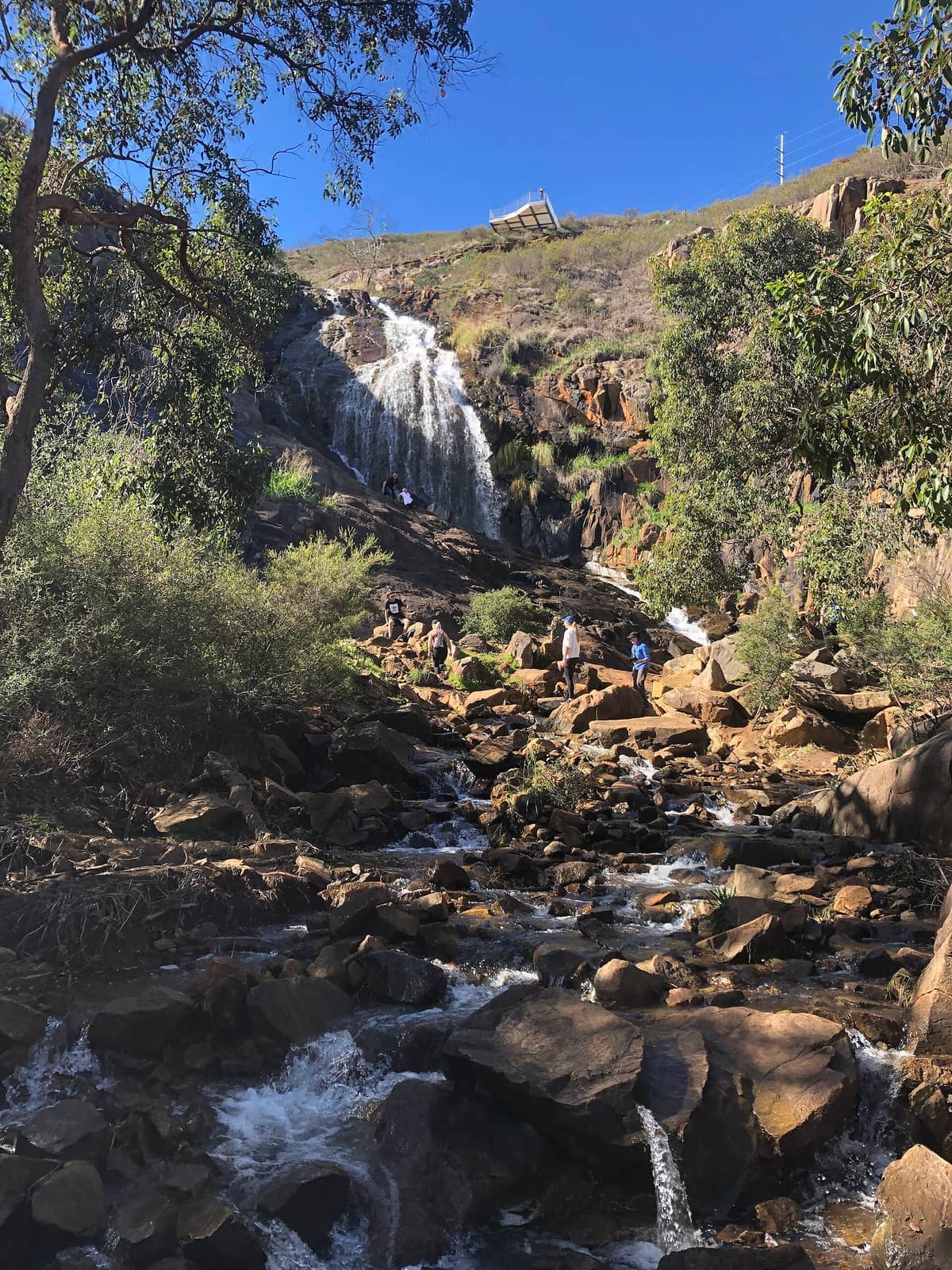
What Lesmurdie Falls Actually Is
Lesmurdie Falls is a waterfall on the western face of the Darling Range escarpment, situated within Mundy Regional Park on the eastern fringe of Perth's metropolitan area. The falls descend the escarpment into a gully below, with the Darling Scarp rising steeply behind and the Swan Coastal Plain spreading out toward the coast in front. The park includes walk trails and viewing platforms, with views across the surrounding landscape.
The site sits on Whadjuk Noongar Country. Public recreation facilities were documented here as far back as 1910, and the land was formally resumed for use as a national park in 1933, according to the State Heritage Office record. That heritage listing recognises the falls' cultural and scenic value, describing the drop down the escarpment without specifying an exact measurement. What is clear from the geography is that the descent is substantial enough to produce a genuinely dramatic waterfall during and after the winter rains, and little more than a trickle by late summer.
⚠️ What to skip
The falls are seasonal. Flow peaks between June and October after winter rain. If you visit in January or February during a dry year, you may find little more than a damp rock face. Check recent rainfall before making a special trip.
How the Experience Changes by Season and Time of Day
Winter and early spring are when Lesmurdie Falls earns its reputation. After a week of good rain the flow is audible from the upper picnic area — a deep, consistent rush that fills the gully with white noise. The rock face is dark with moisture, ferns and mosses glow intensely green against the granite, and the air carries the mineral smell of wet stone and eucalyptus. On weekday mornings in July or August you may have the lower viewing area almost to yourself.
Late spring brings lighter flow but warmer walking conditions, and the surrounding bush comes alive with wildflowers. By December the falls are typically reduced or dry, and the hike becomes a bush walk rather than a waterfall experience. Summer visitors should still find the shaded gully cooler than surrounding suburbs, but the visual centrepiece is gone. Perth's Mediterranean climate concentrates rain heavily into the June to August window, with monthly averages around 121 to 148 mm, compared to about 10 to 21 mm in midsummer, according to Bureau of Meteorology long-term data.
Mornings are consistently better than afternoons. The light falls on the escarpment face from the east in the early hours, creating clean, shadow-free conditions for photography. By early afternoon in summer the heat is oppressive on the exposed upper track. Arrive before 9 am on weekends in winter and you will beat the family groups that arrive mid-morning with picnic bags and toddlers in tow.
Lesmurdie Falls is one of the more accessible entry points into Perth Hills walking country. If you want a longer day out in the same area, theJohn Forrest National Parkto the north offers more developed trails and its own waterfall circuit. For a broader overview of hiking options across the region, thePerth hiking guide covers difficulty levels, access, and seasonal conditions across multiple parks.
Tickets & tours
Live prices and dates from our booking partner. If you book, we may earn a commission at no extra cost to you.
The Bell Tower chiming experience
From 11 €Instant confirmationFree cancellationPinnacles and Swan Valley Full-day Guided Tour
From 201 €Instant confirmationFree cancellationPerth and Fremantle Guided Tour and Swan River Cruise
From 110 €Instant confirmationFree cancellationPerth and Fremantle Tour in German with Hotel Pickup
From 84 €Instant confirmationFree cancellation
The Walk: Upper Area to Lower Lookout
Most visitors park at the Falls Road upper car park and walk down to the main viewing area. The upper section is relatively gentle, passing through jarrah and marri woodland with views opening toward the coastal plain. The path then steepens and the surface becomes rockier as you descend toward the escarpment edge. Steps are cut into some sections but the footing is uneven in places, particularly after rain when the granite becomes slippery. Sturdy footwear is not optional here; the park authority's own notes flag the uneven and rocky surfaces clearly.
The lower access point at the end of Palm Terrace offers an alternative entry from the valley floor, though many visitors find the upper-to-lower descent the more satisfying direction because you arrive at the falls from above and gain the view gradually. If you are bringing children, the upper picnic area has toilets and parking and is worth using as a base before committing to the steeper section. Trails beyond the picnic area include steps, steep gradients and uneven rocky surfaces, limiting access for wheelchairs and prams.
💡 Local tip
Wear closed, non-slip footwear. The granite steps near the falls are consistently wet in winter and more treacherous than they look from a distance. Thongs or flat sandals are a genuine hazard on the descent.
The full circuit combining upper and lower access takes roughly two to three hours at a relaxed pace. Those with limited time can reach a satisfying viewpoint from the upper area in under 45 minutes return. The park does not charge an entry fee, and no bookings are required.
Photography at Lesmurdie Falls
The main photographic challenge here is contrast. In full flow the white water against dark wet granite is stark, and the surrounding vegetation adds layers of texture. Midday in winter often produces flat, overcast light that is actually favourable for waterfall photography, suppressing the harsh shadows that direct sun creates on the rock face. A polarising filter removes the glare from the wet surface and saturates the greens noticeably.
For long-exposure shots of the flowing water, a tripod and a shutter speed of half a second to two seconds produces the silky water effect against sharp rock. The gully floor provides a stable flat area to set up, but plan on wet shoes if you want the closest angle. The vertical drop of the escarpment also makes the falls difficult to capture in a single wide shot without significant distortion; many photographers work better with detail shots of specific cascades rather than trying to show the entire drop in one frame.
Getting There and Practical Notes
There is no practical public transport route to Lesmurdie Falls at the time of writing. The site is not served by Transperth rail or a convenient bus connection. A car is the standard way to visit. From central Perth the drive is approximately 25 to 30 minutes via Roe Highway, heading east into the hills suburb of Lesmurdie. The Falls Road car park is signposted and has accessible parking bays. The lower Palm Terrace access has its own smaller parking area.
If you are combining Lesmurdie Falls with a broader day in the hills, Kalamunda township is a few minutes' drive away and has cafes, a small heritage precinct, and farmers market facilities. Details on what to expect in that area appear on theKalamunda attraction page. For a fuller day-trip structure beyond the hills, theday trips from Perth guide lays out how to sequence multiple stops efficiently.
Check the Department of Biodiversity, Conservation and Attractions park page before visiting, particularly around public holidays or after severe weather that might close tracks. The DBCA page is the authoritative source for temporary closures.
ℹ️ Good to know
No entry fee applies. Bring drinking water regardless of season — the walk can be warmer than expected in spring. Check the park information for current facilities before visiting.
Who Should Reconsider This Visit
Lesmurdie Falls is not the right destination if you cannot drive or arrange private transport, if you are visiting between December and May in a low-rainfall year, or if you are expecting a dramatic all-day adventure. The site is best understood as a scenic half-day excursion from Perth, not a major destination. Wheelchair users and those who cannot manage steep or uneven terrain are limited to the upper picnic area, which is pleasant but does not give a view of the falls themselves. Visitors who have travelled specifically from overseas with limited days in Perth should weigh whether the seasonal uncertainty justifies the detour unless they are visiting in winter.
For families weighing options, the Perth with kids guidecovers a wider range of family-appropriate stops across the metro area that might combine well with a morning at the falls. Those focused on natural scenery and free outdoor experiences will also find useful context in thefree things to do in Perth guide.
Insider Tips
- Visit on a weekday morning in June or July for the strongest flow and the fewest crowds. Weekend late mornings in winter draw family picnickers who fill the upper car park by 10 am.
- The lower Palm Terrace access gives a different perspective looking up at the escarpment face. It is worth combining both entry points if your legs are up to the return walking distance.
- Check the Bureau of Meteorology Perth rainfall summary for the previous two weeks before driving out. Fewer than 20 mm of cumulative rain in that window often means a disappointing trickle rather than a full cascade.
- The upper picnic area is a decent spot for a packed lunch with a view over the coastal plain. On clear winter days the view extends toward the city skyline and the distant coast, which is a payoff even if the falls themselves are modest.
- Kalamunda village is nearby and has good coffee. Build in a cafe stop before or after the walk rather than expecting food or drink at the park itself.
Who Is Lesmurdie Falls For?
- Perth locals wanting a quick nature fix within 30 minutes of the city
- Families with children old enough to manage steps and uneven paths
- Photographers chasing waterfall and escarpment landscapes in winter light
- Hikers combining a short trail with broader Perth Hills exploration
- Visitors in Perth during winter or spring who want greenery beyond the beach suburbs
Nearby Attractions
Other things to see while in Perth Hills:
- John Forrest National Park
Proclaimed in 1900, John Forrest National Park is Western Australia's oldest national park and the Perth Hills' most accessible wilderness escape. Jarrah and marri forest, seasonal waterfalls, and the atmospheric Swan View Tunnel sit just 26 kilometres from the city centre.
- Kalamunda
Kalamunda is a hill town on the Darling Scarp, about 24 kilometres east of Perth. The centre is walkable, the History Village sits on the old railway station site, and the Bibbulmun Track starts here. The Zig Zag Scenic Drive is a short hop away in Gooseberry Hill.
- Mundaring Weir
Mundaring Weir is a century-old engineering landmark set deep in the forested Perth Hills, about 45 minutes from the city centre. The reservoir, walking trails, and heritage infrastructure make it a rewarding half-day escape for nature lovers, history enthusiasts, and families alike.
- Perth Observatory
Perched in the Bickley valley of the Perth Hills, Perth Observatory is one of Western Australia's oldest scientific institutions. Whether you visit on a Sunday afternoon to explore the heritage domes or book a night-sky tour to see the Southern Cross through a working telescope, this is a rare chance to connect with both history and the cosmos — without flying to a remote outback site.
Planning a trip? Discover personalized activities with the Nomado app.