Jaws Corner: Stone Town's Living Room
Jaws Corner is the informal social hub of Stone Town, where locals gather over strong Swahili coffee, play dominoes, and argue politics under the shade of an old building's overhang. There are no tickets, no signs, and no agenda — which is precisely what makes it worth seeking out.
Quick Facts
- Location
- Intersection of Sokomuhogo, Cathedral, and Baghani Streets, Stone Town, Zanzibar City
- Getting There
- On foot only — Stone Town's lanes are too narrow for vehicles. Walk from the waterfront or Darajani Market; allow 5–10 minutes from either.
- Time Needed
- 15–45 minutes, depending on how long you linger
- Cost
- Free to visit; coffee sold separately at minimal cost
- Best for
- Culture-seekers, photographers, solo travelers, slow travelers
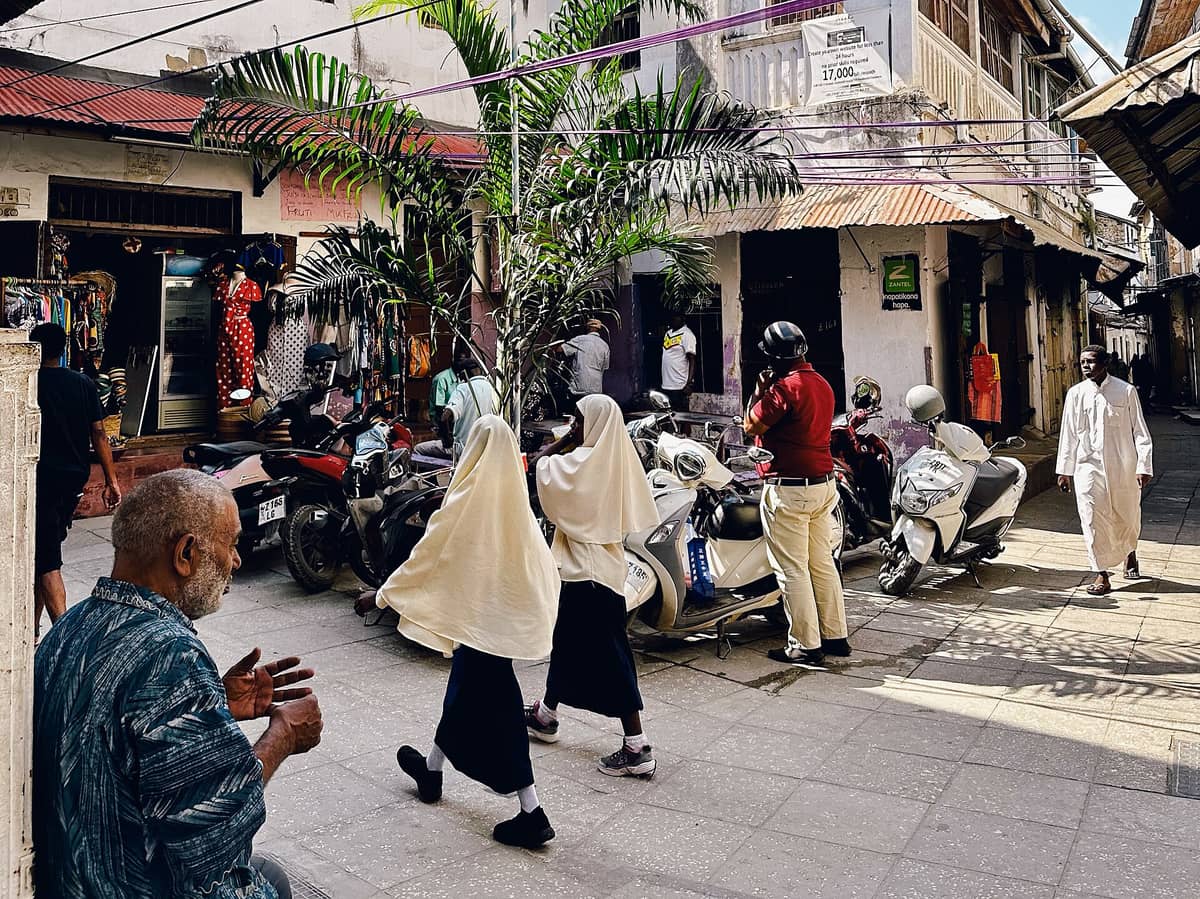
What Jaws Corner Actually Is
Jaws Corner is not a café, a monument, or an organized attraction. It is a street corner in the heart of Stone Town, located near the intersection of Sokomuhogo, Cathedral, and Baghani Streets, behind the mosque on Cathedral Street. What happens there is entirely unscripted: men of all ages gather from early morning onward to drink small cups of strong, spiced Swahili coffee, play dominoes on folding tables, swap gossip, and engage in the kind of unhurried debate that has been a cornerstone of Swahili coastal culture for generations.
The name Jaws Corner has been in informal use for years, reportedly because of the animated, mouth-moving arguments that take place there. It is the kind of nickname a place earns through reputation, not through any official designation. There are no signs pointing the way. First-time visitors frequently walk past it, then double back when they notice the cluster of chairs, thermos flasks, and the particular buzz of a group that has nowhere more pressing to be.
ℹ️ Good to know
There is no entrance fee and no ticket. Buying a cup of coffee from the vendor is not mandatory, but it is a natural way to participate and show respect for the space. Prices are local — expect to pay the equivalent of a few hundred Tanzanian shillings.
The Experience at Different Times of Day
Morning is when Jaws Corner is most alive. From shortly after sunrise, the smell of brewing coffee drifts into the surrounding lanes — a roasted, cardamom-edged scent that is recognizably Swahili. The tables fill with older men, many in white kanzus and kofia caps, and the tempo is deliberate: sipping, watching, talking in low Swahili. The light at this hour is still soft, filtering between the carved stone facades of the surrounding buildings, and the heat is bearable.
By midday, activity shifts. Some regulars leave for prayer or lunch; others take their place. The composition of the crowd changes, with younger men and occasional boda-boda drivers passing through. The stone underfoot radiates heat, and the shade of the building overhang becomes more valuable. Visitors who arrive in the early afternoon often find a quieter, less photogenic version of the corner, though no less authentic.
Late afternoon brings a second surge. As the worst of the heat passes and the call to prayer echoes across Stone Town's rooftops, the corner picks up again. This is a good time to sit and observe without feeling conspicuous — the crowd is larger, more varied, and generally relaxed about the presence of curious outsiders. The golden pre-dusk light is also favorable for photography, catching the texture of the walls and the worn surfaces of the domino tables.
Tickets & tours
Live prices and dates from our booking partner. If you book, we may earn a commission at no extra cost to you.
Zanzibar catamaran and snorkelling tour to Mnemba Marine Park
From 114 €Instant confirmationFree cancellationNyerere National Park two-day safari with two game drives
From 866 €Instant confirmationFree cancellationSerengeti National Park private three-day safari from Zanzibar
From 2.144 €Instant confirmationFree cancellationZanzibar north coast sunset dhow cruise
From 42 €Instant confirmationFree cancellation
Cultural Context: Why This Corner Matters
Swahili urban culture has always revolved around shared public space. The street corner, the shaded arcade, the doorway of a mosque — these have been places of community exchange for centuries in coastal East African towns. Jaws Corner is a living example of that tradition, and its persistence in a city increasingly oriented toward tourism is notable.
Stone Town itself is a UNESCO World Heritage Site, recognized for its layered architectural and cultural history that spans Arab, Persian, Indian, and European influences. Walking its lanes — as the Stone Town walking guide explains in detail — involves navigating a city where the 19th century is still visibly present in the carved wooden doors, the coral-stone walls, and the pattern of daily life. Jaws Corner fits squarely into that fabric: it is less a tourist stop than a proof that the city is still actively inhabited by people who are not performing their culture for visitors.
The coffee itself carries cultural weight. Swahili coffee — bitter, small, and often flavored with cardamom or ginger — is served in small handleless cups and consumed quickly. It is not a drink you nurse over an hour; it is a ritual of social contact. Accepting a cup is an act of participation, not just consumption.
How to Approach It as a Visitor
The single most important thing to understand about Jaws Corner is that you are entering someone else's social space, not a designated tourist zone. The people gathered there are not there to be observed — they are there for each other. That said, most regulars are accustomed to curious visitors and are generally welcoming if approached with basic courtesy.
A greeting in Swahili — 'Jambo' or, more correctly, 'Habari?' — goes a long way. Sitting nearby, ordering coffee, and watching without hovering or loudly narrating the scene to travel companions is the baseline of respectful behavior. Do not point cameras directly at individuals without some acknowledgment or a nod of permission. Some men will actively invite you to photograph; others will turn away. Read the situation.
💡 Local tip
If you speak any Swahili at all, use it here. Even a stumbling attempt at basic phrases will be met with warmth, and it signals that you are engaging rather than just extracting. Even 'Asante' (thank you) after your coffee makes a difference.
Stone Town's layout can be disorienting — the lanes do not follow a grid, and signage is inconsistent. If you are navigating from the waterfront, head inland toward Gizenga Street and look for the cluster of white plastic chairs and thermos flasks near the junction. The smells and sounds will help orient you before you can see it clearly. If you are lost, asking any local for 'Jaws Corner' will produce directions; it is well known.
Photography and Practicalities
The corner is compact, and serious photographers should be aware that the light in the surrounding lanes is often contrasty and uneven, especially at midday. Early morning and late afternoon offer the most flattering conditions: directional light, shadows with detail, and a crowd that is settled rather than in transit. A wide lens at close range works better than a zoom from a distance, both technically and socially — it signals presence rather than surveillance.
Bring cash in small denominations if you intend to buy coffee. The corner operates entirely on informal exchange — no card readers, no printed menus. Dress modestly as a baseline: Stone Town is a predominantly Muslim city, and bare shoulders or shorts that are very short draw unnecessary attention. Light, loose clothing is practical in any case given the heat.
Accessibility is limited by the nature of Stone Town's infrastructure. The lanes are uneven, often cobbled, and occasionally interrupted by steps. There is no step-free guarantee at Jaws Corner itself. Travelers with significant mobility constraints should be aware that reaching the corner involves navigating Stone Town's characteristic stone-paved alleys, which can be uneven and narrow.
Honest Assessment: Is It Worth Your Time?
Jaws Corner is not a spectacle. There is nothing to 'see' in the conventional sense — no architecture to admire, no exhibit to read, no performance to watch. What it offers is a pause: a chance to step out of the sightseeing rhythm and sit with the actual texture of daily life in Stone Town. For travelers who arrive expecting something photogenic or exciting, it will feel underwhelming. For those who are already engaged with the city — who have walked its streets, visited Forodhani Gardens in the evening, or spent time browsing Darajani Market — Jaws Corner makes sense as a quiet counterpoint.
It pairs naturally with a broader walk through Stone Town. Consider combining it with a look at the carved Zanzibar doors that line the surrounding streets, or stopping at the Old Dispensary on the waterfront afterward. The Zanzibar Swahili culture guide gives useful background if you want to understand what you are observing before you arrive.
⚠️ What to skip
Who should skip it: travelers on very tight schedules who need every stop to deliver a clear payoff. Jaws Corner is about atmosphere and presence, not content. If your Stone Town time is limited to a few hours, prioritize the historic sites and save this for a return visit or a quieter morning.
Insider Tips
- Arrive before 8am for the most atmospheric experience: the crowd is at its most consistent, the light is good, and the coffee vendor is usually just setting up — meaning your cup will be freshly made rather than reheated.
- The corner is liveliest after Friday prayers, when the surrounding streets fill and the tables spill slightly into the lane. This is also when impromptu debate gets most animated.
- Do not mistake silence for unwelcome. The men here are not performers; they may acknowledge you briefly and then return to their own conversation. That is normal. Stay, sip your coffee, and the atmosphere will open up gradually.
- If you have a guide, ask them to introduce you to a regular rather than simply pointing the place out. A personal introduction changes the dynamic entirely and can lead to a genuine conversation.
- Jaws Corner is a useful orientation point if you are learning Stone Town's geography. It sits near several key streets, and using it as a landmark rather than a destination is a good way to build a mental map of the old town.
Who Is Jaws Corner For?
- Solo travelers who are comfortable sitting and observing without a structured activity
- Culture-focused visitors wanting unmediated contact with daily Swahili urban life
- Photographers looking for candid, low-light street scenes in the early morning
- Travelers spending multiple days in Stone Town who want to move beyond the main monuments
- Anyone interested in the social architecture of a historic Indian Ocean port city
Nearby Attractions
Other things to see while in Stone Town:
- Darajani Market
Darajani Market, also known as Marikiti Kuu or the Great Market, is a principal market in Stone Town. Dating to 1904, it draws fishermen, spice traders, and local shoppers every morning in a scene that has changed little in over a century. Entry is free, and an hour here tells you more about Zanzibari daily life than any museum.
- Forodhani Gardens
Forodhani Gardens is a seafront park in the heart of Stone Town that doubles as Zanzibar's most celebrated street food market after dark. By day it's a quiet refuge of sea breezes and colonial-era architecture; by evening, dozens of grills and lantern-lit stalls transform it into the social and culinary center of the old city.
- Freddie Mercury Museum
Opened in 2019 on Kenyatta Road in Stone Town's Shangani quarter, the Freddie Mercury Museum occupies the building associated with his childhood. It is a small but carefully assembled tribute to his life, his music, and his largely overlooked Zanzibari origins — making it one of the most personally resonant stops in all of Stone Town.
- Hamamni Persian Baths
Built for Sultan Barghash between 1870 and 1888, the Hamamni Persian Baths were once the grandest public bathhouse in Zanzibar. Today the ruins stand as one of Stone Town's most atmospheric historic sites, offering a quiet counterpoint to the neighborhood's busier attractions.
Planning a trip? Discover personalized activities with the Nomado app.