Hopetoun House: Scotland's Greatest Stately Home, Just Outside Edinburgh
Set on the south shore of the Firth of Forth about 11 miles west of Edinburgh, Hopetoun House is the ancestral seat of the Marquess of Linlithgow and one of Scotland's most architecturally ambitious country houses. Designed first by Sir William Bruce in 1699 and dramatically expanded by William Adam from 1721, the estate combines baroque grandeur with extensive parkland, deer herds, and interiors packed with original art and furniture.
Quick Facts
- Location
- South Queensferry, Edinburgh, EH30 9SL — approx. 11 miles (18 km) west of central Edinburgh
- Getting There
- Train to Dalmeny station (approx. 3.4 miles away), then taxi or walk; or bus to South Queensferry, then a 2 km walk. Easiest by car.
- Time Needed
- 2.5 to 4 hours for house tour and grounds
- Cost
- Adult approx. £15, Concession approx. £13.50, Child approx. £7, Family (2 adults + 2 children) approx. £38 — verify current prices before visiting
- Best for
- Architecture lovers, Scottish history enthusiasts, families wanting space to roam, photography
- Official website
- hopetoun.co.uk
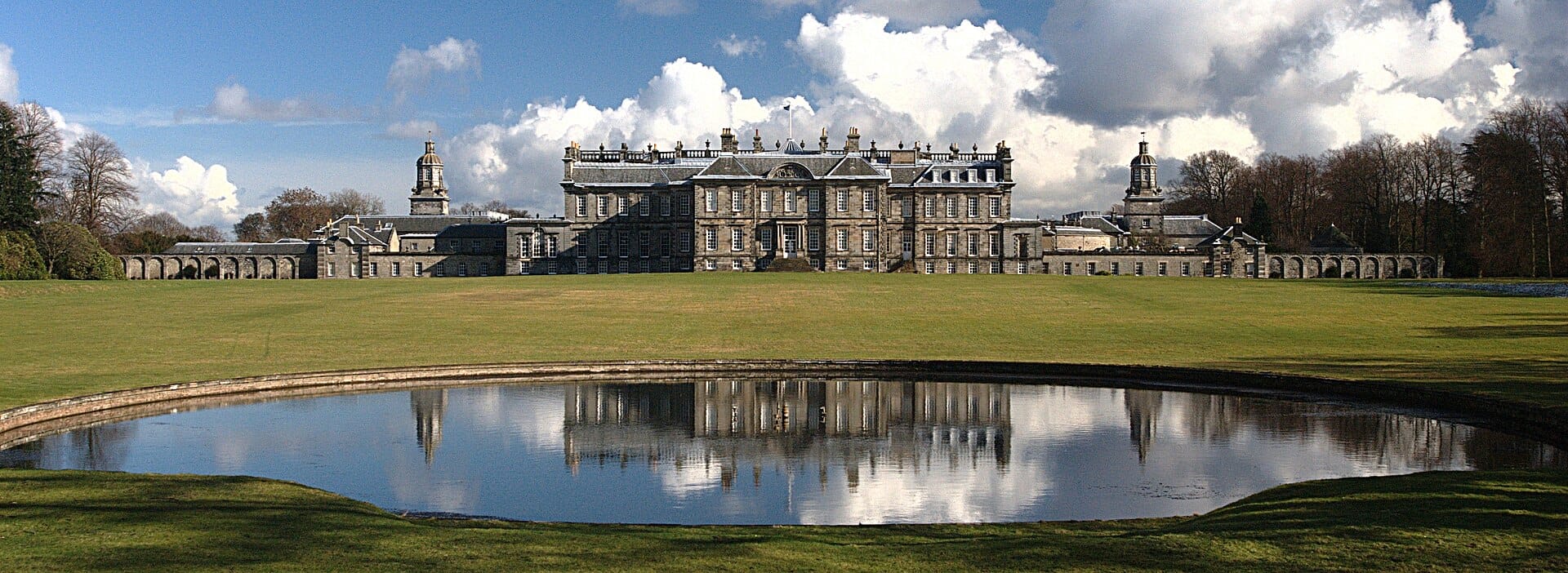
What Hopetoun House Actually Is
Hopetoun House is not a castle, not a museum in the conventional sense, and not a ruin. It is a stately home and national monument, managed by the Hopetoun House Preservation Trust, with part of the house still occupied by the Hope family and its doors open to the public for a seasonal visitor period each year. The house has been continuously occupied by the Hope family for more than three centuries, which gives it something that polished heritage sites often lack: a sense that real life has accumulated here, layer by layer, rather than being reconstructed for visitors.
The scale surprises most first-time visitors. The facade stretches wide across a terrace above formal lawns, its curved colonnades reaching outward like arms. Inside, the state rooms are dressed in original red and yellow damask, hung with portraits of the Hope family, and filled with furniture that has never been moved to storage. The scale of ambition on display reflects the enormous wealth and political influence of one of Scotland's most prominent noble families during the 18th century.
ℹ️ Good to know
Opening season: Hopetoun House is typically open Thursday to Monday, 11:00–17:00 (last entry 16:00), from Easter/early April through the last Sunday in September. Dates and hours can shift year to year — check hopetoun.co.uk before planning your visit.
The Architecture: Two Visions, One Extraordinary Building
Construction began in 1699 when Sir William Bruce, the leading Scottish architect of his generation, designed a compact but refined baroque house for the 1st Earl of Hopetoun. Bruce's work survives in the older core of the building, where the proportions are tighter and the detail more restrained. Within two decades, however, ambitions had grown considerably.
From 1721 through to 1748, William Adam — father of the more famous Robert Adam — undertook a dramatic expansion. He wrapped Bruce's original block with a new entrance facade, added the sweeping colonnaded wings on either side, and gave the house the palatial silhouette it carries today. The result is one of the most complete expressions of Scottish baroque architecture anywhere in the country. Adam's composition draws on continental European models while remaining firmly grounded in the Scottish landscape setting.
For visitors with a serious interest in Scottish neoclassical architecture, pairing Hopetoun with the Georgian House on Charlotte Square in Edinburgh's New Town provides a compelling contrast: the urban refinement of Robert Adam's later work set against the rural baroque confidence of his father's Hopetoun expansion.
Tickets & tours
Live prices and dates from our booking partner. If you book, we may earn a commission at no extra cost to you.
Self-guided audio tour on the history of witchcraft in Scotland
From 5 €Instant confirmationWest Highland Lochs, mountains and castles tour from Edinburgh
From 61 €Instant confirmationFree cancellationLoch Ness, Glen Coe and the Highlands tour from Edinburgh
From 66 €Instant confirmationFree cancellationDay Trip to Holy Island, Alnwick Castle and Northumbria from Edinburgh
From 60 €Instant confirmationFree cancellation
Inside the House: What You Will See
The state rooms open to visitors are among the best-preserved in Scotland. The Yellow and Red Drawing Rooms retain their original silk damask wall coverings, framed by carved gilded woodwork. Portraits by some of the leading painters of the 17th and 18th centuries hang in their original positions, and the furniture was largely commissioned specifically for these rooms. The effect is different from a museum display because nothing is in a case or behind a rope in quite the same way — the rooms feel inhabited rather than curated.
The rooftop viewing platform is a highlight that guide books sometimes underplay. From up here, the full sweep of the Firth of Forth opens out, and on a clear day you can usually see the three Forth bridges to the east. The red of the Forth Bridge's steelwork stands against the water and the hills of Fife beyond. It is one of the more unexpected views available on any Scottish house tour.
If the Forth bridges themselves interest you, the Forth Bridge is close enough to combine with a Hopetoun visit in a single day, particularly if you have a car.
The Grounds: 100 Acres Worth Exploring
The approximately 40 hectares (roughly 100 acres) of designed parkland immediately surrounding the house are included in the admission price and deserve at least an hour on their own. The formal terrace directly in front of the house gives way to sweeping grassland where a herd of red deer grazes freely. Seeing large red deer at relatively close range, in the context of an 18th-century designed landscape, is one of those experiences that does not photograph especially well but makes a strong impression in person.
The grounds slope toward the shore of the Firth of Forth, offering views across the water. Woodland walks wind through the estate, and the gardens closer to the house include formal plantings that shift in character through the spring-to-autumn open season. In April, the grounds tend to be quieter and the light is sharp; by July and August, families arrive in larger numbers and the lawns can fill with children.
💡 Local tip
Wear waterproof shoes or walking boots if you plan to explore beyond the immediate terraces. The woodland paths can be muddy even after a single day of rain, which in Scotland is rarely far away.
Getting There and Planning Your Visit
Hopetoun House sits approximately 11 miles (18 km) west of central Edinburgh, just beyond South Queensferry. The most straightforward way to arrive is by car: there is ample free parking on site, and the drive from Edinburgh city centre typically takes around 30 minutes depending on traffic. By public transport, the journey requires more planning. You can take a train to Dalmeny station and then arrange a taxi or face a walk of roughly 3.4 miles, or travel by bus to South Queensferry and walk approximately 2 km to the house entrance.
South Queensferry itself is worth a brief stop: the village sits directly beneath the Forth Bridge and has its own character and cafes. If you are planning a day trip from Edinburgh that combines several attractions, the day trips from Edinburgh guide outlines how to structure the journey efficiently.
The on-site cafe and restaurant provide lunch and light refreshments, which matters on a site this large. There is also a gift shop. For visitors with mobility needs, the house confirms general accessibility provision including parking, toilets, and facilities, though specific arrangements around wheelchair access to upper floors should be confirmed directly with the estate before visiting.
Photography, Timing, and Honest Expectations
Hopetoun photographs well in almost any conditions, but the morning light on the main facade is particularly good. Arriving close to the 11:00 opening means the crowds from coach tours have not yet arrived, and the rooftop platform is quieter. By early afternoon, especially on summer weekends, tour groups fill the state rooms and the queues for the rooftop can slow your progress.
Photography inside the house is generally permitted without flash, but check current house rules on arrival as this can change. The parkland and exterior facade are unrestricted and offer the most dramatic compositions: the wide curved colonnade works best from a distance, ideally from the formal lawns in front. The rooftop views reward a wide-angle lens if you have one.
Hopetoun is not the kind of attraction that rewards a rushed hour. If your Edinburgh itinerary is very tight, a 3-day Edinburgh itinerary can help you decide whether to allocate a full afternoon here or prioritize sites within the city.
⚠️ What to skip
Hopetoun House is only open seasonally (for example, in 2026 from Friday 3 April to Sunday 27 September) and is closed Tuesday and Wednesday. It also closes for private events, particularly in summer. Check the official calendar at hopetoun.co.uk before travelling specifically to visit — arriving to a closed gate is a real risk if you do not verify in advance.
Who Will Get the Most From Hopetoun — and Who Might Not
Hopetoun House rewards visitors who come with some appetite for Scottish history and 18th-century design. The interiors are rich but not extensively interpreted with panels and interactive displays in the way that national museums are. You are expected to absorb and observe rather than be guided through a narrative. For those who find stately homes engaging on their own terms, this is a strength. For visitors who prefer structured storytelling and clear explanatory text throughout, the experience can feel slightly sparse.
Families with younger children will find the parkland and deer herd genuinely engaging, and the space to run around is considerable. But if you are visiting Edinburgh with children primarily seeking hands-on activities, Dynamic Earth or the National Museum of Scotland in the city centre will likely hold their attention more effectively.
Visitors who arrive without a car and find public transport connections frustrating are well-advised to check journey times carefully beforehand. The location is genuinely rural, and the walk from South Queensferry, while manageable in dry weather, is less appealing in rain. This is not an attraction you stumble across; it requires deliberate planning.
Insider Tips
- Arrive within the first 30 minutes of opening to have the state rooms largely to yourself. Coach tour groups typically arrive mid-morning and the rooms become noticeably crowded from around 12:30 onward.
- The rooftop viewing platform is one of Scotland's better-kept viewpoint secrets. On a clear day you can see the Firth of Forth and the Forth bridges — bring binoculars if you have them.
- The red deer in the parkland are most active in the earlier part of the day. By afternoon, they tend to move to shadier ground at the park's edges and are harder to spot from the main lawns.
- Hopetoun hosts private events, weddings, and corporate functions throughout its open season. On event days it may be partially or fully closed to the public even during advertised open hours. Always check the official website or phone ahead if you are making a long journey specifically for this visit.
- Combine the visit with South Queensferry village — it adds 30 to 45 minutes and gives you close views of the Forth Bridge from directly beneath its structure, which is a completely different experience from the distant view from Hopetoun's rooftop.
Who Is Hopetoun House For?
- Architecture enthusiasts interested in Scottish baroque and the work of William Adam
- Travellers wanting a genuine stately home experience away from Edinburgh's main tourist circuit
- Families with older children who appreciate space, wildlife, and landscape
- Photographers looking for grand exterior compositions and panoramic Firth of Forth views
- Anyone combining a visit with South Queensferry and the Forth bridges on a day trip from Edinburgh
Nearby Attractions
Combine your visit with:
- Colinton Tunnel
The Colinton Tunnel is a 137-metre Victorian railway tunnel on the Water of Leith Walkway, transformed into Scotland's largest heritage mural. Inspired by Robert Louis Stevenson's poem 'From a Railway Carriage', it's free to visit, fully accessible, and open around the clock.
- Craigmillar Castle
Craigmillar Castle is a remarkably complete medieval ruin sitting on a low hill 3 miles southeast of Edinburgh's centre. Once a retreat for Mary, Queen of Scots, it rewards visitors with genuine history, sweeping city views, and crowds that are a fraction of Edinburgh Castle's.
- Cramond Beach & Island
A short bus or drive from the city centre, Cramond Beach leads to one of Edinburgh's most unusual free attractions: a tidal island in the Firth of Forth, reachable only during a narrow low-tide window. Sandy shores, wartime concrete pylons, and quiet woodland paths make this a world away from the Royal Mile.
- Edinburgh Zoo
Set across 82 acres of wooded hillside in western Edinburgh, Edinburgh Zoo is Scotland's largest wildlife attraction and home to over 2,500 animals. It holds a remarkable place in zoo history as the first zoo in the world to successfully house and breed penguins, and it remains the only UK zoo incorporated by royal charter.
Planning a trip? Discover personalized activities with the Nomado app.