Greektown on the Danforth: Toronto's Most Flavourful Street Walk
Greektown on the Danforth is a lively stretch of Danforth Avenue home to one of the largest Greek communities in North America. Expect souvlaki smoke drifting from open grills, hand-lettered Greek signage, strong coffee, and a neighbourhood that feels genuinely lived-in rather than curated for tourists.
Quick Facts
- Location
- Danforth Avenue between the Don Valley Parkway and Main Street, Toronto, ON
- Getting There
- TTC Line 2 (Bloor–Danforth): Chester or Pape stations are closest to the heart of the strip
- Time Needed
- 1.5 to 3 hours for a leisurely walk, meal, and coffee; longer for the Taste of the Danforth festival
- Cost
- Free to walk; meals typically CAD $15–$40 per person depending on the restaurant
- Best for
- Food lovers, culture explorers, evening diners, families, and festival-goers
- Official website
- greektowntoronto.com
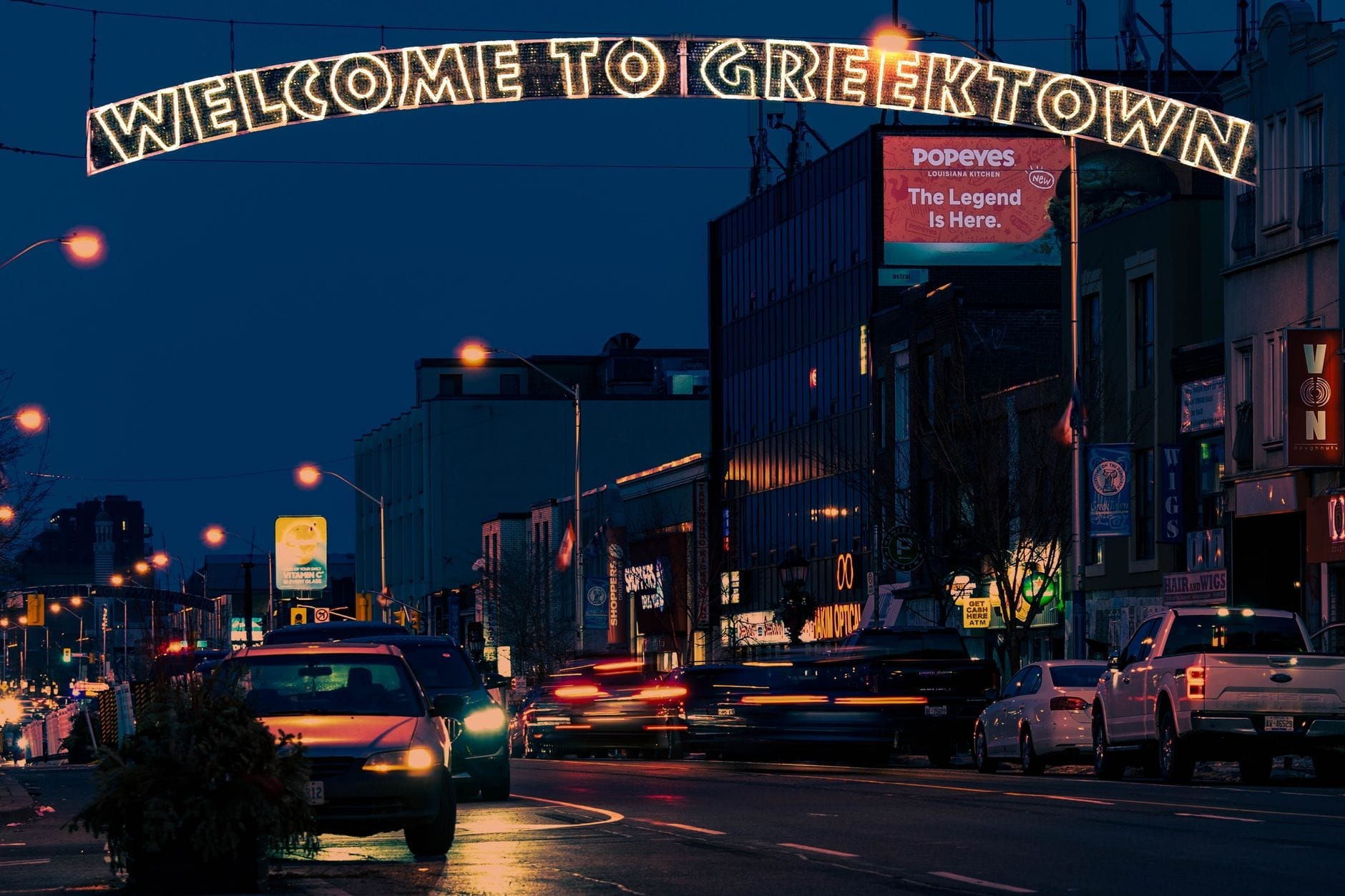
What Is Greektown on the Danforth?
Greektown on the Danforth is a Business Improvement Area (BIA) stretching along Danforth Avenue in Toronto's east end, and it represents one of the most culturally coherent neighbourhoods in a city defined by its diversity. The official BIA address is 452A Danforth Avenue, Toronto, ON, and the district runs roughly from the Don Valley Parkway to Luttrell Avenue. Street signs appear in both English and modern Greek, and on a warm evening the air carries the distinct smell of charcoal, oregano, and grilled meat from restaurants that line both sides of the street.
The neighbourhood is frequently cited as the largest Greek community in North America, a distinction that carries real weight when you walk the strip. Unlike some ethnically branded districts in North American cities, Greektown has retained a genuine residential and commercial character. Greek bakeries sell koulouri and baklava not as novelties but as everyday goods. Older patrons sit outside kafeneions nursing Greek coffee in the afternoon. For a sense of how Greektown fits into the broader tapestry of Toronto's multicultural neighbourhoods, the guide to Toronto's multicultural neighbourhoods is a useful starting point.
ℹ️ Good to know
Greektown is a public street and open at all hours. Individual restaurants and shops set their own hours, so call ahead if you have a specific venue in mind, especially on weekdays when some smaller businesses close earlier.
How the Neighbourhood Changes Through the Day
Mornings on the Danforth belong to locals. Bakeries open early, and the smell of fresh bread and pastry hits you before you even see the shop fronts. Foot traffic is light, and it is a good time to browse without pressure, pick up a coffee and a piece of spanakopita, and walk the length of the strip at an unhurried pace. Shops selling imported Greek goods, ceramics, and religious icons are often just opening their shutters before 10am.
By midday, restaurants begin to fill, especially on weekends. Many tavernas push their lunch menus hard at this hour, and you can often get a full meal at a noticeably lower price than the same dishes at dinner. The foot traffic peaks around 1pm on Saturdays, when the Danforth resembles a slow-moving parade of families, couples, and groups.
Evenings are where Greektown earns its reputation. From around 6pm onward, restaurant terraces fill up, the grill smoke thickens, and the neighbourhood gets loud in the best way. Some restaurants stay open past midnight on Fridays and Saturdays. The lighting along the strip is warm and the patio culture is genuine, not manufactured. If you are visiting in summer, an evening walk down Danforth between Broadview and Pape is one of the more enjoyable free experiences Toronto offers.
💡 Local tip
Arrive for dinner before 6:30pm on summer weekends to avoid waits at the more popular tavernas. Most do not take reservations for small parties, and the outdoor tables go fast.
Tickets & tours
Live prices and dates from our booking partner. If you book, we may earn a commission at no extra cost to you.
Toronto Old Town: Dark Side Exploration Game and Tour
From 12 €Instant confirmationFree cancellationLEGOLAND Discovery Centre Toronto tickets
From 16 €Instant confirmationFree cancellationToronto 'Little Canada' entrance tickets
From 27 €Instant confirmationFree cancellationNiagara Falls evening tour with boat, dinner and Illumination Tower
From 77 €Instant confirmationFree cancellation
Getting Here and Getting Around
The TTC Line 2 (Bloor–Danforth subway) runs directly beneath Danforth Avenue, making this one of the easiest neighbourhoods in Toronto to reach without a car. Chester station puts you at the western edge of the main strip, roughly a three-minute walk to the densest cluster of restaurants. Pape station drops you closer to the centre, about seven minutes from the heart of the strip. Broadview station is slightly west and marks the neighbourhood's informal gateway from the downtown side.
If you are combining Greektown with other east-end destinations, the TTC makes connections straightforward. The guide to getting around Toronto covers fares, Presto card options, and transit logistics across the city. Driving is possible but street parking along Danforth is limited and competitive on weekend evenings; side streets offer more options a block or two north or south.
The neighbourhood itself is entirely navigable on foot. Danforth Avenue is flat, the sidewalks are wide, and the distance from Broadview to Luttrell is walkable in about 25 minutes at a comfortable pace without stopping. Cyclists will find the area accessible, though the main strip has no dedicated bike lane, so most cyclists use the side streets.
Cultural Context: Why This Neighbourhood Exists
Greek immigration to Toronto accelerated significantly from the 1950s through the 1970s, and the Danforth corridor became the commercial and social heart of that community. The area developed organically around social clubs, Orthodox churches, and small family businesses, which gave it a cohesion that more recently constructed ethnic shopping districts often lack. Today the Orthodox presence remains strong: the domes of St. Irene Chrysovalantou Greek Orthodox Church are visible from the street, and the rhythms of the liturgical calendar still shape some business closures and community events.
Pop culture has added another layer to the neighbourhood's identity. Several scenes from the 2002 film My Big Fat Greek Wedding were filmed in Greektown, and the connection has become part of how the area markets itself, though locals tend to treat it as a footnote rather than the main story. The neighbourhood's significance predates the film by decades.
The annual Taste of the Danforth festival, held in August, draws hundreds of thousands of visitors over a single weekend. The festival closes Danforth Avenue to traffic and fills it with food stalls, live music, and cultural performances. It is one of the largest outdoor food festivals in Canada. If your visit coincides with it, be prepared for serious crowds. For guidance on timing a Toronto trip around events like this, the best time to visit Toronto page is worth consulting.
What to Eat and Where to Look
The food here is the point. Souvlaki and spit-roasted meats are the flagship offerings, and the quality across the strip is generally high because the competition is visible and immediate. Prices tend to be reasonable by Toronto standards, with most full dinners landing between CAD $20 and $40 per person before drinks. Mezze platters are a good strategy for first-time visitors: they let you sample a range of dishes, including taramosalata, dolmades, grilled halloumi, and spanakopita, without committing to a single main.
The bakeries deserve equal attention. Pastries like baklava, galaktoboureko, and koulouri are made fresh and sold cheaply. Several shops also carry imported Greek products, from olive oils to preserved goods, which make practical and lightweight souvenirs. The coffee culture is taken seriously, with Greek coffee (medium or sweet, brewed in a briki) available at cafes throughout the strip.
Greektown is one node in a broader east-end food scene. If you are planning a dedicated food day, the Toronto food guide maps out the city's most worthwhile culinary destinations by neighbourhood.
💡 Local tip
Order Greek coffee at the end of a meal rather than a beginning. It is strong, unfiltered, and arrives in a small cup with grounds at the bottom. Let it sit for 30 seconds before drinking.
Photography, Accessibility, and Practical Notes
The visual character of Greektown is strongest in the hour before sunset in summer, when the warm light hits the painted Greek lettering on shop fronts and the terraces are full of people. The blue-and-white colour palette that dominates Greek-themed signage throughout the strip photographs well in natural light. Wide-angle shots along the Danforth axis work best from the minor cross streets, where you get the full depth of the streetscape without being in the way of foot traffic.
Accessibility along Danforth Avenue is reasonable for wheelchair users and those with mobility considerations. The sidewalks are paved and generally even, though occasional uneven sections appear near older shop fronts. TTC subway stations on Line 2 vary in their elevator availability; check the TTC's accessibility map before visiting if this is a factor. Individual restaurants range from fully accessible to difficult, depending on whether they have steps at the entrance or narrow interiors.
Who might not enjoy Greektown: visitors who prefer tightly curated, aesthetically uniform districts may find the Danforth a little rough around the edges in places. It is a working commercial street, not a pedestrianised tourist precinct. Some blocks between the main restaurant clusters are quieter and less polished. If the food and culture are not the draw, there is not a single iconic landmark to anchor a visit the way a museum or viewpoint would.
Seasonal Considerations
Summer is the obvious peak season. Patio dining is central to the Greektown experience, and without it, the neighbourhood loses some of its energy. From late May through September, the outdoor terraces are reliably open and the street has a sociable, warm-weather character that is hard to replicate indoors.
Winter visits are not without merit, but the experience is different. Restaurants are warm and generally uncrowded on weeknight evenings, and the bakeries and coffee shops are excellent refuges from the cold. Toronto's winters are genuinely cold, with temperatures regularly dropping below -10°C in January and February. The guide to Toronto in winter covers how to navigate the city during the colder months, including what to expect from street-level neighbourhoods like Greektown.
Spring and fall offer the best compromise: mild temperatures, no festival crowds, and restaurants that are busy enough to feel alive without the summer wait times. October in particular is underrated for a Greektown visit, as the nearby residential streets show their autumn foliage and the neighbourhood feels genuinely local.
Insider Tips
- The blocks between Chester and Pape stations contain the highest concentration of traditional tavernas and bakeries. The blocks east of Pape toward Main Street are quieter and more residential, with fewer tourist-facing businesses.
- Several restaurants on the Danforth have second-floor or rooftop terraces that are not visible from street level. If you see stairs going up inside, ask about seating above the main floor — views along the Danforth from height are considerably better than from a sidewalk table.
- The Taste of the Danforth festival (held annually in August) is worth attending specifically on Friday evening or Sunday late morning, when crowds are thinner than the Saturday peak. Saturday afternoon is the busiest single window of the festival weekend.
- Greek bakeries on the Danforth often reduce pastry prices in the late afternoon to move the day's stock. If you are budget-conscious, visiting around 4–5pm can mean paying noticeably less for the same items sold at full price in the morning.
- The Danforth Music Hall, a well-preserved mid-sized concert venue at the western end of the strip, hosts touring acts regularly and is worth checking for shows that coincide with your visit. It adds a distinct evening option beyond the restaurant circuit.
Who Is Greektown on the Danforth For?
- Food-focused travellers who want to eat well without spending a lot
- Visitors interested in immigrant community history and cultural geography
- Evening diners and patio seekers during Toronto's summer months
- Festival-goers visiting Toronto in August for Taste of the Danforth
- Families looking for an accessible, low-cost neighbourhood to explore with children
Nearby Attractions
Combine your visit with:
- Aga Khan Museum
The Aga Khan Museum in Toronto is one of North America's only institutions dedicated to the arts of Muslim civilizations. Housed in a purpose-built building designed by architect Fumihiko Maki, it holds over 1,200 masterpieces spanning 14 centuries. Whether you spend 90 minutes or a full afternoon, the experience rewards curiosity at every turn.
- The Village at Black Creek (Black Creek Pioneer Village)
The Village at Black Creek is a fully realized open-air living history museum in northwest Toronto, where around 40 restored historic buildings, heritage breed livestock, and costumed interpreters recreate rural Ontario life from the 1800s. Operated by the Toronto and Region Conservation Authority, it offers a rare, tactile experience of pre-industrial Canada that few urban attractions can match.
- Blue Mountain & Collingwood
Perched on the Niagara Escarpment above Georgian Bay, Blue Mountain and Collingwood form Ontario's most accessible four-season resort destination. Whether you come for winter skiing, summer hiking, or a weekend in the pedestrian village, the area rewards visitors who plan around the season.
- Canada's Wonderland
Canada's Wonderland is the country's largest amusement park, located in Vaughan just north of Toronto. With 18 roller coasters, more than 200 attractions, and a 20-acre water park, it's a full-day commitment that rewards planning. Here's how to make the most of it.
Planning a trip? Discover personalized activities with the Nomado app.