Greek Theatre of Taormina: Ancient Drama, Volcanic Views, and 2,300 Years of History
The Teatro Antico di Taormina is one of Sicily's most spectacular ancient sites, combining Greek and Roman architecture with an unmatched backdrop of Mount Etna and the Ionian Sea. Cut into the rock of Monte Tauro in the 3rd century BC, this theatre is still in active use today. Here is everything you need to plan a visit that lives up to the setting.
Quick Facts
- Location
- Via Teatro Greco, 1, 98039 Taormina ME, Sicily
- Getting There
- Walk up from Taormina's centro storico via Corso Umberto; the theatre is about 10 minutes on foot from the main bus terminal at Porta Catania
- Time Needed
- 1.5 to 2.5 hours, more if you linger for the views
- Cost
- Full price €14; reduced €7 (EU citizens 18–25); free for EU under-18s, Italian teachers, visitors on their birthday, and on the first Sunday of each month for all visitors
- Best for
- Ancient history, dramatic landscapes, photography, architecture
- Official website
- www.visitsicily.info/en/attrazione/il-teatro-greco-di-taormina
What the Teatro Antico di Taormina Actually Is
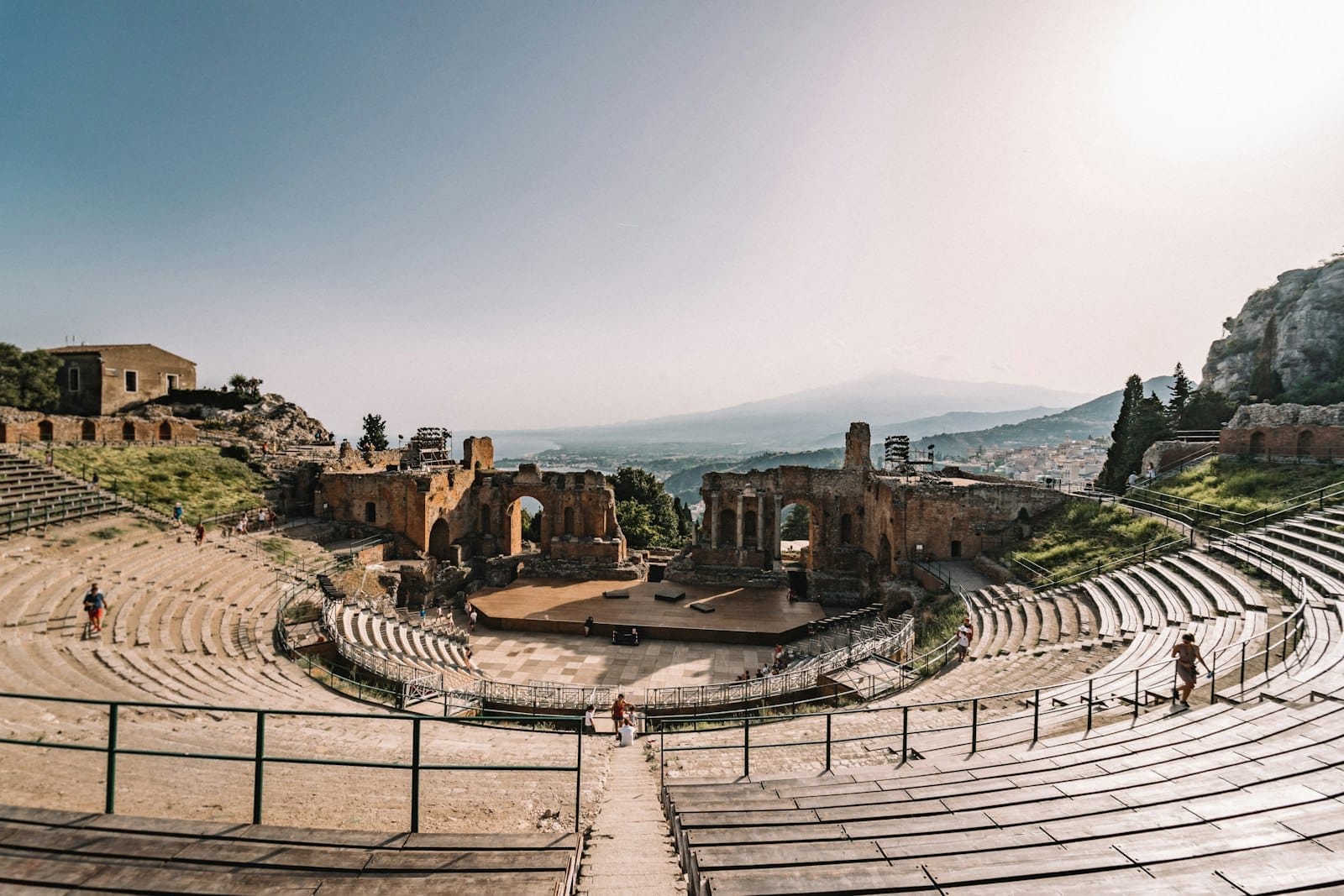
The Greek Theatre of Taormina, officially called the Teatro Antico di Taormina, is a partially intact ancient theatre carved directly into the southern slope of Monte Tauro in the 3rd century BC. It is the second-largest ancient theatre in Sicily after the one in Syracuse, and it is, by almost any measure, the most dramatically situated. The cavea faces south and east, framing a panorama that takes in the coastline, the Ionian Sea, and the snow-dusted cone of Mount Etna on clear days. It is not a ruin in the crumbling, desolate sense. It is a working venue that hosts a major arts festival every summer, which means the site is actively maintained and retains a functional atmosphere rather than a purely archaeological one.
What visitors see today is a hybrid of two civilisations. The Greeks who founded Tauromenion in the 4th century BC built the original theatre into the hillside, using the natural slope as the structural base for the seating tiers. The Romans who later controlled Sicily significantly rebuilt and expanded the structure, widening the stage building (the scaenae frons), adding a two-storey backdrop of brick arches, and repurposing the orchestra for gladiatorial combat rather than choral performance. The arched brick walls still standing behind the stage are Roman work, not Greek, but they photograph magnificently against the sky.
ℹ️ Good to know
Opening hours change with the seasons. The site opens at 09:00 year-round, but closing times range from 16:00 in winter to 19:00 in summer (May through August). Always check before visiting, especially in shoulder months when the hours shift every two weeks.
Arriving and First Impressions
The entrance on Via Teatro Greco is easy to find but easy to underestimate from street level. Standard admission is €14 (€7 reduced for EU citizens aged 18–25; higher tariffs may apply during special exhibitions or festival performances). You pay at the ticket booth, pass through a modest gate, and then walk through a vaulted corridor that opens, with little warning, onto the full sweep of the theatre. That first moment of emerging into the cavea is the one most visitors talk about. The seating tiers curve away below you, the stage arches rise ahead, and beyond them, depending on the weather, Etna floats on the horizon like a separate world.
The stone of the seating tiers is worn smooth and pale. In morning light it has a warm, almost cream colour. By early afternoon the sun moves to the south and the stone bleaches to a harder white, making photographs flatter. The smell inside the theatre on hot summer days is dry stone and wild herbs, the thyme and fennel that grow in the cracks between the ancient blocks. In spring, small flowers push through the same gaps.
Taormina draws enormous numbers of day-trippers, and the theatre is one of the main reasons they come. If you arrive after 10:30 on a summer morning, you will share the space with tour groups, school trips, and independent visitors moving in clusters. The site is large enough to absorb the crowds reasonably well, but the best viewpoints, specifically the central upper tiers and the area directly in front of the stage arches, fill up quickly. For a quieter experience, aim to arrive at opening (09:00) or within the last hour before closing. For more context on timing your visit to Taormina as a whole, the best time to visit Sicily guide covers seasonal patterns across the island.
Tickets & tours
Hand-picked options from our booking partner. Prices are indicative; availability and final rates are confirmed when you complete your booking.
Taormina private tour with an expert guide
From 42 €Instant confirmationFree cancellationEntrance tickets to the Ancient Theater of Taormina with Audioguide
From 26 €Instant confirmationSyracuse's Greek Theatre and Neapolis Guided Tour
From 39 €Instant confirmationFree cancellationPrivate Tour of Syracuse's Greek Theatre and Neapolis
From 250 €Instant confirmationFree cancellation
The View: Why the Setting Defines the Experience
It would be incomplete to describe the Greek Theatre of Taormina without spending time on the view, because for many visitors the panorama is the primary memory they take away. The theatre was positioned on the hillside deliberately, and the architects understood what they were doing. The stage building acts as a frame. Through the central archway and the gaps between the brick columns, you see the sea, the coastline curving toward Catania, and, on clear days, Etna rising to around 3,326 metres above sea level with a plume of steam or smoke trailing from the summit crater.
The quality of this view changes hour by hour. Early morning brings low light that picks out the texture of the stage brickwork and turns the sea a dark, deep blue. Late afternoon shifts the colour temperature toward gold, and the shadow of Monte Tauro begins to fall across the lower tiers. Etna is most often visible in early morning and late afternoon, when haze has not built up over the coastal plain. In summer midday heat, the mountain frequently disappears entirely behind atmospheric haze. If the view matters to you, morning is the reliable time.
💡 Local tip
For the clearest view of Etna, visit on a day when the wind has come from the northwest overnight. This clears the coastal haze. A quick check of the weather forecast before your visit can save disappointment.
Walking the Site: What to See Beyond the Main Cavea
Most visitors descend to the orchestra level and photograph the stage arches, which is the obvious and correct thing to do. The brick scaenae frons is the best-preserved part of the Roman reconstruction, and standing at orchestra level gives you the full theatrical proportions of the space. The stage area is roped off for preservation, but you can get close enough to read the layers of construction, Greek stonework at the base giving way to Roman brick above.
Spend some time in the upper tiers, which most visitors rush past. The view from the highest accessible row is wider than from the orchestra, and you can see both the theatre's geometry and the coastline simultaneously. There are also two flanking towers at the top of the cavea, roofless but still standing to considerable height, with carved stone details worth examining if you have an interest in Roman masonry.
The site also contains a small permanent display area near the entrance with excavated artefacts and explanatory panels covering the theatre's construction history and its various phases of use. If you read Italian, the original panels are detailed. English translations are available but briefer. For the deeper archaeological context of ancient Sicily, the guide to the best Greek ruins in Sicily places Taormina within the broader picture of the island's ancient heritage.
Seasonal Variations and the Summer Festival
The theatre transforms completely in summer. The Taormina Arte festival, held annually from roughly June through August, uses the ancient stage as its backdrop for opera, theatre, film screenings, and concerts. During these periods, the site may close early or restrict access to prepare for evening performances, and on festival nights the theatre is lit artificially in ways that make it look like an entirely different building. If you are visiting primarily as a cultural tourist rather than a festival attendee, avoid summer evenings and check whether festival scheduling has altered daytime access before you go.
Outside of festival season, the theatre feels more genuinely archaeological. October and November bring cooler air, fewer visitors, and a quality of light that suits the worn stone. The site stays open until 16:00 or 17:00 depending on the precise date, which limits photography in the golden hour, but the trade-off in atmosphere and crowd levels is significant. March and April offer a middle ground: mild temperatures, spring wildflowers in the seats, and fewer visitors than high summer.
⚠️ What to skip
During the Taormina Arte festival season (roughly June to August), evening events may restrict daytime access to parts of the theatre. Confirm visiting hours directly with the site or via the official Visit Sicily page before your trip.
Practical Details: Getting There, Photography, and What to Bring
Taormina has no train station in the town centre. Trains stop at Taormina-Giardini station on the coast below, from which an AST or Interbus service or a taxi takes you up the hill. Most visitors arriving by public transport from Catania or Messina take the intercity bus, which drops passengers at Porta Messina or the main terminal near Porta Catania. From there, Corso Umberto runs the length of the historic centre, and Via Teatro Greco branches off from it on the eastern side. The walk from Porta Catania to the theatre entrance takes roughly 10 minutes on foot, uphill on a pedestrianised street.
The theatre is set on uneven ancient stone throughout. Comfortable, flat-soled shoes are essential. Sandals with thin soles become uncomfortable on the worn tiers after an hour. There is no shade in the main cavea during summer midday, and temperatures inside the stone bowl can feel significantly higher than the ambient air temperature. Bring water, sunscreen, and a hat if you are visiting between June and September.
Photography is unrestricted within the general public areas. A standard wide-angle lens captures the theatre's scale from the upper tiers; a longer focal length lets you pull in the Etna cone through the stage arches without the coastal haze swallowing it. Tripods are manageable given the open space but are rarely necessary given modern camera sensors. The best light for the stage arches is from the east, which means early morning. The best light for photographing the view through the arches toward Etna is mid to late morning when the sun is higher and illuminates the mountain's flanks.
If you are combining the theatre with other Taormina sights, Castelmola, the hilltop village above Taormina, is reachable on foot or by cable car and rewards the extra effort with even higher views over the coast. Budget at least half a day for both.
Who Should Think Twice
The Greek Theatre of Taormina has genuine limitations. Visitors with significant mobility difficulties will find the uneven ancient stone challenging, and there is no information from official sources about adapted access routes. The site has no seating or rest areas aside from the stone tiers themselves. In peak summer, the heat inside the open stone bowl is relentless and the crowds substantial. Visitors who have already seen Segesta's temple or the Valley of the Temples at Agrigento expecting a similar experience of solitary, contemplative ruin-wandering may find Taormina's theatre more touristic and less serene than those sites.
The theatre is also one of Sicily's most commercialised ancient sites, partly because Taormina itself is among the island's most visited towns. If you prioritise authenticity and quiet over dramatic settings, the Segesta temple offers a comparably powerful ancient atmosphere with a fraction of the foot traffic.
Insider Tips
- The first Sunday of every month is free admission for all visitors, not just EU citizens. This makes it one of Sicily's few major sites with a genuinely free public day, but expect it to be crowded by mid-morning.
- If you visit on your birthday, bring your passport or ID, as the free birthday admission requires proof of date of birth at the ticket booth.
- The small side rooms adjacent to the stage arches, partly preserved from the Roman scaenae frons, are often overlooked. They show the layering of Greek stonework at the base and Roman brick above more clearly than the main facade.
- The theatre looks entirely different at different times of year. In late winter and early spring, the stone tiers have wild flowers growing from the cracks between blocks, which adds a quality to photographs that is absent in summer.
- Taormina fills its hotels months in advance during the festival season. If you want to attend a performance in the theatre rather than simply visit it as a monument, book accommodation and event tickets well ahead, often six months or more for headline acts.
Who Is Greek Theatre of Taormina For?
- History and archaeology enthusiasts interested in the transition from Greek to Roman culture in ancient Sicily
- Photographers chasing the combination of ancient ruins and active volcano in a single frame
- Travellers on a one-week Sicily itinerary who want to pair a coastal resort town with a major archaeological site
- Couples looking for a visually dramatic and historically rich half-day experience
- Visitors who want to attend a live cultural performance in an ancient setting during the summer festival season
Nearby Attractions
Other things to see while in Taormina:
- Castelmola
Castelmola sits on a rocky peak above Taormina, offering panoramic views over the Ionian Sea, the smoking cone of Etna, and the coastline below. A small Norman-era village with castle ruins, medieval churches, and far fewer crowds than the resort town it overlooks, it rewards the effort of getting up here.
- Corso Umberto
Corso Umberto I is Taormina's main pedestrian street, stretching roughly one kilometre between Porta Messina and Porta Catania. It follows the line of an ancient Greco-Roman road and passes through layers of Arab, Norman, Gothic, and Baroque architecture. Access is free and the street is open at all hours, though the experience changes dramatically depending on when you arrive.
- Giardini Naxos
Giardini Naxos sits on a wide Ionian bay just below Taormina, combining some of Sicily's most accessible beach life with the remarkable backstory of Naxos, the island's first Greek colony, founded around 735 BC. The seafront promenade is free to walk, the water is reliably calm, and the archaeological park adds genuine historical weight to what might otherwise look like a straightforward resort town.
- Isola Bella
Isola Bella is a tiny protected islet just off the Mazzarò coast below Taormina, connected to the mainland by a narrow strip of land that can be submerged depending on tides. Once a private retreat, it is now a Regional Naturalistic Nature Reserve with a small museum inside a restored villa. The surrounding coves offer some of the clearest water on Sicily's Ionian coast.