Castelmola: The Hilltop Village That Puts Taormina in Perspective
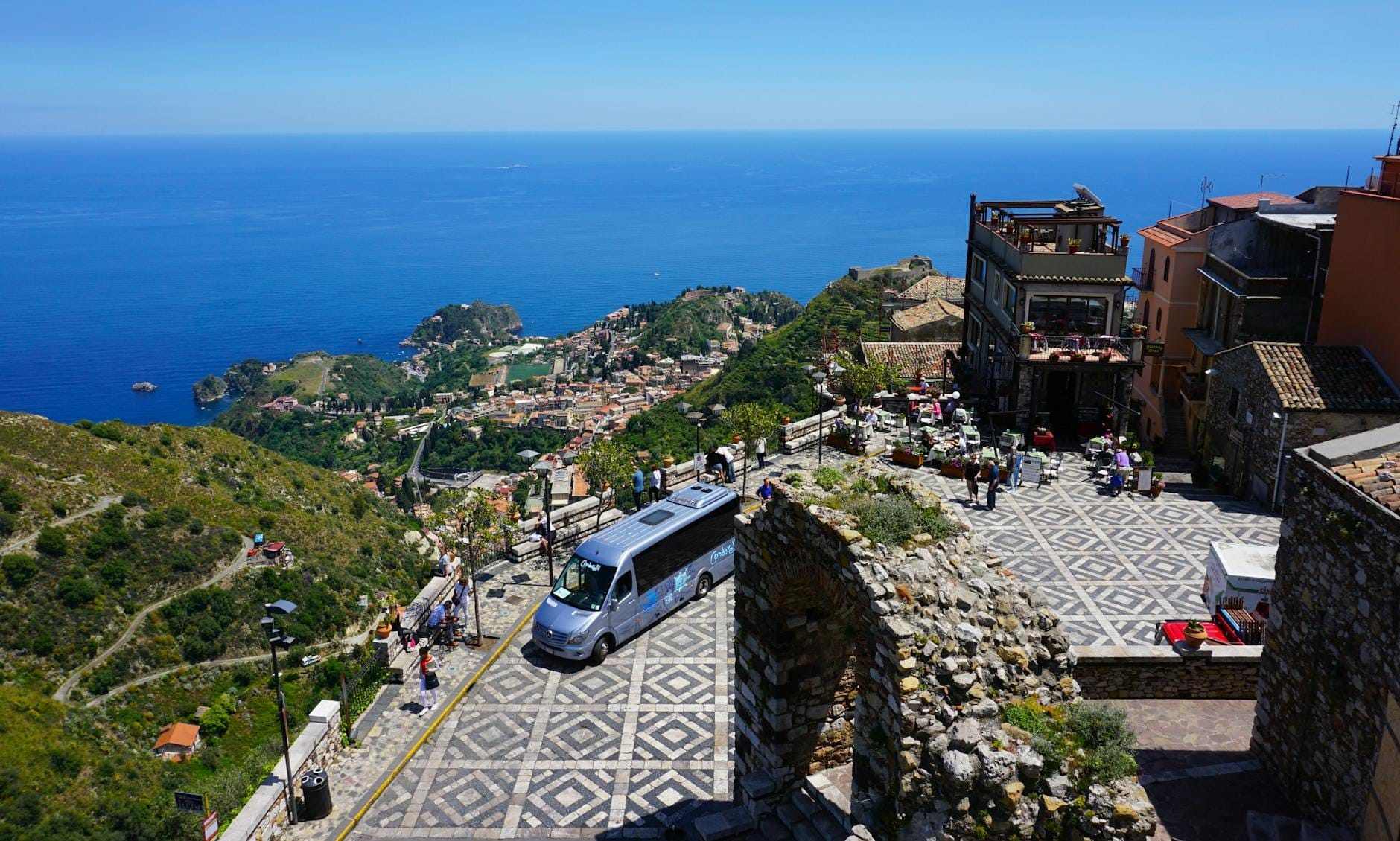
Castelmola sits on a rocky peak above Taormina, offering panoramic views over the Ionian Sea, the smoking cone of Etna, and the coastline below. A small Norman-era village with castle ruins, medieval churches, and far fewer crowds than the resort town it overlooks, it rewards the effort of getting up here.
Quick Facts
- Location
- Castelmola, Province of Messina, Sicily — hilltop above Taormina
- Getting There
- Local bus from Taormina (~10–15 min); taxi; on foot via marked trail; or by car along SP10
- Time Needed
- 2–4 hours, or half a day if walking up from Taormina
- Cost
- Free to enter the village; castle area accessible at no charge
- Best for
- Panoramic views, medieval history, escaping Taormina's summer crowds
- Official website
- www.visitsicily.info/en/castelmola
What Castelmola Actually Is
Castelmola is a small hilltop village perched on a rocky crag roughly 520 metres above sea level, directly above Taormina in the Province of Messina. It is a functioning municipality, not a theme park or a scenic outlook platform, which means stone houses are lived in, the bar on the main square has been open for generations, and the cats that patrol the terraces belong to someone. The village is built around and into the ruins of a Norman-era castle known as Castello di Mola, whose name comes from the concave, millstone-like shape of the summit rock on which it sits.
The village is small enough to walk end to end in fifteen minutes, but the views it commands are disproportionately large. On a clear day, you can trace the entire arc of the Ionian coast from the Calabrian toe of mainland Italy in the north down past Taormina's famous Greek theatre far below to the dark lava fields south of Catania. Etna fills the southern skyline, close enough that you can make out the summit craters. This geographic advantage, combined with the village's near-complete escape from the coach-tour infrastructure that dominates Taormina's Corso Umberto, is what makes Castelmola worth the climb.
ℹ️ Good to know
The village itself is free to enter and open at all hours. The castle area is generally accessible during daylight and into the evening. Individual churches, shops, and bars set their own hours. No tickets are required at the village gate.
The Approach: Getting Up There
Most visitors arrive by the local bus that runs from Taormina up to Castelmola, stopping near Piazza Sant'Antonio at the village entrance. The journey takes around 15 to 20 minutes along a road of tight switchbacks that would be nerve-wracking to drive yourself. Taxis are the other popular option, and drivers typically wait near the church of Sant'Antonio Abate in the village for the return trip, though this should not be assumed in low season.
The more physically satisfying option is to walk up via the marked footpath from Taormina, which passes through terraced lemon groves and skirts the older walls before arriving at the village from below. The route is doable in around 45 minutes to an hour depending on pace, and many visitors walk up and take the bus back down. Bring water, wear shoes with grip, and start early if you are doing this in summer, because the exposed sections of the path become punishing once the sun is fully up.
Drivers can follow the SP10 road up from Taormina, a distance that is only about 2 kilometres as the crow flies but considerably longer in actual driving distance due to the hairpin bends. Parking is available within the village. If you are combining Castelmola with other stops along the Taormina coast, a car gives you the most flexibility.
Castelmola pairs naturally with a morning at the Greek Theatre in Taormina — spend the theatre visit before the midday heat, then head up to Castelmola for the afternoon when the light on the sea turns golden and the worst of the tourist coaches have started their return journeys.
Tickets & tours
Hand-picked options from our booking partner. Prices are indicative; availability and final rates are confirmed when you complete your booking.
Giardini Naxos, Taormina and Castelmola half-day tour
From 94 €Instant confirmationFree cancellationGiardini Naxos, Taormina and Castelmola tour
From 85 €Instant confirmationFree cancellationEtna South Upper Craters Guided Excursion from Taormina
From 42 €Instant confirmationFree cancellationTaormina private tour with an expert guide
From 42 €Instant confirmationFree cancellation
The Castle Ruins and the Main Square
The Castello di Mola is not a museum. There are no audio guides, no ticket desks, no reconstructed interiors. What you get are substantial sections of Norman wall clinging to the summit rock, and the sensation of standing on a fortification that was strategically important enough for multiple civilisations to fight over. The site was used by the Byzantines before the Normans, and before them by the Sicels, the island's pre-Greek indigenous people. The name Mola refers to the millstone shape of the crag, though the village has also been called Castel Mola and is officially registered as the Comune di Castelmola.
Reaching the castle from the village square takes around ten minutes of uphill walking through narrow alleys. The path is uneven and there are no guardrails at the top, so the castle area is not well suited to very young children or anyone with significant mobility limitations. The reward is a 360-degree view that is arguably even more expansive than what you see from the village streets below.
Back in the village, Piazza Sant'Antonio is the social centre. There is a historic bar here that is famous locally for its almond wine, a sweet, slightly bitter local specialty made from Sicilian almonds. Sitting at an outdoor table in the late afternoon, with the sea visible in the gap between the buildings and the temperature a degree or two cooler than it would be in Taormina, is one of the more genuinely pleasant experiences the area offers.
The Churches: More History Than First Appears
Castelmola has several churches that deserve more than a glance in passing. The Church of Saint Nicholas of Bari is the most prominent, sitting on the main square. The current building was largely rebuilt in 1934 and 1935, but it incorporates 18th-century decorative elements and stands on a site of much older worship. Its facade looks out over a terrace from which the coastal panorama is framed as neatly as if it were planned that way.
Smaller and older are the churches of San Biagio and the Annunziata, both of which are believed to date to around the 11th century, placing them in the early Norman period of Sicilian history. They are not always open to visitors, and their interiors are modest, but the fact that they are still structurally intact after nine centuries in a seismic zone on a windswept hilltop is quietly remarkable.
For travellers interested in Sicily's layered Norman heritage, the churches here can be understood as smaller, more local expressions of the same architectural culture that produced the Cathedral of Monreale and the Palatine Chapel in Palermo, both of which are far grander but share the same historical roots.
How the Visit Changes Through the Day
Early morning, before 9am, Castelmola belongs almost entirely to its residents. The light comes in low from the east, hitting the castle walls at a sharp angle that makes the stonework look almost golden. There are very few other visitors at this hour, and the village is audibly different: swifts cutting across the square, someone opening a shutter, the smell of coffee from the bar before it properly opens. This is the best window for photography, and for genuinely feeling the scale of the place.
Between 10am and 2pm, day-trippers begin arriving, particularly in the peak months of July and August. The village never approaches the density of Taormina on a summer Saturday, but Piazza Sant'Antonio fills up and the lanes toward the castle become single-file. By mid-afternoon the crowd thins again as visitors head back down for dinner. The hour before sunset, roughly 6 to 7pm depending on the season, produces the best light on the sea and on Etna, and the village is quiet enough again to hear the wind.
In autumn and spring, the entire dynamic shifts. Castelmola in October or April can be nearly empty on a weekday, the air noticeably cooler than the coast below, and the views often sharper because the summer haze has lifted. Rain is possible in these months, and low cloud can close in around the summit entirely, which transforms the visit but does not ruin it — there is something atmospheric about the castle walls appearing through mist, even if the panorama disappears.
⚠️ What to skip
If you visit in summer, avoid the midday hours between 11am and 3pm. The exposed terraces and pathways have almost no shade, and the heat reflected off the stone is significant. Bring more water than you think you need.
Practical Notes for the Visit
Castelmola's streets are narrow, stone-paved, and frequently steep. This is not an accessible destination for wheelchair users or anyone who cannot manage uneven inclines. The bus stop and the main square are relatively level, but almost any exploration beyond them involves gradient. Comfortable walking shoes are not optional.
There is no large supermarket or pharmacy in the village. Bring any medications or supplies you might need. The bar on the main square sells drinks and some snacks, and there are a couple of small restaurants in the village, but Castelmola is not set up as a half-day dining destination in the way Taormina is. If you plan to eat up here rather than down in Taormina, check that restaurants are open before making the trip.
For those building a wider itinerary, Castelmola works well as part of a day that also includes Isola Bella in the morning and the views from Corso Umberto at dusk. A car makes this sequence straightforward; by public transport, the bus schedule needs checking in advance.
If you are spending more time in eastern Sicily, the day trips from Catania guide covers how to combine Taormina and Castelmola with other stops including the Alcantara Gorge and the Etna foothills.
💡 Local tip
Photography tip: the best Etna shots from Castelmola are taken from the terrace in front of the Church of Saint Nicholas, facing southeast, in the early morning before atmospheric haze builds. In summer, Etna's summit is often clearest before 9am.
Honest Assessment: Is It Worth Going?
Castelmola is not for everyone. If you are after beach time, nightlife, or a full museum experience, it offers none of those things. If you are exhausted from a long travel day or have limited mobility, the physical demands are real and the payoff may not justify the effort. And if you visit on a poor-weather day when cloud covers the summit, you will lose the main reason most people come.
But if panoramic views from medieval heights are something that moves you, if you want to briefly step off the conveyor belt of Taormina's tourist infrastructure, or if you are a photographer chasing that particular angle of Etna above the Ionian coast, Castelmola delivers with very little competition. The village is genuine, the views are extraordinary, the entry cost is zero, and on a good afternoon in late spring or early autumn, it is one of the more quietly satisfying places on this part of the island.
Insider Tips
- Take the bus up and walk down via the footpath to Taormina — the descent is far easier than the ascent, and you pass through terraced countryside that the road entirely bypasses.
- Try the almond wine (vino di mandorla) at the bar on Piazza Sant'Antonio. It is a genuinely local product and not easily found elsewhere on the island in the same form.
- The view of Etna is better from Castelmola than from most points in Taormina itself because the elevation clears the lower ridge that partially obscures the volcano from the town's terraces.
- In high summer, arriving by the first bus of the day and leaving before 11am gets you the best light, the emptiest lanes, and avoids the worst of the heat — all in a single move.
- The churches of San Biagio and the Annunziata are often overlooked by visitors heading straight for the castle. If you find them open, the interiors are small but the age of the buildings — Norman-era, around 1100 CE — gives them a different kind of weight than the rebuilt parish church on the main square.
Who Is Castelmola For?
- Photographers wanting elevated angles of Mount Etna and the Ionian coastline
- Travellers seeking a calmer alternative to Taormina's peak-season crowds
- History enthusiasts interested in Norman-era Sicily and Byzantine-Norman continuity
- Hikers who want a concrete destination at the top of a scenic walking route from Taormina
- Visitors who prefer free, open-air experiences over ticketed museum circuits
Nearby Attractions
Other things to see while in Taormina:
- Corso Umberto
Corso Umberto I is Taormina's main pedestrian street, stretching roughly one kilometre between Porta Messina and Porta Catania. It follows the line of an ancient Greco-Roman road and passes through layers of Arab, Norman, Gothic, and Baroque architecture. Access is free and the street is open at all hours, though the experience changes dramatically depending on when you arrive.
- Giardini Naxos
Giardini Naxos sits on a wide Ionian bay just below Taormina, combining some of Sicily's most accessible beach life with the remarkable backstory of Naxos, the island's first Greek colony, founded around 735 BC. The seafront promenade is free to walk, the water is reliably calm, and the archaeological park adds genuine historical weight to what might otherwise look like a straightforward resort town.
- Greek Theatre of Taormina
The Teatro Antico di Taormina is one of Sicily's most spectacular ancient sites, combining Greek and Roman architecture with an unmatched backdrop of Mount Etna and the Ionian Sea. Cut into the rock of Monte Tauro in the 3rd century BC, this theatre is still in active use today. Here is everything you need to plan a visit that lives up to the setting.
- Isola Bella
Isola Bella is a tiny protected islet just off the Mazzarò coast below Taormina, connected to the mainland by a narrow strip of land that can be submerged depending on tides. Once a private retreat, it is now a Regional Naturalistic Nature Reserve with a small museum inside a restored villa. The surrounding coves offer some of the clearest water on Sicily's Ionian coast.