Corso Umberto I, Taormina: The Street That Holds the Whole Town Together
Corso Umberto I is Taormina's main pedestrian street, stretching roughly one kilometre between Porta Messina and Porta Catania. It follows the line of an ancient Greco-Roman road and passes through layers of Arab, Norman, Gothic, and Baroque architecture. Access is free and the street is open at all hours, though the experience changes dramatically depending on when you arrive.
Quick Facts
- Location
- Corso Umberto I, 98039 Taormina (ME), Sicily, Italy — runs between Porta Messina and Porta Catania in the historic centre
- Getting There
- Park at Lumbi or Porta Catania car parks and walk or take the shuttle bus up. No vehicles permitted on the corso itself
- Time Needed
- 45–90 minutes for a focused walk; 2–3 hours if you sit at a café or visit churches along the way
- Cost
- Free — public pedestrian street, open 24 hours. Budget separately for cafés, shops, or nearby ticketed attractions
- Best for
- Architecture lovers, people-watchers, couples, first-time visitors to Taormina, and anyone combining the corso with a visit to the Greek Theatre
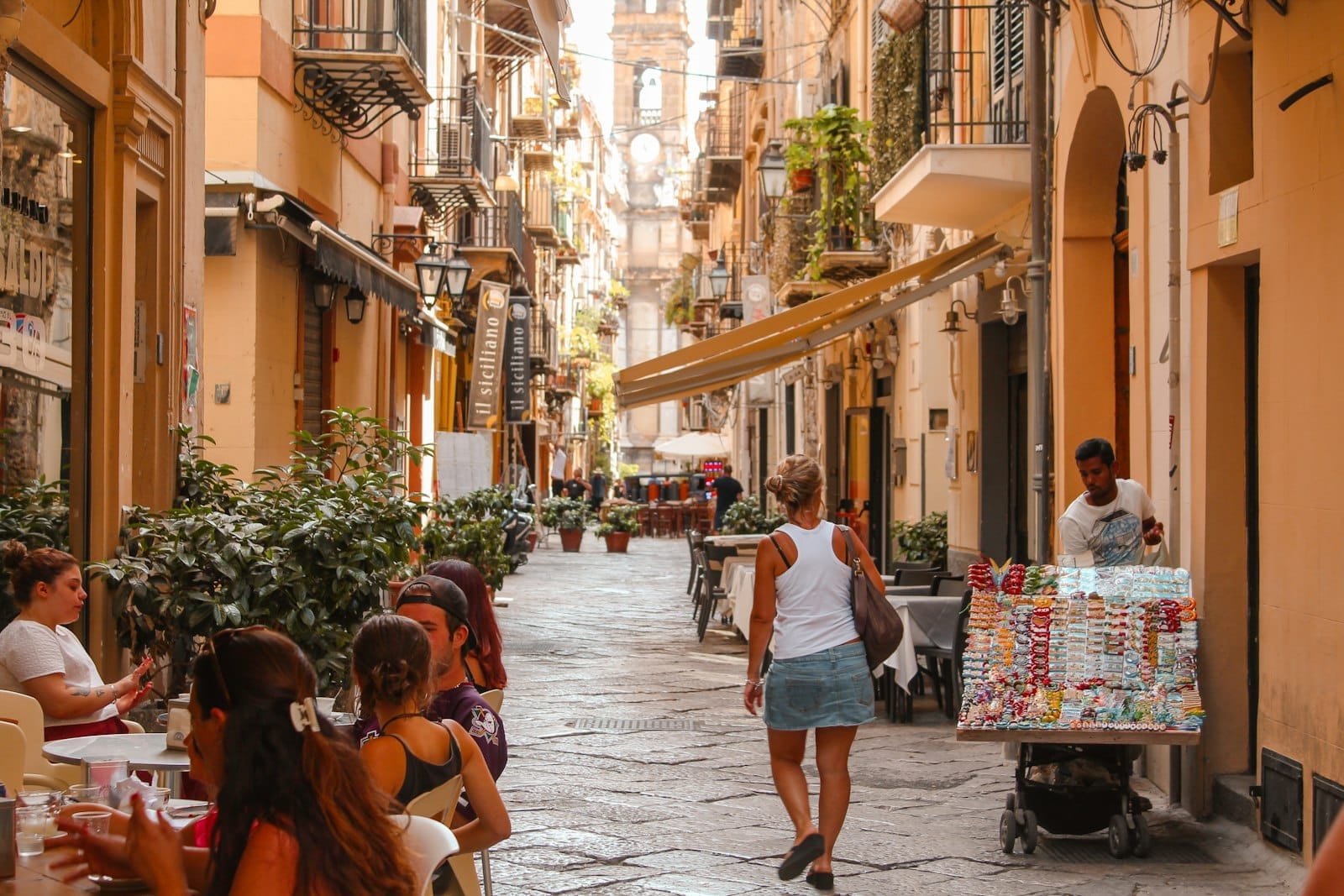
What Corso Umberto I Actually Is
Corso Umberto I is Taormina's pedestrian main street, running roughly one kilometre between two medieval gates: Porta Messina to the northeast and Porta Catania to the southwest. It is named after Umberto I of Savoy, King of Italy from 1878 to 1900, but its roots go considerably further back. The corso follows the exact path of the ancient Via Valeria, the Greco-Roman consular road that once connected Messina to Catania through the hilltop town of Tauromenium, as Taormina was then known.
This isn't a reconstructed historical street. It has been in continuous use for over two millennia, and the buildings lining it reflect every major cultural phase Sicily has passed through: Arab arches tucked behind Norman masonry, Gothic windows above Baroque doorways, and churches that stand on the footprints of earlier Greek and Roman structures. Walking the corso is, in a real sense, walking through the sediment of Sicilian history compressed into a single paved line.
ℹ️ Good to know
The corso is a public street: no ticket, no booking, no entrance gate. The only costs you'll encounter are the ones you choose — a coffee at Piazza IX Aprile, a pastry from one of the bars, or entry fees to the nearby Greek Theatre, which is a separate attraction.
How the Street Feels at Different Hours
Early morning, before 9am, Corso Umberto belongs almost entirely to locals. Shopkeepers roll up metal shutters, bar staff arrange chairs outside, and the light from the east catches the pale stone facades in a way that's almost too perfect. The air at this hour carries the smell of espresso and freshly baked cornetti from the bars near Porta Messina. The cobblestones, still damp from overnight cleaning, reflect the sky. This is genuinely the best time to photograph the street without crowds blocking your sightlines.
By mid-morning, the dynamic shifts completely. Tour groups arrive from the cable car and from the car parks below, and the corso narrows psychologically even though nothing has changed physically. The gelato shops open, souvenir displays spill onto the pavement, and the sound level rises sharply. Between roughly 10am and 6pm in high season (June to September), the street is genuinely crowded. Moving at your own pace requires patience.
Evening brings a different version of the corso again. The tour buses are gone, the light turns amber and then deep blue, and Taormina's permanent residents come out to walk. The passeggiata is a real cultural institution here, not a performance for tourists. Restaurants open their outdoor tables, candles appear, and the whole street slows down. This is when the corso shows its most atmospheric side.
💡 Local tip
Visit twice if you can: once in the morning for architecture and photography, once after 7pm for the passeggiata atmosphere and dinner. The experience is genuinely different each time.
Tickets & tours
Hand-picked options from our booking partner. Prices are indicative; availability and final rates are confirmed when you complete your booking.
Etna South Upper Craters Guided Excursion from Taormina
From 42 €Instant confirmationFree cancellationTaormina private tour with an expert guide
From 42 €Instant confirmationFree cancellationSyracuse and Ortygia Island guided tour from Taormina
From 65 €Instant confirmationFree cancellationMount Etna and Alcantara Gorges guided tour from Taormina
From 100 €Instant confirmationFree cancellation
The Architecture: What You're Actually Looking At
Taormina was successively controlled by Greeks, Romans, Arabs, Normans, and various Aragonese and Spanish rulers before becoming part of unified Italy in the 19th century. Corso Umberto I is the physical record of that sequence. The buildings don't conform to a single style because they weren't built by a single civilization. What makes the street architecturally interesting is exactly this layering.
The Clock Tower, known as the Torre dell'Orologio or Porta di Mezzo, sits roughly in the middle of the corso and marks the symbolic division between the street's two historical sections. The Greek-Roman part of town lies to the northeast; the medieval quarter, developed primarily under Norman and later Aragonese influence, lies to the southwest. The tower itself was added in the 15th century and incorporates an older archway. Passing through it feels like a threshold, which architecturally it is.
Along the corso's length you will encounter carved Gothic windows, Arab-influenced horseshoe arches, Baroque church facades, and occasional Roman stone fragments that have simply been absorbed into later walls. None of this has been over-restored. Some of it is genuinely worn, which makes it more credible.
Piazza IX Aprile: The Natural Pause Point
About halfway along the corso, the street opens into Piazza IX Aprile, a wide terrace that juts out over the hillside and delivers an unobstructed view across the Ionian Sea toward Etna. On clear days you can see the volcano clearly, sometimes with a faint plume rising from the summit crater. The piazza contains the 17th-century church of Sant'Agostino (now a library), the church of San Giuseppe, and a row of café terraces that capitalize on the view.
The terrace view is one of the most photographed in Sicily, and the café prices reflect this. A coffee here costs noticeably more than at a bar without a view. That's a transparent transaction: you're paying for the terrace. Whether it's worth it depends on how long you sit and how good the light is. For context on the broader landscape you're looking at, the volcanic trails of Mount Etna are visible across the water on a clear day and are roughly 50 kilometres to the southwest.
The piazza is also where the corso's crowd dynamics are most visible. Tour groups tend to cluster here, photograph the view, and then move on. If you arrive between 11am and 4pm in July or August, you will be sharing this space with a significant number of people. Come at dusk or first thing in the morning and it feels entirely different.
Walking the Full Length: What to Expect
The corso is approximately one kilometre from gate to gate, and it is relatively flat for a hilltop town, which is part of its appeal. The surface is cobbled, with sections of larger smooth stone near the piazzas. Comfortable walking shoes matter more than most guidebooks suggest: the cobblestones are uneven in places, and after an hour of browsing and stopping you will notice the difference.
Starting from Porta Messina and walking southwest, you pass small ceramics shops, bars, and several side streets worth exploring before reaching the Clock Tower. Beyond the tower the street opens slightly, and you begin to see the church facades that define the southwestern section. Porta Catania at the far end is the quieter gate, and the streets just beyond it lead toward the cable car station and, further down the hill, Giardini Naxos on the coast below.
Side streets branching off the corso are worth taking. Via Teatro Greco leads north toward the ancient theatre and passes some of Taormina's quieter residential architecture. Streets to the south offer glimpses of the valley below. The corso is the spine, but Taormina's texture is in these narrower lanes.
⚠️ What to skip
Mobility note: while the corso itself is relatively flat, approaching Taormina's historic centre from any of the car parks involves steep paths or steps. The cable car from Mazzaro beach provides the easiest access for visitors with mobility impairments, though the final approach to the corso still involves some uneven cobblestone. No formal accessibility grading has been confirmed for the street.
What Corso Umberto Is Not
It is worth being direct about the corso's limitations. The street is heavily commercial in its central sections, and in peak season the density of souvenir shops selling the same Sicilian ceramics and Etna lava-stone products can feel repetitive. The café quality varies considerably: some bars near the main piazza trade on location alone, while better options can be found by walking a hundred metres toward either gate.
The corso is also not a substitute for Taormina's actual historical monuments. The Greek Theatre of Taormina is a short walk from the corso and is one of the best-preserved ancient theatres in Sicily, with views over the sea that make the ticket price straightforward to justify. The corso leads you toward it but doesn't replace it.
Visitors who arrive expecting a quiet, atmospheric historic lane and stay only during peak daytime hours will likely find the corso overcrowded and commercially monotonous. Those who time their visit correctly — morning or evening, shoulder season rather than high summer — will find something considerably more rewarding.
Practical Notes: Getting There, Photography, and Timing
Taormina has no central car park on the corso itself. Drivers typically use the Lumbi car park to the north of town or the Porta Catania car park at the southwestern end, then walk or take the shuttle bus (orange local buses run between the car parks and the old town gates). The cable car from Mazzarò beach at the base of the hill is another practical option, depositing you near Porta Messina.
The corso is an easy addition to a day trip from Catania, which is roughly 45–50 kilometres to the south. If you're planning the broader region, the day trips from Catania guide covers transport options and how to combine Taormina with other eastern Sicily destinations.
For photography, the corso faces roughly northeast to southwest, which means morning light falls on the southwestern (Porta Catania) section, and afternoon light catches the northeastern facades. The Clock Tower photographs best in the late afternoon when the light is low and the stone glows. Piazza IX Aprile is best photographed with the sea view at golden hour, approximately 45 minutes before sunset in summer.
Taormina is worth visiting year-round, but the experience on the corso changes dramatically by season. Summer brings full commercial energy and maximum crowds. Spring and autumn offer better temperatures and a more local atmosphere. For a broader view of when to go, the best time to visit Sicily covers seasonal trade-offs across the island.
Insider Tips
- Walk the corso from Porta Catania toward Porta Messina (southwest to northeast) rather than the reverse. Most tour groups exit the cable car near Porta Catania and walk in the opposite direction, so going against the flow puts you ahead of the crowds for the first 15 minutes.
- The bar directly inside Porta Messina is consistently cheaper than any of the café terraces on Piazza IX Aprile and serves the same espresso. Use the piazza terraces for a long sit with the view; use the side-street bars for a quick coffee.
- The side streets immediately north of the Clock Tower lead to some of Taormina's quietest residential lanes, where the architecture is just as interesting but almost no one else is walking. Worth 20 minutes of detour.
- In July and August, the corso between 11am and 5pm is genuinely packed. If you can't avoid those hours, start at Porta Messina where the crowds thin first, and work toward Piazza IX Aprile rather than away from it.
- The Clock Tower's arch is narrow enough that two-way pedestrian traffic slows to a bottleneck at peak hours. Photographs of the tower itself are easier from a position 20–30 metres back, where you get the full arch and surrounding buildings in frame without being jostled.
Who Is Corso Umberto For?
- First-time visitors to Taormina who want to orient themselves before exploring individual monuments
- Architecture and history enthusiasts interested in Arab-Norman-Baroque layering in a single streetscape
- Couples looking for an evening passeggiata with restaurants and sea views
- Photographers working in early morning or golden-hour light
- Travellers combining a Taormina day trip with the Greek Theatre or the cable car down to the coast
Nearby Attractions
Other things to see while in Taormina:
- Castelmola
Castelmola sits on a rocky peak above Taormina, offering panoramic views over the Ionian Sea, the smoking cone of Etna, and the coastline below. A small Norman-era village with castle ruins, medieval churches, and far fewer crowds than the resort town it overlooks, it rewards the effort of getting up here.
- Giardini Naxos
Giardini Naxos sits on a wide Ionian bay just below Taormina, combining some of Sicily's most accessible beach life with the remarkable backstory of Naxos, the island's first Greek colony, founded around 735 BC. The seafront promenade is free to walk, the water is reliably calm, and the archaeological park adds genuine historical weight to what might otherwise look like a straightforward resort town.
- Greek Theatre of Taormina
The Teatro Antico di Taormina is one of Sicily's most spectacular ancient sites, combining Greek and Roman architecture with an unmatched backdrop of Mount Etna and the Ionian Sea. Cut into the rock of Monte Tauro in the 3rd century BC, this theatre is still in active use today. Here is everything you need to plan a visit that lives up to the setting.
- Isola Bella
Isola Bella is a tiny protected islet just off the Mazzarò coast below Taormina, connected to the mainland by a narrow strip of land that can be submerged depending on tides. Once a private retreat, it is now a Regional Naturalistic Nature Reserve with a small museum inside a restored villa. The surrounding coves offer some of the clearest water on Sicily's Ionian coast.