Gaasbeek Castle: The Medieval Fortress Just Outside Brussels Worth the Trip
Set in the rolling Flemish countryside southwest of Brussels, Gaasbeek Castle is a richly restored medieval fortress surrounded by a sculptural museum garden. It rewards visitors with ornate interiors, centuries of turbulent history, and a genuine escape from the city.
Quick Facts
- Location
- Kasteelstraat 40, 1750 Gaasbeek, Flemish Brabant — approx. 10 km southwest of Brussels city centre
- Getting There
- Best reached by car, bicycle, or a combination of train and bus. Check De Lijn or SNCB journey planners for current routes.
- Time Needed
- 2.5 to 4 hours, including castle interior, museum garden, and surrounding grounds
- Cost
- Standard combi ticket (castle + museum garden): €15. Museumpass holders: free. Persons with disabilities and one companion: free. Verify current prices at kasteelvangaasbeek.be.
- Best for
- History enthusiasts, architecture lovers, countryside walkers, families looking for a half-day excursion from Brussels
- Official website
- kasteelvangaasbeek.be/en
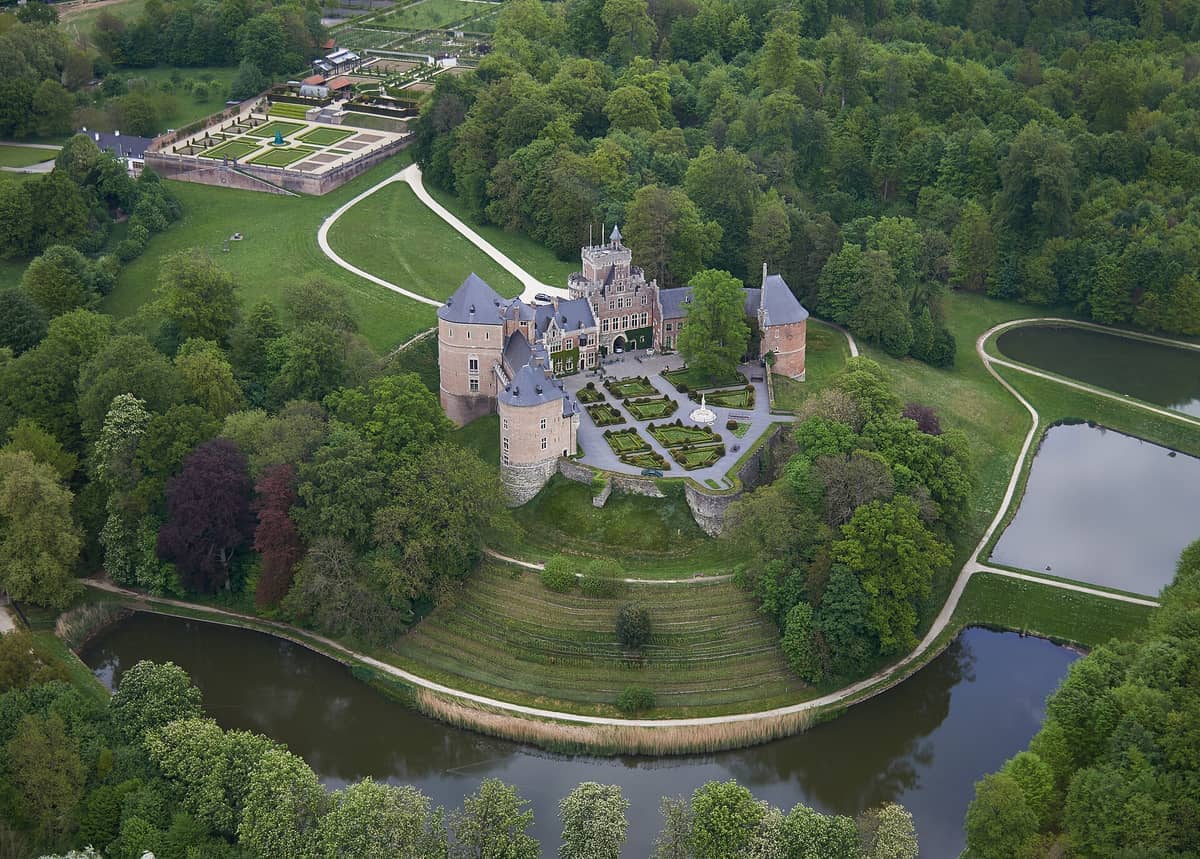
What Is Gaasbeek Castle?
Gaasbeek Castle (Dutch: Kasteel van Gaasbeek; French: Château de Gaasbeek) is a large medieval fortress set on a wooded hilltop in the municipality of Lennik, in the Flemish Brabant province southwest of Brussels. The castle's origins reach back to the 13th century, and it carries a long record of political conflict. The castle's story has long given it a notable place in local history that still draws visitors today.
The structure visitors see now is not purely medieval. Like many Belgian châteaux, Gaasbeek owes much of its current appearance to an ambitious late-19th-century restoration. Its last private owner, the Marquise Arconati Visconti, acquired the castle in 1887 and spent decades filling it with an exceptional collection of tapestries, paintings, furniture, silverware, and decorative objects, turning a ruined stronghold into something closer to a palatial residence-museum. She bequeathed the estate to the Belgian state in 1921, and it opened to the public in 1924.
ℹ️ Good to know
The castle is open seasonally from 1 April to 15 November. It closes entirely during winter — its so-called 'hibernation' period. Plan accordingly, and confirm hours at the official website before making the trip.
The Castle Interior: Layers of Time in One Building
Inside, the castle presents an unusual combination of medieval architecture and Victorian-era collecting instincts. The rooms are furnished with objects gathered from across Europe: Flemish tapestries of considerable size and age, carved wooden furniture, Renaissance paintings, Gothic sculpture, and silverwork displayed in cabinets that were clearly arranged for effect. The Marquise Arconati Visconti had strong aesthetic opinions and the resources to act on them — the result is dense, layered, and occasionally overwhelming in the best sense.
The scale of individual rooms varies significantly. Some feel intimate, with low ceilings and narrow window embrasures that communicate genuine medieval proportions. Others, particularly the formal reception rooms, have the height and ornamentation of a 19th-century romantic idea of what a castle should look like. The contrast is not a flaw — it is the essential character of the place.
Lighting inside can be low in certain sections, both to protect the textiles and because the windows are often small. Bring any optical aids you need and allow your eyes to adjust. The tapestries in particular reward close attention: details that disappear at a glance become legible when you slow down.
💡 Local tip
Last castle entry is at 17:00 (or 16:00 in the later-season schedule shown on the official site). If you want to see the interior without rushing, arrive no later than early afternoon. Late arrivals who linger in the garden first often find themselves short on time for the rooms.
Tickets & tours
Hand-picked options from our booking partner. Prices are indicative; availability and final rates are confirmed when you complete your booking.
Ghent tour from Brussels
From 43 €Instant confirmationFree cancellationEscape Tour self-guided, interactive city challenge in Antwerp
From 30 €Instant confirmationEscape Tour self-guided, interactive city challenge in Antwerp
From 30 €Instant confirmationTablet Workshop at Choco-Story Brussels
From 45 €Instant confirmation
The Museum Garden: Sculpture, Geometry, and Open Sky
The museum garden surrounding the castle is as much a destination as the building itself. Laid out across multiple terraced levels, it combines a formal geometric structure with sculpture placed throughout the greenery. The combination of clipped hedges, gravel paths, and stone statuary gives the garden a considered, unhurried atmosphere that contrasts with the density of the castle rooms.
In spring and early summer, the garden is at its most photogenic: flowering sections come into color, the air carries a cut-grass and damp-earth quality, and the light in the late morning hours falls across the facade at an angle that emphasizes the castle's vertical stonework. By mid-afternoon in summer, the garden fills with families and couples; the early evening light, in the hours before closing, returns a degree of calm.
The surrounding park and woodland extend beyond the formal garden and are worth exploring if time allows. The broader estate sits within a gentle agricultural landscape — meadows, hedgerows, tree-lined lanes — that feels far removed from the urban density of central Brussels despite being only about 20 kilometers away.
When to Visit and How the Experience Changes
Gaasbeek Castle is open Tuesday through Sunday from 10:00 to 18:00 (last castle entry at 17:00), and from October, closing moves to 17:00 with last entry at 16:00. Mondays are closed throughout the season. The castle is closed entirely outside the April-to-November season, so this is not an attraction accessible year-round.
Weekday mornings, particularly Tuesday through Thursday, see the thinnest crowds. Weekend afternoons, especially in May, June, and September when the weather encourages day trips from Brussels, bring considerably more visitors. If you have flexibility, a Tuesday or Wednesday morning visit offers the closest thing to having the rooms to yourself.
Brussels has a temperate oceanic climate with rain possible in any month and no guaranteed dry period. The garden visit is weather-dependent in a way the interior is not. Come prepared for cool, damp conditions even in summer: a light waterproof layer and comfortable walking shoes are practical across the season. The gravel and stone paths in the garden can be uneven, and the estate grounds involve some uphill walking.
⚠️ What to skip
The castle sits in the Flemish countryside outside Brussels. Public transport connections are limited and route-dependent. Visitors without a car should plan carefully using current journey planners (De Lijn, SNCB) before the trip — do not assume bus or rail connections are straightforward from central Brussels.
Historical and Cultural Context
The castle's medieval history places it within the broader story of Flemish Brabant and the tensions between noble power and urban autonomy that shaped this region during the late Middle Ages. The 1388 siege by Brussels citizens was an act of collective political violence in response to what they saw as the murder of a civic hero. The memory was long: for years afterward, the lords of Gaasbeek were barred from entering Brussels. This kind of friction between castle authority and city governance was characteristic of the region's political culture.
Later periods brought different layers of significance. The castle passed through several aristocratic families before falling into disrepair. Its 19th-century resurrection as a furnished museum estate reflects a wider European tendency to reinvent medieval structures as romantic nationalist symbols. Belgium, newly independent from 1830 and building a cultural identity, produced several such restorations during this era. The Royal Museums of Fine Arts in Brussels and institutions like the Art and History Museum reflect a similar impulse toward collecting and preserving Flemish cultural heritage in state hands.
The Marquise Arconati Visconti's donation also fits into a European tradition of aristocratic women as cultural patrons and collectors. Her collecting was selective and often scholarly rather than purely decorative. The castle's holdings include documents and objects with genuine historical significance alongside the purely ornamental.
Practical Walkthrough: How to Structure Your Visit
The sensible sequence is to begin with the castle interior when you arrive, while your energy is fresh and before the afternoon crowds build. Allow 60 to 90 minutes for the rooms, longer if you want to read the panels and study the tapestries properly. Then move to the formal museum garden and, if the weather holds, extend into the broader grounds.
There is a cafe on site, which makes a full half-day visit sustainable without needing to carry food. The village of Gaasbeek itself is small and quiet; it does not have the restaurant density of a tourist town, so if you are planning lunch, either use the castle's facilities or bring a picnic to enjoy in the grounds.
Gaasbeek Castle makes a natural pairing with other countryside destinations southwest of Brussels. Visitors interested in forest landscapes might combine it with a visit to the Forêt de Soignes, the ancient beech forest that extends along the southeastern edge of Brussels. For those who prefer to keep their day trip within the city before venturing out, the Bois de la Cambre provides a gentler introduction to Brussels's green edge.
If Gaasbeek Castle inspires an interest in Belgium's broader architectural heritage, the day trips context is worth exploring. A separate visit to Waterloo Battlefield lies in a similar direction south of Brussels and can be combined into a full-day countryside itinerary for travelers with a car. For those interested in exploring what else Belgium's heritage offers outside Brussels, the day trips from Brussels guide covers the logistics.
Accessibility and Practical Notes
Visitors with disabilities receive free admission to the castle, and one accompanying companion also enters free. The castle's accessibility service can be contacted in advance for specific needs — details are listed on the official accessibility page at kasteelvangaasbeek.be. It is worth making contact before the visit if mobility or other requirements are a concern, since historic castle buildings present inherent architectural limitations.
Holders of the Belgian Museumpass (Museumpas) enter free, making Gaasbeek an obvious inclusion for any passholder doing a multi-attraction Brussels or Belgium trip. Note that the Museumpass benefit does not extend to group guided tours, which are priced separately at €80 per guide plus €8 per adult visitor.
Photography is generally possible in the gardens and exteriors. Restrictions may apply inside certain rooms, particularly where fragile textiles or objects are displayed. Follow posted guidance and staff instructions rather than assuming indoor photography is unrestricted.
Who Should Skip This
Gaasbeek Castle is not well suited to visitors with very limited time in Brussels who have not yet seen the city's core attractions. It requires a dedicated half-day and transport planning that Brussels attractions like the Grand-Place or the Magritte Museum do not. Visitors focused on Brussels's contemporary culture, food scene, or nightlife will find limited relevance here.
Those primarily interested in Belgian art may get more concentrated value from a morning at the Magritte Museum or the Royal Museums of Fine Arts before committing a separate day to the castle. And anyone expecting a castle experience similar to a theme-park presentation — with theatrical guided dramatizations or interactive exhibits — should temper expectations. Gaasbeek is a scholarly, somewhat austere attraction. It rewards patient visitors who find meaning in historical objects and architectural layers.
Insider Tips
- The Museumpass (Museumpas) grants free entry and is available to Belgian residents and tourists alike — if you plan to visit three or more Belgian museums, the pass pays for itself quickly and eliminates ticket queuing at the castle.
- Tuesday mornings in the shoulder season (April, May, September, October) are reliably quiet. The weekend crowds that arrive in summer are not enormous by city-museum standards, but the rooms are small enough that 20 people can feel dense.
- The castle grounds extend beyond the formal museum garden into open agricultural landscape. Bring a good walking layer and plan time to walk the estate perimeter — this context makes the castle feel like a living part of the landscape rather than an isolated monument.
- The tapestries inside the castle are among the most underappreciated objects in the collection. Give them more than a passing glance: the narrative and allegorical scenes woven into them often tell a story legible only at close range.
- If you are driving from Brussels, the approach road through the village of Gaasbeek offers the best first view of the castle tower rising above the trees — a detail worth anticipating, and one reason to avoid GPS routes that approach from the north through the service entrance.
Who Is Gaasbeek Castle For?
- History and heritage travelers who want context beyond city-centre landmarks
- Architecture enthusiasts interested in medieval fortification and 19th-century romantic restoration
- Museumpass holders looking to maximize value on a countryside half-day
- Families with older children who can engage with historical objects and outdoor grounds
- Cyclists and walkers based in Brussels looking for a meaningful destination ride through Flemish Brabant
Nearby Attractions
Combine your visit with:
- AfricaMuseum Tervuren
Set in a grand neoclassical palace 14 km east of Brussels, the AfricaMuseum is one of Europe's largest museums dedicated to Central Africa. Reopened in 2018 after a five-year renovation, it now confronts its own colonial past head-on while housing world-class natural history, ethnographic, and art collections.
- Basilica of the Sacred Heart (Koekelberg)
The National Basilica of the Sacred Heart in Koekelberg is one of the largest Art Deco religious buildings in the world, its green copper dome rising 89 metres above Brussels. Entry to the basilica is free; a paid climb to the dome platform delivers one of the city's most underrated panoramas.
- Cantillon Brewery (Brasserie Cantillon)
Cantillon Brewery (Brasserie Cantillon) is one of the few remaining traditional lambic breweries in Brussels, doubling as the Brussels Museum of the Gueuze since 1978. Located a short walk from Gare du Midi in Anderlecht, it is a working industrial site and a serious destination for anyone wanting to understand why Belgian beer culture earned UNESCO recognition.
- Comic Strip Route (Mural Trail)
Brussels' Parcours BD is a free, self-guided trail of more than sixty large-scale comic murals painted on building walls across the city. Created in 1991, it turns the streets themselves into an open-air gallery celebrating Belgium's most distinctive art form. No ticket required, no opening hours to check.