Waterloo Battlefield & Butte du Lion: Where Napoleon's Empire Ended
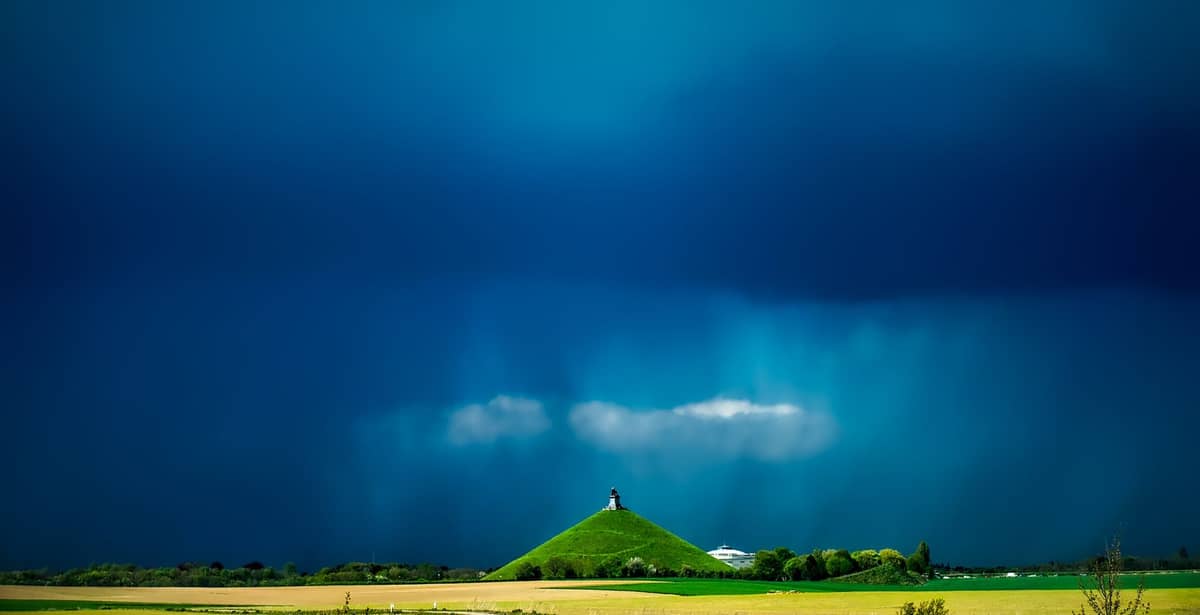
Roughly 20 kilometres south of Brussels, the Waterloo Battlefield preserves the ground where the Battle of 18 June 1815 decided the fate of Europe. The Lion's Mound looms over the rolling farmland, and the Waterloo 1815 Memorial combines a panoramic painting, an immersive museum, and access to Hougoumont Farm into a half-day excursion that rewards anyone with even a passing interest in military history.
Quick Facts
- Location
- Route du Lion 1815, 1420 Braine-l'Alleud, Belgium — approx. 20 km south of Brussels
- Getting There
- By car is the most practical option; use GPS address Route du Lion 1815, Braine-l'Alleud. On-site parking is available.
- Time Needed
- 3–5 hours for the full domain (museum, panorama, Lion's Mound, Hougoumont Farm)
- Cost
- Around €24 for a standard adult ticket (museum + panorama + Lion's Mound). Verify current prices at waterloo1815.be before visiting.
- Best for
- History enthusiasts, Napoleon-era buffs, families with older children, landscape photographers
- Official website
- waterloo1815.be/en
The Scale of What Happened Here
On 18 June 1815, roughly 200,000 soldiers from three armies converged on a narrow strip of Belgian farmland south of Brussels. By nightfall, the French Imperial Army had collapsed, Napoleon Bonaparte's political career was finished, and the map of Europe was about to be redrawn at the Congress of Vienna. The Waterloo Battlefield is the physical ground where all of that unfolded, and what is remarkable about visiting today is how much of that ground remains open and legible.
The landscape is not dramatic in any natural sense. These are soft, undulating fields under large Belgian skies, punctuated by the occasional farmhouse. The drama is entirely historical, and that means visitors who arrive without any prior reading may struggle to feel its weight. Those who have done even a few hours of reading, however, will find the topography surprisingly meaningful: the ridge where Wellington's Anglo-allied forces held, the sunken lane, the exposed slope down which French cavalry charged repeatedly and futilely.
💡 Local tip
Practical prep matters here. Download or buy a battlefield map before you arrive. The official Waterloo 1815 Memorial provides orientation, but understanding the troop positions before you climb the Lion's Mound makes the panoramic view from the top significantly more informative.
The Lion's Mound: What It Is and What It Costs You
The Butte du Lion, or Lion's Mound, is an artificial earthen hill erected in the 1820s under the direction of the Dutch-Belgian authorities to commemorate the spot where William II of the Netherlands was wounded during the battle. A large iron lion cast from melted-down French and allied cannons crowns the summit, facing south toward France. The mound rises prominently above the flat farmland around it and is visible from several kilometres away.
Access to the mound is only included as part of the full Waterloo 1815 domain ticket, which runs around €23 for adults in high season as of mid-2026 and also covers the Memorial museum and the circular Panorama painting. There is no separate mound-only entry. The climb involves a steep exterior staircase of over 200 steps, and the mound is explicitly noted as not accessible to visitors with reduced mobility. On clear days, the view from the top stretches across the entire battlefield, making the physical effort worthwhile for those who can manage it.
The mound itself altered the original battlefield terrain when it was built. Soil was excavated from the ridge where Wellington's troops stood, which means the precise contour historians debate was partly erased by the very monument built to celebrate the victory. This small irony is worth keeping in mind when you stand at the top.
Tickets & tours
Hand-picked options from our booking partner. Prices are indicative; availability and final rates are confirmed when you complete your booking.
Ghent tour from Brussels
From 43 €Instant confirmationFree cancellationTablet Workshop at Choco-Story Brussels
From 45 €Instant confirmationShared tour of Delft and the Keukenhof Estate from Brussels
From 86 €Instant confirmationFree cancellationOrigins of Brussels exploration game and tour
From 10 €Instant confirmationFree cancellation
The Waterloo 1815 Memorial: Museum and Panorama
The domain's centerpiece is the Waterloo 1815 Memorial, a modern visitor complex built around two main experiences: an immersive museum covering the political and military context of the Hundred Days campaign, and the 19th-century Panorama of the Battle of Waterloo, a circular painting roughly 110 metres in circumference that surrounds visitors on a raised platform.
The Panorama is the more visceral of the two. Painted in 1912 by French artist Louis Dumoulin and his team, it depicts the height of the battle around 7pm on 18 June, with French cavalry and infantry pressing against Wellington's line. The painting is enormous, illusionistic, and genuinely impressive in person in a way that photographs fail to capture. The lighting is designed to suggest late-afternoon battlefield haze, and the foreground is populated with three-dimensional props, uniforms, and weapons that blend into the painted background. Visitors who have seen other 19th-century panorama paintings in Europe will recognize the format; few examples survive in this condition.
The museum section is comprehensive and well-produced, with multilingual displays covering Napoleon's return from Elba, the political stakes of the campaign, individual soldiers' perspectives from both sides, and the post-battle period. Plan at least 90 minutes for the museum and Panorama combined. The museum and Panorama are accessible to visitors with reduced mobility.
Hougoumont Farm: The Battle Within the Battle
A short distance from the main domain, Hougoumont Farm was the site of one of the most sustained and tactically significant engagements of the entire battle. Wellington had positioned allied troops here to anchor his right flank, and French forces attacked the farm complex almost continuously from midday onward. The farm held. Military historians have argued that the defense of Hougoumont bought Wellington the time he needed for Prussian reinforcements to arrive and effectively decide the battle.
The farm has been partially restored and is now open to visitors as part of the domain. The surviving chapel, the north gate through which a famous counter-charge occurred, and the partially ruined outbuildings give the site a texture that the open battlefield cannot. The terrain around Hougoumont is uneven, but visitor information indicates the site is accessible to people with reduced mobility, with interior areas and key features reachable despite some outdoor irregularities. The site is quieter than the main mound area, and if you are visiting on a weekday in spring or autumn, you may have stretches of it entirely to yourself.
ℹ️ Good to know
Opening hours vary by season. The domain is open daily: April to June and September to October, 10:00–18:30; July and August, 9:30–19:00; November to March, 10:00–17:30. Hougoumont Farm hours follow a similar seasonal pattern but may differ slightly. Check waterloo1815.be for the current season's times before traveling.
How the Site Feels at Different Times of Day and Year
Summer mornings, particularly in July and August when the domain opens at 9:30, offer the best balance of light and relative quiet. By midday, tour groups from Brussels and beyond begin arriving, and the Panorama viewing platform can feel crowded. Late afternoon light on the battlefield, especially in late spring or early autumn, is genuinely atmospheric: long shadows fall across the grain fields and the silhouette of the lion on the mound takes on a more somber quality.
Winter visits between November and March are underrated for anyone who wants to feel something of the battlefield's actual character. The trees are bare, the light is flat and northern, and the fields are often muddy in ways that make the terrain viscerally harder to imagine crossing under fire. Crowds are minimal. The domain's winter hours close at 17:30, so an early arrival is important if you want to visit both the museum and the mound.
Rain affects the experience meaningfully. The Lion's Mound staircase becomes slippery, and the path to Hougoumont turns to mud. The museum and Panorama are fully interior and weather-proof, making this a viable rainy-day option from Brussels if you focus on the indoor elements. Wear shoes with grip regardless of the forecast. Brussels has a temperate maritime climate with no genuinely dry season, so a rain layer is worth packing year-round.
Getting There from Brussels
The site is in Braine-l'Alleud, approximately 20 kilometres south of central Brussels. By car, the drive from the city centre takes around 30–40 minutes depending on traffic, and the GPS address Route du Lion 1815, 1420 Braine-l'Alleud is the recommended navigation input. On-site parking is available and signposted.
Public transport connections to the battlefield are limited and involve transfers; driving or joining a guided tour from Brussels is the most practical approach for most visitors. Several Brussels walking and day-trip tour operators run regular battlefield excursions that include transport and a guide, which significantly improves the interpretive experience if you are not already familiar with the campaign.
The battlefield makes an easy combination with other excursions south of the city. For context on Brussels itself before or after your visit, the BELvue Museum near the Royal Palace covers Belgian history from 1830 onward and provides useful political context for understanding why the Battle of Waterloo mattered so specifically to Belgian national identity.
Who Will Get the Most From This Visit, and Who Might Not
Visitors with a genuine interest in Napoleonic history, military history, or 19th-century European politics will find this one of the most satisfying day trips from Brussels. The combination of landscape, the Panorama, the museum, and Hougoumont Farm is comprehensive enough that a full day is justified. History teachers, readers of Patrick O'Brian or Bernard Cornwell, and anyone who has visited the Musée de l'Armée in Paris will feel immediately at home.
Visitors who are primarily seeking Brussels's urban, culinary, or design culture may find the detour hard to justify against competing options. The city itself offers significant depth: the Royal Museums of Fine Arts and the Magritte Museum represent half-days that never require a car or full-day time commitment.
Young children under 10 will likely find the experience long, particularly in winter or if the outdoor sections are included. The museum has some interactive elements but is primarily text and object-based. Teenagers with an interest in history or strategy games tend to engage well with the site.
Visitors with reduced mobility should note clearly that the Lion's Mound (steep external staircase) and Hougoumont Farm (uneven terrain) are not accessible, while the Memorial museum and Panorama are. Plan accordingly and factor this into how much of the domain you wish to cover.
⚠️ What to skip
The Lion's Mound is only accessible as part of the full domain ticket. There is no option to simply climb the mound and leave. Budget both the full ticket cost and the time to use what you have paid for.
Insider Tips
- Visit the Panorama before climbing the Lion's Mound, not after. The painting orients you spatially to the battlefield, so that when you look out from the top of the mound, you can already read the landscape in front of you.
- The domain ticket includes the Panorama, museum, and Lion's Mound, but Hougoumont Farm may require a separate booking or timed entry slot depending on the season. Check the official site in advance, particularly for summer visits.
- The area around the mound base is noticeably quieter during the first hour after opening. Arriving at opening time on a weekday means you can climb the mound and take in the view before the main coach tour groups arrive around mid-morning.
- The farm track between the main domain and Hougoumont Farm is best done on foot (around 15 minutes each way). Wear proper walking shoes; the path crosses working agricultural land and can be muddy after rain.
- The town of Waterloo itself, a few kilometres north of the battlefield, has several additional sites including Napoleon's last headquarters (the Caillou Museum) and Wellington's headquarters museum. Neither is included in the main domain ticket, but together they extend the experience considerably for dedicated visitors.
Who Is Waterloo Battlefield & Butte du Lion For?
- Napoleonic and military history enthusiasts wanting to walk actual battlefield ground
- Travellers combining Belgian history with a day trip from Brussels
- Families with history-aware teenagers or older children
- Photographers interested in wide-open landscapes and monumental 19th-century sculpture
- Anyone interested in the origins of modern Belgium and the post-Napoleonic European order
Nearby Attractions
Combine your visit with:
- AfricaMuseum Tervuren
Set in a grand neoclassical palace 14 km east of Brussels, the AfricaMuseum is one of Europe's largest museums dedicated to Central Africa. Reopened in 2018 after a five-year renovation, it now confronts its own colonial past head-on while housing world-class natural history, ethnographic, and art collections.
- Basilica of the Sacred Heart (Koekelberg)
The National Basilica of the Sacred Heart in Koekelberg is one of the largest Art Deco religious buildings in the world, its green copper dome rising 89 metres above Brussels. Entry to the basilica is free; a paid climb to the dome platform delivers one of the city's most underrated panoramas.
- Cantillon Brewery (Brasserie Cantillon)
Cantillon Brewery (Brasserie Cantillon) is one of the few remaining traditional lambic breweries in Brussels, doubling as the Brussels Museum of the Gueuze since 1978. Located a short walk from Gare du Midi in Anderlecht, it is a working industrial site and a serious destination for anyone wanting to understand why Belgian beer culture earned UNESCO recognition.
- Comic Strip Route (Mural Trail)
Brussels' Parcours BD is a free, self-guided trail of more than sixty large-scale comic murals painted on building walls across the city. Created in 1991, it turns the streets themselves into an open-air gallery celebrating Belgium's most distinctive art form. No ticket required, no opening hours to check.