Forêt de Soignes (Sonian Forest): Brussels' Ancient Forest and UNESCO World Heritage Site
Stretching across the south-eastern edge of Brussels, the Forêt de Soignes is one of Western Europe's most significant beech forests and part of a UNESCO World Heritage serial property. Free to enter and accessible year-round, it offers walking trails, cycling routes, and a rare sense of deep woodland just minutes from the city centre.
Quick Facts
- Location
- South-east of Brussels, spanning Watermael-Boitsfort, Auderghem, and beyond into Flemish and Walloon territories
- Getting There
- Tram 8 to Hippodrome Boitsfort; train to Boitsfort or Groenendaal stations; bus connections to Rouge-Cloître
- Time Needed
- 2 hours for a short loop; half a day or more for deeper exploration
- Cost
- Free to enter; some organised activities and sports facilities charge separately
- Best for
- Walkers, cyclists, families, nature photographers, and anyone needing a break from the urban centre
- Official website
- www.foret-de-soignes.be
What Is the Forêt de Soignes?
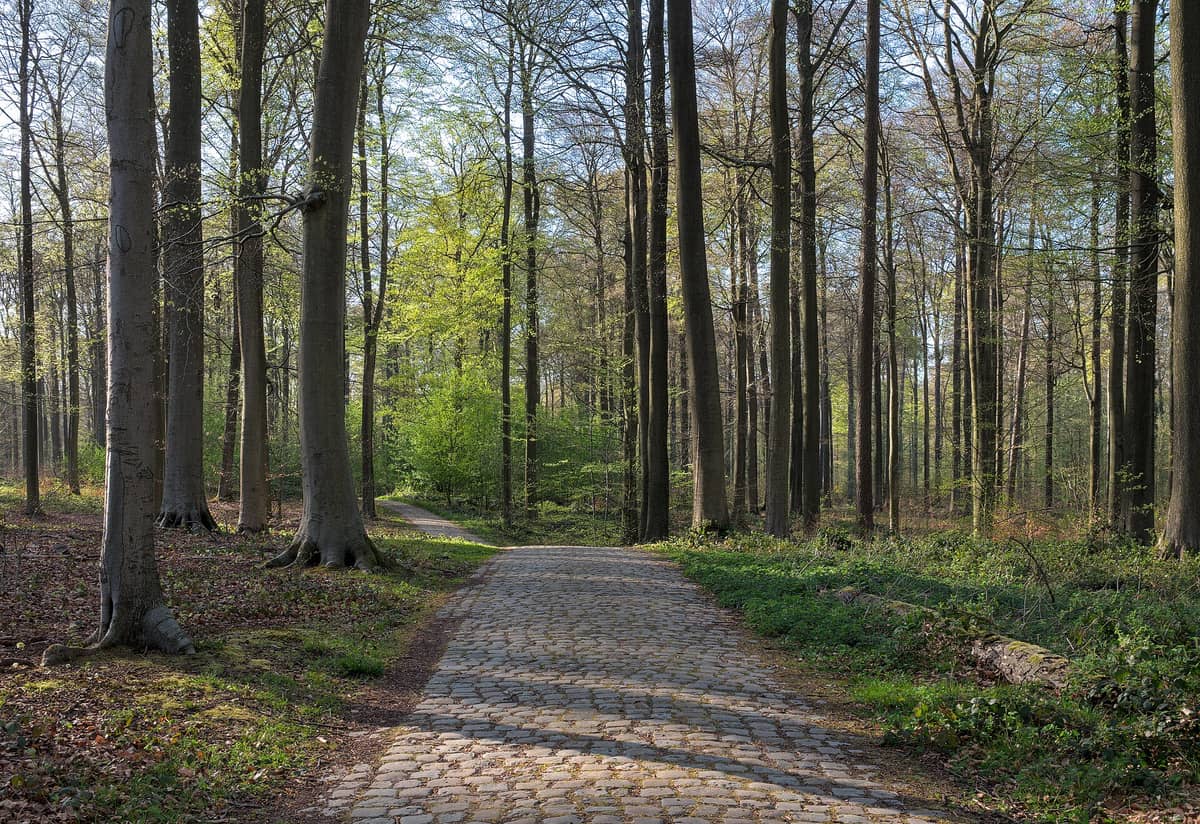
The Forêt de Soignes, known in Dutch as the Zoniënwoud and in English as the Sonian Forest, is an ancient beech forest that begins almost where the Brussels tram lines end. Covering roughly 4,400 hectares across the Brussels-Capital Region and parts of Flanders and Wallonia, it is one of the largest and ecologically most important urban forests in Europe. It is not a manicured park. This is a working, breathing forest with tall beech canopies that close overhead in summer and let angular light through in winter, muddy tracks between the managed drèves (wide avenues), and the kind of stillness that city forests rarely achieve.
In 2017, the Sonian Forest was inscribed as part of the UNESCO World Heritage serial property "Ancient and Primeval Beech Forests of the Carpathians and Other Regions of Europe," a transnational designation that now covers 93 beech forest sites across 18 countries.. That inscription places this Brussels-adjacent forest in the same conservation category as some of the most untouched woodland on the continent. For visitors, it means the forest is managed with long-term ecological integrity in mind, not just recreational convenience. If you want to understand how Brussels fits into its natural landscape, start here before visitingBois de la Cambre, the smaller managed park that acts as a kind of urban threshold to the forest's northern edge.
The Experience at Different Times of Day and Year
Arriving early on a weekday morning, especially between October and November, produces a near-cinematic effect. The tall beech trunks, pale grey and column-straight, catch low horizontal light and the ground is carpeted in copper and ochre leaves. Sound carries differently in beech forest compared to mixed woodland: footsteps are muffled, and birdsong rings out more clearly. The smell is of damp leaf litter and bark, distinctly different from the mineral notes of a city park.
By mid-morning on weekends, particularly in autumn and on sunny spring days, the main entrances and the wide drèves fill with joggers, dog walkers, and families on bicycles. The Groenendaal and Rouge-Cloître gateway areas become noticeably busy. If you prefer quieter walking, head to the secondary paths between the main avenues: the wider unpaved tracks branching off the drèves see significantly less foot traffic even on peak days.
Summer transforms the forest into a green tunnel. When temperatures in Brussels reach 28 or 30°C, the canopy brings the internal temperature down noticeably, and this is when the forest draws its most practical crowd: people escaping the heat. Bring insect repellent from late May through August. Winter visits are underrated. The bare canopy reveals the architecture of the trees, and the forest feels genuinely wild. Frost on the forest floor and mist through the beeches in January or February is visually striking, though paths can be slippery near slopes.
⚠️ What to skip
The forest may be temporarily closed or restricted during high-wind weather events. Check the Brussels Gardens website (gardens.brussels) before visiting after storms, particularly in winter and early spring when branch fall is a real hazard.
Tickets & tours
Hand-picked options from our booking partner. Prices are indicative; availability and final rates are confirmed when you complete your booking.
Ghent tour from Brussels
From 43 €Instant confirmationFree cancellationTablet Workshop at Choco-Story Brussels
From 45 €Instant confirmationShared tour of Delft and the Keukenhof Estate from Brussels
From 86 €Instant confirmationFree cancellationOrigins of Brussels exploration game and tour
From 10 €Instant confirmationFree cancellation
History and Ecological Significance
The Sonian Forest is a remnant of the vast Silva Carbonaria, the ancient coal forest that covered much of the southern Low Countries in the medieval period. It served as a royal hunting ground for the Dukes of Brabant and later for the Habsburg rulers of the Spanish and Austrian Netherlands. This aristocratic protection, paradoxically, preserved the forest from the widespread clearance that eliminated most of the region's ancient woodland.
The predominant tree is the European beech (Fagus sylvatica), which in Sonian grows to unusual height and straightness due to centuries of managed silviculture. You will notice the canopy layer is notably high and the understory relatively sparse, which creates the cathedral-like quality that the forest is known for. Old growth sections contain trees several hundred years old. The forest also supports populations of woodpeckers, bats, rare fungi, and invertebrates that depend on mature beech deadwood, a habitat type almost absent from agricultural landscapes.
Getting There: Entrances and Practical Routes
The forest has several main gateway areas, each with a different character. Rouge-Cloître, on the northern edge near Auderghem, is the most accessible from central Brussels by public transport and connects to a historic priory site. Groenendaal, in the south, has parking, a restaurant, and is a popular cycling departure point. Jezus-Eik and La Hulpe are further out but offer quieter entry and are favoured by those arriving by train on the Brussels-Namur line.
From central Brussels, tram 8 reaches the Auderghem area, which provides access to the northern entrances. Train services on the SNCB/NMBS network stop at Boitsfort and Groenendaal stations, both directly adjacent to forest entry points. The full getting around Brussels options are worth reviewing before you go, as combining tram and train can save time depending on your starting point.
For cyclists, the forest is accessible directly from Ixelles via the dedicated cycling infrastructure that connects Bois de la Cambre to the forest's northern perimeter. The transition from urban cycling path to forest track is abrupt and satisfying. The forest road network includes wide gravel and tarmac drèves suitable for road bikes as well as unpaved tracks for mountain bikes and gravel bikes.
💡 Local tip
If arriving by car, parking at Groenendaal is the most straightforward option for reaching the southern forest network. On-street parking near Rouge-Cloître fills quickly on sunny weekend mornings from 9am onwards.
Walking and Cycling: What to Expect on the Trails
The forest is crossed by a grid of drèves, wide avenues originally designed for horse-drawn carriages and hunting. These are easy to walk and mostly flat, though the forest sits on gently rolling terrain and some paths have modest elevation changes. Signage within the forest is present but not exhaustive: it is genuinely easy to take a wrong turn on the narrower paths, so downloading an offline map (such as the forest's official PDF maps or a trail app with downloaded tiles) before entering is practical advice, not just caution.
For those with reduced mobility, an accessible circular route of approximately 21.2 km starting from the Centre ADEPS d'Auderghem at Waversesteenweg 2057 has been assessed and certified for accessibility by Access-i. The route includes reserved parking and adapted toilet facilities, with a detailed roadbook available from Pro Velo. The wide drèves are also generally manageable for wheelchair users and pushchairs, though sections with camber or soft ground after rain require caution.
The Sonian Forest sits on the south-eastern edge of the Brussels-Capital Region. It is a natural companion to a broader day that could include the AfricaMuseum in Tervuren, which lies just beyond the forest's eastern boundary. Combining a morning walk in the forest with an afternoon at the museum makes for a coherent and satisfying day away from the city centre.
Photography, Weather, and What to Bring
The forest is at its most photogenic in late October and early November when the beech canopy turns fully golden before leaf drop. Early morning arrivals, between 7 and 9am, produce the best light: mist between the trees, low sun angles, and very few other people in frame. A 24-70mm equivalent lens covers most situations. The tall straight trunks reward wide-angle compositions looking upward, and the colour in autumn rewards longer focal lengths to compress the layers of warm colour in the canopy.
Brussels' temperate maritime climate means rain is possible in any month. The forest paths become muddy after rain, particularly on unpaved tracks. Waterproof footwear is the single most practical piece of advice for any visit from September through April. A light waterproof layer is sensible year-round. In summer, the canopy provides significant shade but does not eliminate heat on the warmest days.
ℹ️ Good to know
The Sonian Forest is part of the UNESCO World Heritage serial property 'Ancient and Primeval Beech Forests of the Carpathians and Other Regions of Europe,' inscribed in 2017. The designation reflects genuine ecological rarity and comes with conservation obligations that shape how the forest is managed.
Who Should Probably Skip This
Visitors with only a day or two in Brussels and a checklist of landmarks may find the time commitment hard to justify. The forest rewards slow exploration, and a rushed hour at the edge of Rouge-Cloître does not convey what makes it special. If your priority is architecture, food, or cultural institutions, direct that time to the Grand-Place, the Horta Museum, or the Royal Museums of Fine Arts instead.
The forest also does not offer the curated experience of a botanical garden or themed park. There are no interpretation centres at most entrances, limited signage on ecological features, and no visitor centre in the conventional sense at the main access points. Visitors who prefer guided, explained experiences should look for official guided tours offered through Brussels Environment or local walking organisations rather than arriving independently and expecting on-site interpretation.
Insider Tips
- The Groenendaal arboretum, located within the forest near Groenendaal station, contains a collection of exotic tree species planted in the 19th century. It is free to visit and receives far fewer visitors than the main forest trails, making it a good alternative on busy weekend mornings.
- Weekday mornings between 7 and 9am at any forest entrance give you the closest thing to solitude that a Brussels-adjacent forest can offer. After 10am on sunny weekends, the main drèves near Groenendaal and Rouge-Cloître are busy enough to lose the woodland atmosphere.
- The forest floor after a wet autumn morning produces extraordinary fungal displays, particularly along the bases of older beech trunks. If mycology interests you, September through November after rainy periods is the window.
- Cyclists should note that the forest road network is shared with walkers and horse riders. Speed is formally restricted, and some sections are explicitly pedestrian-only. Check the official cycling map before planning a route to avoid entering restricted paths.
- The train from Brussels-Central to Groenendaal takes under 20 minutes on the Namur line and deposits you directly at a main forest entrance. This is faster and more direct than any bus route from the city centre and avoids the parking frustration entirely.
Who Is Forêt de Soignes (Sonian Forest) For?
- Walkers and hikers looking for a full half-day or full-day trail experience within reach of central Brussels
- Cyclists wanting a car-free forest route with varying terrain and well-marked drèves
- Families with children who need open space, clear paths, and the freedom to roam without major hazards
- Nature and landscape photographers, particularly in autumn when the beech canopy turns
- Brussels residents or long-stay visitors wanting a regular outdoor escape from the urban fabric
Nearby Attractions
Combine your visit with:
- AfricaMuseum Tervuren
Set in a grand neoclassical palace 14 km east of Brussels, the AfricaMuseum is one of Europe's largest museums dedicated to Central Africa. Reopened in 2018 after a five-year renovation, it now confronts its own colonial past head-on while housing world-class natural history, ethnographic, and art collections.
- Basilica of the Sacred Heart (Koekelberg)
The National Basilica of the Sacred Heart in Koekelberg is one of the largest Art Deco religious buildings in the world, its green copper dome rising 89 metres above Brussels. Entry to the basilica is free; a paid climb to the dome platform delivers one of the city's most underrated panoramas.
- Cantillon Brewery (Brasserie Cantillon)
Cantillon Brewery (Brasserie Cantillon) is one of the few remaining traditional lambic breweries in Brussels, doubling as the Brussels Museum of the Gueuze since 1978. Located a short walk from Gare du Midi in Anderlecht, it is a working industrial site and a serious destination for anyone wanting to understand why Belgian beer culture earned UNESCO recognition.
- Comic Strip Route (Mural Trail)
Brussels' Parcours BD is a free, self-guided trail of more than sixty large-scale comic murals painted on building walls across the city. Created in 1991, it turns the streets themselves into an open-air gallery celebrating Belgium's most distinctive art form. No ticket required, no opening hours to check.