Fourth Presbyterian Church: A Quiet Sanctuary on the Magnificent Mile
Standing directly across Michigan Avenue from the tower at 875 North Michigan Avenue, the Fourth Presbyterian Church of Chicago is one of the city's most beautiful and accessible architectural landmarks. Entry is free, the Gothic courtyard offers rare urban calm, and Sunday services fill the sanctuary with organ music that travels far beyond its stone walls.
Quick Facts
- Location
- Michigan Avenue & Delaware Place, Magnificent Mile, Chicago
- Getting There
- CTA buses along Michigan Ave; nearest Red Line stop is Chicago (800 N, State Street)
- Time Needed
- 20–45 minutes for self-guided visit; longer for a full Sunday service
- Cost
- Free admission; no tickets required
- Best for
- Architecture lovers, quiet seekers, photography, spiritual visitors
- Official website
- www.fourthchurch.org
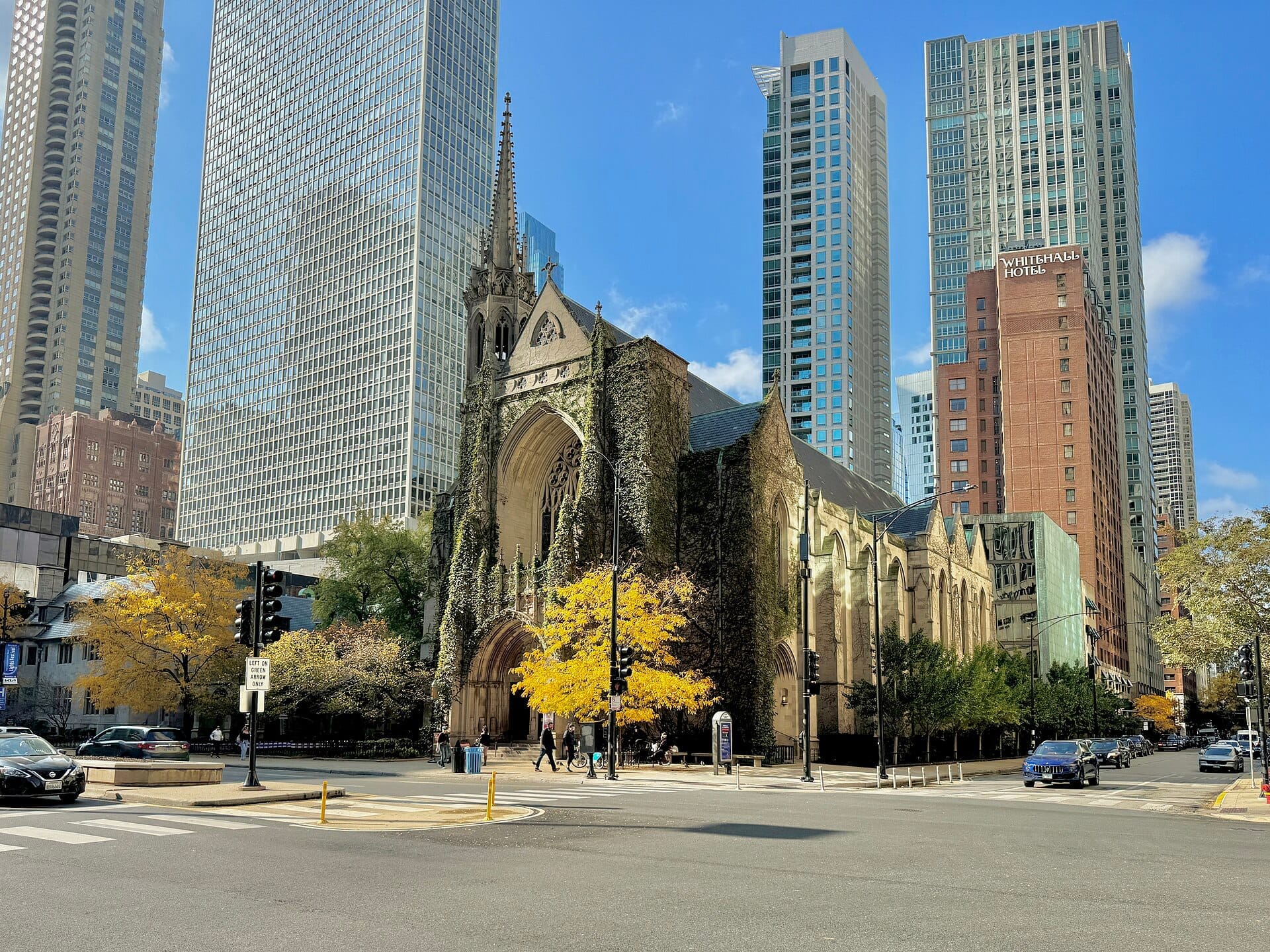
What Is the Fourth Presbyterian Church?
The Fourth Presbyterian Church of Chicago sits at the corner of Michigan Avenue and Delaware Place, occupying one of the most commercially charged addresses in the United States. And yet, step through the iron gate into its cloister courtyard and the sound of traffic muffles almost immediately. It is a genuine pocket of stillness within one of Chicago's loudest corridors.
The congregation itself dates to February 12, 1871, formed from the merger of North Presbyterian Church (organized 1848) and Westminster Presbyterian Church (organized 1855). Today it is one of the largest congregations in the Presbyterian Church (U.S.A.), and the building it occupies is a recognized architectural landmark. The combination of historical depth, Gothic stone construction, and free public access makes it unlike most attractions on the Magnificent Mile.
💡 Local tip
The campus entrance for general visitors during the week is at 126 E. Chestnut Street, half a block west of North Michigan Avenue. The Sanctuary entrance faces Michigan Avenue at Delaware Place.
The Architecture: Gothic on a Modern Street
The church building is a study in contrast. On one side of Michigan Avenue you have the sleek curtain-glass tower at 875 North Michigan Avenue; on the other, a Gothic Revival structure in Indiana limestone that looks as though it drifted in from an English cathedral precinct. The juxtaposition is genuinely arresting, and it is one of the most photographed architectural pairings on the street.
The main sanctuary features pointed arches, ribbed stone vaulting, and art glass windows that diffuse afternoon light into pale amber and deep blue tones across the pews. The woodwork in the nave is dark and substantial without being oppressive. Acoustically, the space is exceptional, which is part of why the church has maintained a serious music program for generations.
If you have more than a passing interest in Chicago's architectural legacy, it is worth reading about the broader context of Gothic and Romanesque styles along Michigan Avenue. The Chicago Architecture Center on the riverfront offers excellent background on how ecclesiastical architecture fits into the city's built environment, and guided tours occasionally include stops in this neighborhood.
Tickets & tours
Hand-picked options from our booking partner. Prices are indicative; availability and final rates are confirmed when you complete your booking.
Go City | Chicago All-Inclusive Pass
From 127 €Instant confirmationFree cancellationiFLY Chicago Lincoln Park indoor skydiving experience
From 126 €Instant confirmationFree cancellationiFLY Chicago Rosemont indoor skydiving tickets
From 117 €Instant confirmationFree cancellationChicago lakefront neighbourhood bike tour
From 18 €Instant confirmationFree cancellation
The Courtyard: The Real Reason to Stop Here
Most visitors who know about the Fourth Presbyterian do not come primarily for the sanctuary. They come for the cloister courtyard. Framed by low arcaded walkways on three sides, with a small garden at its center, the courtyard is one of Chicago's more effective urban escapes. On a warm weekday afternoon, you will find office workers eating lunch on the stone benches, tourists resting their feet, and occasionally a wedding party in the early evening.
In winter, the courtyard takes on a different character entirely. The stone walls hold the cold, snow accumulates on the gargoyle detailing along the roofline, and the whole space feels more medieval than Midwestern. It is one of the few spots in the neighborhood where the scale does not overwhelm you.
Morning light reaches the courtyard from the east, making it photographically interesting between roughly 9 and 11 a.m. By early afternoon in summer, the shadows from the surrounding structure create a patchwork of light and shade that is equally compelling. The stone surfaces are textured enough to photograph well even in flat, overcast light.
Visiting Hours and When to Go
The campus is generally open daily during daytime hours, but specific opening and closing times can vary; the Sanctuary is typically accessible to visitors on weekdays during the late morning and early afternoon, while Saturdays are often reserved for events such as weddings, so if your goal is to see the interior, a weekday morning is the most reliable window—check the official website for current hours before you go.
Sunday worship services are held according to the liturgical calendar. From the Sunday after Labor Day through the Sunday before Memorial Day, there are typically two traditional morning services, both with organ and choir, while during the summer (Memorial Day weekend through Labor Day weekend) worship is usually consolidated into a single morning service; exact times can change, so consult the church’s current worship schedule online before planning around a specific hour. All services are also livestreamed. Attending a Sunday service is free and open to all, and hearing the pipe organ in that space is an experience the courtyard alone cannot provide.
⚠️ What to skip
The Sanctuary is closed to casual visitors on Saturdays due to private events. If you arrive on a Saturday and find the main doors closed, the courtyard and exterior may still be accessible during campus open hours — but confirm at the Chestnut Street entrance.
If you are planning a broader itinerary around the Magnificent Mile, consider reading the Chicago architecture guide for context on what else the neighborhood offers architecturally, from the Tribune Tower to the Wrigley Building.
Practical Details for Getting There
The church sits at one of the most transit-accessible points in the city. Multiple CTA bus routes travel along Michigan Avenue, and the Red Line's Chicago station (800N/State) is a short walk west at Chicago Avenue and State Street. From Millennium Park or the Loop, the walk north along Michigan Avenue takes about 15–20 minutes and passes several other notable buildings along the way.
There is no dedicated parking lot on the church campus. Discounted parking for those attending church events is available at the 900 N. Michigan garage to the north and at the garage in the 875 North Michigan Avenue building directly across the street to the east. For a visit of under an hour, neither option is particularly economical by Chicago standards. Public transit or walking from a nearby hotel is the more practical approach.
The church is located within the Magnificent Mile and Streeterville neighborhood, which means it shares its immediate surroundings with high-end retail and hotel towers. The contrast between the Gothic stonework and the commercial density around it is part of what makes the stop interesting.
What to Realistically Expect
This is not a museum. There are no guided tours listed for general drop-in visitors, no audio guides, and no interpretive signage in the manner of a heritage attraction. What you get is a working church that extends genuine hospitality to anyone who walks in quietly and respectfully during open hours.
The interior is not dramatically lit for tourists. On a cloudy day, the sanctuary can feel quite dim, which actually suits the architecture well but does not make for easy photography without a capable lens. The art glass windows are the primary light source, so arrival on a sunny day makes a substantial difference to what you see.
If you are building a broader half-day itinerary around this stop, the nearby Chicago Water Tower is two blocks north, and the Magnificent Mile itself runs the full length of North Michigan Avenue. For those interested in another significant historic building nearby, the Wrigley Building is at the south end of the strip.
Who Should Skip This
If you are on a tight schedule and primarily chasing Chicago's headline attractions, the Fourth Presbyterian may not justify a dedicated trip. It works best as a deliberate pause during a longer walk along Michigan Avenue, not as a standalone destination requiring transit. Visitors traveling with restless children may also find the quiet expected inside the sanctuary challenging to maintain.
Those visiting on a Saturday with the specific goal of seeing the sanctuary interior will likely be turned away due to private events. And anyone hoping for detailed historical docent tours will need to contact the church directly rather than expecting on-demand interpretation.
Insider Tips
- Arrive on a sunny weekday morning between 10 and 11 a.m. to catch the art glass windows at their most vivid — afternoon light from the west does not reach the nave's east-facing windows in the same way.
- The courtyard is accessible even when the sanctuary is not. On a warm afternoon it serves as a legitimate rest stop with seating, and it is considerably calmer than any coffee shop within a four-block radius.
- If you want to hear the pipe organ, attend a Sunday service rather than trying to time a weekday visit around rehearsals. The acoustics in the sanctuary make the experience significantly different from any recorded version.
- The church campus entrance at 126 E. Chestnut Street is less obvious than the Michigan Avenue sanctuary door — if the main facade looks closed, try Chestnut first during campus open hours.
- Photography of the exterior is best framed from the east side of Michigan Avenue, where you can capture the Gothic stonework against the sky without being pressed up against the facade.
Who Is Fourth Presbyterian Church For?
- Architecture enthusiasts interested in Gothic Revival buildings in an urban context
- Travelers looking for a quiet, free break from the commercial intensity of the Magnificent Mile
- Photography visitors seeking textured stone, art glass, and strong architectural contrast
- Those interested in the history of Chicago's religious and civic institutions
- Visitors attending or curious about traditional Protestant worship with a serious choral music program
Nearby Attractions
Other things to see while in Magnificent Mile & Streeterville:
- 360 CHICAGO Observation Deck
Perched on the 94th floor of 875 North Michigan Avenue, 360 CHICAGO delivers panoramic views stretching across the city grid, Lake Michigan, and on clear days, four states. With the TILT ride, interactive displays, and a full bar, it offers more than just a lookout.
- American Writers Museum
Tucked on the second floor of 180 N. Michigan Avenue, the American Writers Museum makes a persuasive case that literature shaped the United States as much as any battlefield or boardroom. It's compact, thoughtfully curated, and rewards visitors who slow down.
- Centennial Wheel
Standing nearly 196 feet above the Lake Michigan shoreline, the Centennial Wheel at Navy Pier offers enclosed, climate-controlled gondola rides with some of the most expansive views of Chicago's skyline. Opened in 2016 to mark Navy Pier's 100th anniversary, it replaced a beloved predecessor and quickly became one of the city's most recognizable structures.
- Chicago Children's Museum
Perched inside Navy Pier on the lakefront, Chicago Children's Museum has been sparking curiosity in kids since 1982. With hands-on exhibits built for children under 10, it rewards an unhurried half-day visit. Here is exactly what to expect, when to go, and how to make the most of your time.