Fortnum & Mason: London's Most Storied Food Hall
Founded in 1707 and long associated with 181 Piccadilly, Fortnum & Mason is one of London's most enduring institutions. Part luxury food hall, part department store, part tea room, it offers everything from rare teas and hand-finished hampers to a full afternoon tea service across multiple floors.
Quick Facts
- Location
- 181 Piccadilly, London W1A 1ER (West End)
- Getting There
- Piccadilly Circus or Green Park (both approx. 5 min walk)
- Time Needed
- 45 minutes to browse; 2–3 hours if dining
- Cost
- Free entry; food, drink and dining priced separately
- Best for
- Food lovers, gift hunters, afternoon tea, Anglophiles
- Official website
- www.fortnumandmason.com
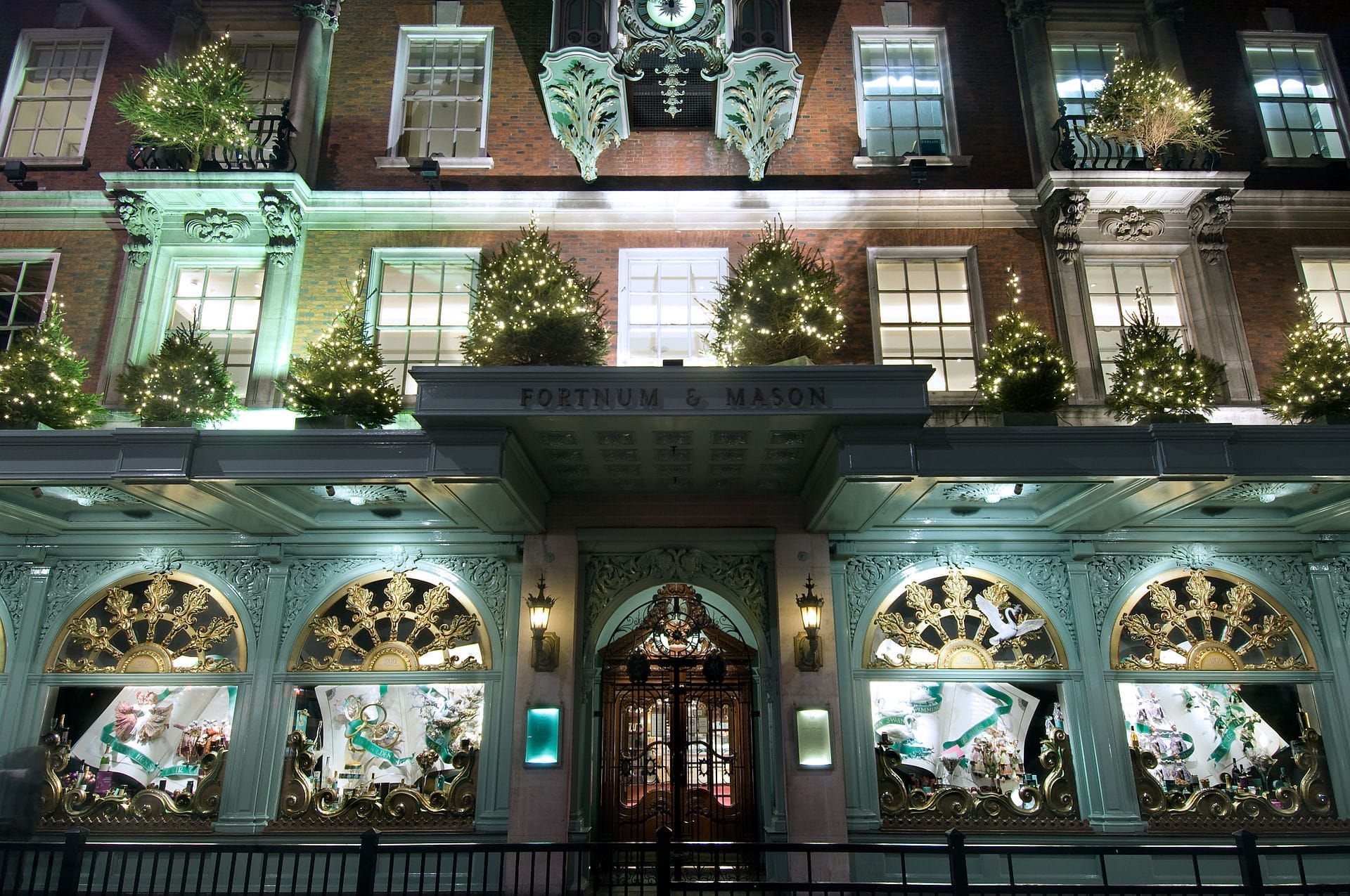
What Is Fortnum & Mason?
Fortnum & Mason is a luxury British department store and food hall at 181 Piccadilly, in the heart of London's West End. It has traded under the Fortnum & Mason name in Piccadilly since 1707, making it one of the oldest retail businesses in the country. The building is immediately recognisable from the street: a pale facade, gilded signage, and the famous mechanical clock above the entrance that chimes every quarter-hour with figurines of Mr Fortnum and Mr Mason appearing to bow to each other.
Unlike most department stores, Fortnum's has never tried to be all things to all people. Its identity is anchored in exceptional food and drink, particularly teas, preserves, biscuits, chocolate, and the hand-assembled hampers that have been a British gifting tradition for centuries. The upper floors expand into tableware, fragrances, stationery, and clothing, but the ground floor food hall is why most visitors come.
It is worth being clear about what Fortnum & Mason is not: it is not a museum, not a ticketed attraction, and not a tourist trap in the conventional sense. It is a functioning, upscale shop with a loyal local clientele alongside the visitors. You will find Londoners here picking up tea gifts or a box of biscuits as naturally as you find travellers photographing the hamper displays. For context on the broader West End neighbourhood, which offers one of London's densest concentrations of shops, theatres, and restaurants, the area rewards a full day's exploration.
A Brief History Worth Knowing
The store's origins date to around 1705, when Hugh Mason ran a small shop in the area and William Fortnum, a footman in the royal household of Queen Anne, began selling used candle stubs from the palace as a side business. The partnership that followed gave rise to one of London's most durable commercial legacies. By the 18th century, Fortnum & Mason had established itself as a supplier to the aristocracy and a pioneer in food preservation, reportedly sending provisions to British troops and explorers across the empire.
The royal connection has never faded. The store holds several Royal Warrants, the formal appointments granted by members of the Royal Family to suppliers they use regularly. These warrants are displayed prominently inside the store and speak to a continuity of purpose that few retail businesses anywhere in the world can claim. The Piccadilly building visitors see today is not the original structure; the current Neo‑Georgian building dates from 1926–27 while the business has remained based in Piccadilly for over three centuries.
Tickets & tours
Hand-picked options from our booking partner. Prices are indicative; availability and final rates are confirmed when you complete your booking.
Soho Instagram a self-guided walking tour to top photo spots
From 6 €Instant confirmationFree cancellationTootbus London by Night: Bus tour
From 32 €Instant confirmationFree cancellationIFS Cloud Cable Car Ride and Uber Boat Hop-on Hop-off 1 Day Ticket
From 38 €Instant confirmationFree cancellationThe Making of Harry Potter Guided Tour of London Warner Bros. Studio
From 201 €Instant confirmationFree cancellation
The Ground Floor: Where Most People Spend the Most Time
The ground floor is the store's centrepiece. Rows of pale green tins are stacked in precise columns. Loose-leaf teas are displayed like library books. Seasonal hampers, some the size of small trunks, occupy dedicated floor space with descriptive cards listing every item inside. The colour palette throughout is the signature eau-de-nil green, a shade so associated with the brand that it functions like a trademark.
💡 Local tip
The ground floor is busiest between 11:30 and 14:00, particularly on Saturdays. If you want to browse without crowds pressing around the tea display, arrive when the store opens (10:00 Monday–Saturday, or just after midday on Sunday).
The tea selection alone merits time. There are dozens of blends, from the house Fortnum's Royal Blend (reportedly created for King Edward VII) to single-estate varieties and seasonal editions. Staff on the floor are knowledgeable and generally not pushy. The biscuit and confectionery counters nearby are popular for smaller purchases and gifts, with prices that range from accessible to seriously expensive depending on what you choose.
The smell of the ground floor is distinctive: a blend of roasted coffee, dried tea, chocolate, and something faintly floral from the preserves section. It is one of those sensory cues that stays with you. The acoustics are relatively quiet by central London retail standards, with the mechanical clock chimes filtering down from outside providing the main punctuation to the browsing experience.
Upper Floors: Food Halls, Dining, and Beyond
The store spreads across several floors, each with a distinct character. The lower ground floor hosts a wine and spirits section. Upper floors move into homeware, fine china, crystal, fragrances, and fashion accessories, though these are not the primary draw for most visitors. The presentation throughout is consistent: considered, unhurried, and visually precise.
Fortnum's has multiple dining options, of which The Diamond Jubilee Tea Salon on the fourth floor is the most celebrated. Afternoon tea here is a formal affair with a set menu, reserved seating, and waiting times that often stretch weeks ahead for weekend slots. Booking in advance is essential. For a less structured experience, the Parlour on the ground floor serves sundaes and light meals with a shorter wait. If afternoon tea is a priority during your London visit, our guide to afternoon tea in London covers Fortnum's alongside other top venues with comparable booking advice.
181 Piccadilly Wine Bar on the lower ground floor is a quieter option for those who want a glass of something good without the full afternoon tea commitment. It tends to attract a mix of shoppers and office workers from the surrounding Mayfair area, and the atmosphere is noticeably more casual than the floors above.
Practical Walkthrough: How to Approach the Visit
Fortnum & Mason is open Monday to Saturday from 10:00 to 21:00, and Sunday from 12:00 to 18:00, with a short browsing-only window from 11:30 on Sundays. There is no admission charge; the store is free to enter and explore. The evening hours on weekdays are a useful detail that most visitors overlook: the store is noticeably quieter after 18:00 on weekdays, making it a good post-dinner stop or a calmer alternative to the midday rush.
⚠️ What to skip
Opening hours can vary around bank holidays and special events. Always check the official Fortnum & Mason website at fortnumandmason.com before a specific visit, particularly around Christmas and Easter when hours may change significantly.
Getting there is straightforward. Both Piccadilly Circus and Green Park Tube stations are roughly five minutes on foot from the store entrance at 181 Piccadilly. Coming from Piccadilly Circus, you walk west along Piccadilly past the Royal Academy of Arts; the store appears on your left before you reach Green Park. Coming from Green Park station, you exit onto Piccadilly and walk east. Bus routes along Piccadilly also stop nearby.
The store sits in the Mayfair and St James's area, which is one of central London's most refined neighbourhoods. The Royal Academy of Arts is a three-minute walk east, and Piccadilly Circus is visible from the front entrance on clear days. This makes Fortnum & Mason easy to incorporate into a broader West End loop without significant detour.
For photography, the store's exterior is most striking in the morning light before the street fills with foot traffic. The interior is well-lit throughout, though flash photography is generally frowned upon in premium retail environments. The hamper displays and tea walls photograph well in natural light from the store's tall windows. The mechanical clock performs its chime at each quarter-hour and draws a small crowd of onlookers each time.
Who This Is and Isn't For
Fortnum & Mason rewards visitors who appreciate food provenance, packaging craft, or British commercial history. You do not need to buy anything to get value from the visit: the store itself is worth seeing as an example of retail presentation taken seriously over a very long time. Prices are high across all categories, and there is no budget version of the experience. A tin of biscuits will cost several times what you would pay in a supermarket, and the tea prices can surprise even seasoned shoppers.
Visitors travelling with young children may find the experience manageable but not especially engaging for the children themselves. The store is not designed as a family attraction. Those with pushchairs should note that the floors are connected by lifts, but the narrower aisles near display counters can be difficult to navigate in busier periods. Anyone looking primarily for a department store with broad fashion or electronics ranges will not find that here: Fortnum's is deliberately focused, and that focus is its strength.
Travellers on a tight budget who want to experience something of the store without spending significantly can do so easily: entry is free, browsing is welcome, and even buying a single small item like a packet of tea bags or a jar of honey gives you a piece of the Fortnum's experience at a lower price point. If cost is a primary concern across your trip, the broader free things to do in London guide covers many no-cost options in the surrounding area.
Insider Tips
- The store's own-brand biscuits and preserves are among the best value purchases relative to quality. A tin of Piccadilly Mix biscuits or a jar of the house lemon curd makes an excellent souvenir that fits in hand luggage.
- Weekday evenings after 18:00 are the least crowded time to browse. The full range is available, staff are less occupied, and the pace is relaxed. This window is almost unknown to tourists who assume the best experience comes in the middle of the day.
- The Diamond Jubilee Tea Salon books out weeks in advance for weekend slots. If your dates are flexible, a Tuesday or Wednesday afternoon has significantly better availability and a noticeably calmer atmosphere than any weekend slot.
- The seasonal hamper range changes around Christmas, Easter, and other occasions. If you are visiting during these periods, the ground floor display becomes a extraordinary piece of retail theatre, with hampers assembled to a level of detail that takes considerable time to fully appreciate.
- The mechanical clock above the Piccadilly entrance chimes at every quarter-hour with the figures of Mr Fortnum and Mr Mason. It is easy to miss if you enter without looking up. Position yourself on the pavement opposite just before the hour for the clearest view of the full performance.
Who Is Fortnum & Mason For?
- Food enthusiasts who want to explore British culinary tradition through one of its oldest commercial expressions
- Gift hunters seeking premium, distinctly British items in elegant packaging that travel well
- Afternoon tea devotees prepared to book ahead for the Diamond Jubilee Tea Salon experience
- Travellers with an interest in architectural retail design and the visual language of heritage brands
- First-time London visitors who want a single location that condenses a significant thread of British cultural identity
Nearby Attractions
Other things to see while in West End:
- British Library
The British Library holds over 170 million items spanning thousands of years of human thought, from the Magna Carta to Beatles lyrics. Entry to the building and permanent collection galleries is free, making it one of the most rewarding stops in central London for curious travellers.
- British Museum
The British Museum holds one of the world's great collections of human history and culture, spanning two million years across more than 60 free galleries. Entry to the permanent collection is free, but knowing how to navigate the scale of it makes the difference between a rewarding visit and an overwhelming one.
- Carnaby Street
Carnaby Street is the pedestrianised shopping district in Soho that defined the look of 1960s London and continues to draw fashion lovers, food hunters, and curious walkers today. Free to explore and five minutes from Oxford Circus, it rewards those who slow down and wander its connecting lanes.
- Coal Drops Yard
Coal Drops Yard is a redeveloped Victorian industrial estate in King's Cross, now home to independent retailers, restaurants, and bars set beneath strikingly restored brick vaults. The public outdoor spaces are free to enter and a short walk from King's Cross St Pancras station.