The Dublin Portal: Where O'Connell Street Connects to the World in Real Time
Unveiled in May 2024, the Dublin Portal is a large circular LED sculpture on O'Connell Street that originally streamed a continuous live video link between Dublin and New York City, but now connects Dublin with other cities via a rotating livestream. Free to view at any hour, it raises immediate questions about distance, connection, and what it means to share a moment across an ocean.
Quick Facts
- Location
- O'Connell Street, Dublin City Centre
- Getting There
- Luas Green Line: O'Connell GPO / O'Connell Upper stops; multiple Dublin Bus routes on O'Connell Street
- Time Needed
- 10–20 minutes; longer if you linger for crowd interaction
- Cost
- Free – no ticket or registration required
- Best for
- First-time visitors, tech-curious travellers, quick stops between sights
- Official website
- www.portals.org/portal/dublin
What the Dublin Portal Actually Is
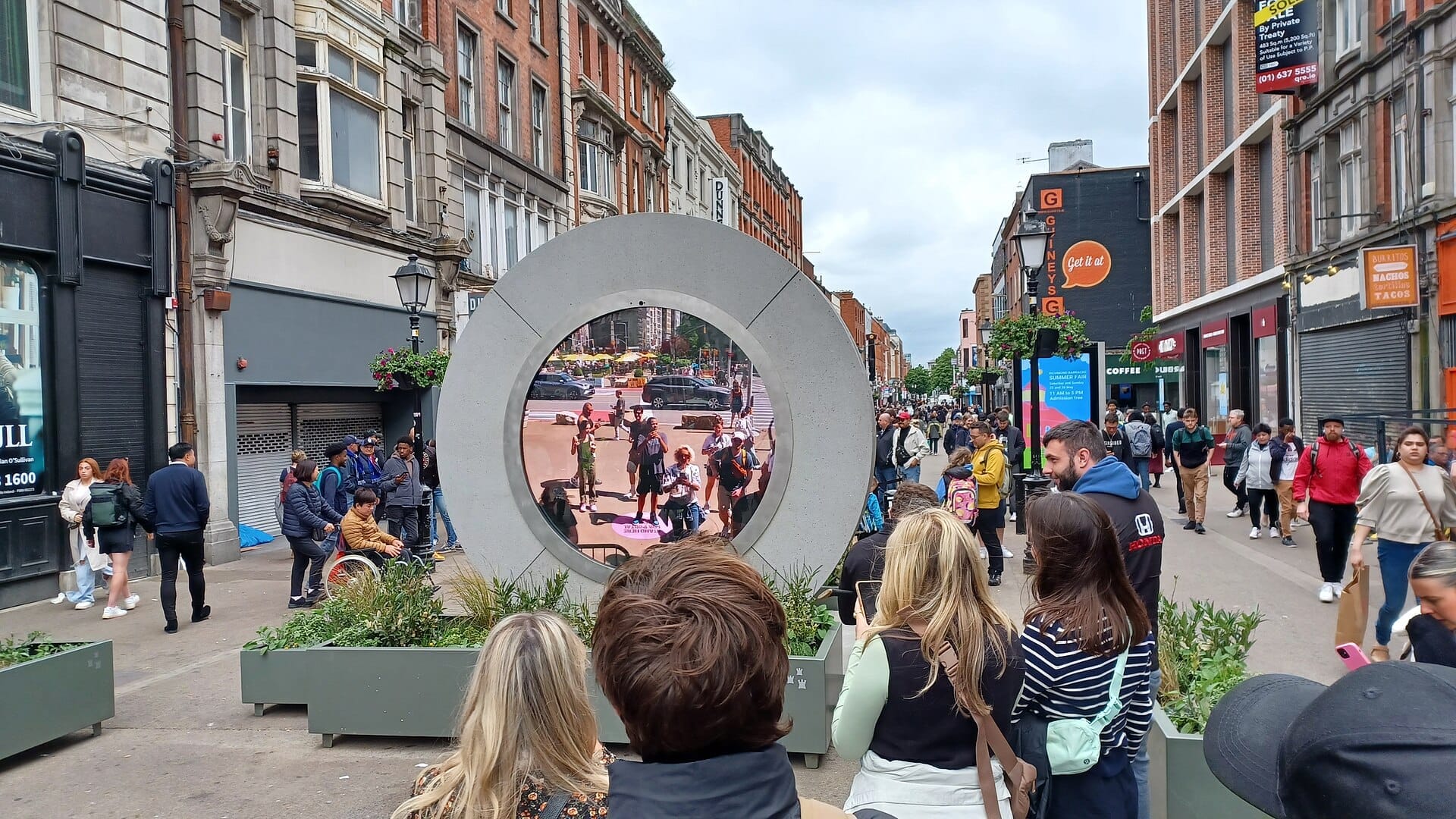
The Dublin Portal is a large circular LED sculpture installed on a public plaza facing O'Connell Street, Dublin's main thoroughfare. Unveiled in May 2024, it operates as one half of a live, two-way video link between Dublin and other cities in the Portals network via a near-continuous livestream. On the Dublin side, you see a real-time image of people gathered around the connected Portal; on their end, they see you. No filters, no delay worth speaking of, just a round window into another city's street life.
The project is part of a broader global network developed by Portals.org, and when the Dublin installation launched it became one of the early portals in that network. The concept originated with Lithuanian artist Benediktas Gylys, and the initial New York counterpart was sited in the Flatiron District before being relocated to Philadelphia. Dublin City Council and Smart Dublin supported the installation, positioning it in one of the most symbolically loaded locations in the city, directly in view of the GPO and within sight of the Spire.
ℹ️ Good to know
The Portal streams live, so what you see depends entirely on which connected city is currently active and its local time. Dublin is 5 hours ahead of Eastern Time in the US, which means a midday visit in Dublin would show 7am in an East Coast city like Philadelphia when that connection is live, often lining up late afternoon in Dublin with lunchtime crowds there.
The Experience at Different Times of Day
The Portal looks different depending on when you visit, and that variation is part of what makes it worth returning to. In the early morning, the O'Connell Street plaza is relatively quiet. The screen glows against a pale sky, and if a connected city is just waking up, you might catch a sparse scene of joggers or commuters. The contrast between the stillness of early Dublin and the bustle of a morning starting elsewhere is quietly striking.
By mid-morning and into the afternoon, crowds on both sides tend to build. People wave, hold up signs, do small performances, or simply stare. Some Dubliners treat it as a novelty photo stop; others stand for several minutes watching the other city go about its day. On the connected end during Irish-related events, or around St. Patrick's Day, the exchanges reportedly become more animated. Children react with immediate delight and confusion in equal measure.
After dark is the most visually arresting time to visit. The circular screen becomes intensely bright against the night sky, and the contrast between the lit facade of the GPO behind you and the live image of a nocturnal or morning street scene in the connected city creates a genuinely disorienting effect. Because many connected cities in the network are 5 hours behind Dublin on Eastern Time, a 10pm visit in Dublin can show an early evening scene in a US city like Philadelphia, often livelier than what surrounds you on O'Connell Street at that hour.
Tickets & tours
Hand-picked options from our booking partner. Prices are indicative; availability and final rates are confirmed when you complete your booking.
Giant's Causeway, Dark Hedges, and Belfast Tour from Dublin
From 85 €Instant confirmationFree cancellationDublin self-guided audio tour
From 10 €Instant confirmationBird of Prey, Cliffs of Moher and Aillwee Cave from Dublin
From 201 €Instant confirmationFree cancellationGame of Thrones Studio tour with return transfer from Dublin
From 63 €Instant confirmationFree cancellation
Location and What Surrounds It
The Portal sits in a direct sightline of two of Dublin's most recognizable landmarks: the GPO on O'Connell Street, which served as the headquarters of the 1916 Easter Rising, and the Spire, the 120-metre stainless steel monument that has dominated the street since 2003. This placement is not accidental. Putting a forward-looking piece of technology within the historic and civic gravity of O'Connell Street creates a deliberate tension between past and present.
O'Connell Street is one of the widest streets in Europe and has long functioned as the civic spine of central Dublin. The area around the Portal sees continuous foot traffic from commuters, tourists, and local shoppers. The Luas Green Line stops are a short walk away, and the street is served by a large number of Dublin Bus routes, making it one of the easiest locations in the entire city to reach from any direction.
If you're planning a wider day in the area, the Portal fits naturally into a walk that takes in the Dublin City Gallery Hugh Lane to the north or heads south toward Temple Bar and the river.
Cultural Context: Why This Location, Why Now
The Ireland-diaspora connection the Portal visualizes is one of the most demographically significant relationships in the history of both places. An estimated 30 to 40 million Americans claim Irish ancestry, a figure rooted largely in the waves of emigration that began during the Great Famine of the 1840s and continued through the 20th century, and American cities historically received more Irish emigrants than anywhere else. Installing a live visual link between Dublin and overseas cities on one of Dublin's most historic streets carries weight that goes beyond novelty technology.
Whether the Portal fully captures that weight is a question visitors will answer differently. Some find the concept moving: watching strangers in another city go about their day while standing on a street where Irish history was made connects something real. Others find it more gimmick than monument, particularly when the interaction devolves into people on both sides doing silly gestures for the camera. Both reactions are legitimate, and the Portal seems designed to accommodate the full spectrum.
Practical Walkthrough: Visiting the Portal
The Portal is in a publicly accessible streetscape plaza and requires no ticket, no booking, and no registration. You can approach it, stand in front of it, and walk away at any time. The screen operates on a near-24/7 livestream, though the project recommends checking their official site for current connected cities, maintenance, or temporary interruptions before making a special trip.
Photography is entirely straightforward from the street. The circular form photographs well at night when the surrounding darkness makes the lit screen pop, and in the late afternoon when the light is softer. Wide-angle shots from the far side of the plaza capture both the Portal and the GPO in the same frame, which gives context and scale. If you want to appear in what the connected city sees, step closer and position yourself within the central camera field.
💡 Local tip
For the most interesting human interaction, visit between 4pm and 6pm Dublin time (11am–1pm on the US East Coast when a city like Philadelphia is connected). That window gives you active street life on both sides of the Atlantic simultaneously.
The plaza is street-level with standard pavement access. There are no steps to navigate, no barriers, and no queuing infrastructure. Wheelchair and pram access is the same as standard O'Connell Street footpath access. There is no seating dedicated to the Portal, though the surrounding street has standard urban street furniture.
Honest Assessment: Is It Worth Your Time?
If you are already on O'Connell Street, which most visitors to Dublin will be at some point, the Portal costs you nothing to stop at and takes under five minutes to understand. Whether it holds you for longer depends on your temperament and the time of day. It is not a substitute for a museum visit or an extended cultural experience. It is a public art installation that works best when real human interaction happens across the link, and that is partly beyond your control.
Travellers who are primarily interested in Irish history, literature, or traditional culture may find the Portal less engaging than nearby institutions like the EPIC Irish Emigration Museum, which covers the Ireland-diaspora story in far more depth. The Portal's strength is immediacy and surprise, not depth.
There were periods in 2024 when the Dublin–New York feed was temporarily suspended due to technical issues or moderation decisions following inappropriate behaviour by visitors on the New York side, and the New York–Dublin Portal was ultimately shut down on September 2, 2024 and relocated to Philadelphia. The project team now operates Dublin’s portal as part of a network linking it to other cities, so it is worth checking the current operational status and city connections if you are visiting specifically for the live link rather than the sculpture itself.
⚠️ What to skip
The original Dublin–New York Portal link was permanently taken offline on September 2, 2024 after incidents at the New York end, and the New York portal has since moved to Philadelphia. Check portals.org to see which cities are currently connected before making it the main point of a journey.
Insider Tips
- Visit after 9pm Dublin time if you want to see a US East Coast city in early evening energy, such as Philadelphia when that connection is active, while enjoying a quieter O'Connell Street around you. The visual contrast of a busy overseas scene on a calmer Dublin night is one of the Portal's more unexpected effects.
- Stand at a moderate distance from the screen, roughly 5–10 metres, rather than pressing close. At that range you get a better sense of the full circular form and the live scene has more spatial context.
- The Portal is free and takes very little time, which makes it a natural first or last stop on a longer O'Connell Street walk. Pair it with a stop inside the GPO to understand the historical weight of the location.
- If you visit around Irish-American holidays or during events like St. Patrick's Day, interactions through the Portal can become noticeably more animated on the connected US city side, such as Philadelphia when it is live.
- Midweek mornings are the quietest time to observe the Portal without competing with tour groups or crowds gathering to wave at the screen.
Who Is The Dublin Portal For?
- First-time visitors to Dublin wanting a quick, free, and contemporary experience on O'Connell Street
- Families with children, who respond strongly to the interactive and live nature of the installation
- Travellers interested in public art, urban technology, or the visual culture of cities
- Anyone with personal connections to the Irish diaspora in New York
- Photographers looking for an unconventional night shot on O'Connell Street
Nearby Attractions
Combine your visit with:
- Abbey Theatre
Founded in 1904 by W.B. Yeats and Lady Gregory, the Abbey Theatre is Ireland's National Theatre and one of the most historically significant stages in the English-speaking world. Sitting on Lower Abbey Street in the heart of Dublin city centre, it continues to produce new Irish work alongside classic plays that shaped a nation's identity.
- Blessington Street Basin
Once the Royal George Reservoir supplying water to Dublin's north side, Blessington Street Basin is now a free public park in Phibsborough. The central lake, Tudor gate lodge, and resident wildfowl make it one of the most quietly rewarding green spaces within walking distance of Dublin city centre.
- Casino Marino
Casino Marino is an 18th-century Neo-Classical pleasure house in north Dublin, designed by Sir William Chambers for the Earl of Charlemont. Despite its compact exterior, the building conceals 16 rooms across three floors — a feat of architectural illusion that continues to astonish visitors. Access is by guided tour only, with admission from €3 for children and students and €5 for adults.
- Clontarf Promenade
Clontarf Promenade stretches 4.5 kilometres along Dublin Bay from Fairview to the Bull Wall at Dollymount, offering open sea views, public art, and a marked cycle route along much of its length. It costs nothing to visit, runs along a flat sea wall path, and delivers some of the most expansive coastal scenery accessible from Dublin city centre.