Drach Caves (Cuevas del Drach): Mallorca's Most Spectacular Underground World
Hidden beneath the limestone hills of southeastern Mallorca, the Cuevas del Drach contain one of the largest underground lakes in Europe, a cathedral of stalactites, and a live classical music concert you won't see coming. This guide tells you exactly what to expect, when to visit, and how to make the most of your 90 minutes underground.
Quick Facts
- Location
- Ctra. de les Coves, s/n, Porto Cristo, municipality of Manacor, southeast Mallorca
- Getting There
- By car from Palma: approx. 60 km east via Ma-15. Limited bus connections to Porto Cristo from Manacor; car rental strongly recommended
- Time Needed
- Allow 90 minutes total: 1-hour guided tour plus arrival, queuing, and parking
- Cost
- Paid admission; prices vary by season. Book online in advance via the official website to secure your preferred time slot
- Best for
- Families, geology enthusiasts, photography, escaping summer heat, first-time Mallorca visitors
- Official website
- www.cuevasdeldrach.com/en
What the Drach Caves Actually Are
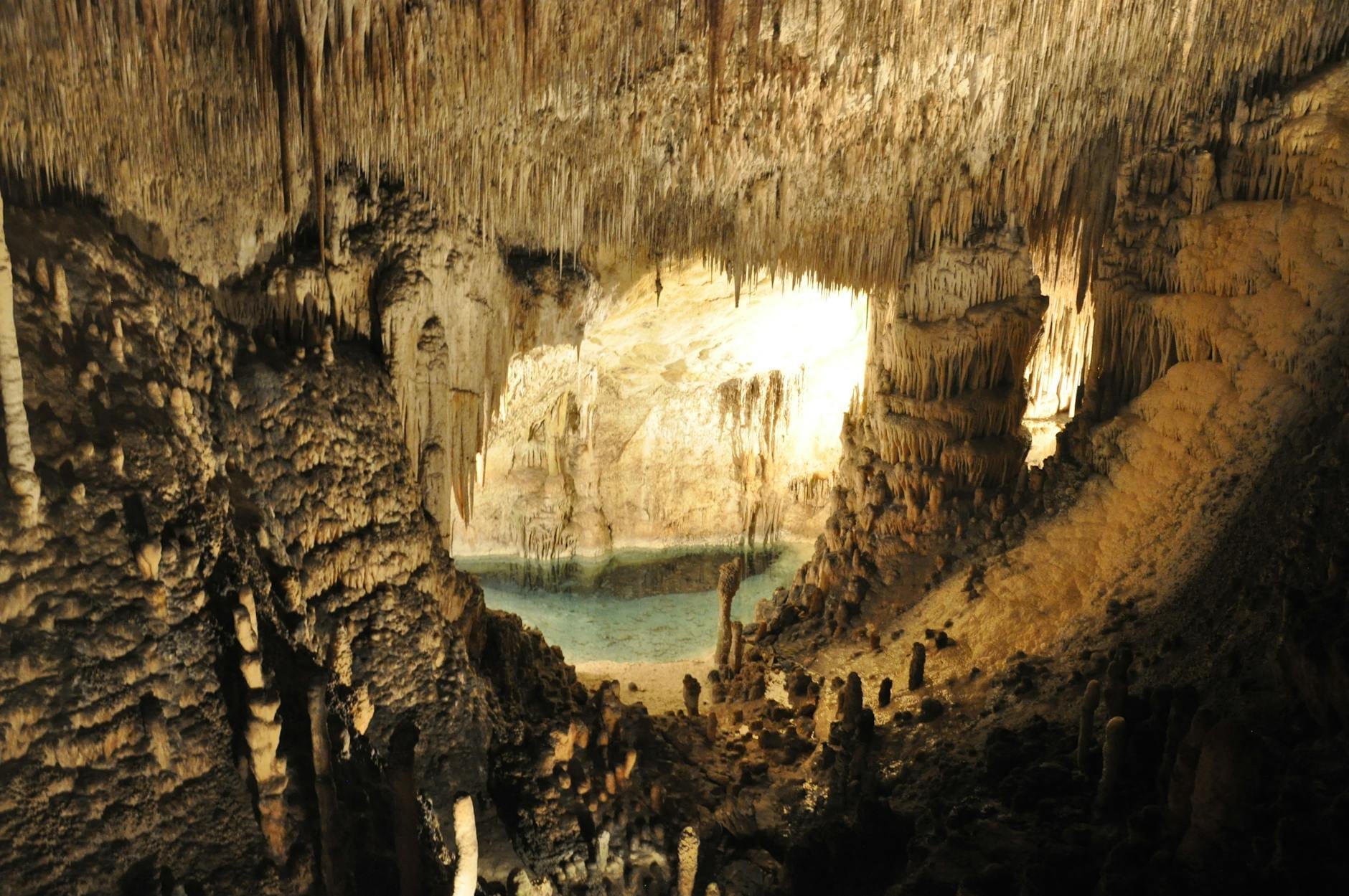
The Cuevas del Drach (Drach Caves) are a system of four interconnected limestone caverns stretching nearly 2,400 metres in total length, with a guided path of 1,200 metres open to visitors. Located just outside Porto Cristo on Mallorca's southeastern coast, the caves descend to a maximum depth of 25 metres and maintain a constant temperature of 17 to 21 degrees Celsius year-round, which makes them a genuinely refreshing destination in the height of summer.
The four chambers, named Los Franceses, Luis Salvador, Blanca, and Negra, open progressively as you walk through, each with its own character. Blanca (White Cave) and Negra (Black Cave) are named for the colouring of their formations: the white calcite columns in one, the dark oxidised rock surfaces in the other. The visual contrast between chambers is sharper than most visitors expect.
At the heart of the system is Lake Martel, 117 metres long, 30 metres wide, and between 4 and 12 metres deep. Hydrologically connected to the nearby sea, it ranks among the largest underground lakes in Europe and is the focal point of every tour. What happens at the lake is explained below, but it is genuinely the kind of spectacle that earns the word extraordinary.
💡 Local tip
The caves stay between 17 and 21°C all year. Bring a light layer even in July: most visitors in shorts and summer clothes feel cold within 20 minutes underground.
A Brief History: From Medieval Mystery to Cultural Monument
The caves have been known to local inhabitants since at least the 14th century, with the first documented mention dating to around 1338 to 1339. For centuries they were explored by locals with torches, their true scale unmapped and their deeper chambers unknown. That changed in 1896, when French speleologist Édouard-Alfred Martel conducted a systematic expedition and discovered the underground lake that now bears his name. His findings brought the caves to the attention of the wider scientific and tourism world.
The theatrical lighting that defines the experience today was designed by Carles Buïgas, the Catalan illumination engineer also responsible for the Font Màgica in Barcelona, installed in the early 20th century. In 1988, the Cuevas del Drach were declared an Asset of Cultural Interest (Bien de Interés Cultural) by the Spanish government, the same protective designation applied to historic monuments across the country.
Tickets & tours
Hand-picked options from our booking partner. Prices are indicative; availability and final rates are confirmed when you complete your booking.
Dinosaurland and Caves of Hams combined ticket
From 25 €Instant confirmationFree cancellation90-minute Coll Baix and caves tour from Can Picafort
From 199 €Instant confirmationFree cancellationJet ski adventure from Cala Bona to the Caves of Arta
From 165 €Instant confirmationFree cancellationCala Varques guided sea caves with kayak and snorkelling expedition
From 61 €Instant confirmationFree cancellation
The Tour: What You Actually Walk Through
Tours depart on a fixed schedule and last approximately one hour. During high season (14 March to 31 October), tours run hourly from 10:00 to 17:00. In low season (1 November to 13 March), departure times are reduced to 10:45, 12:00, 14:00, and 15:30. The caves are closed on 25 December and 1 January. No freestanding self-guided exploration is permitted.
A guide leads groups along a paved, well-lit path through the cave system. The formations are genuinely dense: stalactites hang in clusters from arching ceilings, stalagmites rise from the floor in shapes that have accumulated over millions of years, and columns form where the two have met. The lighting, designed to be dramatic rather than uniform, picks out particular formations and casts others into shadow, which creates a sense of depth and scale beyond the path itself.
The path slopes gently but includes steps. Surfaces are damp and can be slippery in sections. Closed-toe shoes with grip are strongly recommended. The walkway is not fully accessible for wheelchair users or those with significant mobility limitations, as the terrain is uneven throughout.
⚠️ What to skip
Wear closed, non-slip footwear. The cave floor is often wet, and sandals or flip-flops are a genuine hazard on the stone steps.
The Lake Martel Concert: The Moment That Stays With You
Every tour ends at the shore of Lake Martel. The group is seated on stone benches carved into the cave walls in a rough amphitheatre arrangement. The lights dim. Then, from the far end of the lake, small illuminated boats emerge through the darkness carrying a small ensemble of musicians who perform a short classical concert directly on the water.
The acoustics inside the cave amplify every note in a way that would be difficult to engineer above ground. The reverb is natural, the air completely still, and the reflections off the lake surface double the visual effect of the boat lights. It lasts only 10 to 15 minutes but is the single detail most visitors mention first when describing the experience. After the concert, a portion of the group boards boats for a short ride across the lake before exiting the caves from the far side.
The boat ride is included in the standard ticket and is the only way to exit the cave system. Those with significant mobility issues should confirm with the site in advance whether alternative exit arrangements are available.
When to Visit and How to Plan
The caves are one of Mallorca's most-visited attractions, and during peak summer months, the car park fills quickly and queues form before each tour departure. The 10:00 and 11:00 tours in high season attract the largest groups. If you are visiting between June and August, arriving before 09:45 or choosing an afternoon slot after 14:00 slightly reduces the crowd density, though no time slot is quiet in summer.
Spring and autumn visits (April to May, September to October) offer a markedly calmer experience with smaller tour groups and easier parking. The low-season schedule still covers midday and early afternoon, making a November or February visit feasible for those in Mallorca outside summer. The constant underground temperature means the caves are genuinely pleasant in winter when it is cold outside.
Booking online in advance is strongly recommended during high season. Slots sell out on popular dates. The official site also lets you confirm current pricing, which is not fixed in this guide as it is subject to change. For broader context on planning your Mallorca trip around seasonal conditions, see the best time to visit Mallorca guide.
💡 Local tip
Photography inside the caves is permitted without flash. A wide-aperture lens and a steady hand (or small tripod if permitted) produce far better results than a phone camera in the low light. The lake concert is the hardest section to photograph well: embrace the atmosphere rather than the shot.
Getting There and What's Around
Porto Cristo is roughly 60 kilometres east of Palma along the Ma-15 road, a drive of about 50 to 60 minutes depending on traffic. The caves are signed from the main road into Porto Cristo and easy to find by car. Parking on-site is available but limited during peak season; arriving early is the practical solution.
Public transport connections to Porto Cristo are limited and infrequent. A rental car is the most realistic option for most visitors. If you are planning to drive the eastern coast as part of a wider itinerary, see the Mallorca road trip guide for a practical route that pairs the caves with nearby coastal stops.
Porto Cristo itself is a low-key harbour town with a small beach and several seafood restaurants along the waterfront. It makes a natural base for an afternoon after the cave tour. The southeastern coast of Mallorca extends further south toward Cala Figuera, Cala Llombards, and Mondragó Natural Park, all worth including in a full day exploring the region.
Honest Assessment: Is It Worth It?
For most visitors, yes. The Cuevas del Drach deliver on their central promise: the scale of the formations is genuinely impressive, Lake Martel is larger and more dramatic than photographs suggest, and the concert on the water is an unusual experience that works better than it has any right to. The combination of geology, history, and live performance in a single one-hour tour is difficult to find anywhere else.
That said, the experience has limitations worth knowing. The tour is structured and paced by the guide, which means you cannot linger at a formation that interests you or return to a chamber for a second look. Groups are large during peak season, which affects the atmosphere at the lake. And the exit by boat, while memorable, means the whole operation is more logistically regimented than a freeform nature visit.
Travellers who find crowded tour groups frustrating, who have significant walking or mobility challenges, or who are primarily interested in swimming and beaches may find the Drach Caves underwhelming relative to Mallorca's other offerings. For that group, the island's coastline, including Caló des Moro in the southeast, is likely a better use of half a day.
Insider Tips
- Book the first tour slot of the day (10:00 in high season) to experience the lake with the smallest possible crowd before coaches from the resort towns arrive.
- The cave temperature is constant year-round, but the contrast with hot summer air outside makes it feel colder than 17°C. A light long-sleeved layer that folds into a bag solves this without taking up suitcase space.
- After the boat ride deposits you at the far exit, the path back to the car park passes through a gift shop and café. The café terrace overlooking the gardens is quieter than it looks from inside and worth five minutes.
- If you are travelling with young children, seat them near the aisle of the amphitheatre at Lake Martel so they have a clear sightline to the water. The benches at the back of the seating area are elevated but partially obscured by the cave walls.
- The nearby Cuevas dels Hams (Caves of Hams) in Porto Cristo offer an alternative cave experience with smaller crowds, though they are less extensive. The two are close enough to compare on the same day if cave geology genuinely interests you.
Who Is Drach Caves (Cuevas del Drach) For?
- Families with children aged 5 and up who respond to dramatic spectacle
- Visitors seeking relief from summer heat who want an activity rather than a beach
- Geology and natural history enthusiasts interested in speleothem formations
- Photographers comfortable shooting in low light without flash
- First-time visitors to Mallorca building a highlights itinerary of the island's most iconic sites
Nearby Attractions
Other things to see while in Southeast Mallorca:
- Cabrera National Park
The Cabrera Archipelago Maritime-Terrestrial National Park is one of the most strictly protected natural areas in the western Mediterranean. Nineteen uninhabited islands, near-pristine seabed, and a 14th-century castle make it a world apart from mainstream Mallorca tourism. Access is limited and must be booked in advance.
- Cala Agulla
Cala Agulla is a 550-metre natural beach in northeast Mallorca, declared a protected natural area in 1991. Backed by dunes and pine forest, with shallow turquoise water and no major development, it's one of the cleanest and most unspoiled stretches of coastline on the island.
- Cala d'Or
Cala d'Or is a planned resort village on Mallorca's southeast coast, designed in the 1930s by an Ibizan architect and built around several sheltered sandy coves. With calm, clear water, low-rise whitewashed buildings, and a relaxed marina atmosphere, it draws families and couples looking for beach days without the noise of larger resorts.
- Cala Figuera
Cala Figuera is a working fishing village on the southeastern coast of Mallorca, set inside a narrow, fjord-like inlet that splits into two quiet arms. With no sandy beach, no resort hotels, and a harbor still active with traditional wooden boats, it offers something genuinely rare on this island: calm, character, and a sense of place.