Dappermarkt: Amsterdam's Most Diverse Street Market
Running along Dapperstraat in Amsterdam-East since 1910, Dappermarkt is a street market with around 200 stalls selling everything from fresh produce and spices to fabrics and secondhand clothing. Free to enter, open Monday through Saturday, and drawing locals from across the city, it offers a sharply different experience from the tourist-facing markets in the centre.
Quick Facts
- Location
- Dapperstraat, 1093 BS Amsterdam (Amsterdam-East)
- Getting There
- Trams 3, 7, 14 to Dapperstraat; Amsterdam Muiderpoort station (~5 min walk)
- Time Needed
- 45–90 minutes
- Cost
- Free entry; individual stall prices vary, with many items under €5
- Best for
- Budget shoppers, food lovers, anyone wanting an authentic Amsterdam neighbourhood experience
- Official website
- www.dappermarkt.nl
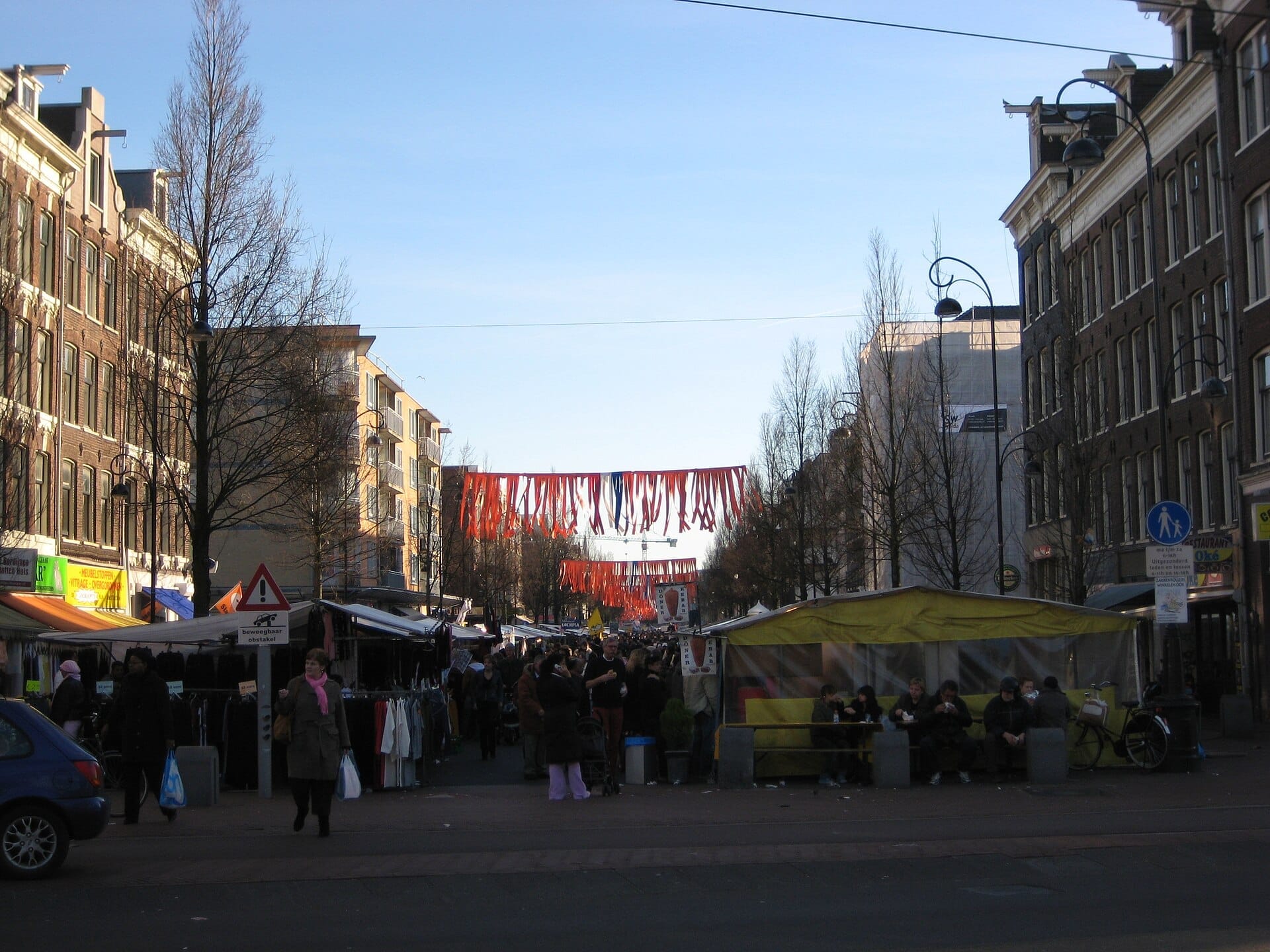
What Is Dappermarkt?
Dappermarkt is a daily street market that runs the length of Dapperstraat, a flat residential road in Amsterdam's Oost (East) district, between Mauritskade and Wijttenbachstraat in Amsterdam East. With roughly 250 stalls operated by around 160 merchants, it is one of the largest and most consistently attended street markets in the city. The municipality formally designated Dapperstraat as a market street in 1910, and it has operated as a market street since then.
Unlike the Bloemenmarkt or the Albert Cuyp, Dappermarkt is not primarily structured around visitors. The crowd here is almost entirely local: families doing the weekly shop, regulars who have known particular vendors for years, and residents from the surrounding blocks cutting through on their way to work. That is precisely what makes it worth the trip.
💡 Local tip
Arrive before 11:00 on a weekday for the best combination of full stalls, relaxed pace, and easy navigation. Saturday draws the largest crowd and the most atmosphere, but aisles become noticeably tighter by midday.
What You'll Find at the Stalls
The market's range is genuinely broad. Fresh produce dominates: stacks of tomatoes, peppers, aubergines, and leafy greens at prices that make the tourist-centre supermarkets look expensive. Whole fish lie on ice alongside prepared seafood snacks. There are stalls piled with olives, dried fruits, and loose spices sold by weight from large open sacks, filling that section of the street with a warm, layered smell of cumin, coriander, and dried chilli.
Beyond food, you'll find fabric and notions stalls, cheap household goods, secondhand clothing sold by the kilo or the piece, phone accessories, and inexpensive cosmetics. A handful of vendors sell Dutch street food: fresh stroopwafels, herring, and fried snacks. The overall aesthetic is functional rather than curated. Stalls are set up quickly and practically, not styled for Instagram.
For context on how Dappermarkt compares to other Amsterdam markets in terms of character and product mix, the Amsterdam markets guide covers the differences clearly.
Tickets & tours
Live prices and dates from our booking partner. If you book, we may earn a commission at no extra cost to you.
Gray Line Canal Cruise with snackbox & Heineken Experience
From 48 €Instant confirmationFree cancellationAmsterdam evening canal cruise
From 18 €Instant confirmationFree cancellationJewish Museum and Portuguese Synagogue entrance ticket
From 20 €Instant confirmationFree cancellationAdmission ticket for Artis Royal Zoo and Micropia
From 39 €Instant confirmationFree cancellation
The Neighbourhood Context
Dappermarkt sits in one of the most ethnically and culturally mixed parts of Amsterdam. The surrounding streets are home to communities with roots in Morocco, Turkey, Suriname, Indonesia, and across sub-Saharan Africa, alongside long-term Dutch residents and a younger wave of newcomers drawn by relatively lower rents. That demographic reality shows up directly in what is sold and what is spoken at the stalls. You will hear Dutch, Arabic, Berber languages, and Papiamentu within the space of a few minutes of walking.
This is not a sanitised multicultural experience. It is a working-class neighbourhood market doing what working-class neighbourhood markets have always done: supplying daily essentials at prices people can actually afford. For visitors accustomed to the more polished versions of Amsterdam life found around Museumplein or the canal ring, Dappermarkt can feel like a genuinely different city.
How the Market Changes Through the Day
The market opens at 09:00 and the first hour tends to be purposeful: local residents buying produce before work or school, vendors still arranging their displays, and the food stalls preparing fresh stock. The smell of bread and frying is strongest early. If you want to move freely and have conversations with vendors, this is the window.
By late morning, density increases noticeably. Pushchairs and shopping trolleys fill the central lane, and the food stalls develop short queues. This is also when the market feels most alive: the sounds of competing vendor calls, the clatter of scales and coins, the occasional burst of laughter from a regular customer and a familiar stall owner.
In the early afternoon, the crowd gradually thins. Some stalls begin closing or reducing stock from around 15:00, and by 17:00 the market is finished. The tail end of the day has its own rhythm: deeper discounts on produce, a slightly more relaxed pace, and vendors willing to negotiate on remaining stock. What you gain in price, you lose in choice.
ℹ️ Good to know
The market operates Monday to Saturday, 09:00 to 17:00, for most of the year. It is generally closed on Sundays, with only occasional special Sunday markets.
Getting There and Getting Around
Dapperstraat is well served by public transport. Tram lines 3, 7, 9, 10, and 14 all stop near the market, and bus lines 22, 37, and 41 serve the area. Amsterdam Muiderpoort railway station is approximately a five-minute walk away, making it straightforward to combine a visit with the Oosterpark or the Tropenmuseum if you are spending time in the east.
If you are cycling, cycling in Amsterdam is straightforward from the centre: Dapperstraat is roughly 2.5 km east of Waterlooplein. There is no dedicated cycle parking at the market itself, but standard street racks are available on surrounding streets.
The street is flat and level, which makes navigation with a pram or a wheeled shopping bag practical. The market operates on a standard Amsterdam pavement and road surface, with tram tracks running along the wider surrounding roads. There are no formal accessibility facilities specific to the market, but the terrain itself presents few barriers beyond the general crowding on busier days.
Photography, Honest Assessment, and Who Should Skip It
The market photographs well in the late morning when light comes in low along the street and the stalls are fully loaded. The produce stalls, the fabric displays, and the vendor faces offer strong visual material. That said, some vendors are less comfortable with cameras than others, particularly on food stalls where personal interaction is constant. A quick nod or a small purchase goes further than any request.
It is worth being direct about what Dappermarkt is not. If you are looking for artisan cheeses, vintage finds, organic produce arranged in attractive wooden crates, or craft goods, this is not the right market. The Albert Cuyp in De Pijp has more of that character. Dappermarkt is built around price and practicality. The quality of fresh produce is generally good, but you are buying from a working market, not a food hall.
Visitors doing a broader market tour of Amsterdam might also consider the Noordermarkt for organic produce and the Waterlooplein market for secondhand goods and a more central location.
Travelers who prefer quiet, uncrowded experiences or who find dense market conditions uncomfortable may find peak-hour Dappermarkt stressful. There is nowhere to sit down, the aisles are narrow on busy days, and the general atmosphere is transactional rather than leisurely. Those are features if you want authenticity. They are drawbacks if you want comfort.
Insider Tips
- Bring a reusable bag or a wheeled shopping trolley. Plastic bags are available from stalls but the best approach is to arrive prepared, especially if you plan to buy produce.
- If you want to eat at the market, the savoury snack stalls in the middle section of Dapperstraat tend to have more variety than those near the ends. Fried snacks and fresh stroopwafels are reliable choices.
- Saturday draws the largest and most diverse crowd of the week, which is good for atmosphere but makes moving quickly through the stalls harder. A weekday visit between 09:30 and 11:00 is the most efficient window.
- Vendors at produce stalls will often negotiate small discounts if you are buying larger quantities. This is not expected for single items, but asking politely for a price on a full crate or large bag is normal practice here.
- The streets immediately surrounding Dapperstraat have several small Surinamese and Moroccan restaurants that are worth exploring after the market. Prices reflect the neighbourhood rather than the tourist circuit.
Who Is Dappermarkt For?
- Budget travelers wanting fresh produce, cheap household goods, or inexpensive clothing
- Food-curious visitors interested in spices, dried goods, and street snacks from multiple culinary traditions
- Travelers who want to see a working Amsterdam neighbourhood that functions independently of tourism
- Photographers looking for colour, texture, and unposed street life
- Locals and long-term residents who already know the centre markets and want something different
Nearby Attractions
Combine your visit with:
- Amsterdam Dance Event (ADE)
Every October, Amsterdam transforms into the global capital of electronic music for five days. Amsterdam Dance Event brings together more than 1,000 shows across nearly 200 venues, from intimate club nights to warehouse raves, alongside a major industry conference that shapes the direction of dance music worldwide.
- Amsterdamse Bos (Amsterdam Forest)
Covering nearly 1,000 hectares on Amsterdam's southwestern edge, Amsterdamse Bos is a man-made forest park three times the size of New York's Central Park. Free to enter and open year-round, it offers cycling paths, a rowing lake, wildlife meadows, and genuine breathing room that the city centre simply cannot provide.
- Haarlem
Just under 20 km west of Amsterdam, Haarlem is the capital of North Holland and one of the Netherlands' oldest cities, granted city rights in 1245. A compact historic centre, the landmark Grote Kerk, the Frans Hals Museum, and a lively market square make it one of the most rewarding half-day escapes from the capital.
- Keukenhof Gardens
Keukenhof Gardens in Lisse, South Holland, is one of the world's largest flower parks, open for just eight weeks each spring. Planted with around 7 million bulbs across 32 hectares, it draws visitors from around the world for its tulip displays, historic landscape design, and glasshouse collections. Plan carefully: timing, transport, and ticket booking all matter more here than at most attractions.
Planning a trip? Discover personalized activities with the Nomado app.