Haarlem: The Day Trip from Amsterdam That Actually Delivers
Just under 20 km west of Amsterdam, Haarlem is the capital of North Holland and one of the Netherlands' oldest cities, granted city rights in 1245. A compact historic centre, the landmark Grote Kerk, the Frans Hals Museum, and a lively market square make it one of the most rewarding half-day escapes from the capital.
Quick Facts
- Location
- Haarlem, North Holland, ~20 km west of Amsterdam
- Getting There
- Sprinter or Intercity train from Amsterdam Centraal: ~15 min
- Time Needed
- 3–6 hours (half-day or full day)
- Cost
- Free to enter the city; individual museums charge admission
- Best for
- History lovers, architecture fans, day-trippers avoiding Amsterdam crowds
- Official website
- www.visithaarlem.com/en
Why Haarlem Works as a Day Trip
The case for Haarlem is simple: it gives you the best of a classic Dutch city without the compression of Amsterdam. The canals are quieter, the streets are wider in places, the market square is genuinely used by locals, and the pace slows down just enough to let you actually look at things. It is not a theme-park version of the Netherlands. It is a functioning provincial capital of about 162,000 people that happens to have a medieval core worth serious attention.
Haarlem is also one of the easiest day trips logistically. Trains from Amsterdam Centraal run frequently throughout the day on both the Sprinter and Intercity lines, and the journey takes roughly 15 minutes. The station drops you a short walk from the historic centre. You do not need a car, a tour bus, or a pre-booked ticket to enter the city itself. For a fuller picture of how to plan your time across the region, the day trips from Amsterdam guide covers Haarlem alongside other options and helps you compare travel times and logistics.
💡 Local tip
Buy your train ticket through the NS app or use an OV-chipkaart. Single-journey tickets purchased at station machines are significantly more expensive than tap-in/tap-out card travel. The journey time is around 15 minutes each way, so round-trip fares are modest.
The Grote Markt and Sint-Bavokerk: The Heart of the City
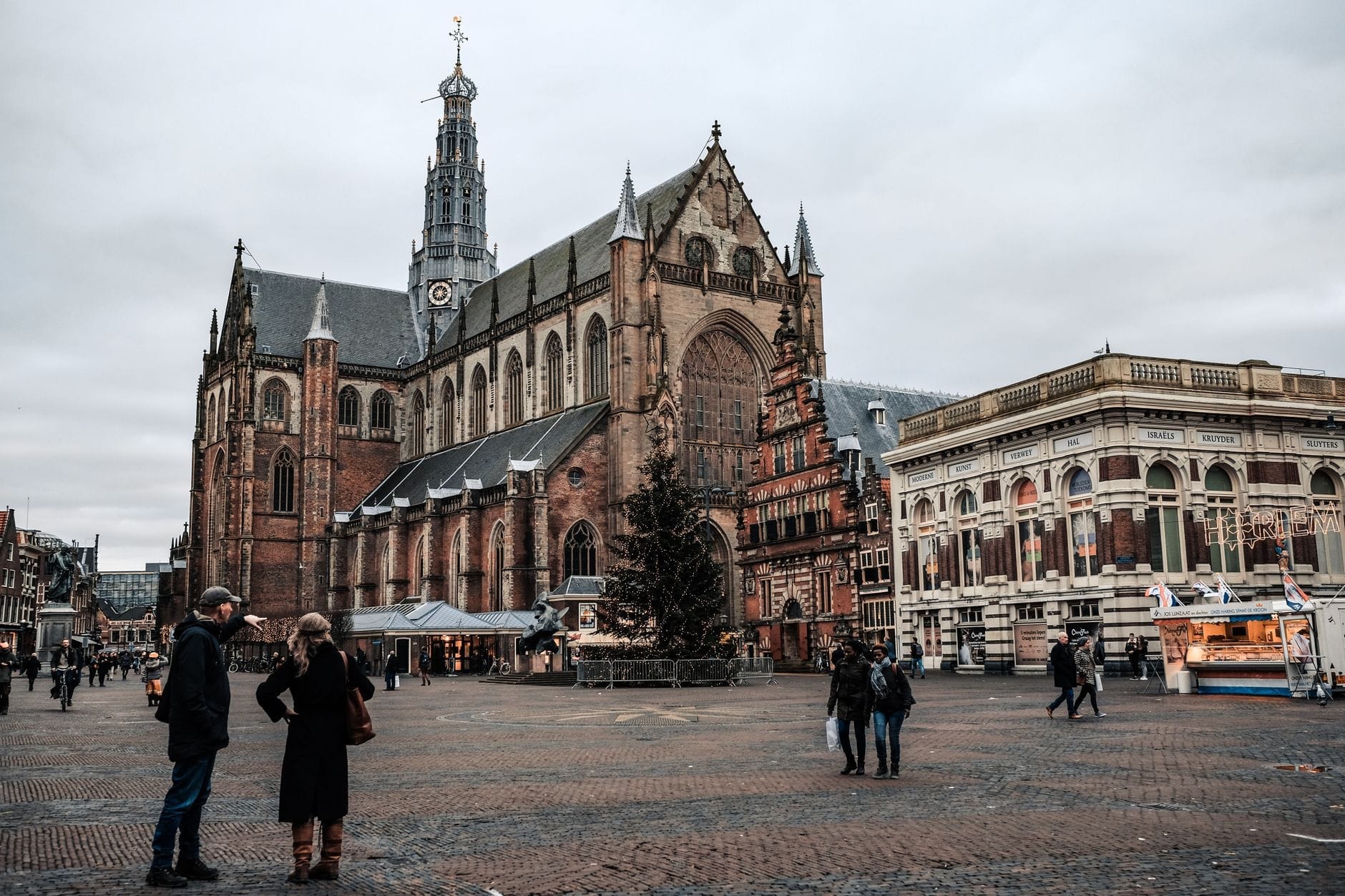
Arriving in Haarlem on foot from the station, you pass through a grid of ordinary shopping streets before the city reveals itself all at once: the Grote Markt, a large open market square framed by the Sint-Bavokerk (Grote Kerk) on one side and the 15th-century Stadhuis (city hall) on the other. This is the kind of medieval civic space that urban planners reference in textbooks. The scale of the church relative to the square is almost theatrical.
The Sint-Bavokerk dominates the skyline from almost every approach into the old centre. The church is a late-Gothic cruciform structure built primarily between the 14th and 16th centuries, and its sandstone tower is visible well before you reach the square. Inside, the Müller organ (completed 1738) is the instrument that a young Wolfgang Amadeus Mozart played during a visit to Haarlem in 1766, when he was ten years old. Handel is also said to have played it. The organ remains one of the finest Baroque instruments in the world. Opening hours and admission for the church should be verified at the official Sint-Bavokerk site before visiting, as they vary by season and event schedule.
The Grote Markt on a Saturday morning operates as a working market, with stalls selling cheese, vegetables, flowers, and textiles. Arrive before 11:00 and you will find it at full activity, with genuine local foot traffic. By early afternoon the stalls begin closing and the square transitions to café terrace territory. Mornings are the most photogenic: the low northern light hits the church's stone facade from the east, and the market stalls add colour and human scale to a square that might otherwise feel empty.
Tickets & tours
Live prices and dates from our booking partner. If you book, we may earn a commission at no extra cost to you.
Gray Line Canal Cruise with snackbox & Heineken Experience
From 48 €Instant confirmationFree cancellationAmsterdam evening canal cruise
From 18 €Instant confirmationFree cancellationJewish Museum and Portuguese Synagogue entrance ticket
From 20 €Instant confirmationFree cancellationAdmission ticket for Artis Royal Zoo and Micropia
From 39 €Instant confirmationFree cancellation
The Frans Hals Museum: One of the Best Small Art Museums in Europe
Haarlem's cultural reputation rests largely on one painter. Frans Hals (c.1582–1666) spent virtually his entire career here, and his civic group portraits are among the most technically accomplished paintings of the Dutch Golden Age. The Frans Hals Museum holds the world's most important collection of his work, including the large militia company portraits that established his reputation and the late regent paintings, dark and psychologically penetrating, that he made in his eighties.
The museum is split across two locations in Haarlem: Hof (the historic almshouse building in the centre) and Hal (a secondary space). The Hof location, a converted 17th-century almshouse around an internal courtyard, is the main draw. The building itself is part of the experience: a long galleried space around a quiet courtyard that gives you somewhere to decompress between the large-scale group portraits. Ticket prices and current opening hours should be confirmed at the museum's official site, as they are subject to change and timed entry may be required.
ℹ️ Good to know
The Frans Hals Museum is roughly a 10-minute walk from the Grote Markt through the old centre. Maps are available at the museum or from the Visit Haarlem tourist office near the station. If you are combining the museum with a full walk of the city, allow at least 90 minutes inside, more if you want to spend time with the large group paintings.
Walking the Old Centre: What to Look For
Haarlem's historic centre is compact enough to cover thoroughly in two to three hours on foot. The River Spaarne runs along the eastern edge of the old town, and the stretch of water from the Gravestenenbrug (a working bascule bridge) back toward the Grote Kerk gives you the postcard view of the city: brick facades, church tower, water. Early mornings are cleanest here, before delivery boats and day-tripper groups arrive.
The Hofje tradition is one of Haarlem's quieter pleasures. A hofje is an enclosed almshouse courtyard, originally built by wealthy merchants as charitable housing. Haarlem has more hofjes than almost any other Dutch city, and several of them are accessible to respectful visitors during daytime hours. They are unmarked on most tourist maps, which means you find them by wandering down narrow passages off the main streets. The Frans Loenenhofje and the Hofje van Bakenes are two of the more frequently open examples, though visitors should remain quiet and stay out of residential areas.
The Jansstraat and Kruisstraat axes running north-south through the centre are lined with independent shops, bookshops, and cafes. This is a different retail character from Amsterdam's Nine Streets: less curated, more genuinely local. You will find cheese shops, delicatessens, and bakeries that clearly serve the resident population rather than tourists.
Haarlem and the Tulip Bulb Trade
Haarlem carries the informal title of Bloemenstad, flower city, and the connection to tulips is historically real rather than marketing invention. The sandy soil of the coastal dune strip west and north of Haarlem proved ideal for bulb cultivation from the 17th century onward, and Haarlem became the commercial hub of the Dutch bulb-growing industry. The speculative frenzy of tulip mania in 1636-1637, often cited as one of history's first recorded asset bubbles, was centred in part on markets in this region.
Today the bulb fields are planted between Haarlem and the coast, and in spring (roughly late March through early May) the fields along this corridor bloom in structured rows of colour. The drive or cycle route from Haarlem toward the coast passes through active bulb farms. If you are visiting during this window, the Amsterdam tulip season guide has practical details on timing and which areas to prioritise.
Practical Information: Timing, Getting There, and What to Know
Haarlem is a public city accessible at all times. There is no admission fee to enter. The train is by far the most practical way to arrive from Amsterdam: Sprinter and Intercity services run from Amsterdam Centraal frequently throughout the day, with a journey time of approximately 15 minutes. The station is a short walk from the historic centre. Buses also connect to surrounding areas, but for a day trip from Amsterdam the train is the obvious choice.
The city is at its most comfortable on weekdays and on Saturday mornings when the market is active. Sunday sees some shops closed and a quieter, more residential atmosphere, which suits some visitors and frustrates others. School holidays and spring weekends bring noticeably more Dutch domestic tourism to the city, though it rarely reaches the density of Amsterdam's centre.
The historic centre is mostly flat but has uneven cobbled surfaces on many streets, which can be difficult for wheelchair users and those with mobility limitations. Modern public transport infrastructure in the Netherlands is generally accessible, with step-free access on most trains and at major stations, but checking in advance with NS (Dutch Railways) for specific journey needs is advisable. The city's tourism portal at visithaarlem.com offers current visitor information including accessibility resources.
⚠️ What to skip
Haarlem is a genuine city, not a day-trip park. Locals cycle through the centre at speed, delivery vehicles use the historic streets, and not every sign is translated into English. This is mostly an asset, but visitors accustomed to heavily managed tourist environments should be prepared for a more ordinary urban experience.
For broader trip planning, the Amsterdam 3-day itinerary positions Haarlem as a natural extension for travellers who want to move beyond the capital's immediate centre.
Who Should Skip This Trip
Haarlem does not suit travellers who need constant programmed activity or who are primarily visiting Amsterdam for its nightlife and urban energy. The city is pleasant but modest in ambition. There are no large-scale spectacle attractions, no NEMO-style interactive museums for young children, and no equivalent of Amsterdam's major museum cluster. If your visit to the Netherlands is short and Amsterdam's core offerings remain unseen, prioritise those first.
Travellers who have already covered Amsterdam's main sites, who want to see a functioning Dutch city at normal scale, or who are interested in Dutch Golden Age painting beyond the Rijksmuseum's overview will find Haarlem genuinely rewarding. It is also a good choice for anyone experiencing museum fatigue in Amsterdam: a day here resets expectations without requiring heavy planning.
Insider Tips
- Arrive on a Saturday morning to catch the Grote Markt market at full activity, then walk to the Frans Hals Museum by late morning before the lunch crowds arrive. The combination takes about four hours and covers the city's two strongest offerings back to back.
- Look for the hofje entrances: they are typically marked by a small door or arch in a row of street-facing buildings, often with a name plate in old Dutch script. Most that allow visitors are accessible between roughly 10:00 and 17:00 on weekdays, but there is no guarantee. Knock quietly or enter slowly; if residents indicate the space is private, leave without argument.
- The stretch of the River Spaarne between the Gravestenenbrug and the older Bakenessergracht area is significantly less photographed than the Grote Markt but equally characteristic of the city. Walk it in both directions: the light and the framing of the buildings change completely depending on which side of the water you are on.
- Haarlem has a local craft beer culture worth noting. Several independent cafes near the Grote Markt serve regional and Dutch microbrews alongside the standard options. This is worth knowing if you are extending your day into the early evening before the train back.
- The train back to Amsterdam runs frequently and the journey is short, so there is no need to rush the end of your visit. Last trains run well into the night, giving you the option of staying for dinner without scheduling anxiety.
Who Is Haarlem For?
- Travellers who have already visited Amsterdam's major museums and want a different register of Dutch city life
- Art and architecture enthusiasts, particularly those interested in Dutch Golden Age painting beyond the Rijksmuseum's curated selection
- Spring visitors combining a Haarlem walkabout with a trip through the nearby tulip bulb fields
- Solo travellers or couples who want a quieter, slower-paced day without managing large crowds
- Anyone making a longer Netherlands trip who wants to understand how a medium-sized Dutch provincial city actually functions
Nearby Attractions
Combine your visit with:
- Amsterdam Dance Event (ADE)
Every October, Amsterdam transforms into the global capital of electronic music for five days. Amsterdam Dance Event brings together more than 1,000 shows across nearly 200 venues, from intimate club nights to warehouse raves, alongside a major industry conference that shapes the direction of dance music worldwide.
- Amsterdamse Bos (Amsterdam Forest)
Covering nearly 1,000 hectares on Amsterdam's southwestern edge, Amsterdamse Bos is a man-made forest park three times the size of New York's Central Park. Free to enter and open year-round, it offers cycling paths, a rowing lake, wildlife meadows, and genuine breathing room that the city centre simply cannot provide.
- Dappermarkt
Running along Dapperstraat in Amsterdam-East since 1910, Dappermarkt is a street market with around 200 stalls selling everything from fresh produce and spices to fabrics and secondhand clothing. Free to enter, open Monday through Saturday, and drawing locals from across the city, it offers a sharply different experience from the tourist-facing markets in the centre.
- Keukenhof Gardens
Keukenhof Gardens in Lisse, South Holland, is one of the world's largest flower parks, open for just eight weeks each spring. Planted with around 7 million bulbs across 32 hectares, it draws visitors from around the world for its tulip displays, historic landscape design, and glasshouse collections. Plan carefully: timing, transport, and ticket booking all matter more here than at most attractions.
Planning a trip? Discover personalized activities with the Nomado app.