Keukenhof Gardens: What to Know Before You Go
Keukenhof Gardens in Lisse, South Holland, is one of the world's largest flower parks, open for just eight weeks each spring. Planted with around 7 million bulbs across 32 hectares, it draws visitors from around the world for its tulip displays, historic landscape design, and glasshouse collections. Plan carefully: timing, transport, and ticket booking all matter more here than at most attractions.
Quick Facts
- Location
- Stationsweg 166A, 2161 AM Lisse, Netherlands (approx. 30 min from Amsterdam by road)
- Getting There
- Combi bus tickets (admission + direct bus from Amsterdam Centraal or Schiphol) available via official site; no direct train to Lisse
- Time Needed
- 3 to 5 hours; full day if including surrounding bulb fields
- Cost
- Adults from €21, children 4–17 €10, under-4s free; parking €9 per car
- Best for
- Spring travelers, photography, families, garden and horticulture enthusiasts
- Official website
- keukenhof.nl/en
What Keukenhof Actually Is
Keukenhof Gardens is a seasonal spring park in the town of Lisse, about 30 kilometres south-west of Amsterdam. It is not a botanical garden in the research sense, nor a public park open year-round. It exists for one purpose: to display flowering spring bulbs at their peak, over a window of roughly eight weeks each year, typically mid-March to mid-May. For 2026, the park is open daily from 19 March to 10 May, 08:00 to 19:00.
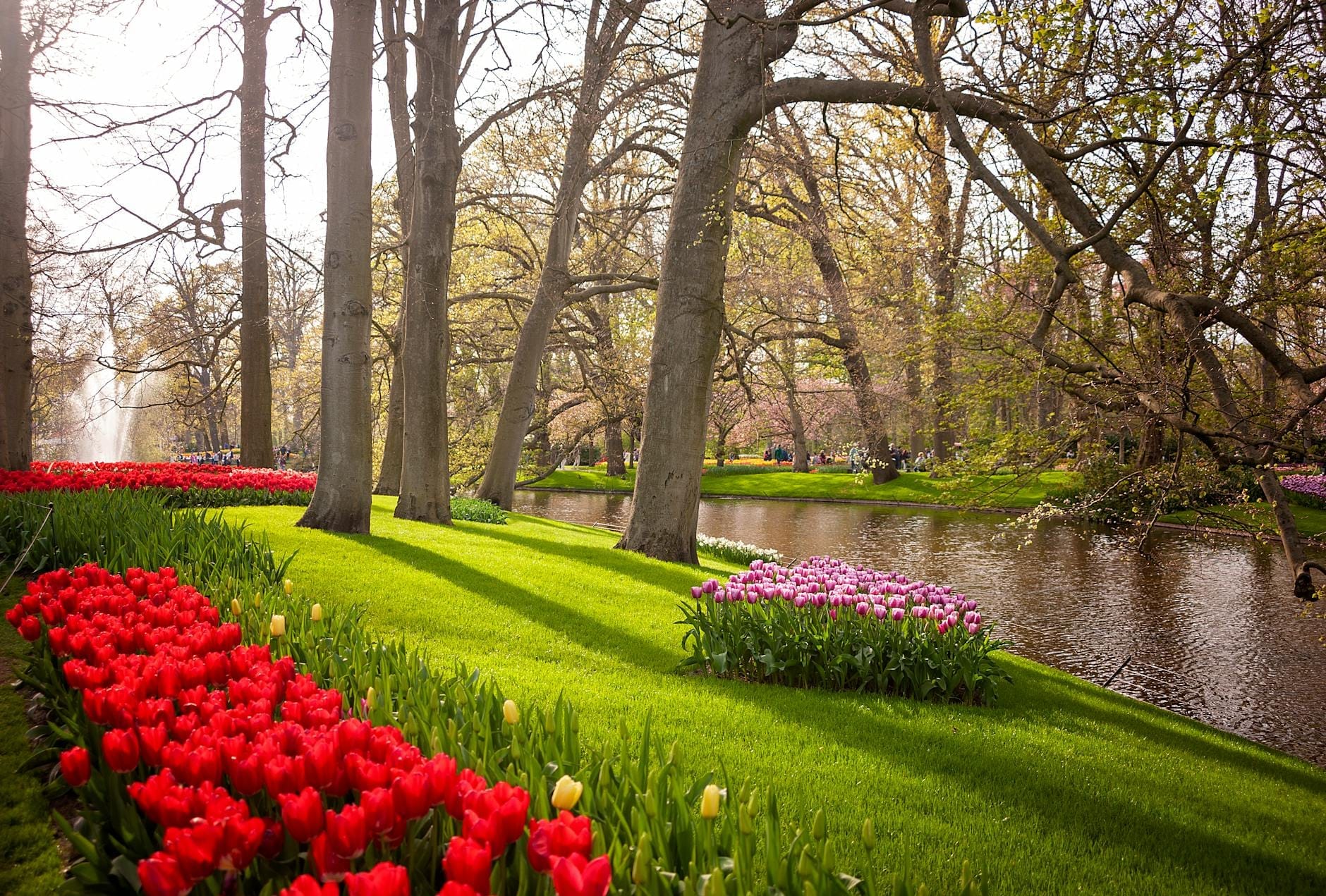
The scale is the first thing that catches visitors off guard. The park covers 32 hectares and is planted annually with approximately 7 million bulbs, including tulips, daffodils, hyacinths, and smaller species like muscari and fritillaria. The planting is dense and deliberate: colour blocks, gradient beds, and winding ribbon borders follow the contours of the Zocher-designed landscape. On a clear morning in late April, the combined scent of hyacinths alone is strong enough to stop you walking.
💡 Local tip
Book timed-entry tickets online before you travel. Keukenhof uses a slot system and popular time slots sell out weeks in advance during peak weeks in April. On-site card-only sales are available, but availability is limited.
History: From Kitchen Dunes to Flower Park
The estate's name traces back to the 15th century, when the area was called 'Keukenduyn' (kitchen dunes) and used by Countess Jacoba van Beieren (Jacqueline of Bavaria, 1401–1436) as kitchen grounds for nearby Teylingen Castle. Keukenhof Castle itself was built in 1641, and over subsequent centuries the estate grew to cover more than 200 hectares.
The park's current form owes its bones to Jan David Zocher and his son Louis Paul Zocher, the landscape architects who redesigned the castle gardens in 1857 in the English landscape style. Their work introduced the naturalistic water features, sweeping lawns, and winding paths that still structure the visitor experience today. The formal spring flower park opened to the public in 1950, following a 1949 initiative by prominent flower-bulb growers who wanted a showcase for Dutch horticulture. That commercial origin is still visible: the park is partly funded by the bulb industry and serves as a live catalogue for professional buyers alongside the general public.
Tickets & tours
Live prices and dates from our booking partner. If you book, we may earn a commission at no extra cost to you.
Day Trip to Keukenhof, Tulip Farm and Windmill Cruise
From 85 €Instant confirmationFree cancellationTulips and windmills small-group tour with Keukenhof skip-the-line ticket
From 120 €Instant confirmationFree cancellationKeukenhof Gardens and Tulip Experience From Amsterdam
From 79 €Instant confirmationFree cancellationHalf-day tour to Keukenhof Gardens with optional canal cruise
From 80 €Instant confirmationFree cancellation
The Experience: Morning vs Afternoon
Arriving at or close to opening (08:00) makes a significant difference. The first hour sees far fewer visitors, the light is softer and lower, and the paths through the denser tulip sections feel genuinely spacious. By 10:30, tour groups begin arriving in volume and the main routes around the central pond get congested. The noise profile shifts too: mornings are relatively quiet, with birdsong audible above the rustling of visitors' bags. By midday, ambient crowd noise is constant.
Weekdays are noticeably less crowded than weekends. If you have flexibility, a Tuesday or Wednesday morning in the third week of April (when tulips are typically at full peak) is the closest thing to an optimal visit. Weekends in mid-April are the busiest period of the entire season: expect queues at food stalls, limited space near key flower beds for photography, and slower movement on main paths.
The park has multiple glasshouses worth visiting regardless of weather. The Oranje Nassau Pavilion and the Willem-Alexander Pavilion contain cut flower displays, competition arrangements, and bulb exhibits that offer context for what you're seeing outdoors. On overcast or rainy days, these become a natural refuge, and the displays inside are no less impressive than the beds outside.
ℹ️ Good to know
Peak tulip bloom typically falls in the third or fourth week of April, but this varies by a week or more depending on winter temperatures. A cold March delays the season; an early warm spell accelerates it. Check the Keukenhof bloom calendar on their official site close to your visit date.
Getting There from Amsterdam
Keukenhof is in Lisse, South Holland, not in Amsterdam. There is no direct train connection to Lisse. The practical options are: a combi ticket (park admission plus a direct bus) departing from Amsterdam Centraal or Amsterdam Airport Schiphol, renting a car or cycling through the bulb fields, or joining an organised day trip. The combi bus route is the most straightforward option for first-time visitors and the tickets are sold through the official Keukenhof website.
If you are already planning to explore Amsterdam's surroundings, Keukenhof pairs well with a broader day trip from Amsterdam. The drive south from Amsterdam through the Bollenstreek (bulb region) is itself part of the experience: the flat, wide fields striped in yellow, red, and purple on either side of the road in April are something the park alone cannot replicate. Cycling between fields is possible from nearby towns if you have the time and reasonable fitness.
Parking at the park costs €9 per car. Drivers should note that the access roads to Keukenhof get heavily backed up on peak weekends. Arriving before 09:00 or after 15:30 reduces delays significantly.
What to See and Where to Walk
The park is large enough that a single circuit without pausing would take well over an hour. Most visitors spend three to five hours, though garden enthusiasts and photographers regularly fill a full day. The paths are well-maintained, mostly flat, and paved or compacted gravel, which makes the park accessible for pushchairs and wheelchairs on the main routes. For detailed accessibility information including wheelchair rental, the official site carries a dedicated FAQ.
The central section around the main pond is the most photogenic and the most crowded. The Dutch-style windmill near the park's eastern edge provides an obvious backdrop and draws many visitors for photos at peak times. For quieter walking and less dense crowds, the outer perimeter paths and the sections near the smaller water channels tend to be overlooked by groups following the main route.
The glasshouses are genuinely worth time, not just a wet-weather fallback. They contain orchids, amaryllis, and early-season varieties that have not yet bloomed outside, and the horticultural competition displays offer a level of craft that goes beyond what most visitors expect. If spring flowers are a serious interest, also consider reading about Amsterdam's tulip season to understand the broader regional context of what you're seeing.
Photography: Practical Advice
Morning light between 08:00 and 10:00 is often best for photography at Keukenhof. The sun is low, shadows are long, and the colours of the tulip beds read more distinctly in lower-angle light than in the flat midday sun. The park faces predominantly open sky with few tall trees near the main beds, so overcast days actually produce even, shadow-free light that many flower photographers prefer.
Wide-angle shots from elevated positions (there are a few gentle rises near the pond and pavilions) give a sense of scale but can look cluttered with visitors at busy times. Close-up and macro work at almost any hour is rewarding, especially on hyacinths and the more unusual tulip varieties. Bring a wide-angle and a short telephoto or macro lens if you're serious about the visit.
⚠️ What to skip
Drone flying is not permitted at Keukenhof. Security staff enforce this actively. Aerial images you see online are either licensed commercial shots or taken from adjacent farmland, not from within the park.
Honest Assessment: Is It Worth It?
Keukenhof is frequently described in hyperbolic terms, and for once the reality largely justifies it, within certain conditions. If you visit in the right week (late April for tulips), on a weekday, and arrive close to opening time, the experience is genuinely memorable: the density of colour, the scent, and the sheer horticultural ambition of the planting are unlike anything most visitors have seen.
On a rainy weekend in early April before the tulips have peaked, or in the final week of the season when petals are dropping, the experience is considerably less impressive and the crowds remain. The park does not offer refunds for poor weather or off-peak timing. This is the single most important thing to understand before booking.
Visitors who find the park over-commercialised or prefer unmediated nature over curated display will likely be underwhelmed. If your interest in Dutch spring culture extends beyond the park itself, the Bloemenmarkt in Amsterdam and the surrounding bulb fields between Lisse and Haarlem offer a less packaged perspective on the same flower industry.
Families with children generally find the park well-suited to them: the flat terrain, the novelty of the flower displays, and the available food facilities make it manageable for most ages. For a broader view of how to spend time in the region, Amsterdam with kids covers several complementary options.
Insider Tips
- The first 90 minutes after opening (08:00 to 09:30) are the least crowded period of the day. On peak April weekends, visitor numbers are much higher by 11:00.
- Combi tickets from Schiphol airport are practical if you're arriving into the Netherlands during the season and want to stop en route to Amsterdam, avoiding a return trip.
- The park's outer northern paths, away from the central pond, are planted with less-photographed species beds and are rarely congested even at midday. Good for unhurried walking.
- Food inside the park is available but expensive. Bringing your own food is permitted and can save both money and queuing time at the on-site restaurants.
- The bulb fields surrounding Lisse, visible from the road and from cycling routes, are free to view and often at their most dramatic in late April. Renting a bike from Lisse and cycling the Bollenstreek route adds an hour and significantly widens the experience.
Who Is Keukenhof Gardens For?
- Travelers visiting the Netherlands specifically during the spring tulip season
- Photographers looking for structured floral subjects in natural light
- Families with young children who need flat, well-organised outdoor space
- Garden and horticulture enthusiasts with an interest in bulb cultivation
- First-time visitors to the Netherlands wanting to see the country's most iconic spring landscape
Nearby Attractions
Combine your visit with:
- Amsterdam Dance Event (ADE)
Every October, Amsterdam transforms into the global capital of electronic music for five days. Amsterdam Dance Event brings together more than 1,000 shows across nearly 200 venues, from intimate club nights to warehouse raves, alongside a major industry conference that shapes the direction of dance music worldwide.
- Amsterdamse Bos (Amsterdam Forest)
Covering nearly 1,000 hectares on Amsterdam's southwestern edge, Amsterdamse Bos is a man-made forest park three times the size of New York's Central Park. Free to enter and open year-round, it offers cycling paths, a rowing lake, wildlife meadows, and genuine breathing room that the city centre simply cannot provide.
- Dappermarkt
Running along Dapperstraat in Amsterdam-East since 1910, Dappermarkt is a street market with around 200 stalls selling everything from fresh produce and spices to fabrics and secondhand clothing. Free to enter, open Monday through Saturday, and drawing locals from across the city, it offers a sharply different experience from the tourist-facing markets in the centre.
- Haarlem
Just under 20 km west of Amsterdam, Haarlem is the capital of North Holland and one of the Netherlands' oldest cities, granted city rights in 1245. A compact historic centre, the landmark Grote Kerk, the Frans Hals Museum, and a lively market square make it one of the most rewarding half-day escapes from the capital.
Planning a trip? Discover personalized activities with the Nomado app.