Cooper Hewitt, Smithsonian Design Museum: The Complete Visitor's Guide
Housed inside the landmark Andrew Carnegie Mansion on Fifth Avenue, Cooper Hewitt, Smithsonian Design Museum is the only museum in the United States dedicated entirely to design. From its interactive pen technology to its walled garden, it rewards curiosity at a pace most major NYC museums cannot match.
Quick Facts
- Location
- 2 East 91st Street, Upper East Side, Manhattan (Museum Mile)
- Getting There
- 4/5/6 to 86th St or 6/Q to 96th St (about a 10-minute walk each); M1/M2/M3/M4 buses stop on Fifth Avenue
- Time Needed
- 1.5 to 2.5 hours
- Cost
- Adults $18, Seniors $12, Students $12, Under 18 free (verify on official site)
- Best for
- Design enthusiasts, architecture lovers, curious adults, students, and families with older children
- Official website
- www.cooperhewitt.org
What Cooper Hewitt Actually Is (And Why It Stands Apart)
Cooper Hewitt, Smithsonian Design Museum is the only museum in the United States devoted exclusively to design in all its forms: product design, graphic design, fashion, urban planning, digital interfaces, wallcoverings, and furniture spanning more than 300 years. That scope sounds abstract until you walk the galleries and find yourself moving from an 18th-century French wallpaper panel to a concept electric vehicle interior in the span of two rooms.
The museum's collection holds more than 215,000 objects, but you will never see most of them at once. Rotating exhibitions pull specific threads from that archive and frame them around a central design question or era. This means repeat visits genuinely feel different, and it also means the museum avoids the numbing effect of encyclopedic collections where quantity overwhelms attention.
Its position on Museum Mile alongside institutions like the Metropolitan Museum of Art and the Guggenheim Museum gives it a natural place in a full day of Upper East Side culture, though its quieter pace makes it worth visiting independently rather than squeezing in at the end of a Met marathon.
The Building: Carnegie's Mansion as a Gallery
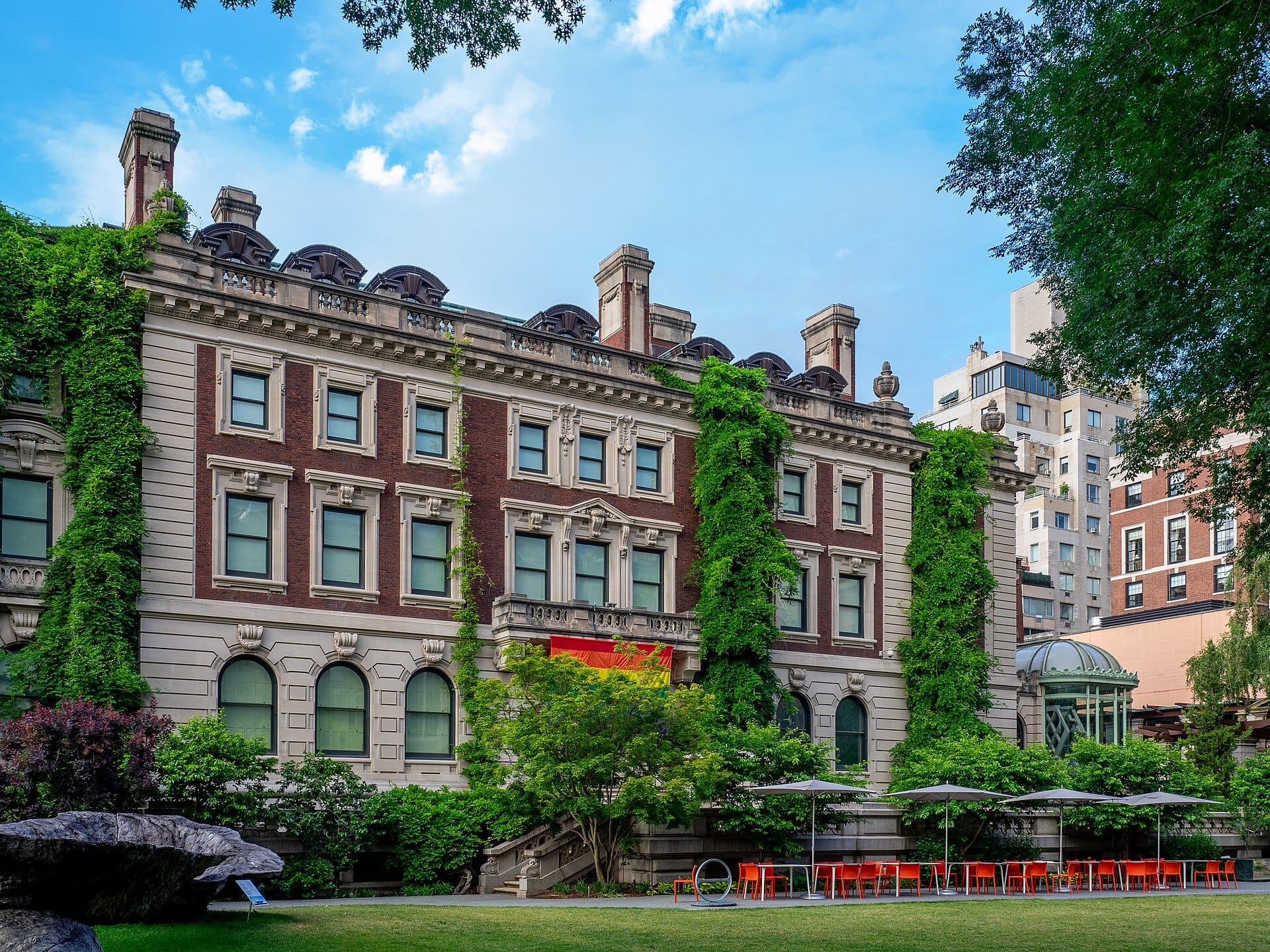
The museum occupies the Andrew Carnegie Mansion, completed in 1901 and considered one of the finest Beaux-Arts residences ever built in New York City. Carnegie commissioned architects Babb, Cook & Willard to design a house with modern comforts that were radical for its time: central heating, a passenger elevator, and steel-framed construction borrowed directly from the commercial buildings Carnegie's steel empire helped to produce. The building offers four floors of public galleries within the historic mansion.
Standing in the main hall, the proportions of a private home remain legible even after decades of institutional use. Ceilings in the formal rooms are high but not cathedral-scale. Woodwork in dark oak runs throughout the ground floor. The fireplaces are original. What Diller Scofidio + Renfro's 2014 renovation achieved was threading contemporary exhibition infrastructure through those rooms without destroying their domestic character: recessed track lighting, discreet display cases, and a seamless rear addition that houses the Immersion Room and expanded gallery space.
The walled garden at the rear of the mansion is often overlooked. In warmer months, it serves as a quiet outdoor space, shaded by mature trees, where the ambient noise of Fifth Avenue disappears almost entirely. It is one of the more genuinely calm outdoor spots on the Upper East Side during daytime hours.
💡 Local tip
If you care about architecture, arrive via Fifth Avenue and look at the facade before entering. The contrast between the mansion's limestone detailing and the glass-and-steel towers surrounding it on 91st Street tells its own story about how New York's residential scale changed across the 20th century.
Tickets & tours
Hand-picked options from our booking partner. Prices are indicative; availability and final rates are confirmed when you complete your booking.
Statue of Liberty, Ellis Island, and Brooklyn Bridge Happy Hour Cruise
From 49 €Instant confirmationFree cancellationSpirit of New York Dinner Cruise
From 161 €Instant confirmationFree cancellationNew York City Highlights bike tour
From 70 €Instant confirmationFree cancellationNew York Statue of Liberty and Ellis Island tour by ferry
From 55 €Instant confirmation
The Interactive Pen: Cooper Hewitt's Most Distinctive Feature
Most visitors receive a digital stylus on entry. The pen is not a gimmick. It links to your personal visit profile and allows you to interact with the museum's large touch-table displays, collect objects from the collection by touching labels, and draw your own designs in the Immersion Room, where your creations are projected in real time across the floor and walls of a darkened gallery. After your visit, you log in to cooperhewitt.org and retrieve every object you collected, along with your drawn designs.
This system changes how you move through the galleries. Instead of photographing everything with a phone and forgetting it later, the pen encourages deliberate selection. You stop in front of an object, read its context, and decide whether to add it to your personal collection. It sounds simple, but it meaningfully slows down the experience and makes the collection feel navigable rather than overwhelming.
The Immersion Room, where projected wallpaper patterns from the collection wrap the entire space, draws crowds during school groups and weekend afternoons. If you want the room to yourself for more than a few minutes, visit on a weekday morning within the first hour of opening.
How the Experience Changes by Time of Day
The museum typically opens at 10:00 a.m. Tuesday through Friday mornings are the quietest windows: galleries hold perhaps two dozen visitors across four floors, and you can stand in front of objects for as long as you want without feeling any social pressure to move on. The light through the mansion's original windows in the ground-floor rooms is at its best in the late morning, especially in rooms facing south toward the garden.
Weekends between noon and 3:00 p.m. are the most crowded, particularly during school holiday periods and when a new exhibition opens. The touch tables and Immersion Room attract clusters of visitors, and the narrow corridors connecting some of the mansion's rooms can feel congested. The outdoor garden, however, remains relatively calm even on busy days.
By mid-afternoon on weekdays, school groups have typically left and the museum settles into its most measured rhythm. The gift shop, which stocks well-edited design books, prints, and objects, is also less crowded then if you want time to browse without being jostled.
ℹ️ Good to know
The museum generally closes at 6:00 p.m. Last admission is typically around 5:30 p.m. Check the official site before visiting for holiday closures or special event days when public access may be altered.
The Collection and Exhibitions: What to Expect
The permanent collection spans textiles, furniture, metalwork, graphic design, drawings, and digital media from the 1600s to the present. American and European design are both well represented, with particular depth in decorative arts, product design, and printed materials. The collection's origins trace to 1897, when it was founded as the Cooper Union Museum for the Arts of Decoration, making it one of the older design-focused institutions in the country.
Rotating special exhibitions are typically the most intellectually ambitious programming. Past shows have addressed topics like the design of protest graphics, sustainable materials innovation, and the history of color in manufactured objects. These are not retrospectives of famous designers' careers so much as arguments about how design shapes daily life, which makes the museum more engaging for general visitors than a strictly craft-history museum might be.
For visitors building a broader cultural itinerary, the museum pairs naturally with the Neue Galerie a few blocks north, and sits within a short walk of several other major institutions along Fifth Avenue. A half-day exploring this stretch of Museum Mile is covered in more detail in our guide to the best museums in New York City.
Practical Walkthrough: Getting There, Getting In, Getting Around
The most straightforward subway approach is the 4, 5, or 6 train to 86th Street, followed by about a 10-minute walk north on Fifth Avenue. The route passes the Metropolitan Museum of Art, so if you are coming from there, you are already pointed in the right direction. Alternatively, the 6 or Q to 96th Street puts you about 10 minutes away from the north. MTA bus lines M1, M2, M3, and M4 run along Fifth Avenue and stop within a block of the entrance.
The entrance on East 91st Street is set slightly back from Fifth Avenue. There is no long queue infrastructure outside, which reflects the museum's more intimate scale compared to its neighbors. Tickets can be purchased at the door or online in advance. Admission for visitors 18 and under is free, which makes this one of the more accessible institutions on Museum Mile for families.
Inside, four floors of galleries are accessible via elevator, and the 2014 renovation brought the building into compliance with modern accessibility standards. If mobility is a concern, confirm specific accessibility details directly with the museum before visiting, as the historic building's layout involves some transitional spaces between the original mansion and newer sections.
⚠️ What to skip
Bags larger than a standard daypack must be checked at the coat check. The pen stylus is loaned on entry and must be returned. If you lose it, there may be a replacement fee. Keep it in a pocket rather than a bag to avoid forgetting it at the end of your visit.
If you are planning a broader Upper East Side afternoon, our New York City architecture guide covers the architectural context of this stretch of Fifth Avenue in more depth.
Honest Assessment: Is It Worth Your Time?
Cooper Hewitt rewards visitors who come with some curiosity about how objects are designed and why. If your primary interest is fine art, the collection will feel unfamiliar: there are no paintings by canonical artists, no sculpture in the traditional sense, and no ancient objects. The museum is genuinely about design as a discipline and a practice, and it makes that argument through its exhibitions rather than assuming you already agree with the premise.
For visitors who want something genuinely different from the standard New York museum experience, this delivers it. The building, the pen technology, the focused collection, and the relatively manageable scale all combine into an experience that feels considered rather than exhausting. Two hours here leaves most visitors satisfied rather than depleted.
Who might skip it: visitors on extremely tight schedules who can only visit one Upper East Side museum will likely prioritize the Met. Travelers with very young children may find the interactive technology confusing for small hands and the content too abstract. The $18 adult admission is not negligible, and the value depends heavily on your interest in the specific exhibitions showing during your visit, so checking current programming at cooperhewitt.org before buying tickets is worth doing.
For budget-conscious travelers, check our guide to free things to do in New York City for alternatives, and note that the Smithsonian's Washington DC museums are free of charge, so NYC visitors sometimes feel the admission here is unexpected given the Smithsonian brand.
Insider Tips
- Log into cooperhewitt.org after your visit to retrieve every object you collected with the pen stylus. The digital collection becomes a personal design archive and a more useful souvenir than any postcard.
- The Immersion Room's projected wallpaper designs rotate through the actual Cooper Hewitt collection. Before you enter, spend five minutes at the touch table in the adjacent gallery to understand which patterns are historical and which are visitor-generated — it changes how you experience the room.
- The museum's gift shop carries design books that are genuinely hard to find elsewhere in New York, including exhibition catalogues and monographs on disciplines like typeface design and industrial materials. Budget time for it if books interest you.
- Weekday mornings in the ground-floor rooms of the Carnegie Mansion are quiet enough that you can study the architectural details of the building itself — original moldings, hardware, and room proportions — without competing with crowds. This is itself a lesson in Gilded Age residential design.
- The outdoor garden at the rear of the mansion is only accessible in warmer months, but if it is open during your visit, it is worth pausing there before or after the galleries. It is one of the few enclosed, tree-lined spaces on the Upper East Side that feels genuinely removed from street noise.
Who Is Cooper Hewitt Smithsonian Design Museum For?
- Design professionals, students, and anyone who thinks critically about how everyday objects are made and marketed
- Architecture enthusiasts who want to see a rare intact Gilded Age mansion interior alongside contemporary exhibition design
- Travelers looking for a substantive museum experience that can be done in under three hours without feeling rushed
- Families with children aged roughly 10 and up who will engage with the interactive pen and Immersion Room
- Visitors building a full Museum Mile day who want contrast to the fine art collections dominating Fifth Avenue
Nearby Attractions
Other things to see while in Upper East Side:
- The Frick collection
The Frick Collection occupies a landmark Fifth Avenue mansion on the Upper East Side, housing one of the most concentrated displays of Old Master paintings and European decorative arts in the United States. With intimate galleries, a price-scaled admission structure, and a pay-what-you-wish Wednesday afternoon window, it rewards careful visitors far more than many larger institutions.
- Solomon R. Guggenheim Museum
The Solomon R. Guggenheim Museum is one of the world's most recognizable buildings and one of New York City's great cultural institutions. Frank Lloyd Wright's continuous spiral rotunda, completed in 1959, is as much the attraction as the art inside. This guide covers what to expect, when to go, and how to make the most of your visit.
- The Jewish Museum
Founded in 1904 and housed in a French Gothic mansion on Fifth Avenue, The Jewish Museum is the first institution of its kind in the United States. With rotating exhibitions, a permanent collection spanning 4,000 years, and free admission every Saturday, it rewards visitors who come curious and leave with more questions than they arrived with.
- The Metropolitan Museum of Art
The Metropolitan Museum of Art is the largest art museum in the Americas, with a collection spanning over 5,000 years and nearly two million works. Located along Museum Mile on the eastern edge of Central Park, it rewards multiple visits and demands a plan for just one.