Neue Galerie New York: The Upper East Side's Most Intimate World-Class Museum
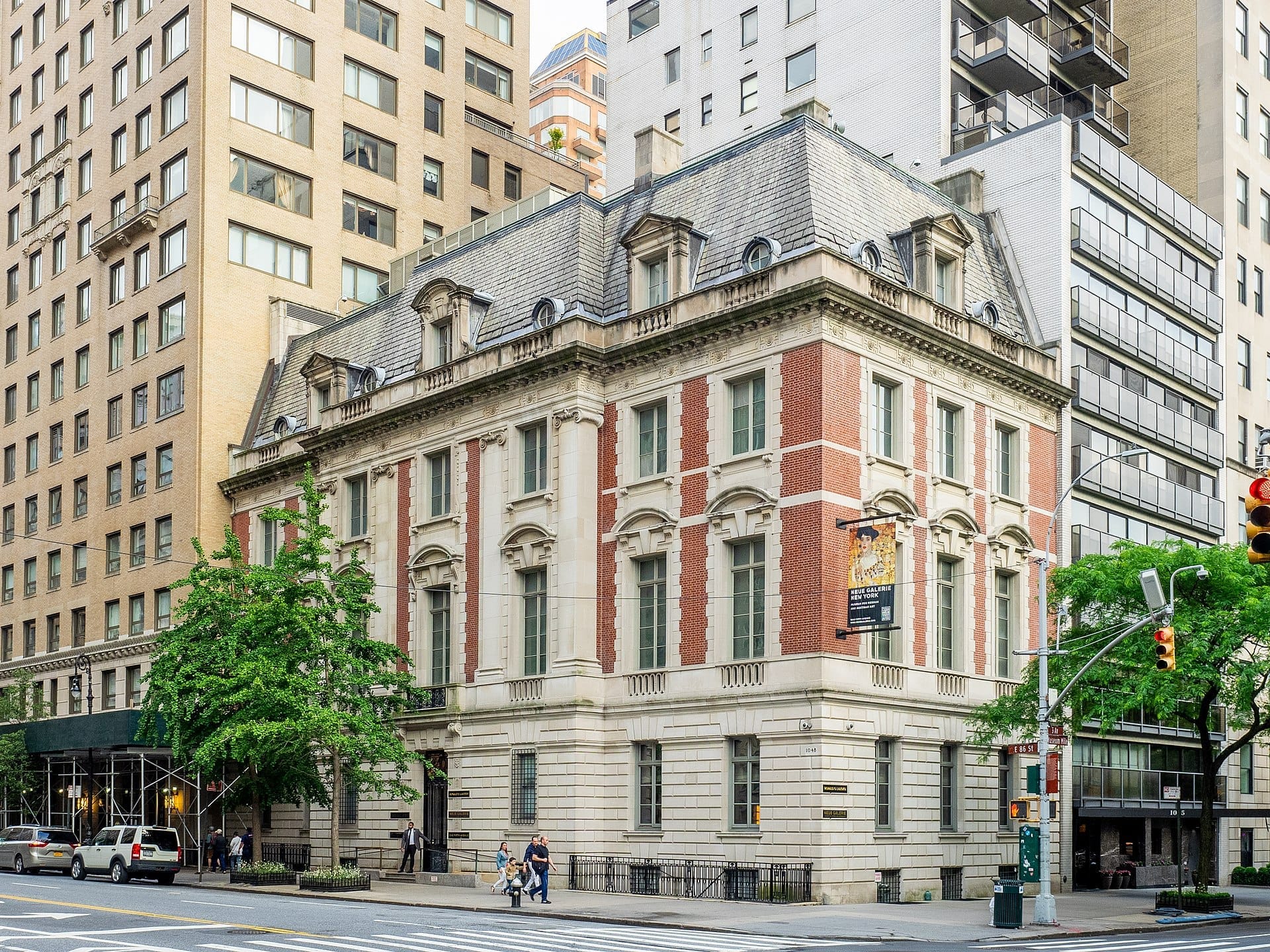
Housed in a 1914 Beaux-Arts mansion on Fifth Avenue, Neue Galerie New York presents one of the finest collections of early 20th-century German and Austrian art outside of Europe. Small enough to visit in two hours, focused enough to leave a lasting impression, it rewards anyone willing to slow down.
Quick Facts
- Location
- 1048 Fifth Avenue at East 86th Street, Upper East Side, Manhattan
- Getting There
- Subway 4, 5, 6 to 86th Street–Lexington Ave or Q to 86th Street–Second Ave; walk west to Fifth Avenue. M86 stops at Fifth Ave & 86th St; M1, M2, M3, and M4 stop on Madison Ave at 86th St.
- Time Needed
- 1.5 to 2.5 hours for a thorough visit; half a day if you linger in Café Sabarsky
- Cost
- General admission USD $28; reduced rates for seniors and students; free on select First Fridays 5–8 p.m.
- Best for
- Art lovers, architecture enthusiasts, Vienna Secession fans, couples, solo cultural travelers
- Official website
- www.neuegalerie.org
What Is the Neue Galerie?
The Neue Galerie New York is a private museum dedicated exclusively to early 20th-century German and Austrian fine and decorative arts. It opened in November 2001, founded by cosmetics heir Ronald S. Lauder and art dealer Serge Sabarsky, and in the two-plus decades since, it has carved out a singular identity on New York's Museum Mile: focused, refined, and quietly authoritative.
This is not a sprawling encyclopedic institution. The collection is compact by design, and that restraint is a strength. You will not experience crowd fatigue here. Instead, each gallery feels curated with genuine intention, from the Vienna Secession canvases on the second floor to the Wiener Werkstätte decorative objects and furniture displayed with extraordinary care on the third.
⚠️ What to skip
Important: The Neue Galerie has announced a temporary closure for Summer 2026 to undertake enhancements to its historic building, with plans to reopen in Autumn 2026. Verify current hours and status at neuegalerie.org before your visit.
The Building: A Beaux-Arts Mansion on Fifth Avenue
The museum occupies the William Starr Miller House, a Louis XIII-influenced Beaux-Arts mansion completed in 1914. Standing on the corner of Fifth Avenue and East 86th Street, it belongs to a row of grand early 20th-century residences that once defined the social ambitions of New York's Gilded Age elite. The building's symmetrical limestone facade, wrought-iron entry gate, and formal proportions signal that you are stepping out of Manhattan's relentless pace into something more deliberate.
Inside, the original residential character has been preserved rather than erased. The grand staircase, the ornate ironwork banisters, the parquet floors and tall windows that flood the front rooms with Fifth Avenue light: all of it survives. The decision to keep the building legible as a private home is not incidental. It mirrors the intimate scale of the Viennese and Berliner salons where much of this art was originally displayed and debated.
The building sits at the northern end of the Upper East Side's Museum Mile, which stretches along Fifth Avenue from 82nd to 105th Street and includes institutions from the Metropolitan Museum of Art to El Museo del Barrio. But unlike its larger neighbors, the Neue Galerie never overwhelms.
Tickets & tours
Hand-picked options from our booking partner. Prices are indicative; availability and final rates are confirmed when you complete your booking.
Statue of Liberty, Ellis Island, and Brooklyn Bridge Happy Hour Cruise
From 49 €Instant confirmationFree cancellationSpirit of New York Dinner Cruise
From 161 €Instant confirmationFree cancellationNew York City Highlights bike tour
From 70 €Instant confirmationFree cancellationNew York Statue of Liberty and Ellis Island tour by ferry
From 55 €Instant confirmation
The Collection: Klimt, Schiele, and the Gesamtkunstwerk
The Neue Galerie's second floor is devoted to Austrian art, and it is here that the museum's international reputation rests. Gustav Klimt's Portrait of Adele Bloch-Bauer I (1907) is the centerpiece: a gold-layered, Byzantine-influenced work that Ronald Lauder purchased in 2006 for a reported $135 million, at the time the highest price ever paid for a painting. Seeing it in person recalibrates expectations formed by photographs. The painting is smaller than many visitors expect, but the surface texture, the metallic shimmer under gallery light, and the sitter's expression carry a charge that reproductions simply cannot transmit.
Egon Schiele's works hang nearby, their raw, angular lines and psychological tension providing a sharp counterpoint to Klimt's decorative opulence. The two artists were contemporaries in Vienna's artistic ferment of the 1900s and 1910s, and seeing them in dialogue here, in a setting that echoes their original cultural context, carries more meaning than encountering them in a general survey collection.
The third floor shifts to German Expressionism and the decorative arts of the Wiener Werkstätte, the Viennese design cooperative founded in 1903. Furniture, textiles, metalwork, and ceramics by Josef Hoffmann, Koloman Moser, and their circle are displayed alongside paintings by Ernst Ludwig Kirchner, Max Beckmann, and Paul Klee. The concept of the Gesamtkunstwerk, the total work of art in which fine and applied arts are unified, is not just an academic talking point here. The third floor demonstrates it.
💡 Local tip
Non-flash photography is generally permitted in many permanent collection galleries, subject to current museum policy and any restrictions posted on-site. The Klimt portrait is the obvious focal point, but spend time with the Wiener Werkstätte objects on the third floor: the craftsmanship in the metalwork and furniture repays close attention.
How the Experience Changes by Time of Day
Arrive when the museum opens at 10 a.m. on a weekday and you may have entire rooms to yourself. The light through the Fifth Avenue windows is at its best in the morning, casting a warm tone across the parquet and illuminating the gold leaf of the Klimt with particular clarity. The building is quiet in a way that larger Upper East Side museums rarely are, and that silence is part of the experience.
By early afternoon on weekends, the Klimt gallery draws a noticeable crowd, and the queue for Café Sabarsky on the ground floor can stretch into the entrance hall. If you plan to eat there, either arrive before noon or accept a wait. By late afternoon, visitor numbers often ease again, and the closing hour of 6 p.m. approaches on most days with a calm that suits the collection.
First Fridays, when the museum opens free of charge from 5 to 8 p.m. on the first Friday of each month, attract a different audience: younger visitors, locals, people who might not otherwise pay $28 for a museum they are unsure about. The energy is noticeably more social, which is not necessarily a problem, but if you want quiet contemplation in front of the Klimt, a Thursday morning is more reliable.
Café Sabarsky: The Visit Within the Visit
Café Sabarsky occupies the ground floor and is modeled on a turn-of-the-century Viennese coffeehouse, complete with dark wood paneling, Thonet bentwood chairs, marble-topped tables, and a menu that takes the conceit seriously. Wiener Melange coffee, Tafelspitz, Apfelstrudel, and sachertorte are mainstays, and the quality matches the setting.
The café operates on the same general weekly schedule as the museum, typically closing on Tuesday, which tells you something about how seriously it is taken as a destination in its own right. Reservations are strongly recommended for weekend lunch and brunch. For a lighter visit, the pastry counter and a coffee at a window seat overlooking Fifth Avenue is one of the more civilized thirty minutes available on the Upper East Side.
Practical Information: Getting There, Tickets, and Accessibility
The museum is at 1048 Fifth Avenue, on the corner of East 86th Street. The 4, 5, and 6 subway trains stop at 86th Street on Lexington Avenue, and the Q (as part of the N‑Q‑R line) stops at 86th Street on Second Avenue; both stations are about a short walk east. The walk along 86th Street to Fifth Avenue takes roughly five minutes. The M86 crosstown bus serves Fifth Avenue at 86th Street, and the M1, M2, M3, and M4 buses serve Madison Avenue at 86th Street, which is useful if you are coming from elsewhere on the Upper East Side or Midtown.
If you are combining the visit with other Museum Mile stops, the Metropolitan Museum of Art is a ten-minute walk south at 82nd Street, and the Guggenheim Museum is between the two at 89th Street. The Neue Galerie pairs especially well with the Met's European paintings galleries, where you can compare the broader canon with the Neue Galerie's focused Viennese and German modernist perspective.
Regular hours (after the current summer closure) are Monday and Wednesday through Sunday, 10 a.m. to 6 p.m.; the museum is closed on Tuesday. General adult admission is USD $28, with reduced prices for seniors ($18), students and educators ($15), and visitors with disabilities ($15). Children under 12 are not admitted during regular hours; check the official site for any exceptions or program-specific policies. Timed entry tickets can be purchased online in advance when offered, which is advisable on weekends and during special exhibitions.
Accessibility: the museum has elevator access to all gallery floors and accommodates visitors with limited mobility. Service animals are permitted. If you have specific accessibility requirements, contacting the museum before your visit is recommended, as the building's historic structure means some practical arrangements benefit from advance coordination.
ℹ️ Good to know
The Neue Galerie's shop on the ground floor carries an unusually well-curated selection of exhibition catalogs, Viennese design reproductions, and art books focused on German and Austrian modernism. It is worth browsing even if you visit only the café.
Is It Worth Your Time? An Honest Assessment
For anyone with genuine interest in early 20th-century European art, the Neue Galerie is among the strongest two hours you can spend in New York. The collection is coherent, the setting is exceptional, and the experience of seeing the Klimt portrait in context, rather than reproduced on a poster in a student dormitory, is genuinely affecting.
Visitors expecting a broad survey museum, a major blockbuster temporary exhibition, or a full day's worth of galleries will find the Neue Galerie too small for their appetite. It is not trying to be the Met. Those looking for interactive family experiences or a wide range of programming for children will also find limited offerings here; the atmosphere skews adult and contemplative.
If your time in New York is short and your primary interest is breadth, the best museums in New York City guide can help you prioritize. But if you have any interest in Viennese modernism, the Wiener Werkstätte, or the cultural history of early 20th-century Central Europe, the Neue Galerie justifies its admission price without qualification.
Insider Tips
- Weekday mornings between 11 a.m. and 1 p.m. offer the quietest experience; the Klimt gallery on the second floor is often nearly empty, which makes a significant difference when standing in front of a painting of that scale and complexity.
- First Fridays (select Fridays, 5–8 p.m.) offer free admission but a more social atmosphere. Check the museum's website for the specific dates each month, as they are not every Friday.
- Book Café Sabarsky in advance for weekend brunch or lunch. Walk-ins are accepted for the pastry counter and coffee service at the bar, which is a faster option on busy days.
- The museum shop stocks some of the best art books on Viennese Secession and German Expressionism available anywhere in the city, including exhibition catalogs that are difficult to find elsewhere. Worth a look even on a tight schedule.
- The building itself rewards attention before and after the galleries: study the ironwork on the entry gate, the staircase banisters, and the original ceiling details in the ground-floor rooms. They are a direct architectural complement to the Wiener Werkstätte philosophy displayed upstairs.
Who Is Neue Galerie New York For?
- Art enthusiasts with a specific interest in Klimt, Schiele, or Vienna Secession-era work
- Architecture lovers drawn to preserved Beaux-Arts interiors in a residential scale
- Couples seeking a refined, unhurried cultural afternoon paired with Café Sabarsky
- Solo travelers who prefer intimate, focused museum experiences over large survey institutions
- Design-minded visitors interested in the Wiener Werkstätte's integration of fine and decorative arts
Nearby Attractions
Other things to see while in Upper East Side:
- Cooper Hewitt Smithsonian Design Museum
Housed inside the landmark Andrew Carnegie Mansion on Fifth Avenue, Cooper Hewitt, Smithsonian Design Museum is the only museum in the United States dedicated entirely to design. From its interactive pen technology to its walled garden, it rewards curiosity at a pace most major NYC museums cannot match.
- The Frick collection
The Frick Collection occupies a landmark Fifth Avenue mansion on the Upper East Side, housing one of the most concentrated displays of Old Master paintings and European decorative arts in the United States. With intimate galleries, a price-scaled admission structure, and a pay-what-you-wish Wednesday afternoon window, it rewards careful visitors far more than many larger institutions.
- Solomon R. Guggenheim Museum
The Solomon R. Guggenheim Museum is one of the world's most recognizable buildings and one of New York City's great cultural institutions. Frank Lloyd Wright's continuous spiral rotunda, completed in 1959, is as much the attraction as the art inside. This guide covers what to expect, when to go, and how to make the most of your visit.
- The Jewish Museum
Founded in 1904 and housed in a French Gothic mansion on Fifth Avenue, The Jewish Museum is the first institution of its kind in the United States. With rotating exhibitions, a permanent collection spanning 4,000 years, and free admission every Saturday, it rewards visitors who come curious and leave with more questions than they arrived with.