CN Tower: Toronto's Skyline Landmark Explained
Standing 553.3 metres above downtown Toronto, the CN Tower remains the tallest free-standing structure in the Western Hemisphere. This guide covers what each level actually delivers, how crowds behave at different hours, and whether the ticket price earns its place in a limited Toronto itinerary.
Quick Facts
- Location
- 290 Bremner Boulevard, Downtown Toronto, ON M5V 3L9 (mailing address; visitor entrance off 301 Front Street West)
- Getting There
- Union Station (TTC Line 1 subway + GO Transit) — approx. 10-min walk
- Time Needed
- 1.5–3 hours (longer if dining or doing EdgeWalk)
- Cost
- Timed-entry tickets vary by date and age (CAD); EdgeWalk from approx. CAD 195/person. Check cntower.ca for current pricing.
- Best for
- First-time visitors to Toronto, architecture enthusiasts, families, thrill-seekers (EdgeWalk)
- Official website
- www.cntower.ca
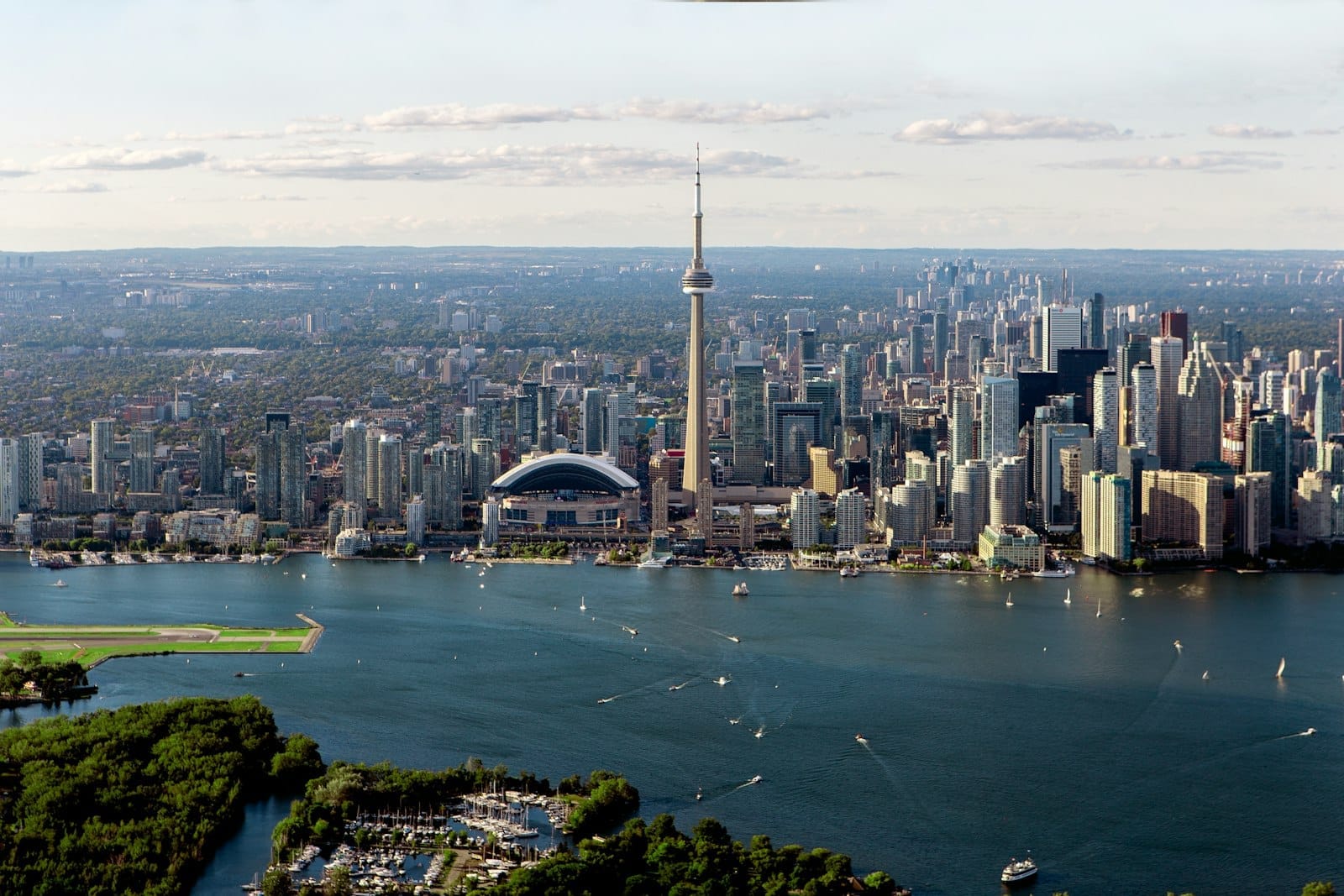
What the CN Tower Actually Is
The CN Tower is a 553.3-metre (1,815 ft) telecommunications and observation tower on the western edge of downtown Toronto, beside Rogers Centre and a short walk from Lake Ontario. It held the title of world's tallest free-standing structure for 31 years, from 1976 until 2007, when the Burj Khalifa surpassed it. It remains the tallest free-standing structure on land in the Western Hemisphere. In 1995, the American Society of Civil Engineers named it one of the Seven Wonders of the Modern World, placing it alongside works like the Channel Tunnel and the Golden Gate Bridge.
Construction began in 1973, driven partly by practical necessity: Toronto's growing cluster of downtown skyscrapers was interfering with television and radio broadcast signals. The tower, then owned and developed by Canadian National Railway (hence the original name, Canadian National Tower), was designed to solve that problem while also functioning as a civic landmark. It opened to the public on June 26, 1976. Today, the name is officially CN Tower and is a registered trademark, though the initials no longer stand for Canadian National in the corporate sense.
The tower sits within the broader downtown Toronto core, surrounded by the Rogers Centre, the Metro Toronto Convention Centre, and the Railway Lands. The waterfront is about a 10-minute walk south. If you are piecing together a full day, it pairs naturally with a visit to the Harbourfront Centre or a walk along the Martin Goodman Trail.
The Observation Levels: What Each Floor Delivers
The tower has three main visitor levels. The Main Observation Level sits at 346 metres (1,136 ft) and includes an interior viewing gallery with wraparound floor-to-ceiling glass, plus an outdoor terrace where the city noise drops away completely and the air carries a faint metallic tang from the railing enclosures. The Glass Floor is part of this level: a series of reinforced glass panels set into the floor, each rated to hold the weight of 14 adult hippos according to the tower's own documentation. Standing on them over the city is disorienting in a way photographs cannot fully convey — your brain resists the logic of what your feet are doing.
The 360 Restaurant occupies its own level at 351 metres and revolves one full rotation approximately every 72 minutes. Dining here adds significant cost but removes the need to budget a separate sightseeing ticket, since restaurant reservations include observation access. The food is above average for a landmark restaurant; the view mid-meal, when the tower has rotated far enough to frame Lake Ontario in the window, is genuinely memorable rather than merely serviceable.
The SkyPod sits at 447 metres (1,465 ft) and requires a separate, additional ticket. The space is small and more spartan than the Main Level, with narrower windows and fewer visitors. At this height, the horizon curves perceptibly, and on clear days you can see the faint outline of spray above Niagara Falls roughly 130 kilometres to the southwest. The SkyPod is genuinely different from the Main Level, but it is primarily for visitors who want to say they went as high as possible, not for those seeking a qualitatively richer experience.
💡 Local tip
Book timed-entry tickets online before you arrive. Walk-up availability is not guaranteed, and popular time slots (especially weekend evenings and public holidays) sell out days in advance.
Tickets & tours
Live prices and dates from our booking partner. If you book, we may earn a commission at no extra cost to you.
EdgeWalk: The Outer Experience
EdgeWalk is a hands-free walk along a 1.5-metre-wide ledge on the outside of the tower's main pod, at a height of 356 metres (1,168 ft). Participants are harnessed to an overhead guide rail at all times. The experience runs in groups of up to six people, lasts approximately 90 minutes including gear-up and briefing time, and tickets start from around CAD 195 per person (verify current pricing at cntower.ca before booking). The walk itself is roughly 30 minutes outdoors.
Restrictions apply: participants must meet height and weight limits, pass a breathalyser test, and cannot wear loose clothing, glasses without a strap, or jewellery that could detach. Anyone with heart conditions, vertigo, or certain mobility limitations should review the medical guidelines on the official site before purchasing. Weather is a factor: EdgeWalk can be suspended in high winds, lightning, or freezing precipitation, and rescheduling depends on availability.
⚠️ What to skip
EdgeWalk can be cancelled or paused due to weather without advance notice. If you have a tight schedule, check the forecast and have a backup plan for your visit time.
Time of Day: How the Experience Changes
Morning visits (typically opening at 10:00) offer the thinnest crowds and the clearest light for photography. The low autumn and winter sun at this hour casts sharp shadows across the Financial District towers below, and the lake surface has a pewter flatness that emphasizes scale. The queue at the elevator is typically short, and the Glass Floor area is quiet enough that you can linger without social pressure.
Midday and early afternoon (12:00–15:00) represent peak volume on weekends and during summer holidays. The elevator queue can extend 20–30 minutes. The outdoor terrace fills quickly, and the Glass Floor area sees steady traffic. If midday is your only option, arriving right at opening will always serve you better than arriving at 11:30.
Sunset is the most requested time slot for good reason. As the sun drops toward Lake Ontario in the west, the sky transitions through orange and amber tones reflected in the glass of the surrounding towers, and the city below takes on a warm, legible quality. Within 20 minutes of sunset, the urban grid begins to illuminate, and the view shifts from scenic to cinematic. This is also the most booked period, so plan and purchase accordingly — sometimes two weeks ahead for summer weekends.
Night visits (after 20:00, approaching the typical 21:00 close on many days) offer a near-empty tower and a city reduced to light grids and moving headlights. The lake becomes invisible in darkness, which some visitors find anticlimactic, but for urban photography the night-time composition is arguably the most striking of the day.
💡 Local tip
For the best photos from the outdoor terrace, bring a lens cloth and avoid pressing your camera lens against the glass barriers — the angle distorts sharpness. Instead, shoot from slightly back, at an angle to the barriers, to minimize reflections.
Getting There and Practical Logistics
The most reliable approach is via Union Station, which is served by TTC subway Line 1 and GO Transit regional rail. From the station's main exit onto Front Street, the CN Tower is visible almost immediately to the west; the walk takes around 10 minutes at a comfortable pace. Streetcar routes along King Street also deposit you within a short walk of the tower.
If you are arriving from Toronto Pearson International Airport, the UP Express train runs between Pearson and Union Station in approximately 25 minutes, with service every 15 minutes. From Union Station, the CN Tower walk takes under 10 minutes. Full transit details are covered in the getting around Toronto guide.
There is no public parking dedicated to the tower. The area has paid parking lots operated by Rogers Centre and private operators nearby, but costs are high on event days when the Rogers Centre is hosting a Blue Jays game or concert. Arriving by public transit or ride-hailing is significantly less complicated.
Accessibility at the CN Tower is comprehensive: all observation levels are reached by high-speed elevators, ramps connect outdoor areas, and the staff are experienced with mobility devices and service animals. The official site's Plan Your Visit section outlines specific accommodations for guests with disabilities. The one exception is EdgeWalk, which has physical requirements that exclude some visitors.
Weather, Seasons, and Honest Caveats
Toronto has a humid continental climate with genuine seasonal extremes. In summer (June through August), daytime highs often reach 26–30°C, and the outdoor terrace can feel oppressive on humid afternoons. Haze is also a real factor: on hot, humid summer days, visibility from the tower can be notably reduced, turning what should be a 100-km panorama into a grey wash. Autumn (September and October) consistently delivers the sharpest air and the best long-distance clarity.
Winter visits are less crowded and often sharply clear, though temperatures on the outdoor terrace can drop to -15°C or below with wind chill. The glass enclosure makes the indoor observation areas comfortable year-round, but plan for layers if you want any outdoor time. The tower remains open through winter.
For a broader look at how seasonal timing affects the overall Toronto visit, the best time to visit Toronto guide breaks down monthly conditions across the city's main attractions.
Who Should Reconsider
The CN Tower is not overhyped in terms of pure engineering spectacle — the structure is genuinely extraordinary and the height is vertiginous in a satisfying way. However, the ticket price is significant, and the core experience (standing on a high observation deck) is shorter than many visitors expect. If your Toronto itinerary is tight and budget matters, it is worth honestly asking whether a free elevated view from a hillside park delivers comparable satisfaction at a fraction of the cost.
Visitors primarily interested in Toronto's cultural depth and architecture may find more sustained engagement at the Royal Ontario Museum or the Art Gallery of Ontario, both of which offer several hours of substantive content for a comparable or lower ticket price. The CN Tower's value is clearest for first-time visitors to the city, families with children who want an active, visceral experience, and anyone arriving by air and scanning the skyline for a sense of orientation.
People with a strong fear of heights should know that the interior observation level, while dramatic, is fully enclosed and does not force exposure. The Glass Floor can be avoided entirely. The outdoor terrace has substantial barriers, but wind and altitude do register physically. EdgeWalk is entirely separate and entirely optional.
Insider Tips
- Timed tickets bought for the first entry slot (typically 10:00) on a weekday consistently mean minimal elevator wait times. The tower typically has no more than a handful of visitors at opening.
- The outdoor terrace on the Main Observation Level faces north, east, south, and west, but the western arc — toward the lake and the setting sun — is what fills camera rolls. Position yourself on the west side at least 15 minutes before sunset and do not wait until the sun is already at the horizon.
- If you plan to dine at the 360 Restaurant, the reservation includes observation access — confirm this when booking so you do not purchase a separate observation ticket unnecessarily.
- On clear autumn days, look southwest from the SkyPod toward the faint mist on the horizon. That is Niagara Falls, roughly 130 km away. It is subtle but visible when the air is dry and cool.
- The elevators have glass panels on one side facing outward during ascent and descent. The ascent takes approximately 58 seconds, and the descent is slightly slower. Some visitors find the outward-facing glass during descent more vertigo-inducing than the observation deck itself — worth noting if travelling with young children or anxious companions.
Who Is CN Tower For?
- First-time visitors to Toronto wanting immediate city orientation and a landmark reference point
- Families with children aged 5 and up who respond well to scale and physical novelty
- Architecture and engineering enthusiasts interested in concrete-core tower construction from the 1970s
- Photographers working the blue hour and sunset, particularly those shooting the Financial District from above
- Thrill-seekers for whom the EdgeWalk outdoor ledge walk is the primary draw
Nearby Attractions
Other things to see while in Downtown Toronto:
- Allan Gardens Conservatory
Allan Gardens Conservatory is a free, year-round botanical conservatory at 160 Gerrard Street East in downtown Toronto. Housed in six glass display houses anchored by a 1910 Edwardian Palm House, it holds about 1,500 m² of tropical palms, cacti, orchids, and seasonal blooms. One of the oldest parks in Toronto, it remains one of the city's most underrated green spaces.
- Art Gallery of Ontario
The Art Gallery of Ontario is one of North America's largest art museums, housing over 90,000 works inside a landmark Frank Gehry-renovated building in downtown Toronto. From Indigenous Canadian art to European masters and contemporary photography, the AGO rewards focused visitors and casual explorers alike.
- Brookfield Place (Allen Lambert Galleria)
The Allen Lambert Galleria inside Brookfield Place is a free, publicly accessible arcade designed by architect Santiago Calatrava between 1987 and 1992. Its arching steel-and-glass canopy, rising between two of downtown Toronto's tallest towers, is one of the most impressive interior spaces in Canada.
- Campbell House Museum
Built in 1822 for Upper Canada's Chief Justice, Campbell House Museum is the oldest surviving residence from the original Town of York. Moved to its current downtown corner in 1972 and opened as a museum in 1974, it offers an intimate, unhurried window into early colonial Toronto — a sharp contrast to the glass towers surrounding it.
Planning a trip? Discover personalized activities with the Nomado app.