Chiesa di Santa Maria dei Miracoli: Venice's Most Beautiful Small Church
Built between 1481 and 1489 by Pietro Lombardo, the Chiesa di Santa Maria dei Miracoli is a compact Renaissance masterpiece sheathed entirely in polychrome marble. Tucked into a quiet canal corner of Cannaregio, it rewards visitors who seek it out with some of the finest stone carving in Venice.
Quick Facts
- Location
- Campiello dei Miracoli, Cannaregio, Venice
- Getting There
- Vaporetto to Ca’ d’Oro or Santi Apostoli, then ~10 min walk (or from Rialto, ~10–15 min walk)
- Time Needed
- 30–45 minutes
- Cost
- Access and fees can change — many Chorus churches now offer free entry. Check chorusvenezia.org for current access and any tickets or passes.
- Best for
- Architecture lovers, photography, quiet reflection
What Is the Chiesa di Santa Maria dei Miracoli?
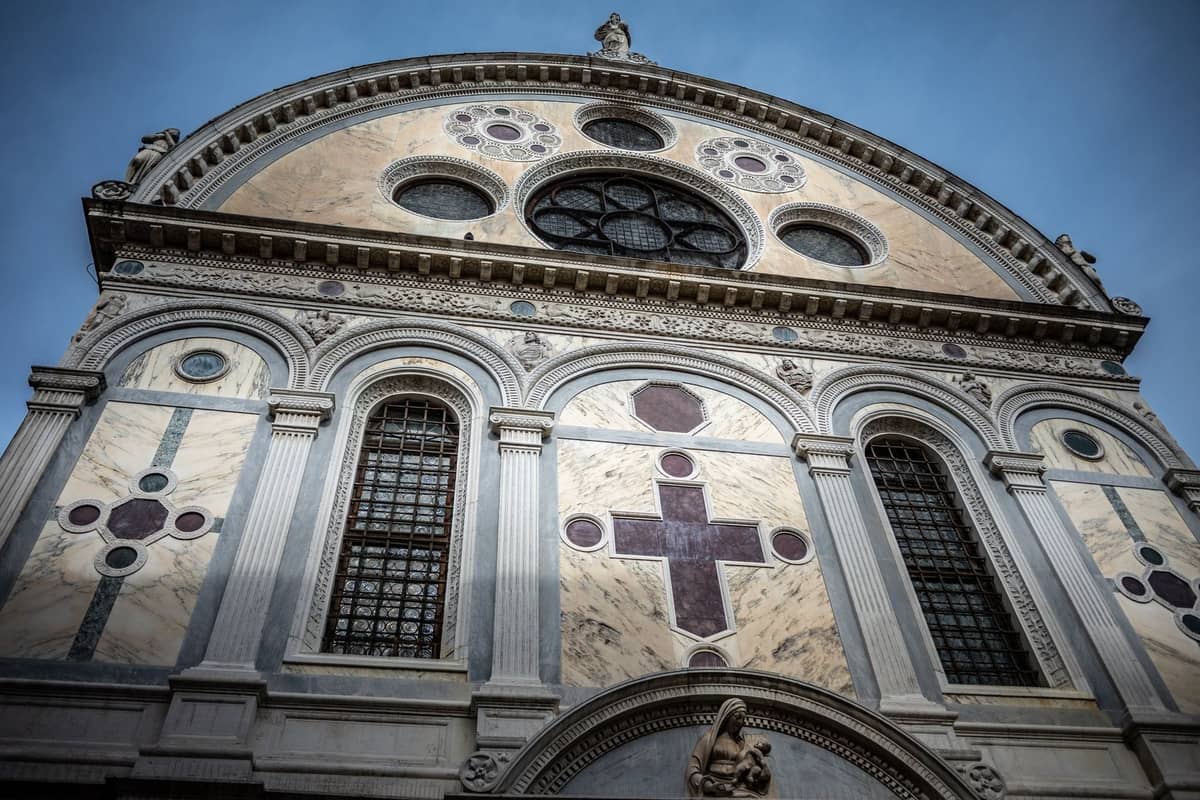
The Chiesa di Santa Maria dei Miracoli is a small early Renaissance church in the Cannaregio sestiere of Venice, completed in 1489 and attributed to the sculptor-architect Pietro Lombardo and his workshop. Its exterior is clad entirely in panels of grey, white, and rose-tinted marble, with delicate pilasters and carved roundels that make it look less like a church and more like an exceptionally refined reliquary box. The effect is unlike anything else in the city.
The church was commissioned by the merchant Angelo Amadi to house a miraculous image of the Virgin Mary, painted around 1408 to 1409 and said to have performed a series of healings. Public donations funded most of the construction, a reflection of how seriously Venetians took the cult of this particular icon. The image still sits at the altar today, framed within a structure that was designed entirely around it.
ℹ️ Good to know
The church is part of the Chorus Association network. Access arrangements for Chorus churches have changed in recent years, and many participating churches now offer free entry rather than a fixed per-church fee. Check chorusvenezia.org for current access rules, opening hours, and whether any pass or donation still applies before your visit.
The Exterior: Marble on a Canal
You arrive at Santa Maria dei Miracoli not along a broad campo but through a narrow calle that suddenly opens onto the Campiello dei Miracoli, a small square where the church sits flush against the Rio dei Miracoli canal on one side. From across the water, the building's south facade is reflected in the canal surface in the morning, when the light catches the marble at a low angle and the rose-grey panels seem almost to glow. This is the best moment to photograph the exterior.
The facade is organized into two registers. The lower section features a series of pilasters in dark serpentine marble framing lighter panels, while the upper section carries a semicircular barrel-vaulted roof capped with a half-dome apse. Carved circular medallions and foliate reliefs cover most of the surface. Pietro Lombardo brought a sculptor's precision to what was structurally an architectural project, and every square meter of the exterior repays close inspection.
The campiello itself is small and often quiet by Venetian standards. There is no large tourist infrastructure here: no souvenir stands, no queue barriers. On a weekday morning before 11:00, you can often stand at the canal edge in near-silence, which makes the building feel genuinely discovered rather than consumed.
Tickets & tours
Hand-picked options from our booking partner. Prices are indicative; availability and final rates are confirmed when you complete your booking.
Doge's Palace skip-the-line tour
From 67 €Instant confirmationFree cancellationVenice Legends, Anecdotes and Ghost Stories Tour
From 35 €Instant confirmationFree cancellationGhosts and legends tour of Venice
From 29 €Instant confirmationFree cancellationSkip-the-line guided tour of Doge's Palace and Saint Mark's Basilica
From 106 €Instant confirmationFree cancellation
Inside: Stone Carving at Its Finest
The interior of the Miracoli is a single barrel-vaulted nave, relatively compact, covered in the same polychrome marble paneling that distinguishes the exterior. The barrel vault above is coffered in 50 painted panels depicting prophets and saints, attributed to Pier Maria Pennacchi and completed around 1528. The gold grounds and deep jewel tones of these panels contrast with the stone coolness of the walls below.
A raised choir occupies the rear of the church, separated from the nave by a balustrade with carved marble balusters. The carving on this balustrade is extraordinarily refined, with mermaids, sea creatures, and floral garlands emerging from the stone with a fluency that seems to belong more to goldsmithing than masonry. Pietro Lombardo trained as a sculptor before he turned to architecture, and it shows. The pulpit that rises from the balustrade rests on a single carved column, a detail that stops most visitors mid-step.
At the far end, three steps lead up to the altar, beneath which rests the miraculous icon of the Virgin. The image itself is fairly small and modest in tone, its gold ground darkened with age. The contrast between the iconic simplicity of the painting and the architectural splendor built around it is one of the most telling things you can observe here: the building exists entirely in service of the object, however disproportionate that relationship now appears.
💡 Local tip
Bring a small pair of binoculars or use your phone camera to zoom into the ceiling panels. They are high enough that the details are lost to the naked eye from ground level, but the painted faces and backgrounds are finely done and worth the effort.
When to Visit and How the Experience Changes
The church opens Monday through Saturday at 10:30, with last entry typically at 16:20 and closing at 16:30. It is generally closed to visitors on Sunday mornings, opening in the afternoon only after religious services. Arriving within the first 30 minutes of opening gives you the best chance of having the interior mostly to yourself. By early afternoon, guided tour groups begin filtering through, and the nave, which holds perhaps 40 visitors comfortably, can feel crowded.
Venice's high season runs from spring through early autumn. During July and August, expect the campiello to be busy from late morning onward, even though the church itself manages crowds reasonably well due to its size. In winter, you may find the marble interior noticeably cold; the atmosphere is more austere, the light through the small windows flatter, but the relative quiet makes for a more contemplative visit.
Acqua alta, the seasonal high-water flooding that affects low-lying parts of Venice, can occasionally affect the area around the church. The campiello sits close to canal level, and after sustained tidal surges, temporary raised walkways (passerelle) may be in place. This does not prevent entry but adds a layer of practical difficulty; check local flood forecasts in autumn and early winter before making a special trip.
Getting There: Navigating Cannaregio
The most straightforward route is to take vaporetto lines 1 or 2 to the Rialto stop, then walk north into Cannaregio. From the Rialto, the walk takes roughly 10 minutes. Cross the Rialto Bridge heading north, follow signs toward Campo Santi Apostoli, and then navigate by the canal signs toward Campo Santa Maria Nova. The church sits just off that campo, announced by a small sign indicating the Campiello dei Miracoli.
There is no direct vaporetto stop adjacent to the church. The walk from Rialto involves several bridge crossings and narrow calli, which can be difficult for visitors with mobility limitations or those pushing strollers. The church entrance itself requires steps from the campiello level, and no specific accessibility provision is documented by public sources. If accessibility is a concern, contact the Chorus Association before your visit to confirm current conditions.
Alternatively, the church makes a natural stopping point on a walk between the Jewish Ghetto to the west and the Fondamente Nove waterfront to the northeast, where ferries depart for the lagoon islands. If you are planning a broader day in Cannaregio, the Miracoli fits neatly into a half-day itinerary.
Photography Notes
The exterior is best photographed in the morning when the sun strikes the south-facing canal facade. Midday light flattens the marble tones and washes out the colour variation. For the canal reflection shot, position yourself on the bridge at the southeast corner of the campiello; from there you get both the facade and its mirror image in one frame.
Inside, natural light enters through small windows and is generally low. A wide-aperture lens or a phone with a capable night mode will handle the interior reasonably well without flash. Flash photography is not permitted. The barrel vault is the compositional challenge: it requires a very wide angle or a vertical panorama to capture the full run of painted panels. The carved balustrade is the single best macro subject in the building.
Who Should Skip This Church
Visitors primarily interested in large-scale paintings, grand altarpieces, or the kind of sweeping interior drama found at the Basilica dei Frari or the Basilica dei Santi Giovanni e Paolo may find the Miracoli underwhelming. It is compact, architecturally specialized, and its single miraculous image is not a major painting by any conventional measure. It rewards those who look carefully at surfaces, but visitors who prefer narrative art or monumental scale should adjust expectations.
The walk to reach it is also non-trivial if you have significant mobility restrictions, as the route from any vaporetto stop involves multiple bridges and uneven paving. If you are planning a tight half-day itinerary, consider whether the detour into the quieter corners of Cannaregio fits your pace.
Insider Tips
- The campiello is at its quietest before 10:30 when the church is still closed. Arriving early lets you photograph the exterior without other tourists in frame, then enter as soon as doors open.
- Check chorusvenezia.org before you go — access rules for Chorus churches change, and many now allow free entry. If a combined pass is still offered when you visit, it may be worthwhile only if several paid-entry Chorus churches are on your list.
- Look down as well as up inside the church. The marble floor is inlaid with geometric patterns that continue the decorative vocabulary of the walls, and it is often overlooked by visitors craning at the ceiling.
- The building's north side, along the Rio dei Miracoli, is accessible via a narrow fondamenta. Walking along the water's edge gives you a side elevation view of the marble cladding and the apse that most visitors miss entirely.
- If you visit in winter, the church is occasionally used for concerts by local ensembles. The acoustics in the barrel-vaulted nave are exceptional. Check local event listings before your trip.
Who Is Chiesa di Santa Maria dei Miracoli For?
- Architecture and design enthusiasts interested in early Renaissance stone carving
- Photographers looking for a Venetian subject that photographs beautifully at any time of year
- Travelers who want a genuinely quiet church experience away from the San Marco crowds
- Art historians and those with an interest in Lombard Renaissance craftsmanship
- Couples and visitors seeking a more contemplative, unhurried stop in Venice
Nearby Attractions
Other things to see while in Cannaregio:
- Ca' d'Oro (Galleria Giorgio Franchetti)
Built for the Contarini family between 1421 and roughly 1430, the Ca' d'Oro is one of the finest Gothic palaces on the Grand Canal. It houses the Galleria Giorgio Franchetti, currently closed for renovation (closed to the public from early 2026, with a planned reopening in spring 2027 — verify at cadoro.org).
- Chiesa di Madonna dell'Orto
One of Venice's great Gothic churches, the Chiesa della Madonna dell'Orto sits quietly on the northern edge of Cannaregio. Free to enter, rich with Tintoretto canvases, and largely overlooked by day-trippers, it rewards anyone willing to walk beyond the Rialto circuit.
- Jewish Ghetto of Venice (Ghetto Ebraico)
Founded by decree in 1516, the Ghetto Ebraico di Venezia in Cannaregio is the oldest Jewish ghetto in the world. Today it holds five historic synagogues, a respected Jewish museum, active kosher restaurants, and one of Venice's most atmospheric campi, all within a compact seven-acre enclave that rewards slow, careful exploration.
- Jewish Museum of Venice
The Museo Ebraico di Venezia sits at the heart of Campo di Ghetto Nuovo, the 16th-century enclave that gave the world the word 'ghetto'. This small but serious museum traces five centuries of Venetian Jewish life through ceremonial objects, archival documents, and guided access to synagogues that are still in active use.