Jewish Ghetto of Venice: Inside the World's First Ghetto
Founded by decree in 1516, the Ghetto Ebraico di Venezia in Cannaregio is the oldest Jewish ghetto in the world. Today it holds five historic synagogues, a respected Jewish museum, active kosher restaurants, and one of Venice's most atmospheric campi, all within a compact seven-acre enclave that rewards slow, careful exploration.
Quick Facts
- Location
- Campo di Ghetto Nuovo, Cannaregio, Venice
- Getting There
- Guglie (lines 4.1/4.2/5.1/5.2) or San Marcuola (line 1); also walkable from Santa Lucia station (~15 min)
- Time Needed
- 1.5 to 3 hours; longer if you join a guided synagogue tour
- Cost
- Campo and streets free to walk; museum and synagogue tours require a ticket (verify current prices at ghettovenezia.com)
- Best for
- History, architecture, culture, quiet exploration away from the tourist centre
- Official website
- www.ghettovenezia.com/en
What the Ghetto Ebraico di Venezia Actually Is
The Ghetto Ebraico di Venezia, founded on 29 March 1516 by decree of Doge Leonardo Loredan and the Venetian Senate, is widely regarded as the first legally instituted Jewish ghetto and the place where the term originated. The word 'ghetto' itself originates here, almost certainly derived from the Venetian word 'geto', referring to a foundry that once operated on this island in Cannaregio. For more than 250 years, Venice's Jewish community was required to live within this roughly seven-acre enclosure, locked in at night by gates that were controlled by Christian guards.
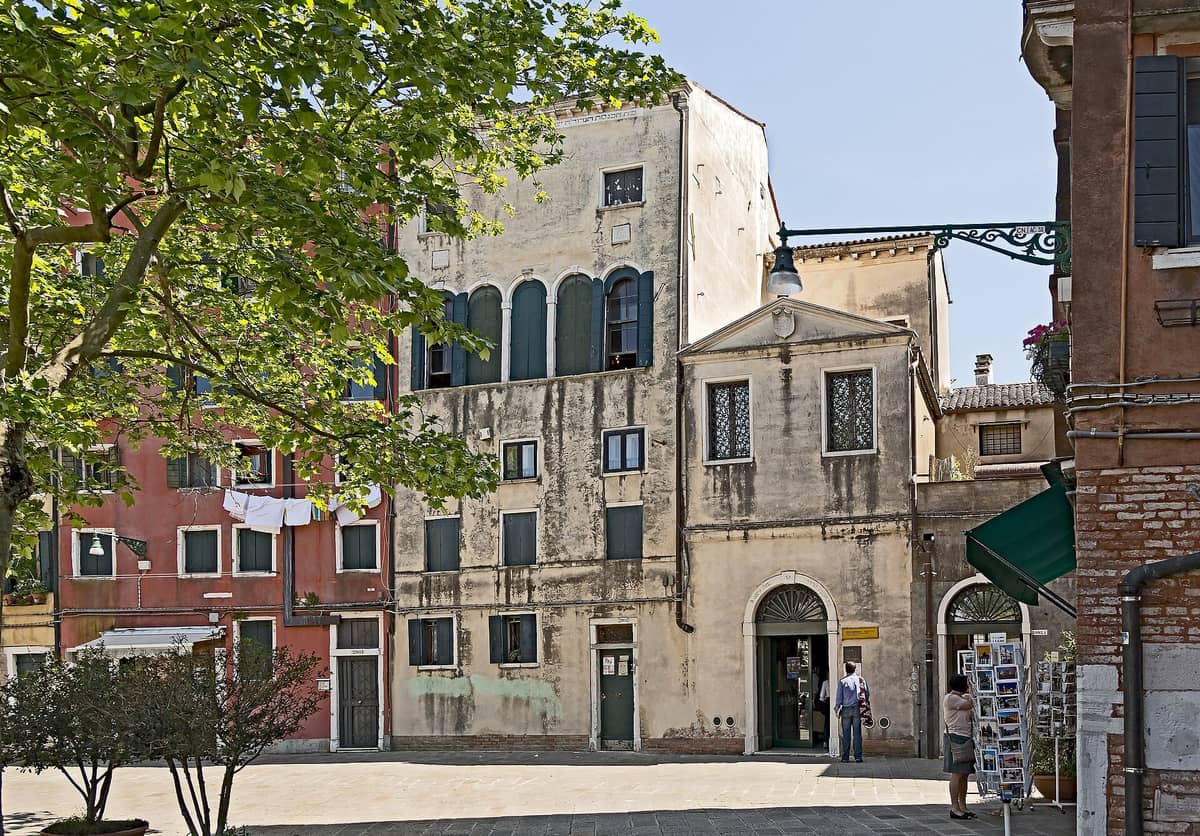
That history is not a footnote. It is the reason every physical detail of the place looks the way it does. Because the community could not expand outward, buildings were stacked upward, and the tenement blocks around Campo di Ghetto Nuovo reach six and seven storeys, towering over the surrounding Venetian fabric in a way that feels immediately unusual. Walk in from any of the narrow sotoporteghi (the low, tunnel-like passages that mark the original gate points) and the change in scale registers before you fully understand why.
ℹ️ Good to know
The ticket office is at Campo di Ghetto Nuovo, 2882, Cannaregio. Museum and synagogue hours vary by season and are subject to closures on Saturdays, Jewish holidays, 1 January, and 25 December. Check current hours at ghettovenezia.com before you visit.
Arriving: The Walk in from Guglie
Most visitors approach from the Guglie vaporetto stop, which deposits you near the Ponte delle Guglie, a broad stone bridge with low obelisk-like spires at each corner. From here the walk is roughly five minutes along the Fondamenta di Cannaregio, a canal-side path wide enough to feel genuinely relaxed compared to the narrow lanes around Rialto. You pass a mix of grocery shops, pharmacies, and bakeries serving the residential neighbourhood, which is worth noting: this is one of the parts of Venice where people actually live and shop.
The entrance to the Ghetto is through a low sotoportego, easy to miss if you are not watching the building numbers. Once through, the campo opens up and the atmosphere shifts. The tall, slightly leaning residential blocks, the large well-head at the centre of the campo, the memorial bronze reliefs on one wall depicting the deportations of 1943 and 1944, and the relative quiet (this is not on the main tourist circuit) all combine to create a space that feels set apart from the rest of the city.
For context on the broader Cannaregio sestiere and how the Ghetto fits within it, the neighbourhood guide covers the area's full character, from its canal-side foundations to its daily rhythms.
Tickets & tours
Hand-picked options from our booking partner. Prices are indicative; availability and final rates are confirmed when you complete your booking.
The Jewish Ghetto of Venice with Audio Commentary
From 14 €Instant confirmationThe Jewish Ghetto of Venice with Audio Commentary
From 12 €Instant confirmationThe Jewish Ghetto of Venice with Audio Commentary
From 9 €Instant confirmationPrivate two-hour tour of the Venetian Jewish Quarter
From 28 €Instant confirmationFree cancellation
The Campo at Different Times of Day
In the morning, Campo di Ghetto Nuovo is quiet to the point of stillness. The tall buildings shade it until mid-morning, and you can study the bronze Holocaust memorial bas-reliefs by Arbit Blatas without competition from other visitors. The memorial, installed on the north wall of the campo, depicts figures being loaded onto trains; it is restrained and devastating in equal measure. This is the best time to absorb the spatial logic of the place, to count the storeys on the buildings and understand what vertical compression meant for the people who lived here.
By midday, particularly in the warmer months, small tour groups arrive at regular intervals, following guides who explain the gate system and the curfew rules. The campo never reaches the crush levels of Piazza San Marco or the Rialto, but it does fill. If you want to take photographs of the campo without figures in every frame, arrive before 10:00 or return after 17:00 in summer. Late afternoon light hits the upper floors of the buildings at a low angle that emphasises the texture of the weathered plaster.
In the evening the campo quietens again, and the kosher restaurants and cafes that border it come into their own. The Ghetto remains a living community, not a museum district, and the smell of cooking from nearby kitchens is a useful reminder of that. If you visit at dusk you may hear prayers from one of the synagogues above, the sound carrying down through open windows.
The Synagogues and the Jewish Museum
Venice once had five synagogues serving different communities within the Ghetto: the German (Scola Tedesca), the Canton (Scola Canton), the Italian (Scola Italiana), the Levantine (Scola Levantina), and the Spanish (Scola Spagnola). All five survive, though not all are regularly open. They are not in separate buildings but are installed on the upper floors of the residential blocks, invisible from the street. This was a deliberate design response to restrictions on Jewish worship: the prayer halls are hidden inside ordinary-looking buildings, identifiable only by small oval windows set high on the facades.
The interiors are remarkable. The Scola Spagnola and the Scola Levantina, both likely remodelled in the seventeenth century, contain elaborately carved wooden furnishings, painted ceilings, and bimot (raised reading platforms) that show the full ambition of the craftsmen working within significant constraints. Access to the synagogues is through a timed guided tour operated by the Jewish Museum of Venice (Museo Ebraico di Venezia). The tours run in multiple languages and typically take around 45 minutes. Independent entry to the synagogues is not permitted.
The Jewish Museum itself occupies rooms above the Scola Tedesca and holds a collection of silver ritual objects, Torah scrolls, embroidered textiles, and archival documents tracing Venetian Jewish life from the sixteenth century onward. It is a focused, well-presented collection. Budget around 30 to 40 minutes for the museum alone. Operating hours vary by season, with generally longer hours from spring to early autumn and shorter Friday hours year-round due to Shabbat preparations. Current hours should be verified directly with the museum before your visit.
💡 Local tip
Synagogue tours are timed and can fill up during peak season. Booking a time slot in advance via the official website is advisable from April through October. Walk-ins are possible but not guaranteed.
Historical and Cultural Context
The Venice Ghetto predates the modern meaning of the word. When the Venetian Senate established the enclosure in 1516, it was responding to a mix of economic pragmatism and social control: the Republic wanted Jewish moneylenders and traders available for commerce while keeping the community physically separated and subject to curfew. The gates were locked at sunset and opened at dawn. Jewish residents paid for the privilege of confinement, covering the salaries of the Christian guards who patrolled the perimeter.
Over the following two centuries, the population within the enclosure grew while the physical footprint stayed fixed. Buildings rose as high as structurally feasible, often six or more storeys, which were considered extraordinary at the time and remain so today. The community developed an internal economy, culture, and intellectual life of considerable depth. By the seventeenth century, Venice's Jewish community was one of the most significant in Europe, producing scholars, poets, physicians, and merchants whose influence extended far beyond the lagoon.
The gates were removed during the Napoleonic occupation in 1797, ending nearly three centuries of enforced confinement. Then, during the German occupation of Venice in 1943 and 1944, 246 Venetian Jews were deported; only a handful returned. That chapter is acknowledged directly in the memorial reliefs on the campo wall and in the museum's permanent collection. The Ghetto is not a heritage site that has been sanitised for tourism. The weight of what happened here is held in the space honestly.
Visitors interested in Venice's broader religious architecture may find value in exploring the best churches in Venice guide, which places the city's Jewish heritage alongside its Christian monuments in a fuller picture of the city's spiritual history.
Practical Walkthrough: How to Structure Your Visit
A logical sequence is to walk the two connected campi first, Campo di Ghetto Vecchio and Campo di Ghetto Nuovo, without entering any buildings. This takes twenty minutes and gives you the spatial understanding you need before going inside anything. Note the sotoporteghi, the well-heads, the varying heights of the buildings, and the plaques on various facades. The Hebrew inscriptions above some doorways and the faded painted signs on a few buildings are legible even without knowing Hebrew once you understand what you are looking at.
Then visit the Jewish Museum and join a synagogue tour. The museum entrance is clearly signed from Campo di Ghetto Nuovo. If you have booked a time slot, you will be directed to the tour meeting point. If not, check availability at the ticket desk. After the tour, allow time to sit in the campo, look at the memorial reliefs carefully, and walk the perimeter passages. The Ghetto is compact but layered, and rushing through it loses most of the point.
There are several kosher restaurants and a bakery serving traditional Jewish-Venetian food in and around the campo. Eating here is both a practical decision and a way of engaging with the community as it exists today. The community is small but active, and the food reflects a distinct culinary tradition shaped by centuries of Venetian, Levantine, and Sephardic influences.
For a wider orientation to Venice's food culture before or after your visit, the what to eat in Venice guide covers the city's broader culinary traditions alongside specialist spots like those found in the Ghetto.
Accessibility, Photography, and What to Wear
The campi themselves are on flat paving and accessible without stairs. The synagogues and museum, however, are on upper floors reached by narrow historic staircases, and the official sources do not confirm full wheelchair accessibility for these spaces. Visitors with mobility considerations should contact the museum directly before their visit.
Photography is generally permitted in the public areas of the campo. Restrictions apply inside the synagogues and museum; follow the instructions of your guide. The memorial reliefs photograph well in soft morning light. Wide-angle lenses are useful for capturing the full height of the campo buildings, but the scale is also worth simply experiencing in person.
Dress modestly for synagogue entry: covered shoulders and knees are required, as in most religious sites in Italy. The museum provides coverings at the door, but bringing your own is simpler. Men will be offered a kippah at the entrance to the synagogue areas.
⚠️ What to skip
The Ghetto is closed on Saturdays, all Jewish holidays, 1 January, and 25 December. If your visit falls near a Jewish holiday, check the museum website in advance. Closures are not always predictable from a standard tourism calendar.
Who This Attraction Is Not For
Visitors primarily interested in Venice's grand Gothic and Byzantine architecture, or those moving quickly between major sights on a single-day itinerary, may find the Ghetto less immediately spectacular than the Doge's Palace or the Frari. The streets are narrow, the buildings are austere, and the experience is primarily intellectual and emotional rather than visually overwhelming in the way that the major monuments are. That is a feature, not a flaw, but it does mean the Ghetto rewards visitors who come with some preparation and a willingness to slow down.
If you are working through a tighter itinerary, the 2 days in Venice guide includes the Ghetto as a half-morning excursion that pairs well with a wider walk through Cannaregio.
Insider Tips
- The two connected campi, Campo di Ghetto Vecchio and Campo di Ghetto Nuovo, are technically separate enclosures from different periods. Stand in Ghetto Vecchio and look north toward Ghetto Nuovo to understand how the community's permitted territory expanded slightly over time, from the 1516 core to the additions of 1541.
- The narrow passages (sotoporteghi) that lead into the campo are the original gate points. There are several of them. Walking through each one and noting how the street narrows to almost nothing at the threshold gives you a visceral sense of how confinement was enforced architecturally.
- If you visit in the late afternoon on a weekday, you may hear the call to prayer from the Scola Levantina, which is still used for services. The sound carries into the campo and is worth waiting for.
- The bookshop attached to the Jewish Museum stocks a well-chosen selection of titles on Venetian Jewish history, Sephardic culture, and Italian Jewish communities. It is one of the better specialist bookshops in Venice and does not require a museum ticket to enter.
- For the best view of the extraordinary building height differential between the Ghetto blocks and the surrounding Cannaregio fabric, walk to the edge of the Ghetto on the side facing the Rio del Ghetto Vecchio. From the canal bank you can see how the buildings rise well above anything adjacent to them.
Who Is Jewish Ghetto of Venice (Ghetto Ebraico) For?
- History and cultural heritage enthusiasts who want more than architectural exteriors
- Travelers with an interest in Jewish history, Sephardic culture, or the origins of the word 'ghetto'
- Visitors doing a slow, walking-based exploration of Cannaregio away from the main tourist routes
- Photographers interested in unusual urban form and the play of light on tall, weathered plaster buildings
- Anyone willing to pair a visit with kosher food and time spent in a living community rather than a heritage zone
Nearby Attractions
Other things to see while in Cannaregio:
- Ca' d'Oro (Galleria Giorgio Franchetti)
Built for the Contarini family between 1421 and roughly 1430, the Ca' d'Oro is one of the finest Gothic palaces on the Grand Canal. It houses the Galleria Giorgio Franchetti, currently closed for renovation (closed to the public from early 2026, with a planned reopening in spring 2027 — verify at cadoro.org).
- Chiesa di Madonna dell'Orto
One of Venice's great Gothic churches, the Chiesa della Madonna dell'Orto sits quietly on the northern edge of Cannaregio. Free to enter, rich with Tintoretto canvases, and largely overlooked by day-trippers, it rewards anyone willing to walk beyond the Rialto circuit.
- Chiesa di Santa Maria dei Miracoli
Built between 1481 and 1489 by Pietro Lombardo, the Chiesa di Santa Maria dei Miracoli is a compact Renaissance masterpiece sheathed entirely in polychrome marble. Tucked into a quiet canal corner of Cannaregio, it rewards visitors who seek it out with some of the finest stone carving in Venice.
- Jewish Museum of Venice
The Museo Ebraico di Venezia sits at the heart of Campo di Ghetto Nuovo, the 16th-century enclave that gave the world the word 'ghetto'. This small but serious museum traces five centuries of Venetian Jewish life through ceremonial objects, archival documents, and guided access to synagogues that are still in active use.