Central Market Kuala Lumpur: The City's Heritage Arts and Crafts Hall
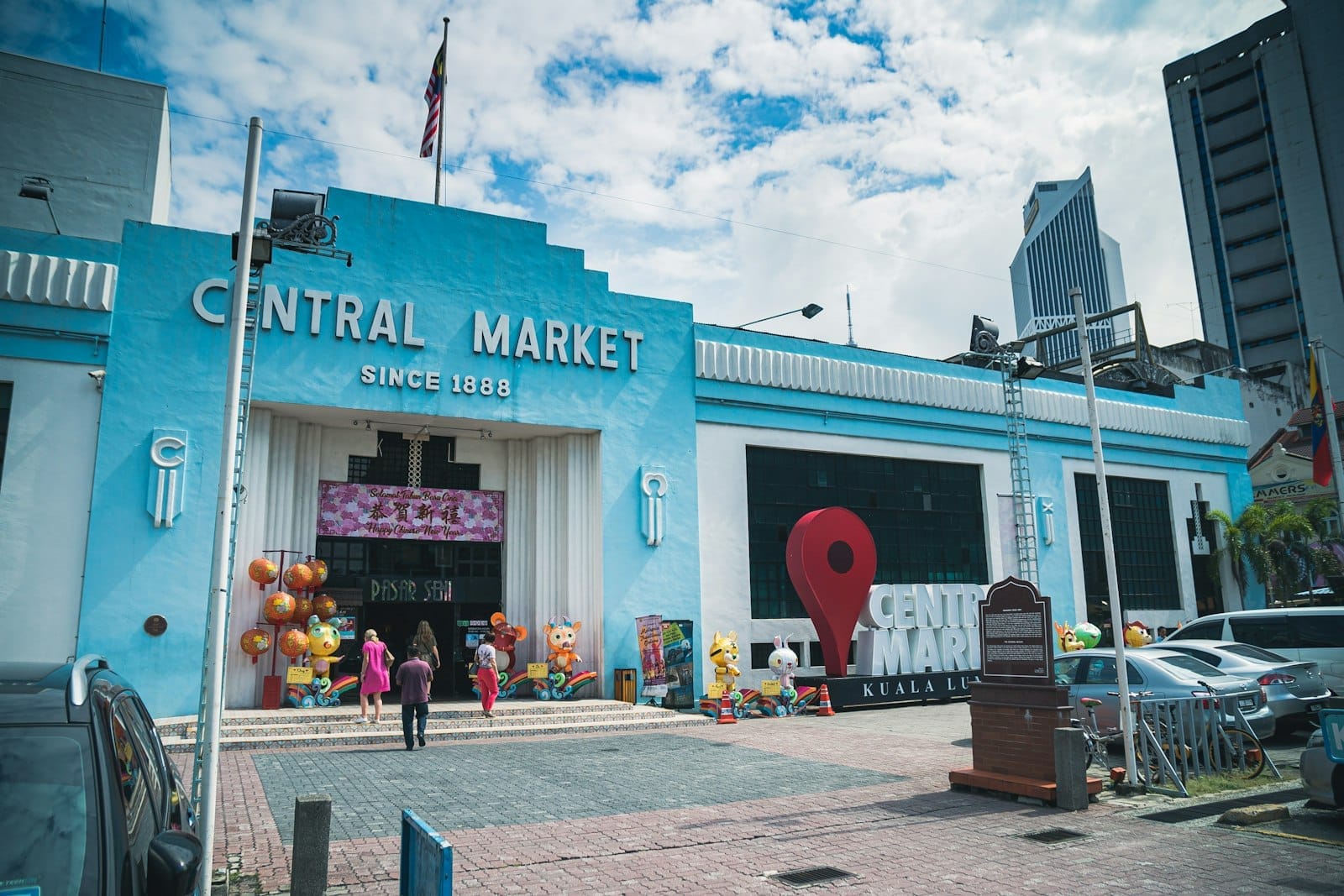
Housed in a powder-blue Art Deco building with the current building completed in 1937, Central Market is Kuala Lumpur's most concentrated showcase of Malaysian handicrafts, traditional textiles, and cultural souvenirs. It sits on the edge of Chinatown and draws everyone from bargain hunters to serious collectors of regional art.
Quick Facts
- Location
- Jalan Hang Kasturi, City Centre, Kuala Lumpur
- Getting There
- Pasar Seni station (LRT Kelana Jaya Line and MRT Kajang Line, exit directly adjacent)
- Time Needed
- 1 to 2 hours
- Cost
- Free entry; purchases vary
- Best for
- Craft shoppers, culture seekers, families, rainy-day visitors
- Official website
- www.centralmarket.com.my
What Central Market Actually Is
Central Market, known locally as Pasar Seni, is a dedicated arts and crafts centre occupying a heritage-listed Art Deco building in the heart of Kuala Lumpur. Unlike a typical street market, it is an indoor, air-conditioned complex with two main trading floors, a long covered outdoor annex called Kasturi Walk, and several annexe shophouses facing the street. The current building dates to 1937, originally constructed as a wet market serving the city's growing population. When wet markets consolidated elsewhere in the 1980s, the building was reimagined as a cultural retail destination, a move that almost certainly saved it from demolition.
Today the ground and first floors are filled with over 200 stalls and shops, selling everything from hand-carved wooden masks and pewter figurines to batik fabric, shadow puppet keepsakes, silver jewellery, and contemporary Malaysian prints. The quality and authenticity of goods vary significantly from stall to stall, which is part of the experience: you will find mass-produced trinkets next to genuinely crafted items made by artisans from Kelantan or Sarawak. Knowing this upfront helps you browse with realistic expectations.
💡 Local tip
Arrive before 11am on a weekday for the calmest experience. Many stalls open by 10am, and the crowds from Pasar Seni station are thinner before lunch.
The Architecture: Why the Building Itself Matters
The Central Market building is one of Kuala Lumpur's examples of Art Deco architecture, a late phase of Art Deco that emerged in the 1930s emphasising smooth surfaces, horizontal lines, and restrained ornament. The exterior is painted in pale blue-grey, and the elongated facade along Jalan Hang Kasturi reads almost like a drawn-out single stroke. It is not a grand colonial showpiece like the Sultan Abdul Samad Building a short walk away, but it has a quieter, utilitarian elegance that suits its origins as a working market.
Step inside and notice the high ceiling and wide internal corridors: these were functional requirements for a wet market managing heavy foot traffic and ventilation, and they now give the retail hall an unexpectedly airy feeling. The building was gazetted as a heritage site in 2000, which means any restoration work must follow conservation guidelines. If you want more context on KL's architectural history, the Sultan Abdul Samad Building and Masjid Jamek are both within a 10-minute walk and together tell a broader story of the city's colonial-era urban planning.
Tickets & tours
Hand-picked options from our booking partner. Prices are indicative; availability and final rates are confirmed when you complete your booking.
Petronas Twin Towers and Kuala Lumpur Tower observation deck tickets
From 34 €Private Taman Negara day trip from Kuala Lumpur with lunch
From 85 €Instant confirmationFree cancellationKuala Lumpur city and Batu Caves tour
From 41 €Instant confirmationFree cancellationKuala Lumpur city exploration private half-day tour
From 42 €Instant confirmationFree cancellation
Navigating the Market: Floor by Floor
The ground floor is the most commercially active. Here you will find batik clothing stalls, pewter workshops from Royal Selangor and smaller independent smiths, woodcarving displays, and vendors selling the colourful songket fabric woven with metallic thread. Prices are generally fixed at the larger branded shops but negotiable at independent stalls, particularly if you are buying multiple items. Do not open with a dramatically low counter-offer: a polite 10 to 15 percent below the asking price is more effective and keeps the exchange pleasant.
The first floor leans more toward art galleries, framing shops, cultural performance spaces, and a handful of local food stalls serving nasi lemak and teh tarik. This floor is quieter and worth the walk up for anyone wanting a more contemplative browse. Several galleries here carry original works by Malaysian painters and printmakers at prices far more accessible than commercial galleries in Bukit Bintang.
The outdoor Kasturi Walk, a covered pedestrian lane connecting Central Market to the surrounding streetscape, carries more casual stalls: sunglasses vendors, dried fruits, affordable clothing, and street food. It connects toward Petaling Street, making it a natural transition point if you plan to continue into Chinatown proper.
For serious shoppers, Central Market works well paired with a broader Chinatown walk. The market itself is the starting point, Kasturi Walk is the connective tissue, and Petaling Street Market is the sensory-overload finale.
How the Experience Changes Through the Day
Morning visits, between 10am and noon, offer the most relaxed atmosphere. Stall owners are setting up, the air conditioning has not yet been overwhelmed by body heat, and you can have actual conversations with artisans about their work. Some vendors, particularly those selling handmade jewellery or batik, are more willing to discuss the craft and technique during quieter hours.
From noon to 3pm, the building fills significantly, particularly on weekends and public holidays. The ground floor can feel congested around the central corridor. Kasturi Walk in the early afternoon smells strongly of grilled corn and coconut-based snacks from the food cart vendors, which some find appealing and others find overwhelming. If you are sensitive to heat and crowds, this window is genuinely uncomfortable.
Late afternoon, roughly 4pm to closing, sees a secondary surge of visitors arriving after work or after touring KLCC and Chinatown. The light through the building's upper windows softens, and the atmosphere shifts slightly from frantic commerce to something more leisurely. Stall owners begin discounting items as closing time approaches, which can work in your favour if you have been eyeing something all day.
ℹ️ Good to know
Central Market is generally open daily from around 10am to 10pm. Hours for individual stalls vary, and some may close earlier on weekdays. Confirm with the management office if you are making a special trip.
Cultural Context: More Than a Souvenir Stop
Central Market was conceived in its current form as part of a broader effort to preserve and commercialise traditional Malaysian crafts that were losing ground to industrial production in the 1980s and 1990s. The idea was to create a single venue where artisans from different states and ethnic communities could sell directly to an urban and tourist market. It has not always succeeded uniformly: some stalls have drifted toward generic tourist merchandise, and the authentic craft vendors are interspersed with vendors selling items that were manufactured elsewhere. But the structure still achieves something real.
Central Market remains one of the few places in the city where you can buy hand-painted batik from Kelantan, Sarawak woven textiles, Orang Asli-inspired carvings, and Peranakan ceramics all under one roof. For visitors who have limited time to travel beyond KL, it functions as a compressed introduction to the country's craft traditions. If you want to follow up with deeper immersion in Islamic decorative arts and regional material culture, the Islamic Arts Museum Malaysia about 3 kilometres south offers an exceptionally well-curated perspective.
Getting There and Practical Notes
The most convenient access point is Pasar Seni station, served by both the LRT Kelana Jaya Line and the MRT Kajang Line. The station exit deposits you directly at the side entrance of the building, making it one of KL's easiest attractions to reach by public transport. From Bukit Bintang, it is three stops on the LRT. From KLCC, change at Masjid Jamek. Journey times from either hub are under 20 minutes.
If you are arriving by taxi or ride-hailing app, the drop-off point on Jalan Hang Kasturi is usually manageable except during Friday prayers when surrounding roads near Masjid Jamek experience temporary closures. For a broader understanding of how to move around the city efficiently, the getting around Kuala Lumpur guide covers all transport modes in practical detail.
Central Market is fully wheelchair accessible on the ground floor, with a lift connecting to the first floor. The outdoor Kasturi Walk has some uneven paving, so exercise caution with mobility aids. Toilets are available inside the building and are generally maintained to an acceptable standard.
⚠️ What to skip
Kasturi Walk vendors are sometimes aggressive with attention-grabbing tactics. A polite but firm 'no thank you' works better than avoiding eye contact, which can prolong the interaction.
Who Should Think Twice
Visitors expecting an open-air, atmospheric traditional market will find Central Market slightly disappointing. The indoor format and commercial focus mean it lacks the sensory rawness of Chow Kit Market or the historic tangle of Petaling Street. Travellers who have already spent significant time in Southeast Asian craft markets in Bangkok, Hanoi, or Bali may find the range here familiar and the prices unremarkable. It is also not the right venue for food tourism: while snacks are available, this is not a food hall in any serious sense.
That said, for a first visit to Kuala Lumpur, especially in combination with a walk through Petaling Street Market and a stop at the River of Life promenade nearby, Central Market fits naturally into a half-day Chinatown circuit.
Insider Tips
- Ask vendors on the first floor whether they make their own pieces. Several batik painters work on-site and will show you the wax-resist process if you express genuine interest.
- Royal Selangor pewter has a proper shop inside Central Market, but independent pewter stalls on the ground floor often carry unique designs at lower prices with room to negotiate.
- The short performance stage near the main entrance occasionally hosts traditional dance demonstrations or cultural showcases, usually on weekend afternoons. Check the Central Market website or ask at the information counter for the current schedule.
- The annexe shophouses facing Jalan Hang Kasturi include a few locally loved coffee shops that are calmer and cheaper than anything inside the main building. Worth knowing if you need a break mid-browse.
- If you are buying batik fabric by the metre rather than pre-made garments, Central Market has better selection and prices than most mall fabric outlets, and vendors can recommend tailors in the Chinatown area who do fast turnaround work.
Who Is Central Market For?
- First-time visitors to Kuala Lumpur wanting a concentrated introduction to Malaysian crafts
- Shoppers looking for meaningful, locally made souvenirs rather than generic merchandise
- Families with children who benefit from an indoor, air-conditioned, easy-to-navigate space
- Architecture enthusiasts interested in 1930s Art Deco commercial buildings in Southeast Asia
- Travellers combining a Chinatown walk with a structured starting point
Nearby Attractions
Other things to see while in Chinatown Kuala Lumpur:
- Jalan Masjid India
Jalan Masjid India is Kuala Lumpur's primary South Asian commercial corridor, running through the heart of the city's Indian-Muslim district. It packs sari boutiques, textile merchants, spice vendors, street food hawkers, and gold jewellers into a stretch that rewards slow, unhurried exploration. The surrounding lanes are just as interesting as the main street.
- Kwai Chai Hong
Kwai Chai Hong is a narrow back alley in Kuala Lumpur's Chinatown that has been transformed into an open-air heritage experience. Murals, bronze sculptures, and restored shophouse facades recreate the sights and textures of 1950s Cantonese urban life. It is compact, atmospheric, and one of the most photographed corners of Petaling Street's neighbourhood.
- Petaling Street Market
Petaling Street Market sits at the heart of Kuala Lumpur's Chinatown and has been a trading hub since the late 19th century. It draws everyone from fruit vendors and herbal medicine sellers to tourists hunting replica goods, making it one of the city's most layered and honest street experiences.
- Sri Mahamariamman Temple
Sri Mahamariamman Temple is Kuala Lumpur's oldest and most ornate Hindu temple, founded in 1873 and rebuilt over decades into a tower of intricate South Indian sculpture. Set on Jalan Tun H.S. Lee in Chinatown, it remains a living place of daily worship — not a tourist attraction dressed up for visitors.