Sultan Abdul Samad Building: KL's Colonial Crown at Merdeka Square
The Sultan Abdul Samad Building is Kuala Lumpur's most recognizable colonial-era landmark, rising above Merdeka Square with its copper-green domes and Moorish arches. Built in 1897, it defines the city's civic heart and rewards visitors who time their arrival for the golden hour.
Quick Facts
- Location
- Jalan Raja, Merdeka Square, Kuala Lumpur
- Getting There
- Masjid Jamek LRT Station (5-min walk)
- Time Needed
- 30–60 minutes (exterior); longer if combining with Merdeka Square
- Cost
- Free to view exterior; interior access depends on current use
- Best for
- Architecture lovers, history enthusiasts, photographers, first-time visitors
What the Sultan Abdul Samad Building Actually Is
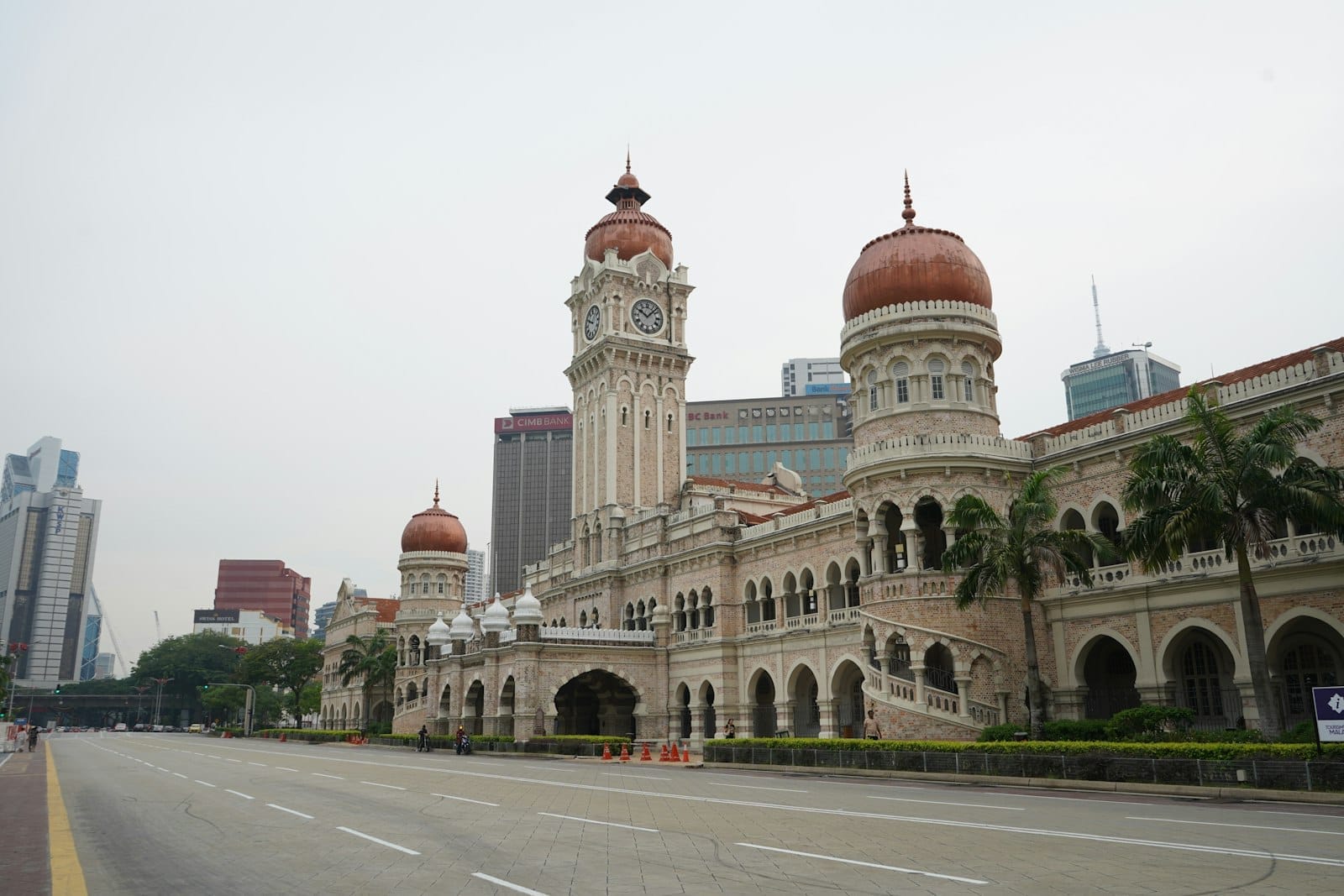
The Sultan Abdul Samad Building is not a palace, despite what its silhouette suggests. Completed in 1897 and designed by A.C. Norman, a British colonial architect working under the Public Works Department, it was built to house government administrative offices during the reign of the Federated Malay States. The building takes its name from Sultan Abdul Samad of Selangor, who granted permission for Kuala Lumpur to be developed as the state capital.
The facade runs nearly 137 meters along Jalan Raja, capped by three large copper domes that have oxidized to a distinctive green-grey over the decades. Below them, pointed Moorish arches line the portico, red brick covers the walls, and a central clock tower rises 40 meters above street level. The style is officially described as Mughal Gothic or Moorish Revival — an architectural hybrid that colonial planners used across British India and the Malay Peninsula to signal authority while nod toward local Islamic aesthetics.
ℹ️ Good to know
The building is now used by Malaysia's Ministry of Information, Communications and Culture, as well as the Court of Appeal. Portions of the interior are not accessible to the general public, but the exterior and surrounding grounds are always open.
The View From the Square
Most visitors first encounter the Sultan Abdul Samad Building from across Merdeka Square, the large open field directly in front. At street level, the scale is easy to underestimate. The building stretches across your entire field of vision, and when you position yourself near the flagpole at the center of the square — the site where the Malaysian flag was raised on August 31, 1957, when independence was declared — the clock tower frames the background in a way that still reads as monumental.
The flagpole itself stands 95 meters tall and is one of the tallest free-standing flagpoles in the world. For context on what happened here politically, the full story of the Merdeka moment is better explored at Merdeka Square itself, which has informational panels and a small heritage trail.
Looking at the building in the morning, the red brick catches direct eastern light and appears almost terracotta. By noon, the glare flattens the texture and the domes reflect silver rather than green. In the late afternoon, when the sun drops toward the west and falls on the facade at an angle, the shadows between the arches deepen and the building finally looks as dramatic as the photographs suggest. This is the window most photographers target.
Tickets & tours
Hand-picked options from our booking partner. Prices are indicative; availability and final rates are confirmed when you complete your booking.
Petronas Twin Towers and Kuala Lumpur Tower observation deck tickets
From 34 €Private Taman Negara day trip from Kuala Lumpur with lunch
From 85 €Instant confirmationFree cancellationKuala Lumpur city and Batu Caves tour
From 41 €Instant confirmationFree cancellationKuala Lumpur city exploration private half-day tour
From 42 €Instant confirmationFree cancellation
History and Why This Building Still Matters
When A.C. Norman drafted the building in the 1890s, Kuala Lumpur was barely 30 years old and still recovering from a period of clan warfare. The colonial administration wanted a structure that communicated permanence and order. The result was a building that looked nothing like anything else in the peninsula at the time — and also, deliberately, nothing like the purely European civic architecture being built in Singapore and Penang.
The Moorish Revival approach was a calculated decision. By incorporating pointed arches, ornamental details derived loosely from North African and Mughal architecture, and a central clock tower that echoed both a minaret and a British town hall, the colonial government created something that could be read as simultaneously local and imperial. Whether that ambiguity was respectful or manipulative is still a subject of debate among Malaysian historians.
After independence, the building became symbolic in a different way: it was the backdrop to the declaration of Merdeka and has remained in continuous government use since. Malaysia's National Day parade on August 31 is still held in front of it each year, filling the Merdeka district with crowds and ceremony that can make the area difficult to navigate — but also extraordinary to witness.
How the Experience Changes by Time of Day
Early morning, before 8am, is the quietest window. Joggers loop Merdeka Square, a few commuters cut through, and the city noise is low enough that you can hear pigeons and the distant call to prayer from Masjid Jamek. The light is soft and diffuse, good for wide-angle photography that captures the whole facade without harsh shadows.
Midday is the least rewarding time to visit if your goal is photography or peaceful observation. Tour groups arrive in numbers, the heat radiating off the open square is significant, and the overhead light creates flat images. That said, the square is shaded on its edges by rain trees, and the building's ground-floor arcade provides some shelter if you want to walk the perimeter without overheating.
💡 Local tip
The hour before sunset, roughly 5:30–6:30pm depending on the season, produces the best light for photography. Position yourself on the western side of Merdeka Square with a wide lens to capture the clock tower and domes in warm directional light.
After dark, the building is floodlit in amber and green, which makes for striking long-exposure photographs but feels somewhat artificial. The surrounding area stays active into the evening, particularly on weekends, but the atmosphere is more social than contemplative. For night photography, a small tripod and patience are worth the effort.
Getting There and Moving Around the Area
The most straightforward approach is the Kelana Jaya or Ampang LRT Line to Masjid Jamek station. From the station exit, the Sultan Abdul Samad Building is visible almost immediately. A short 5-minute walk south along Jalan Raja brings you directly in front of it. For practical guidance on navigating public transit in KL, the getting around Kuala Lumpur guide covers fares, passes, and rail connections clearly.
Parking in this area is limited and traffic along Jalan Raja can be congested during weekday mornings and late afternoons. Arriving by rail is genuinely faster than driving unless you're coming from a direction with no direct transit access.
The building sits within easy walking distance of several other landmarks. Masjid Jamek, one of KL's oldest mosques, is a 3-minute walk north. The River of Life pedestrian corridor runs nearby if you want to extend a walking route.
What to Combine With Your Visit
The Sultan Abdul Samad Building is best treated as part of a broader heritage walk rather than a standalone destination. Merdeka Square takes 20–30 minutes to cross properly and includes a heritage information trail. Add the River of Life promenade for a riverside stroll toward the confluence of the Klang and Gombak rivers, a site that is historically significant as the founding location of Kuala Lumpur.
If you plan to spend a full morning in this area, consider continuing to Central Market about 10 minutes south on foot, which houses craft stalls and a covered arcade in a preserved Art Deco building from 1888. Alternatively, the National Museum is reachable by taxi or ride-share and provides deeper historical context for everything you're seeing in the Merdeka precinct.
Who Should Skip This
Travelers primarily interested in interior access or hands-on museum experiences will find the Sultan Abdul Samad Building frustrating: the public cannot freely enter, and there is no formal exhibition or visitor center within the structure. If your goal is cultural immersion with narrated history, a dedicated museum will serve you better. Likewise, visitors who have already spent significant time at Merdeka Square on a previous trip may find a return visit here offers little new unless they come specifically for golden-hour photography.
Insider Tips
- The clock tower chimes on the hour and can be heard clearly when the square traffic is light, usually before 8am. Worth timing your arrival for the chime if you're already there early.
- During National Day (August 31) and Malaysia Day (September 16), the building serves as a backdrop for large public gatherings. The atmosphere is remarkable but crowds are dense and access to the square itself may be restricted hours before events begin.
- The building is partially visible from the Masjid Jamek LRT platform as you arrive. Get a front-facing spot on the train for a preview before you exit.
- Rain can improve the experience. The building's red brick deepens in color when wet, and the reflections on the damp paving stones around the square add depth to photographs. A brief tropical shower followed by clearing skies is close to ideal.
- For a less-photographed angle, walk north along Jalan Tun Perak until the clock tower appears framed between older shophouses. This perspective shows how the building dominates the surrounding low-rise streetscape and gives a stronger sense of its original civic scale.
Who Is Sultan Abdul Samad Building For?
- First-time visitors to Kuala Lumpur building an itinerary around the city's heritage core
- Architecture enthusiasts interested in Moorish Revival and colonial-era design
- Photographers who plan visits around golden hour and have time to wait for the right light
- History travelers connecting the colonial period to Malaysia's independence narrative
- Travelers combining a morning heritage walk through the Merdeka district with nearby sites
Nearby Attractions
Other things to see while in Merdeka:
- Masjid Jamek
Standing at the junction of the Klang and Gombak rivers, Masjid Jamek is Kuala Lumpur's oldest surviving mosque, completed in 1909. Built in Mughal-inspired style, it marks the very spot where the city's founders first set foot, making it as historically significant as it is architecturally striking.
- Merdeka Square
Merdeka Square is the symbolic heart of Kuala Lumpur, a wide open field flanked by colonial-era buildings where Malaysia's independence was proclaimed in 1957. Today it draws visitors for its striking architecture, the towering national flagpole, and its position at the center of the city's most historically significant neighborhood.
- River of Life
The River of Life is Kuala Lumpur's ambitious waterfront revitalization project, centered on the point where the Klang and Gombak rivers meet near Masjid Jamek. Blue-lit at night and framed by colonial architecture, it tells the story of how this city began, though the experience is more reflective than spectacular.