Masjid Jamek: Where Kuala Lumpur Actually Began
Standing at the junction of the Klang and Gombak rivers, Masjid Jamek is Kuala Lumpur's oldest surviving mosque, completed in 1909. Built in Mughal-inspired style, it marks the very spot where the city's founders first set foot, making it as historically significant as it is architecturally striking.
Quick Facts
- Location
- Jalan Tun Perak, Merdeka, Kuala Lumpur
- Getting There
- Masjid Jamek LRT Station (Kelana Jaya & Sri Petaling lines), direct access
- Time Needed
- 30–60 minutes
- Cost
- Free entry; robes provided for visitors not in modest dress
- Best for
- History seekers, architecture lovers, early morning walkers
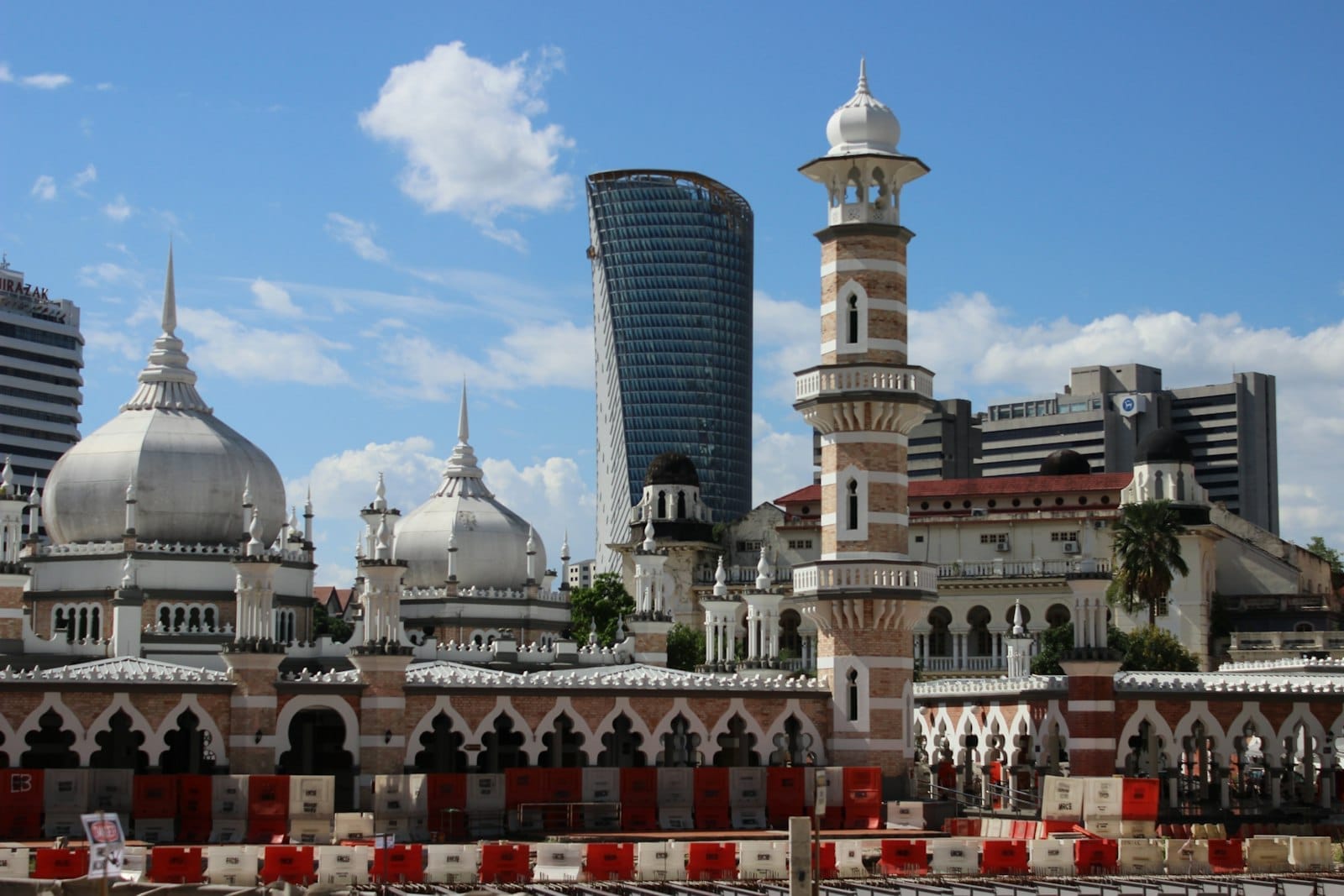
The Birthplace of a City
Kuala Lumpur was not planned. It grew from a muddy trading post where the Klang and Gombak rivers meet, attracting Chinese tin miners in the 1850s and a growing population of Malay, Indian, and British settlers in the decades that followed. By the early 1900s, that confluence point was recognized as the symbolic and practical heart of the settlement. It was here, at the literal junction of two rivers, that British colonial architect A.B. Hubback designed Masjid Jamek, completed in 1909 and officially the oldest mosque still standing in the city.
For over six decades, Masjid Jamek served as the city's Friday mosque, the central place of Muslim worship before the larger Masjid Negara was built in 1965. That history gives it a weight that larger, flashier mosques lack. This is not a monument built for tourism or national prestige. It was built for a community that was still figuring out what Kuala Lumpur would become.
The mosque sits close to Merdeka Square, the colonial-era ceremonial heart of the city, which makes this entire riverbank corridor one of the most historically layered parts of Kuala Lumpur.
Mughal Architecture in a Tropical Setting
Hubback drew on Mughal and Moorish traditions to design the mosque, producing something that looks quietly out of place in the tropics, in the best possible way. The structure features three onion-shaped domes finished in white and red-brick striping, two minarets flanking the main prayer hall, and a series of horseshoe arches that frame the courtyard. The design is precise without being cold, and it photographs exceptionally well in morning light when the sun hits the domes from the east and casts long shadows across the courtyard tiles.
The surrounding palm grove, planted along the riverbanks, adds an almost incongruous lushness. Tall palms rise above the perimeter walls and frame the minarets, creating a composition that feels more like an illustration than a real streetscape. The River of Life urban renewal project has cleaned up and beautified the riverbanks immediately surrounding the mosque, with paved walkways, ornamental lighting, and seating areas that make approaching the mosque by foot far more pleasant than it was a decade ago.
The River of Life waterfront runs directly past the mosque and provides the best exterior views, particularly the angle looking upstream from the pedestrian bridge where both rivers meet in front of the main facade.
💡 Local tip
For the best exterior photographs, arrive before 8:30am. The low morning sun illuminates the domes directly, and foot traffic on the riverbank walkway is minimal. By midday, haze and crowds make clean shots much harder.
Tickets & tours
Hand-picked options from our booking partner. Prices are indicative; availability and final rates are confirmed when you complete your booking.
Petronas Twin Towers and Kuala Lumpur Tower observation deck tickets
From 34 €Private Taman Negara day trip from Kuala Lumpur with lunch
From 85 €Instant confirmationFree cancellationKuala Lumpur city and Batu Caves tour
From 41 €Instant confirmationFree cancellationKuala Lumpur city exploration private half-day tour
From 42 €Instant confirmationFree cancellation
What the Visit Actually Looks Like
Entry to Masjid Jamek is free and open to non-Muslim visitors outside of prayer times. The mosque is closed to tourists during Friday prayers, which typically run from around 12:30pm to 2:30pm, and also during the five daily prayer sessions. Outside these windows, you can enter the courtyard and, in some cases, the outer arcade of the prayer hall, though access to the interior main hall depends on the day and current mosque policy.
At the entrance gate, visitors who are not dressed modestly are given robes to wear, which is standard practice. The attendants at the gate are generally straightforward and helpful. Women should cover their hair. Shoes come off at the entrance. The courtyard underfoot is tiled in cool white stone, a relief on a hot afternoon, and the sound inside the compound shifts noticeably from the street noise outside to something much quieter, occasionally punctuated by the call to prayer from the minarets above.
The visit itself is short by most measures. Thirty minutes is ample for a thorough look around the courtyard, the perimeter arcade, and the riverbank walkway immediately outside. There is no museum, no exhibit, and no audio guide. What you get is the architecture and the atmosphere.
⚠️ What to skip
Check prayer times before you go. If you arrive during Asr or Maghrib prayers, you will need to wait outside. The Friday midday closure is the longest, so plan accordingly if visiting on a Friday.
Time of Day and Crowd Patterns
Early morning, from around 7:30am to 9am, is unambiguously the best time to visit. The prayer rush from Fajr has ended, commuters are moving through Masjid Jamek LRT station rather than stopping at the mosque, and the light is ideal. You can walk the riverbank, photograph the exterior from multiple angles, and enter the courtyard with very few other visitors around. The air smells of damp stone, river water, and the faint scent of incense from nearby street stalls setting up along Jalan Tun Perak.
Midmorning brings office workers cutting through the area on their way to Chinatown or the financial district, and some tourist foot traffic begins to pick up. By early afternoon the heat is significant, and the riverside walkway offers little shade. Late afternoon, from around 4pm until Maghrib, is the second-best window: temperatures drop, the sky turns golden, and the mosque exterior takes on a warm glow that makes for compelling photos from the river bridge.
Weekends see more local families and domestic tourists, particularly on Sunday mornings. International tourist groups occasionally pass through but rarely linger long, which means the mosque never feels as crowded as the major commercial attractions in the city.
Getting There and Getting Around Nearby
Access is as straightforward as any attraction in Kuala Lumpur. Masjid Jamek LRT Station sits directly adjacent to the mosque, served by both the Kelana Jaya and Sri Petaling lines. If you are coming from KLCC, the ride is roughly ten minutes. From Bukit Bintang, the easiest approach is one stop to KL Sentral and a transfer, or a short ride from Hang Tuah station on the Ampang or Sri Petaling line.
The surrounding Merdeka area is highly walkable. From Masjid Jamek you can reach the Sultan Abdul Samad Building in under ten minutes on foot, crossing Dataran Merdeka along the way. Heading in the other direction, the edges of Chinatown and Petaling Street are a short walk south, making it easy to combine both into a single morning.
ℹ️ Good to know
Masjid Jamek LRT station has two exits. Use the exit signposted for the mosque or River of Life to surface directly at the riverbank walkway rather than on the main road.
Honest Assessment: Worth Your Time?
Masjid Jamek is not a destination in the way that the Petronas Twin Towers or Batu Caves are destinations. There is no single dramatic payoff. What it offers is something rarer in Kuala Lumpur: genuine historical weight in a physically beautiful setting, without a ticket queue, without a souvenir shop, and without the sensation of being processed through an attraction.
For travelers who engage with cities through their history rather than their shopping or their skylines, Masjid Jamek delivers clearly. For travelers primarily interested in modern KL, it is worth a brief stop, especially if they are already passing through the Merdeka area. The riverbank walkway and the architecture are photogenic enough to justify the detour even on a short itinerary.
Visitors who want to understand Kuala Lumpur's relationship with Islam more broadly would do well to combine this visit with a trip to the Islamic Arts Museum Malaysia in the Lake Gardens area, which provides the cultural and artistic context that Masjid Jamek itself, as an active place of worship, does not explain.
Who should skip it: travelers with only one full day who have not yet seen the major landmarks, and those with limited mobility who find the riverside pathway and stone courtyard surfaces difficult to navigate. Children will not find much to hold their attention here beyond the pigeons and the river.
Insider Tips
- The pedestrian bridge directly in front of the mosque, over the confluence of the Klang and Gombak rivers, gives the best full-facade photograph. Stand on the bridge rather than on the riverbank walkway for an unobstructed view of both minarets and all three domes simultaneously.
- If you arrive during a prayer session and must wait, use the time to walk the River of Life promenade northward, where the recently renovated boardwalk offers views back toward the mosque from a different angle.
- Early visitors often notice a small outdoor tea stall near the station entrance that opens before most nearby cafes. It is basic, but a glass of teh tarik while the mosque compound is still quiet is a good way to start the morning.
- The mosque's interior prayer hall uses traditional Mughal proportional design, with pointed arches slightly different from the horseshoe arches visible on the exterior. Look for this shift in arch style between outside and inside if you gain access.
- Masjid Jamek is one of the few central KL landmarks with genuinely good sight lines from multiple directions. Walk the full loop around the perimeter walls before entering, so you understand the layout before going in.
Who Is Masjid Jamek For?
- History and heritage travelers who want to understand how Kuala Lumpur actually formed
- Architecture enthusiasts interested in colonial-era Mughal-Moorish design
- Photographers working in early morning light
- Travelers combining a Merdeka area walking route with Chinatown
- Anyone looking for a meaningful, free experience in central KL
Nearby Attractions
Other things to see while in Merdeka:
- Merdeka Square
Merdeka Square is the symbolic heart of Kuala Lumpur, a wide open field flanked by colonial-era buildings where Malaysia's independence was proclaimed in 1957. Today it draws visitors for its striking architecture, the towering national flagpole, and its position at the center of the city's most historically significant neighborhood.
- River of Life
The River of Life is Kuala Lumpur's ambitious waterfront revitalization project, centered on the point where the Klang and Gombak rivers meet near Masjid Jamek. Blue-lit at night and framed by colonial architecture, it tells the story of how this city began, though the experience is more reflective than spectacular.
- Sultan Abdul Samad Building
The Sultan Abdul Samad Building is Kuala Lumpur's most recognizable colonial-era landmark, rising above Merdeka Square with its copper-green domes and Moorish arches. Built in 1897, it defines the city's civic heart and rewards visitors who time their arrival for the golden hour.