National Museum Malaysia: KL's Best Introduction to the Country's History
The National Museum Malaysia (Muzium Negara) is the country's foremost public history museum, tracing Malaysia's civilizations, colonial era, and path to independence. Housed in a landmark 1963 building near the Lake Gardens, it offers four permanent galleries that cover everything from early kingdoms to modern nationhood.
Quick Facts
- Location
- Jalan Damansara, Lake Gardens, Kuala Lumpur
- Getting There
- KTM Kuala Lumpur Station or LRT Pasar Seni, then a short taxi or 15-minute walk
- Time Needed
- 2 to 3 hours for a thorough visit
- Cost
- RM5 for adults, RM2 for children/seniors/students; free for Malaysians and disabled visitors
- Best for
- History enthusiasts, first-time visitors to Malaysia, families, and students
- Official website
- www.muziumnegara.gov.my/en
What Is the National Museum Malaysia?
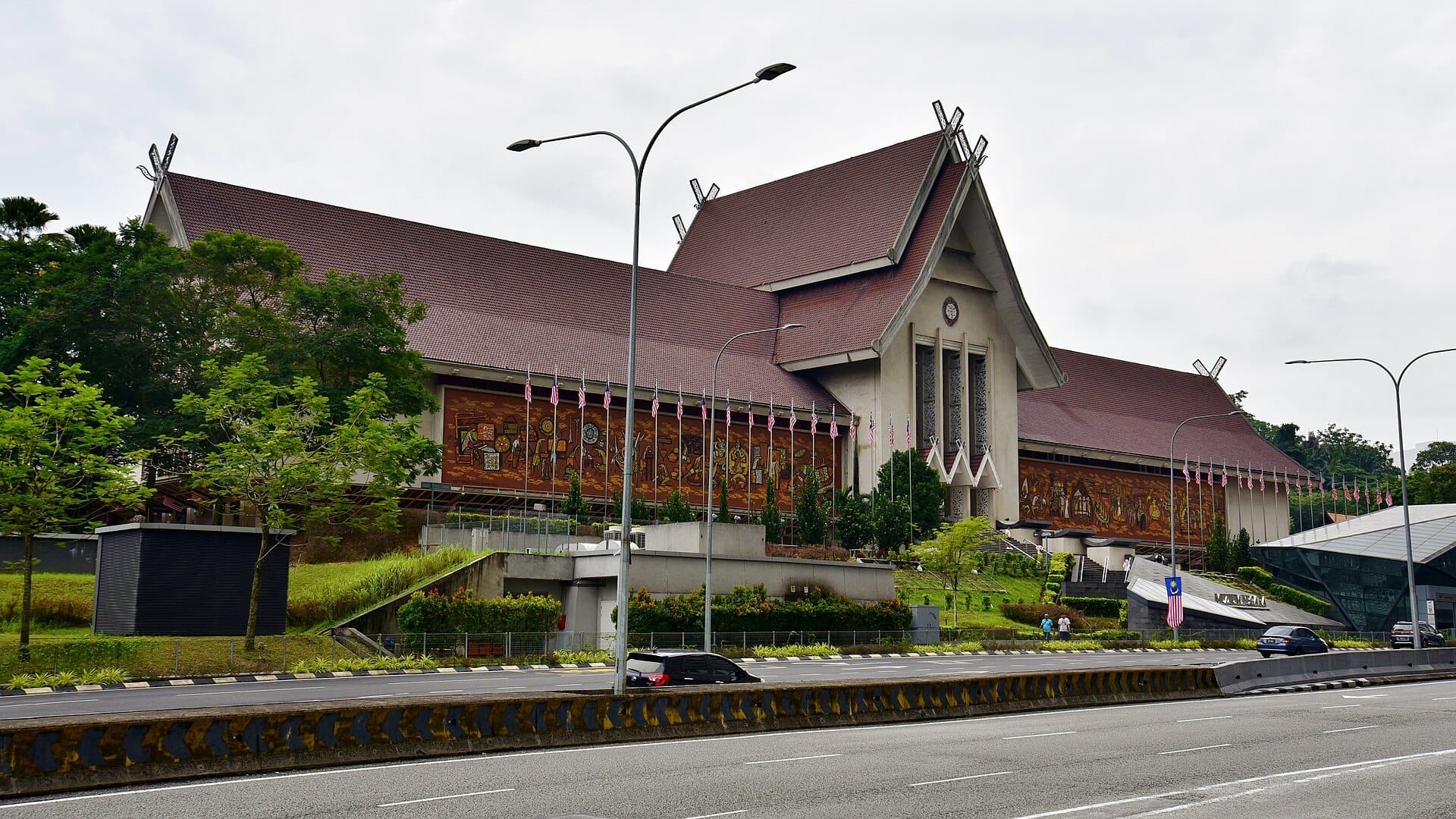
The National Museum Malaysia, known in Malay as Muzium Negara, sits at the southern edge of the Lake Gardens district, separated from the road noise of Jalan Damansara by a broad ceremonial lawn. It opened on 31 August 1963, just six years after independence, and was conceived as a physical statement of nationhood: a place where the new country could define its own history for its own people and for the world.
The building itself makes a strong architectural impression before you even step inside. Designed in a synthesis of Minangkabau and Malay palace styles, its sweeping curved rooflines tilt upward at both ends, referencing the traditional bumbung perabung lima roof form found across Peninsular Malaysia. On either side of the main entrance, two enormous murals created from Italian glass mosaic depict pivotal moments in Malaysian history. These murals, each around 30 meters wide, are among the largest mosaic-glass murals in Southeast Asia and worth close inspection before you go in.
💡 Local tip
Arrive by 10:00 am on weekdays to beat school group visits. The lobby and galleries on the ground floor fill up with student tours between 10:30 am and noon. Afternoons tend to be quieter, though the building gets warm in the upper galleries without direct air-conditioning near the windows.
The Building and Its Surroundings
The museum grounds include a small open-air exhibition area at the rear where traditional Malay houses and old vehicles are displayed. These exterior exhibits are free to walk through and offer a gentler, less structured start to your visit, especially for families with young children who need to burn energy before going inside.
The museum sits at the edge of the broader Lake Gardens precinct, which contains the KL Bird Park, the Perdana Botanical Gardens, and the KL Butterfly Park. A combined visit to the museum and one or two of these attractions makes for a full day without requiring any additional transit.
The surrounding area is relatively quiet compared to the rest of central Kuala Lumpur. There are no major food courts or hawker stalls immediately adjacent, so eat before you arrive or budget time to walk toward the Perdana Lake area for lunch.
Tickets & tours
Hand-picked options from our booking partner. Prices are indicative; availability and final rates are confirmed when you complete your booking.
Petronas Twin Towers and Kuala Lumpur Tower observation deck tickets
From 34 €Private Taman Negara day trip from Kuala Lumpur with lunch
From 85 €Instant confirmationFree cancellationKuala Lumpur city and Batu Caves tour
From 41 €Instant confirmationFree cancellationKuala Lumpur city exploration private half-day tour
From 42 €Instant confirmationFree cancellation
Inside the Galleries: What You Will Actually See
The museum is organized into four permanent galleries, each occupying a distinct section of the two-story building. The flow is logical but not strictly enforced, so you can move between galleries in any order.
Gallery A: Early History and Natural History
This gallery covers Malaysia's prehistoric past, from Paleolithic tool cultures and Neolithic settlements to the early Indianized kingdoms that preceded Islam's arrival in the peninsula. The Lenggong Valley archaeological finds are particularly significant here. Lenggong is a UNESCO World Heritage Site in Perak, and the skeletal remains and tools displayed represent some of the oldest human habitation evidence in Southeast Asia, dating back over 11,000 years. The exhibit labels are informative, though some of the case lighting is uneven, making it worth bringing a small flashlight if you want to examine small artifacts closely.
Gallery B: The Malay Kingdoms
The second gallery traces the rise of the Malay kingdoms, with particular emphasis on the Melaka Sultanate of the 15th century, which became the most powerful trading port in maritime Southeast Asia. Gold jewelry, royal regalia, court manuscripts, and replica keris daggers fill the cases here. The real standout is the collection of traditional Malay textiles, including songket weaving samples that show the extraordinary technical precision of court-commissioned fabrics.
This is where the museum earns its authority as an institution. The curation reflects genuine scholarly depth rather than a generalist overview, and the labels in English are accurate and contextually placed, not just translated from Malay.
Gallery C: Colonial Era and the Road to Independence
The colonial gallery covers Portuguese, Dutch, and British rule with a tone that is measured rather than polemical. It includes documents, weapons, maps, and everyday colonial-era objects that bring the administrative machinery of empire into focus. The sections on the Japanese occupation of Malaya during World War II are handled with particular care, using personal testimonies and photographic records to convey the scale of disruption.
The independence movement section, covering the period from 1946 to Merdeka in 1957, includes original documents from the constitutional negotiations and photographs of the key figures. This is the emotional heart of the museum for many Malaysian visitors, and you can observe that quietly here in a way that the political monuments downtown do not always permit.
Gallery D: Malaysia From 1957 Onward
The final gallery covers modern Malaysia: the formation of the federation in 1963, the racial tensions of 1969, and subsequent economic development. The presentation here is more officially curated than the earlier galleries and does not engage critically with complex political events, which is worth knowing in advance. If you are looking for nuanced political history, this section will feel incomplete. As a record of official nation-building narratives, however, it is useful context.
ℹ️ Good to know
The museum is open daily from 9:00 am to 5:00 pm. Last entry is at 5:15 pm. The building is closed on certain national holidays, so check the official website before visiting during festive periods.
How the Experience Changes by Time of Day
Morning visits, particularly between 9:00 am and 10:30 am, offer the best combination of cool air and quiet galleries. The natural light through the upper windows is softer and the building has not yet absorbed the midday heat. This is the best window for photography, especially in Gallery A where the prehistoric dioramas are lit with ambient rather than harsh artificial light.
Midday brings school groups and the upper floors become noticeably warmer. The courtyard area and outdoor exhibits are worth revisiting in the late afternoon as the light drops and the surrounding trees provide shade. Sunset, visible from the front steps, casts the concrete mural facades in warm amber light and makes for strong photographs of the building's exterior.
Practical Information and Getting There
The museum is most easily reached by taking the KTM Komuter to Kuala Lumpur Station or the LRT to Pasar Seni, then either walking approximately 15 minutes through the Lake Gardens fringe or taking a Grab. There is limited parking on-site for those driving. For more detail on navigating the city, see the getting around Kuala Lumpur guide.
The building is air-conditioned in the main gallery halls, but unevenly so. Light, breathable clothing is recommended. Bags can be stored at a cloakroom near the entrance. Photography without flash is permitted throughout all galleries. A printed floor map is available at the ticket counter in English and Malay.
⚠️ What to skip
The museum café has limited options and inconsistent hours. Do not rely on it for a full meal. The nearest reliable food options are in the Lake Gardens area or back toward Chinatown, a short Grab ride away.
Accessibility and Who Should Consider Skipping
The main galleries are wheelchair accessible via a ramp at the entrance, and an elevator connects the floors. However, some display cases are positioned at heights that make them difficult to view from a seated position, and the outdoor rear exhibits involve uneven paving.
Travelers who are primarily interested in modern art, contemporary culture, or shopping will find this museum less rewarding than other options in Kuala Lumpur. It is a history and heritage institution, not an interactive experience center. For interactive science and discovery content, the Petrosains Discovery Centre at KLCC offers a very different kind of engagement.
Very young children under five may find the pace and content difficult, though the outdoor grounds and the traditional house exhibits can hold their attention. Older children, particularly those studying Southeast Asian history, will get significant value from the visit.
Insider Tips
- The two large concrete and glass mosaics flanking the entrance are often walked past quickly, but they repay close reading: each panel is organized as a narrative sequence and depicts a different historical theme. Stand back on the lawn for the full composition, then approach to read the detail.
- A small museum shop near the exit sells Malay-language academic publications, replica keris miniatures, and traditional batik goods at lower prices than tourist shops in the city center. Worth a browse on the way out.
- If you are combining this with other Lake Gardens attractions, visit the museum first and save the outdoor bird and butterfly parks for afterward. The museum's interior experience is more affected by heat and crowd timing than the outdoor attractions.
- The free outdoor exhibits at the rear of the building, including a Malay stilt house and an old fire engine, are not widely advertised but are included with your ticket and provide good photography opportunities away from the tour groups.
- Check the museum website for temporary exhibitions, which are held regularly and occasionally cover highly specific regional topics such as Orang Asli culture or Borneo heritage that the permanent galleries only summarize.
Who Is National Museum Malaysia For?
- First-time visitors to Malaysia who want historical context before exploring the country further
- History and heritage travelers interested in Southeast Asian kingdoms and colonial-era documentation
- Families with school-age children looking for an educational half-day experience
- Travelers with a limited budget seeking high-value, low-cost cultural content
- Architecture enthusiasts interested in post-independence Malay modernist design
Nearby Attractions
Other things to see while in Lake Gardens:
- Islamic Arts Museum Malaysia
The Islamic Arts Museum Malaysia holds one of the largest collections of Islamic art and artifacts in Southeast Asia, spread across two levels of galleries beneath ornate Ottoman-inspired domes. Located near the Lake Gardens in Kuala Lumpur, it rewards visitors with genuine depth — from intricate Quranic manuscripts to architectural scale models of the world's great mosques.
- KL Bird Park
Spread across 20.9 acres in the Lake Gardens, KL Bird Park is home to more than 3,000 birds from over 200 species, most of them flying freely beneath a vast netted canopy. It rewards early visitors with active feeding, close encounters, and relative quiet before midday crowds arrive.
- KL Butterfly Park
The KL Butterfly Park in Lake Gardens is one of the largest enclosed butterfly parks in the world, housing over 5,000 butterflies from 120-plus species in a lush, landscaped garden. It is a rare urban space where nature takes over completely, and the experience shifts noticeably depending on the time of day you arrive.
- Masjid Negara
Masjid Negara, Malaysia's National Mosque, is one of Southeast Asia's most significant examples of modernist Islamic architecture. Open to non-Muslim visitors outside of prayer times, it offers a rare opportunity to step inside a working place of worship and understand the role of Islam in Malaysian public life.