Masjid Negara: Inside Kuala Lumpur's National Mosque
Masjid Negara, Malaysia's National Mosque, is one of Southeast Asia's most significant examples of modernist Islamic architecture. Open to non-Muslim visitors outside of prayer times, it offers a rare opportunity to step inside a working place of worship and understand the role of Islam in Malaysian public life.
Quick Facts
- Location
- Jalan Perdana, Lake Gardens area, Kuala Lumpur
- Getting There
- Kuala Lumpur station (KTM Komuter) or Pasar Seni LRT — both a short walk or taxi ride
- Time Needed
- 45 minutes to 1.5 hours
- Cost
- Free entry for all visitors
- Best for
- Architecture enthusiasts, culturally curious travelers, those visiting the Lake Gardens area
- Official website
- masjidnegara.gov.my
What Is Masjid Negara?
Masjid Negara, which translates directly as National Mosque, is Malaysia's foremost house of Islamic worship and one of the most architecturally distinctive religious buildings in Southeast Asia. Completed in 1965, just eight years after Malayan independence, the mosque was a deliberate statement of national identity: modern, confident, and unmistakably Malaysian. It can accommodate up to 15,000 worshippers, and on Fridays or during Eid, those numbers are tested.
Unlike the ornate domed mosques of the Middle East or the older colonial-era mosques found elsewhere in Kuala Lumpur, Masjid Negara was designed in a style that blended modernist architecture with traditional Islamic and Malay influences. The result is a building that feels simultaneously of its time and timeless. For non-Muslim visitors, it is one of the few major mosques in Malaysia that actively welcomes respectful tourism outside of prayer hours.
ℹ️ Good to know
Masjid Negara is closed to non-Muslim visitors during the five daily prayer times. The mosque is generally open from 9:00 AM to 6:00 PM, but entry is paused around Fajr, Dhuhr, Asr, Maghrib, and Isha prayers. Check the prayer schedule on the official website before visiting, as times shift by season.
The Architecture: What You'll Actually See
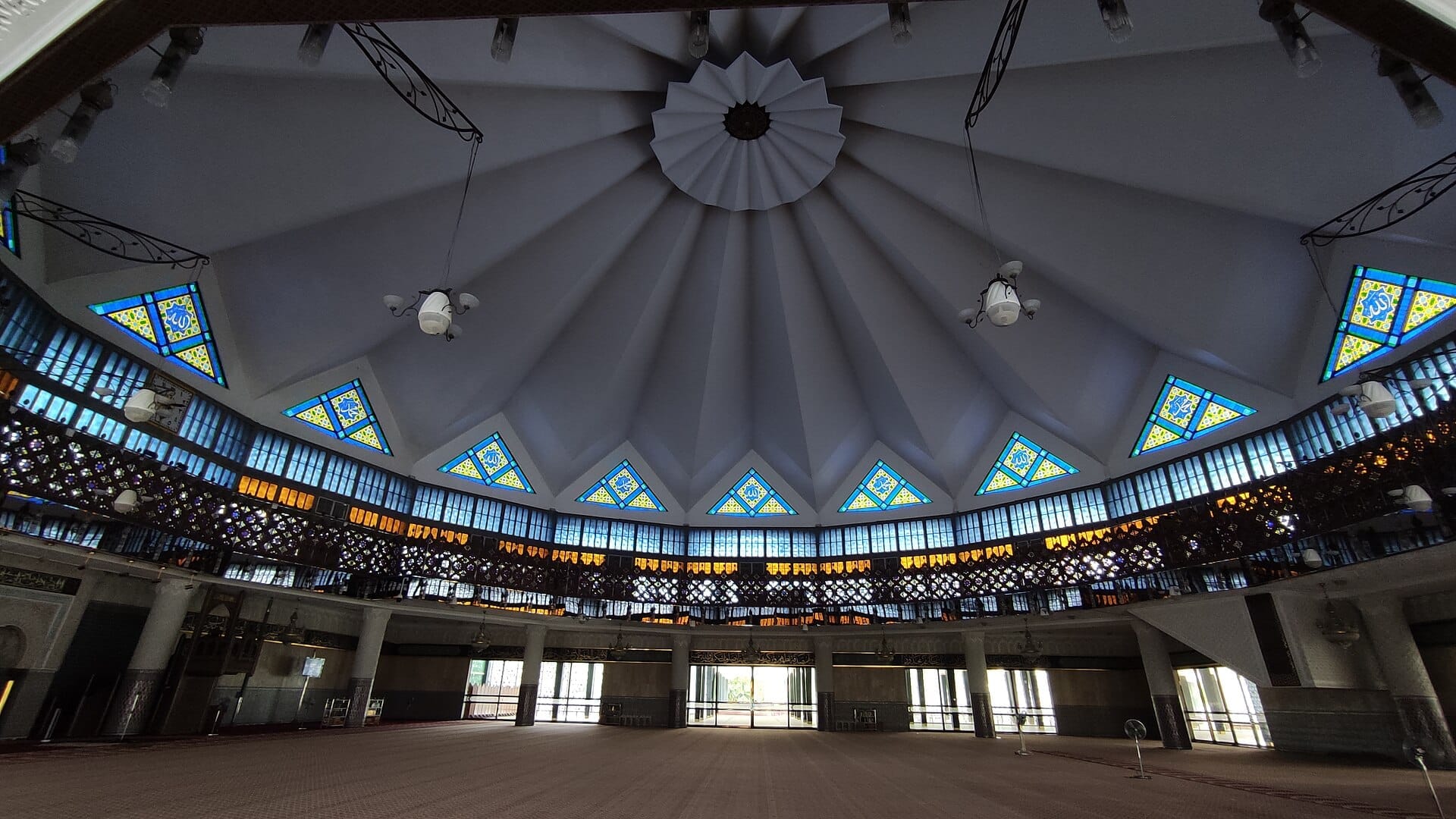
The first thing that catches your eye from the road is the roof: a 16-pointed star-shaped concrete canopy that hovers over the main prayer hall, representing Malaysia's 13 states and the federal government. It rises to a single folded point rather than the conventional dome, giving the mosque a silhouette unlike almost anything else in the city. The 73-meter minaret stands separately, a clean concrete spire that punctuates the surrounding green space.
The interior of the main prayer hall is reserved for Muslim worshippers. Non-Muslim visitors are guided through the outer covered walkways, the ablution areas, and the landscaped gardens. These spaces are more substantial than they sound. The colonnaded outer halls are shaded and quiet, lined with geometric tile work and latticed screens that filter light into shifting patterns across the floor. The acoustic character of the space changes noticeably as you move from the open air into the covered passages.
The rose garden and the reflecting pool to the grounds' edge are worth taking slowly. In the early morning, before tour groups arrive, the garden is almost silent. The low-angle light catches the water and the white concrete differently than it does in the flat midday glare. If photography is your priority, this is a strong argument for arriving at opening time.
💡 Local tip
Photography of the exterior, gardens, and covered walkways is generally permitted. Photographing worshippers in prayer or pointing a camera into the main prayer hall is not. When in doubt, lower the camera and ask.
Tickets & tours
Hand-picked options from our booking partner. Prices are indicative; availability and final rates are confirmed when you complete your booking.
Private Taman Negara day trip from Kuala Lumpur with lunch
From 85 €Instant confirmationFree cancellationTaman Negara jungle tour
From 182 €Instant confirmationFree cancellationPetronas Twin Towers and Kuala Lumpur Tower observation deck tickets
From 34 €Kuala Lumpur city and Batu Caves tour
From 41 €Instant confirmationFree cancellation
Dress Code and Access for Non-Muslim Visitors
The dress code here is enforced, not suggested. Both men and women are required to dress modestly: covered shoulders, covered legs to below the knee, and no shorts. Women are required to cover their hair. If you arrive underprepared, robes are available to borrow free of charge at the entrance — a long blue or maroon garment that covers most of the body. Many visitors use these regardless, finding them comfortable in the heat. Remove your shoes before entering the carpeted areas.
Non-Muslim visitors enter through a designated side entrance rather than the main gate used by worshippers. Staff at the entrance are accustomed to tourists and will direct you clearly. The visit is self-guided within the permitted areas, though information panels in English explain the architectural features and the mosque's history.
⚠️ What to skip
Friday midday prayers draw very large crowds. Visiting on a Friday is possible, but the non-Muslim visiting window will be shorter, and the surrounding streets are significantly more congested between approximately 12:00 PM and 2:00 PM.
Historical and Cultural Context
Masjid Negara was built between 1963 and 1965, designed by a team of three architects from the Public Works Department. The brief was to create a national mosque that reflected a newly independent Malaysia's values, not simply to transplant a Middle Eastern style onto Malaysian soil. The 18-pointed star motif, the folded roof, and the use of open-plan tropical landscaping were all deliberate architectural choices.
The mosque sits in the Lake Gardens district, the same green corridor that contains the KL Bird Park, the Perdana Botanical Gardens, and the Islamic Arts Museum. This clustering was intentional: the Lake Gardens area was developed as Kuala Lumpur's civic and cultural lungs, and Masjid Negara anchors its southeastern edge. Understanding this geography makes the mosque feel less like a standalone stop and more like part of a larger urban idea.
The nearby Islamic Arts Museum Malaysia is a natural pairing with Masjid Negara. Where the mosque provides architectural and spiritual context, the museum provides historical and artistic depth. The two are roughly a 10-minute walk apart through the gardens.
How to Get There and When to Go
The most practical transit option is the KTM Komuter or LRT to Kuala Lumpur station, followed by a short walk or a Grab ride. The Pasar Seni LRT station on the Kelana Jaya Line is also walkable if you are comfortable in the heat, roughly 15 minutes through the older city streets. Coming from the KLCC area, a Grab takes around 10-15 minutes depending on traffic.
If you are planning a wider day in this part of the city, combine Masjid Negara with the Perdana Botanical Gardens and the KL Bird Park, both of which are within easy walking distance. The Lake Gardens district rewards a half-day or full-day approach rather than a quick drop-in.
The best time to visit is weekday mornings, between 9:00 AM and 11:00 AM. The light is good, the crowds are thin, and the heat has not yet peaked. Avoid visiting immediately before prayer times if you want uninterrupted access. Visiting during Ramadan is a different experience entirely: the atmosphere is more charged and the mosque is more active in the evenings, though non-Muslim visitor access may be more limited.
💡 Local tip
Wear comfortable shoes you can slip on and off easily. You will be removing them at least once, possibly twice, as you move between covered and uncovered sections. Flip-flops or slip-on sandals save time and frustration.
Is It Worth the Visit?
For travelers who engage with architecture or want to understand Malaysia beyond its shopping malls and food courts, Masjid Negara is genuinely rewarding. The building is less photographed than the Petronas Towers but arguably more interesting to stand inside, where the scale, the materials, and the quality of light are felt rather than just seen from a distance.
Visitors who struggle with religious dress codes or who are looking for a high-energy, interactive experience will find the atmosphere too subdued. This is a working mosque, and the expectation of quiet and respectful behavior is real. The visit requires a degree of physical effort (walking, removing shoes, wearing robes in humidity), and the areas accessible to non-Muslims are limited.
If you are already planning time in the Lake Gardens area, adding Masjid Negara costs nothing and takes less than 90 minutes. If you are crossing the city specifically for this, consider combining it with other attractions nearby to make the journey worthwhile. A well-planned Kuala Lumpur itinerary can fold in Masjid Negara as part of a broader cultural morning.
Insider Tips
- Arrive within the first 30 minutes of opening. The gardens and outer walkways are essentially empty before 9:30 AM, and the quality of early light on the white concrete is noticeably better than the flat midday sun.
- The borrowed robes are clean and practical, but if you are sensitive to heat, wearing loose, full-length clothing from home keeps you more comfortable and speeds up entry.
- The mausoleum of Malaysia's first Prime Minister, Tunku Abdul Rahman, is located within the mosque grounds. It is easy to miss if you follow the standard tourist walkway, but worth seeking out for context on the mosque's historical significance.
- If you visit during the call to prayer (azan), pause and listen. The sound carries across the gardens and provides one of the more atmospheric moments available anywhere in Kuala Lumpur at no cost.
- The mosque is quieter and more accessible on weekday mornings than on weekends, when domestic tourism peaks. Saturday afternoons in particular can feel crowded near the entrance.
Who Is Masjid Negara For?
- Architecture and design travelers who want to engage with mid-century modernist religious buildings
- Culturally curious visitors seeking genuine insight into Islam's role in Malaysian national identity
- Travelers building a Lake Gardens half-day combining the gardens, bird park, and museum
- Budget travelers: free entry with no hidden costs makes this an easy decision
- Photographers looking for strong geometric forms and interesting light in the early morning
Nearby Attractions
Other things to see while in Lake Gardens:
- Islamic Arts Museum Malaysia
The Islamic Arts Museum Malaysia holds one of the largest collections of Islamic art and artifacts in Southeast Asia, spread across two levels of galleries beneath ornate Ottoman-inspired domes. Located near the Lake Gardens in Kuala Lumpur, it rewards visitors with genuine depth — from intricate Quranic manuscripts to architectural scale models of the world's great mosques.
- KL Bird Park
Spread across 20.9 acres in the Lake Gardens, KL Bird Park is home to more than 3,000 birds from over 200 species, most of them flying freely beneath a vast netted canopy. It rewards early visitors with active feeding, close encounters, and relative quiet before midday crowds arrive.
- KL Butterfly Park
The KL Butterfly Park in Lake Gardens is one of the largest enclosed butterfly parks in the world, housing over 5,000 butterflies from 120-plus species in a lush, landscaped garden. It is a rare urban space where nature takes over completely, and the experience shifts noticeably depending on the time of day you arrive.
- National Museum Malaysia
The National Museum Malaysia (Muzium Negara) is the country's foremost public history museum, tracing Malaysia's civilizations, colonial era, and path to independence. Housed in a landmark 1963 building near the Lake Gardens, it offers four permanent galleries that cover everything from early kingdoms to modern nationhood.