Kwai Chai Hong: Chinatown's Laneway That Time Forgot (Then Restored)
Kwai Chai Hong is a narrow back alley in Kuala Lumpur's Chinatown that has been transformed into an open-air heritage experience. Murals, bronze sculptures, and restored shophouse facades recreate the sights and textures of 1950s Cantonese urban life. It is compact, atmospheric, and one of the most photographed corners of Petaling Street's neighbourhood.
Quick Facts
- Location
- Off Lorong Panggung, Chinatown, Kuala Lumpur
- Getting There
- Pasar Seni LRT/MRT/Monorail station, 5-7 minute walk
- Time Needed
- 30 to 60 minutes
- Cost
- Free to enter
- Best for
- Photography, heritage walks, cultural curiosity
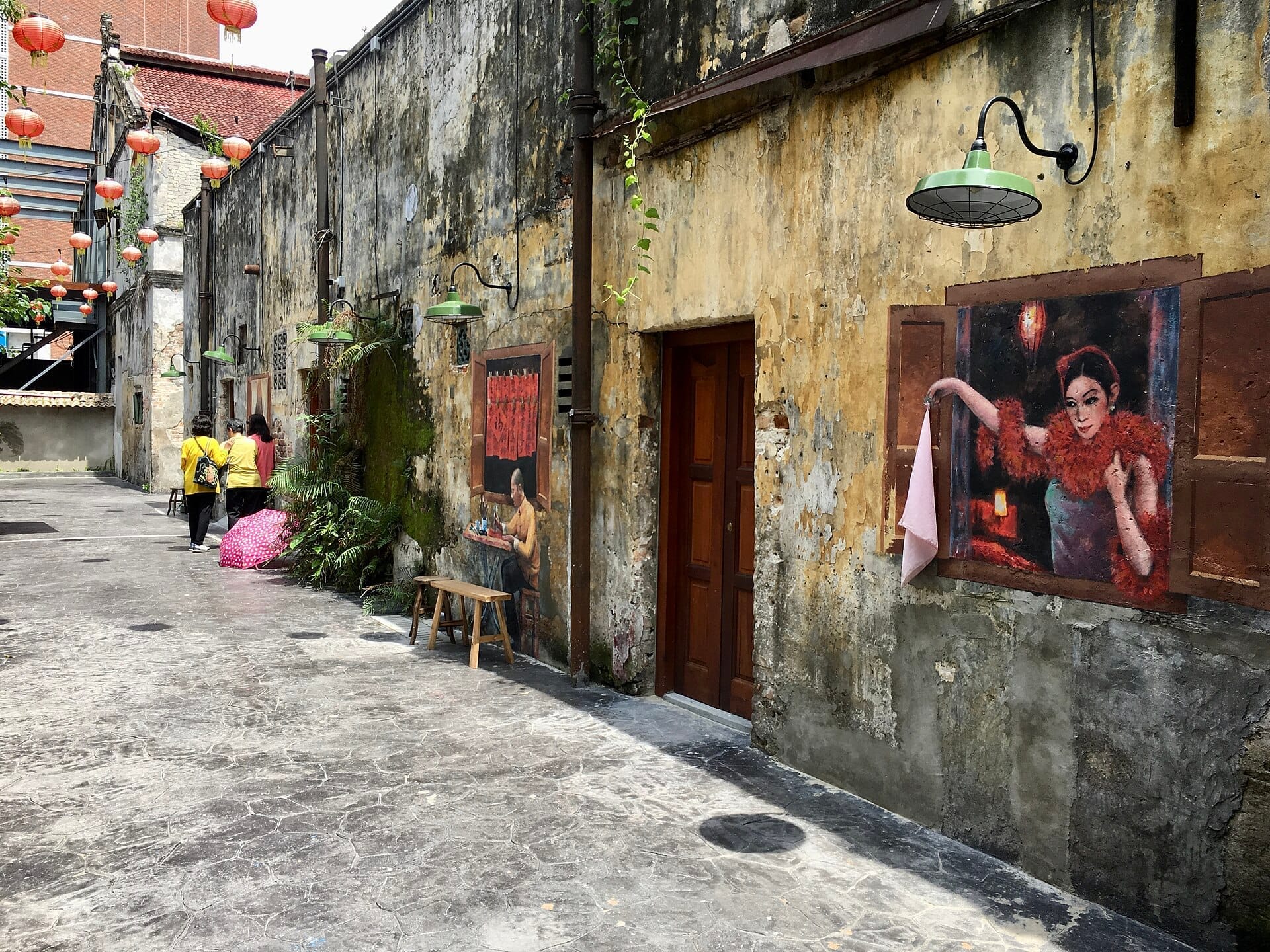
What Is Kwai Chai Hong?
Kwai Chai Hong translates loosely from Cantonese as 'Ghost Child Lane' or 'Little Boy's Lane', a name that carries the faint folklore of old Chinatown. In practice, the alley sits tucked between Lorong Panggung and Jalan Petaling, a slender corridor that for decades was little more than a service passage behind the shophouses of Kuala Lumpur's historic commercial core. What visitors find today is something quite different: a carefully curated streetscape designed to evoke mid-20th century Cantonese community life in Malaya.
The project was developed by the owners of the surrounding heritage hotel and shophouse complex, and it opened to the public in 2019. The design team commissioned murals painted directly onto the old brick walls alongside bronze sculptures depicting everyday characters from the 1950s: a barber, a letter writer, children playing five stones, a trishaw rider. Every figure is rendered at human scale, which gives the alley a peculiar quality. You walk among the sculptures as if entering a still photograph of a vanished neighbourhood.
💡 Local tip
Arrive before 9am or after 6pm for the best light and the fewest people. The laneway is narrow enough that a single tour group can fill it completely during peak afternoon hours.
The Walk Through the Alley
The alley is short, perhaps 80 to 100 metres end to end, and it opens at both Lorong Panggung and a secondary lane near Jalan Petaling. Most visitors enter from the Lorong Panggung side, where a cluster of restored shopfronts and a coffee stall signal the beginning of the experience. The floor is a mix of original concrete and reclaimed tiles, slightly uneven in places, and the air carries the damp, faintly mineral smell that old Kuala Lumpur laneways tend to hold regardless of the weather.
Progress along the alley is naturally slow. The sculptures are positioned at intervals and designed to invite interaction: sitting beside the barber on his stool, crouching next to the children at play. The painted murals behind them are detailed, depicting grocery stalls stacked with enamel containers, rattan furniture under ceiling fans, and the general clutter of postwar urban life. The colour palette is deliberately faded, dusty ochres and weathered blues that blend with the actual aged plaster of the walls.
At one end there is a small kopitiam-style cafe operating out of a restored ground-floor unit. It serves kopi (local white coffee), teh tarik, and a short menu of traditional snacks. The wooden furniture, enamelware cups, and manually operated ceiling fans are period-accurate, or close enough that the aesthetic holds. This is not just a photo set. You can actually sit and drink coffee in a space that feels genuinely rooted in what it is referencing.
Tickets & tours
Hand-picked options from our booking partner. Prices are indicative; availability and final rates are confirmed when you complete your booking.
Petronas Twin Towers and Kuala Lumpur Tower observation deck tickets
From 34 €Private Taman Negara day trip from Kuala Lumpur with lunch
From 85 €Instant confirmationFree cancellationKuala Lumpur city and Batu Caves tour
From 41 €Instant confirmationFree cancellationKuala Lumpur city exploration private half-day tour
From 42 €Instant confirmationFree cancellation
Morning vs. Evening: How the Atmosphere Changes
The laneway behaves very differently depending on the hour. In the morning, roughly 8am to 10am, the kopitiam is active, locals occasionally pass through on foot, and the light enters from the open ends of the alley at a low angle, throwing long shadows across the sculptures and giving the murals a warm, textured quality. It is quieter than at any other time, and the sounds from the surrounding Chinatown market stalls carry faintly into the space without overwhelming it.
By late morning and through the afternoon, footfall increases significantly. Weekends attract the largest crowds, particularly between 11am and 3pm, when the combination of social media attention and proximity to the Petaling Street market draws tour groups and day-trippers. The alley becomes genuinely crowded during these windows, and patience is required to photograph any sculpture without other visitors in frame.
Evening brings a third character to the space entirely. The laneway is lit by warm string lights and period-style lamps after dark, and the surrounding kopitiam and small food stalls extend their hours. The crowd thins again after 7pm, and the artificial lighting gives the murals a deeper, more theatrical quality. This is arguably the most evocative time to visit if you are willing to sacrifice natural light for atmosphere.
ℹ️ Good to know
The laneway is open-access daily from early morning to late evening, but the kopitiam and individual shops within the complex have their own operating hours. Plan for a visit primarily during daylight or early evening for the full experience.
Historical and Cultural Context
The back lanes of Petaling Street have been part of Kuala Lumpur's urban fabric since the late 19th century, when Chinese merchants, many of them Cantonese and Hokkien settlers, built the original shophouse rows that still define the streetscape today. These alleys served practical functions: deliveries, waste collection, informal trade, and in some periods, more shadowed activities that came with overcrowded urban communities. Kwai Chai Hong's name itself points to this ambiguous history, referencing stories of spirits and street children that were part of the oral culture of old Chinatown.
The restoration of this particular alley sits within a broader pattern of heritage tourism development in Chinatown Kuala Lumpur, where private investment has increasingly sought to monetise the neighbourhood's colonial-era architecture and cultural memory. Kwai Chai Hong is honest about this: it is a curated experience rather than a living community space. The 1950s depicted here were a specific and difficult era in Malayan history, marked by the Emergency period, and the installation chooses to focus on the texture of daily life rather than its politics. That is a deliberate editorial decision, and visitors who understand the context will find it worth reflecting on.
For a broader survey of Chinatown's older structures and street life, Petaling Street Market and Central Market are both within walking distance and provide a less staged sense of the neighbourhood's ongoing commercial character.
Photography and Practical Notes
Kwai Chai Hong is designed explicitly for photography, and that is both its strength and its limitation. The compositions are pre-thought: each sculpture is placed against a corresponding mural, and the sightlines are clean. A standard smartphone camera will produce excellent results without any specialist technique. The challenge is timing rather than framing. Weekend afternoons will test your patience considerably if you want uncluttered shots.
For those visiting with a camera rather than a phone, the low-light conditions in certain sections of the alley reward a fast lens. The warm evening lighting also creates a useful balance between artificial illumination and the residual ambient light from the surrounding streets. A tripod is not strictly necessary, but useful for longer exposures if you want to capture motion blur from passing foot traffic.
Accessibility is limited by the alley's width and uneven floor surface. The lane is navigable on foot without significant difficulty, but wheelchair access is not guaranteed throughout its full length. Visitors with mobility considerations should enter from both ends to assess which sections are accessible before committing to the full walk.
⚠️ What to skip
Kwai Chai Hong can get extremely crowded on weekend afternoons, particularly during public holidays. If you are visiting primarily for photography, a weekday morning visit is strongly recommended.
Getting There and What to Combine
The most direct approach is via Pasar Seni station, served by the Kelana Jaya LRT line and Ampang/Sri Petaling LRT line, the Kajang MRT line, and the KL Monorail. From the station, Kwai Chai Hong is a five to seven minute walk through the edges of Chinatown, passing the covered walkways of Jalan Hang Kasturi before turning into Lorong Panggung. The route is walkable even in moderate rain, as much of it passes under covered five-foot ways.
A logical half-day itinerary pairs Kwai Chai Hong with the nearby Masjid Jamek, one of the city's oldest mosques, and the River of Life promenade along the confluence of the Klang and Gombak rivers. These three stops can be covered comfortably in two to three hours on foot. For a full day in the area, consider extending toward Merdeka Square and the colonial civic architecture around it.
Parking in the Petaling Street area is available in several public car parks nearby, but traffic congestion around Chinatown during weekends makes public transport the far more practical choice for most visitors.
Is Kwai Chai Hong Worth Your Time?
For most visitors, yes, but with realistic expectations. This is not a museum with extensive interpretive content, and it is not a market with things to buy or eat at length. It is a well-executed streetscape installation that takes roughly 30 to 45 minutes to explore properly, including a coffee stop. The quality of the artwork and the thoughtfulness of the spatial design make it more than a simple photo backdrop, but less than a comprehensive heritage experience.
Visitors who appreciate urban history, documentary photography, or the visual texture of old Chinese-Malay commercial architecture will find it genuinely rewarding. Those looking for interactive exhibits, substantial food options, or a longer standalone activity may find it too brief. Think of it as one piece of a Chinatown morning rather than a destination in itself, and it is consistently satisfying.
Insider Tips
- The kopitiam inside the complex serves one of the better cups of traditional kopi in the Chinatown area. Order kopi-o (black, no sugar) or kopi-C (with evaporated milk) to get the most authentic preparation.
- Walk the alley in both directions. The murals and sculptures are designed to be read left-to-right from the Lorong Panggung entrance, but many details are only visible clearly from the opposite angle.
- Look up as well as ahead. Some of the upper-wall paintings and decorative details on the restored shophouse facades are easily missed by visitors focused on the bronze sculptures at ground level.
- Weekday mornings between 8am and 10am offer the closest thing to a private visit. Foot traffic is minimal, the coffee stall is open, and the light from the eastern end of the alley is at its most useful for photography.
- The alley connects through to secondary lanes that lead toward Jalan Petaling. Taking time to explore the surrounding back streets reveals unrenovated sections of Chinatown that are, in many ways, more authentic than the restored lane itself.
Who Is Kwai Chai Hong For?
- Photography enthusiasts looking for a composed, atmospheric subject with cultural depth
- Travellers with limited time who want a concentrated dose of heritage character without a full museum visit
- Couples or small groups who enjoy slow, exploratory walks through urban spaces
- History-minded visitors interested in the material culture of postwar Malayan Chinese communities
- Coffee drinkers who want context with their kopi
Nearby Attractions
Other things to see while in Chinatown Kuala Lumpur:
- Central Market
Housed in a powder-blue Art Deco building with the current building completed in 1937, Central Market is Kuala Lumpur's most concentrated showcase of Malaysian handicrafts, traditional textiles, and cultural souvenirs. It sits on the edge of Chinatown and draws everyone from bargain hunters to serious collectors of regional art.
- Jalan Masjid India
Jalan Masjid India is Kuala Lumpur's primary South Asian commercial corridor, running through the heart of the city's Indian-Muslim district. It packs sari boutiques, textile merchants, spice vendors, street food hawkers, and gold jewellers into a stretch that rewards slow, unhurried exploration. The surrounding lanes are just as interesting as the main street.
- Petaling Street Market
Petaling Street Market sits at the heart of Kuala Lumpur's Chinatown and has been a trading hub since the late 19th century. It draws everyone from fruit vendors and herbal medicine sellers to tourists hunting replica goods, making it one of the city's most layered and honest street experiences.
- Sri Mahamariamman Temple
Sri Mahamariamman Temple is Kuala Lumpur's oldest and most ornate Hindu temple, founded in 1873 and rebuilt over decades into a tower of intricate South Indian sculpture. Set on Jalan Tun H.S. Lee in Chinatown, it remains a living place of daily worship — not a tourist attraction dressed up for visitors.