Sri Mahamariamman Temple: KL's Oldest Hindu Shrine in the Heart of Chinatown
Sri Mahamariamman Temple is Kuala Lumpur's oldest and most ornate Hindu temple, founded in 1873 and rebuilt over decades into a tower of intricate South Indian sculpture. Set on Jalan Tun H.S. Lee in Chinatown, it remains a living place of daily worship — not a tourist attraction dressed up for visitors.
Quick Facts
- Location
- 163 Jalan Tun H.S. Lee, Chinatown, Kuala Lumpur
- Getting There
- Pasar Seni LRT/MRT station (~5 min walk south)
- Time Needed
- 30–45 minutes
- Cost
- Free entry (shoe storage fee may apply)
- Best for
- Architecture, Hindu culture, photography, Thaipusam context
What Sri Mahamariamman Temple Actually Is
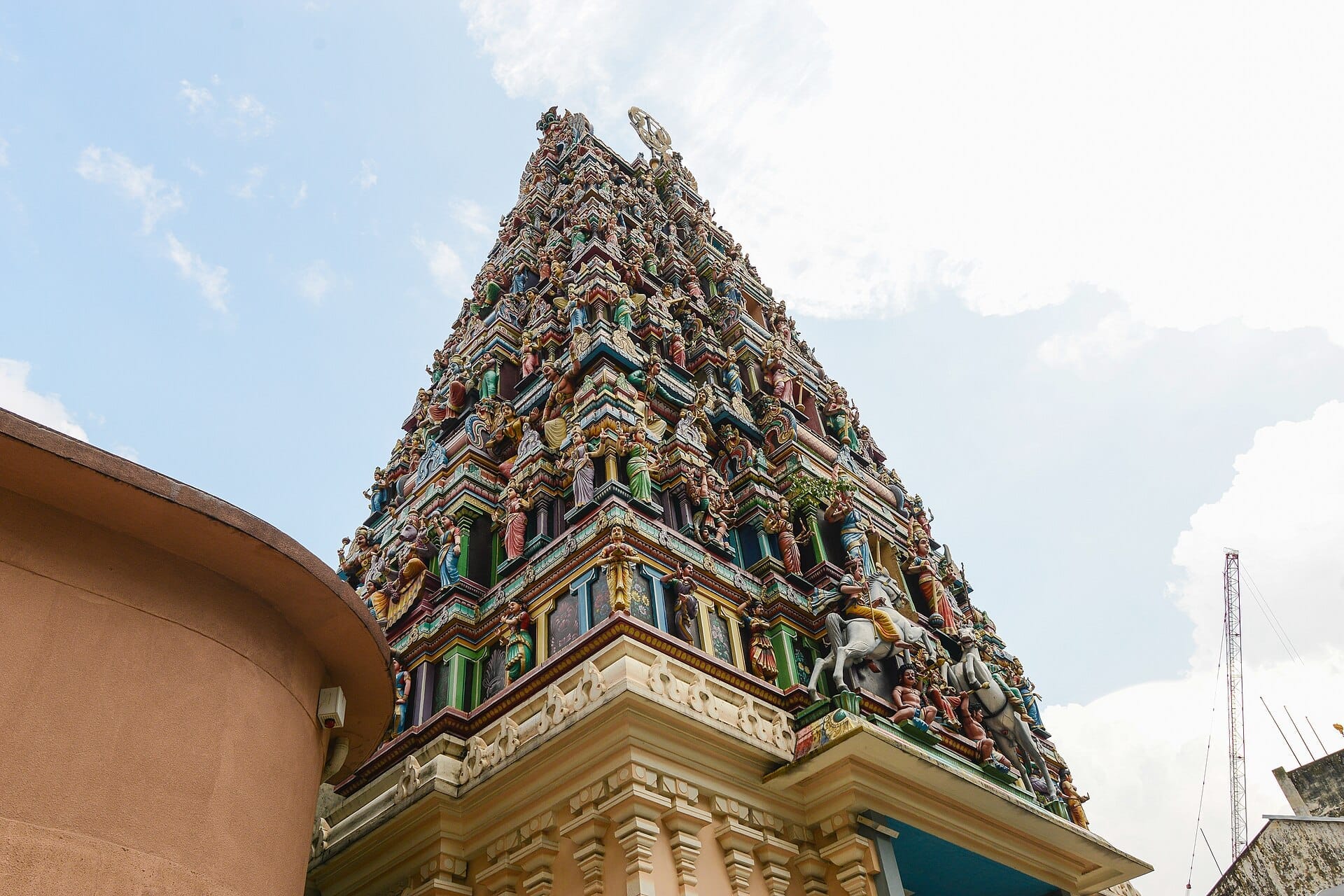
Founded in 1873 by Tamil immigrant K. Thamboosamy Pillai, Sri Mahamariamman Temple is the oldest Hindu temple in Kuala Lumpur. What began as a modest shrine serving the city's early South Indian labor community has grown, through successive rounds of renovation, into one of the most architecturally elaborate Hindu temples in Southeast Asia. The main tower, a towering South Indian gopuram (entrance tower), rises approximately 22.9 meters and is encrusted with hundreds of sculpted Hindu deities, celestial figures, and decorative motifs rendered in vivid color.
The temple is dedicated to Sri Mahamariamman, a South Indian goddess associated with rain, fertility, and healing. Her presence here was not incidental: Tamil laborers working on early colonial infrastructure prayed at temples like this one for protection and community. That history is still tangible in the building's bones, even if the exterior today gleams with gold leaf and polished stonework.
ℹ️ Good to know
The temple is a functioning place of daily Hindu worship. Visitors are welcome but should observe temple protocols: remove shoes before entering (storage available near the entrance), dress modestly covering shoulders and knees, and avoid disrupting active prayer ceremonies.
The Gopuram: Reading the Tower
The first thing most visitors do is stop on the pavement opposite and tilt their head back. The gopuram dominates the streetscape in a way that feels improbable given the narrow lane and the surrounding shophouses. Its five tiers are packed with sculptural detail: manifestations of Mariamman flanked by attendants, mythological animals, decorative garlands, and painted figures that shift color in different light.
This style of tower, Dravidian in origin, follows a sculptural logic where each tier represents a cosmological level, with the deity's domain growing more abstract and powerful as you move upward. You do not need to know Hindu iconography to appreciate the workmanship, but understanding that framework gives the visual complexity a coherent structure rather than looking like ornamentation for its own sake.
Morning light, roughly between 8am and 10am, hits the gopuram directly and makes the gold accents on the upper tiers glow against the blue sky. This is the best window for exterior photography. By midday, harsh overhead sun flattens the relief work and creates unflattering shadows across the sculpted faces. Late afternoon works well too, with softer light from the west catching the side panels.
Tickets & tours
Hand-picked options from our booking partner. Prices are indicative; availability and final rates are confirmed when you complete your booking.
Petronas Twin Towers and Kuala Lumpur Tower observation deck tickets
From 34 €Private Taman Negara day trip from Kuala Lumpur with lunch
From 85 €Instant confirmationFree cancellationKuala Lumpur city and Batu Caves tour
From 41 €Instant confirmationFree cancellationKuala Lumpur city exploration private half-day tour
From 42 €Instant confirmationFree cancellation
Inside the Temple: Atmosphere and Layout
Stepping through the entrance and removing your shoes on the warm stone threshold changes the experience significantly. The interior courtyard is cooler than the street, shaded by the structure itself, and carries the faint smell of incense smoke and fresh jasmine flowers that devotees bring as offerings. The floor is smooth polished stone, noticeably cold underfoot even on a hot day.
The inner sanctum houses the main deity, Sri Mahamariamman, adorned with gold ornaments and fresh floral garlands. Smaller shrines dedicated to Ganesh, Murugan, and other deities line the perimeter. On weekday mornings, you may find small groups of devotees moving between shrines, offering coconuts, incense, or flowers, performing pradakshina (circumambulation) in a quiet and unhurried rhythm. On Friday evenings and festival days, the temple fills with worshippers and the atmosphere shifts to something louder and more charged.
Non-Hindu visitors are generally welcome in the outer courtyard and can observe the main shrine from a respectful distance. Photography inside should be done quietly and without flash. If a puja (ritual prayer ceremony) is in progress, give the space to devotees and observe from the periphery.
💡 Local tip
The temple also serves as the ceremonial starting point for the annual Thaipusam procession, one of KL's most dramatic events. Silver chariots are stored here and paraded to Batu Caves each year during the festival, typically in late January. Visiting during Thaipusam requires early arrival — before 6am — to get any access at all.
The Chinatown Context: A Temple Between Worlds
Sri Mahamariamman Temple sits on Jalan Tun H.S. Lee, a street that reflects Kuala Lumpur's layered history: Chinese shophouses, a decades-old textile district, and Hindu devotion all compressed into a few hundred meters. The Petaling Street market is less than three minutes on foot to the west, while the colonial-era Masjid Jamek sits a short walk north. Few places in KL make the city's multiethnic origins more legible.
The neighborhood around the temple is one of the older quarters of the city, and the street-level detail rewards slow walking. Look for the old tiled facades on the shophouses, the dried-goods merchants, and the occasional incense seller whose business depends partly on foot traffic to the temple. This is not a sanitized heritage zone but a working district with its own commercial logic.
If you are spending time in this part of the city, pairing Sri Mahamariamman with Central Market to the northwest and a walk through KL's Chinatown makes for a half-day that covers three centuries of the city's history without significant travel time.
Practical Walkthrough: Getting There and Moving Around
The most straightforward approach is from Pasar Seni station, served by both the Kelana Jaya LRT line and the Putrajaya MRT line. Exit toward Jalan Cheng Lock, then walk south along Jalan Tun H.S. Lee for roughly five minutes. The gopuram is unmistakable. For full transport context across the city, the getting around Kuala Lumpur guide covers all transit options in detail.
The temple is open daily from approximately 6am to 9pm, though these hours may shift during major festivals. There is no entry fee for the temple itself. A small charge applies if you use the shoe storage service at the entrance, which is recommended over leaving footwear on the street.
Accessibility is limited: the entrance has a small step, and the inner courtyard floor is uneven stone. Visitors using wheelchairs or those with mobility difficulties should assess this at the entrance before committing.
⚠️ What to skip
Avoid visiting during major Hindu festivals if you simply want a quiet look at the architecture. During Thaipusam and other high-attendance events, the temple and surrounding streets are extremely crowded and access to the interior is restricted by the flow of worshippers.
Who Should Reconsider This Stop
Travelers who are primarily looking for a major sightseeing spectacle in the style of a heritage museum may find the temple underwhelming on a quiet weekday. The interior spaces are compact, there are no explanatory panels in English, and the experience is devotional rather than didactic. If you want context and narrative delivered efficiently, this is a place where you will do most of the interpretive work yourself.
Visitors who prefer large outdoor spaces or air-conditioned attractions may also feel this a poor fit with KL's heat. For a contrast in scale, the Batu Caves temple complex — which also has strong Mariamman connections — offers a dramatically different physical environment and includes the famous golden staircase and large cave chambers.
Insider Tips
- Walk to the opposite side of Jalan Tun H.S. Lee for the best unobstructed view of the full gopuram — from directly in front, perspective foreshortens the tower.
- Friday evenings between roughly 7pm and 9pm see the highest number of local worshippers, which makes for a more immersive atmosphere but also tighter movement inside the courtyard.
- The incense sellers and flower vendors positioned near the temple entrance often sell small jasmine garlands for a few ringgit; purchasing one and placing it at a shrine is considered respectful and is welcomed by temple staff.
- If you are visiting during the day, the surrounding block has several old-school kopitiam (coffee shops) where you can sit with a kopi-o and observe the street activity before or after the temple — a useful buffer against the heat.
- The silver chariot used in the Thaipusam procession is sometimes visible inside the temple complex during non-festival months; ask a temple attendant politely if you are curious about viewing it.
Who Is Sri Mahamariamman Temple For?
- Architecture enthusiasts interested in Dravidian gopuram design
- Travelers building a Chinatown heritage walk covering multiple cultural sites
- Photographers working in the 8–10am window for optimal gopuram light
- Visitors wanting to understand KL's Tamil immigrant history and community
- Anyone attending or researching the Thaipusam festival and its ceremonial origins
Nearby Attractions
Other things to see while in Chinatown Kuala Lumpur:
- Central Market
Housed in a powder-blue Art Deco building with the current building completed in 1937, Central Market is Kuala Lumpur's most concentrated showcase of Malaysian handicrafts, traditional textiles, and cultural souvenirs. It sits on the edge of Chinatown and draws everyone from bargain hunters to serious collectors of regional art.
- Jalan Masjid India
Jalan Masjid India is Kuala Lumpur's primary South Asian commercial corridor, running through the heart of the city's Indian-Muslim district. It packs sari boutiques, textile merchants, spice vendors, street food hawkers, and gold jewellers into a stretch that rewards slow, unhurried exploration. The surrounding lanes are just as interesting as the main street.
- Kwai Chai Hong
Kwai Chai Hong is a narrow back alley in Kuala Lumpur's Chinatown that has been transformed into an open-air heritage experience. Murals, bronze sculptures, and restored shophouse facades recreate the sights and textures of 1950s Cantonese urban life. It is compact, atmospheric, and one of the most photographed corners of Petaling Street's neighbourhood.
- Petaling Street Market
Petaling Street Market sits at the heart of Kuala Lumpur's Chinatown and has been a trading hub since the late 19th century. It draws everyone from fruit vendors and herbal medicine sellers to tourists hunting replica goods, making it one of the city's most layered and honest street experiences.