Batu Caves: The Limestone Giant North of Kuala Lumpur
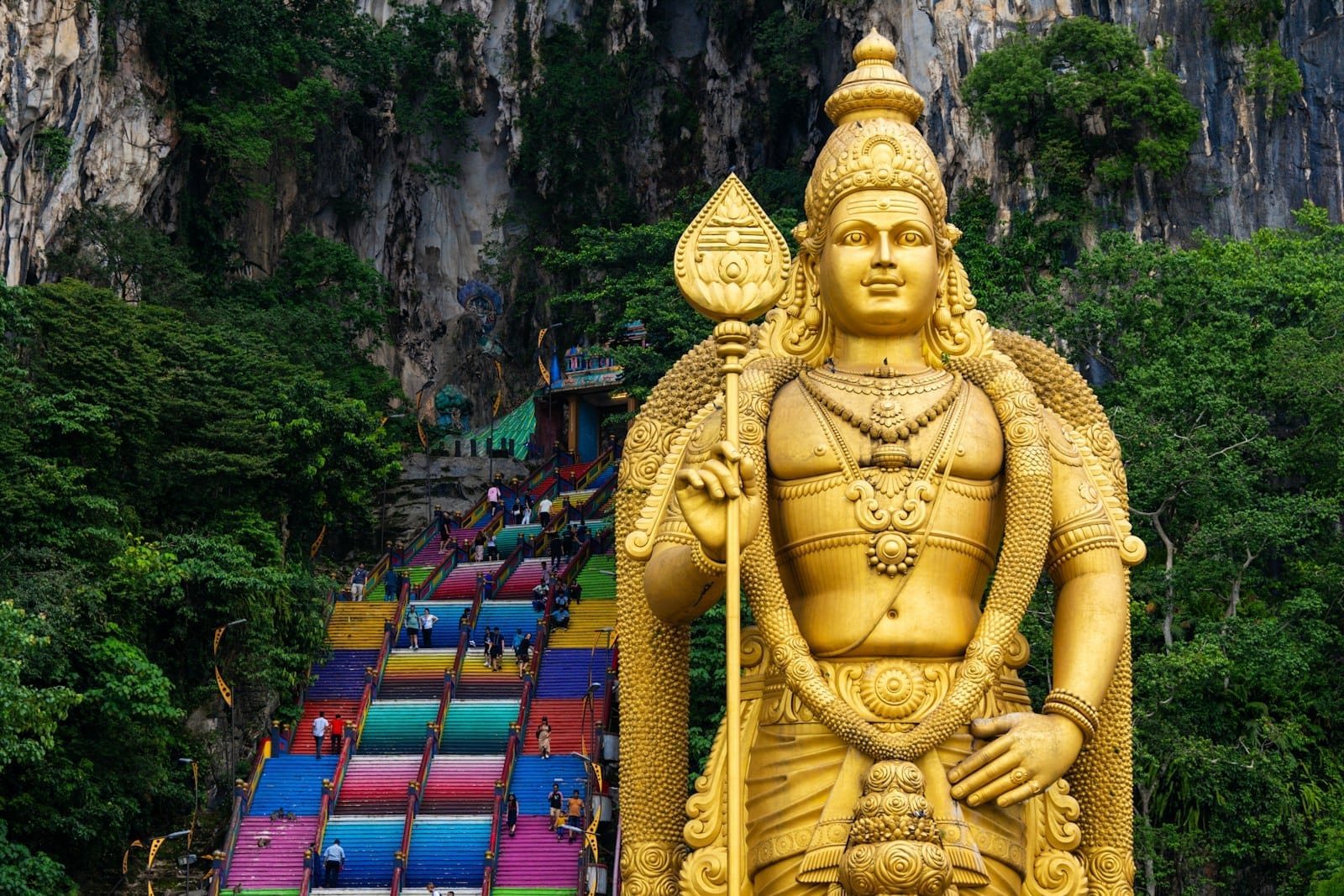
Batu Caves is a series of ancient limestone caverns set inside a 400-million-year-old hill, crowned by a 43-metre golden statue of Lord Murugan and reached by 272 rainbow-coloured steps. It is the most significant Hindu shrine outside India and one of Southeast Asia's most photographed natural landmarks. Whether you come for the temple rituals, the cave ecology, or simply the spectacle, the site rewards visitors who time their arrival carefully.
Quick Facts
- Location
- Gombak, Selangor, approximately 13 km north of Kuala Lumpur city centre
- Getting There
- KTM Komuter Batu Caves station (Batu Caves line); a 5-minute walk from the station to the entrance
- Time Needed
- 2 to 3 hours for Cathedral Cave and surroundings; add 1 hour for Dark Cave or Ramayana Cave
- Cost
- Cathedral Cave (main cave): free entry. Dark Cave: from RM 35 for the walking tour. Ramayana Cave: RM 10. Dress-code sarongs available to borrow at the entrance
- Best for
- Hindu temple culture, limestone geology, dramatic photography, and family outings that combine nature with religious heritage
What Batu Caves Actually Is
Batu Caves is a limestone outcrop rising about 100 metres above the surrounding Gombak plain. The hill contains a network of caverns, the largest of which, Cathedral Cave, has been a place of Hindu worship since the 1890s when K. Thamboosamy Pillai formally established the Sri Subramaniam temple inside it. The cave's association with the god Murugan, son of Shiva and deity of war and victory, made it the natural home for the Thaipusam festival, which draws over one million pilgrims annually and is one of the largest religious gatherings in the world.
The limestone itself is far older than any human story here. Geologists date the formation to roughly 400 million years ago, making Batu Caves one of the oldest limestone outcrops in Malaysia. Over millennia, rainwater carved the caverns, leaving behind stalactites and columns that still drip and grow today at a rate of about one millimetre per century. The ecology inside supports rare species of cave-adapted invertebrates and several bat colonies that exit at dusk in spiralling columns visible from the car park.
💡 Local tip
Arrive before 8:30 am on weekdays to beat tour groups and enjoy the staircase climb in cooler air. By 10 am, the steps can hold hundreds of visitors simultaneously.
The 272 Steps: What the Climb Is Really Like
The 272-step staircase is the defining physical experience of Batu Caves, and it is steeper than it looks from ground level. The steps were repainted in 2021 in a gradient of yellow, pink, orange, purple, and blue, making the staircase itself one of the most-photographed elements of the site. From below, the Lord Murugan statue frames the base of the steps and the cave mouth frames the top, creating a visual corridor that rewards the effort.
The climb takes most visitors 10 to 15 minutes at a comfortable pace. The steps vary in height and depth, so proper footwear matters: flip-flops work but increase the chance of a stumble on the way down, where the angles are less forgiving. The railing runs continuously on both sides. At roughly the halfway point, the angle eases briefly, giving you a natural rest spot with a clear view back toward the golden statue and, on clear days, the KL skyline beyond.
Long-tailed macaques live on and around the staircase in large numbers. They are accustomed to people and will approach directly if you are holding food, plastic bags, or anything that resembles either. They have been known to snatch sunglasses, water bottles, and phone cases. Keep snacks sealed and bags zipped.
⚠️ What to skip
Do not feed or taunt the macaques. Bites do occur. If a monkey approaches aggressively, do not run — stand still, avoid eye contact, and step aside slowly.
Tickets & tours
Hand-picked options from our booking partner. Prices are indicative; availability and final rates are confirmed when you complete your booking.
Kuala Lumpur city and Batu Caves tour
From 41 €Instant confirmationFree cancellationKuala Lumpur cultural experience with Batu Caves half-day tour
From 21 €Instant confirmationFree cancellationBatu Caves, Bukit Melawati and the fireflies private tour with dinner
From 64 €Instant confirmationFree cancellationBatu Caves Discovery Half-Day Tour
From 22 €Instant confirmationFree cancellation
Inside Cathedral Cave: The Temple in the Rock
The cave chamber at the top of the staircase is enormous: roughly 100 metres tall at its highest interior point with natural skylight shafts punching through the limestone ceiling. Light enters in long columns, catching incense smoke and the fine spray of water seeping through the rock. The air smells of wet stone, coconut oil, and marigold garlands. The temperature inside is noticeably cooler than the staircase, providing immediate relief on a hot day.
Several shrines and sub-temples occupy the cave floor, each tended by priests who conduct puja ceremonies throughout the day. Visitors of all backgrounds are welcome inside, though you should remove shoes before entering any shrine enclosure and behave quietly in active prayer areas. The rituals are genuine daily worship, not a performance — treating the space with that understanding changes the experience considerably.
Photography inside is generally permitted, but using flash near ongoing ceremonies is disrespectful. The natural light streaming through the roof openings is extraordinary between 9 am and noon, when sunbeams cut diagonally across the interior and illuminate the coloured shrine decorations. This is the best window for photography inside Cathedral Cave.
Beyond the Main Cave: Dark Cave and Ramayana Cave
The Dark Cave is the most scientifically significant part of the Batu Caves complex and requires a separate guided tour. The 2-kilometre cave system is managed as a nature reserve, and guides explain the geology and the unique invertebrate species found nowhere else on earth, including trapdoor spiders, cave scorpions, and the Tokuda spider. The walking tour (approximately 45 minutes) covers roughly 800 metres of the cave with good lighting. A more demanding adventure tour explores deeper sections by crawling and climbing.
Ramayana Cave, located to the left of the main staircase, presents the Hindu epic Ramayana through large painted statues set inside a smaller cavern. It is more theatrical than sacred, and the entrance fee is nominal. Families with children tend to find it engaging. The cavern's colourful statues and dramatic lighting create some of the most visually unusual photographs available at the site.
The caves sit within a broader limestone ecosystem that connects to the Perdana Botanical Gardens network of protected green space in the region. For context on other natural and cultural sites worth pairing with Batu Caves, the things to do in Kuala Lumpur guide covers how the caves fit into a broader itinerary.
Thaipusam: When the Site Transforms Completely
Thaipusam is a Tamil Hindu festival that falls on the full moon of the Tamil month Thai, typically in January or February. Batu Caves is the primary destination for Thaipusam in Malaysia, and the scale of the event is difficult to overstate. Devotees carry kavadi, elaborate metal frameworks attached to the body by skewers and hooks, up the 272 steps as an act of penance and devotion. The procession begins from Sri Mahamariamman Temple in Chinatown and covers approximately 15 kilometres through the night.
For context on the starting point of the Thaipusam procession, the Sri Mahamariamman Temple in Chinatown is itself a significant Hindu heritage site worth visiting independently.
Visiting during Thaipusam is a profound and overwhelming experience. The crowd size makes independent movement nearly impossible for long stretches. If you want to witness it, position yourself along the procession route or near the base of the steps before 6 am. The atmosphere, the music, the smell of burning camphor and jasmine, and the extraordinary physical endurance on display make it genuinely unlike anything else in Malaysia. But it is emphatically not a casual tourist spectacle: attend with respect and awareness.
ℹ️ Good to know
During Thaipusam, KTM runs extended hours and additional trains to Batu Caves station. Expect severe crowding on all services. The car parks fill overnight.
Getting There and Practical Logistics
The KTM Komuter Batu Caves line is the simplest way to arrive. Trains depart from KL Sentral and Sentul Timur, and the Batu Caves terminus is a 5-minute walk from the cave entrance. The journey from KL Sentral takes approximately 50 minutes. Service runs from around 6 am to 11:30 pm, with trains roughly every 20 to 30 minutes on weekdays and more frequently on weekends and festival days.
Driving is possible but the car parks fill quickly on weekends and are chaotic during festival periods. Taxis and ride-hailing apps (Grab) can drop you at the site entrance directly. For general guidance on navigating public transport across the city, the getting around Kuala Lumpur guide covers KTM, MRT, and bus options in practical detail.
Dress code is enforced at the cave entrance for entry into shrine areas: shoulders and knees should be covered. Sarongs are available to borrow at no charge near the entrance. Shoes must be removed before entering temple interiors. Light clothing made from natural fibres is comfortable for the climb; synthetic fabrics trap heat and make the steps noticeably more unpleasant than they need to be.
The site has food stalls and small restaurants clustered near the entrance selling Indian-Tamil vegetarian food: idli, dosai, thosai, and various curry dishes. The food is inexpensive, freshly prepared, and genuinely good. There is also a cluster of souvenir shops selling devotional items, brass figurines, and tourist goods of the usual variety.
Honest Assessment: Who Will and Won't Enjoy This
Batu Caves genuinely earns its place on most Kuala Lumpur itineraries. The combination of geological scale, living religious practice, and dramatic visual spectacle is rare anywhere in the world. The main cave is free, accessible by public transport, and requires no special preparation beyond appropriate clothing.
That said, visitors who come expecting a quiet or contemplative experience on a Saturday morning will be disappointed. The site draws large crowds throughout the week, and the macaques, hawkers, and general noise level make it a lively rather than serene destination. Those with limited mobility should know that the 272 steps have no lift or ramp alternative for reaching Cathedral Cave: the upper temple is not wheelchair accessible. The Dark Cave is also not suitable for anyone with claustrophobia or serious mobility limitations.
If you are building a full day around north KL, consider pairing Batu Caves with a visit to the National Museum of Malaysia in the afternoon, or exploring the Islamic Arts Museum Malaysia for a contrasting perspective on the region's religious heritage.
Insider Tips
- The best unobstructed photograph of the Lord Murugan statue and staircase together requires standing back roughly 80 to 100 metres from the base — the wide plaza in front of the entrance gives you this distance. Early morning light hits the statue face-on between 8 and 9 am.
- If you visit on a weekday, particularly Tuesday or Thursday, you may witness morning puja ceremonies inside Cathedral Cave with very few other tourists present. These are active temple rituals, not timed performances, so the timing is approximate.
- The Dark Cave guided tours must be booked at the Dark Cave Education Centre counter on-site. There is no advance online booking. Arrive early on weekends as the daily capacity is limited and the afternoon slots sell out.
- The small Tamil vegetarian restaurants at the base of the hill, rather than the food stalls inside the complex, serve far better food at similar prices. Look for the stalls clustered along the road running parallel to the KTM line.
- Bat colonies exit the caves at dusk in large spiralling formations visible from the entrance plaza. If your schedule allows, arriving in the late afternoon and staying until around 7 pm adds an entirely different ecological dimension to the visit at no extra cost.
Who Is Batu Caves For?
- Travellers interested in Hindu religious culture and temple architecture outside a museum context
- Geology and cave ecology enthusiasts, particularly those who opt for the Dark Cave guided tour
- Photographers seeking dramatic natural light inside a cave setting, best achieved between 9 am and noon
- Families with children who can manage the stair climb and are engaged by cave environments and colourful statuary
- Visitors attending Thaipusam who want to witness one of the largest religious festivals in Southeast Asia firsthand
Nearby Attractions
Combine your visit with:
- Istana Budaya
Istana Budaya is Malaysia's premier performing arts venue, staging everything from grand theatrical productions to classical concerts and traditional dance. Beyond the performances, the building itself is a striking piece of contemporary Malaysian architecture worth seeing up close.
- Kepong Metropolitan Park
Kepong Metropolitan Park is one of Kuala Lumpur's largest and least-touristed green spaces, built around a large lake with forest-edged trails, cycling paths, and open lawns. It draws locals for morning jogs and weekend picnics rather than international visitors, which makes it genuinely worth exploring.
- Little India (Brickfields)
Brickfields is Kuala Lumpur's officially designated Little India, a compact neighbourhood packed with Tamil temples, textile traders, flower-garland sellers, and some of the city's best South Indian vegetarian cooking. It rewards slow walking and curious noses more than any checklist approach.
- Menara KL (KL Tower)
Standing 421 metres tall on Bukit Nanas hill, Menara KL offers one of the clearest panoramic views of Kuala Lumpur's skyline. Less crowded than the Petronas Towers observation deck and with a wider field of vision, it is a serious contender for the city's best high-altitude experience.