Istana Budaya: Inside Kuala Lumpur's National Theatre
Istana Budaya is Malaysia's premier performing arts venue, staging everything from grand theatrical productions to classical concerts and traditional dance. Beyond the performances, the building itself is a striking piece of contemporary Malaysian architecture worth seeing up close.
Quick Facts
- Location
- Jalan Tun Razak, Chow Kit, Kuala Lumpur
- Getting There
- Titiwangsa LRT/MRT/Monorail station, ~10-min walk
- Time Needed
- 1–2 hours (exterior + lobby); 3–4 hours for a full performance
- Cost
- Free to visit exterior and foyer; performance tickets vary by show
- Best for
- Architecture lovers, performing arts fans, cultural travellers
- Official website
- www.istanabudaya.gov.my
What Is Istana Budaya?
Istana Budaya, which translates literally as Palace of Culture, is Malaysia's national theatre and the country's most prestigious performing arts venue. Opened in 1999, the complex on Jalan Tun Razak was built to give Malaysia a dedicated world-class stage for opera, ballet, drama, symphony concerts, and traditional Malay performing arts. Before Istana Budaya existed, major productions were staged in hotel ballrooms or borrowed spaces with inadequate acoustics. The national theatre changed that entirely.
The venue is managed by the Ministry of Tourism, Arts and Culture Malaysia and hosts both local productions from companies like the national theatre troupe as well as internationally touring shows. On any given month, the program might include a Malay opera (Bangsawan), a Broadway touring production, a philharmonic concert, or a contemporary dance showcase. The breadth of programming is genuinely wide for a city of Kuala Lumpur's size.
💡 Local tip
Check the official schedule at istanabudaya.gov.my before your trip. Popular shows sell out weeks in advance. Walk-in tickets for low-demand nights are sometimes available at the box office from one hour before curtain.
The Architecture: A Building Worth Staring At
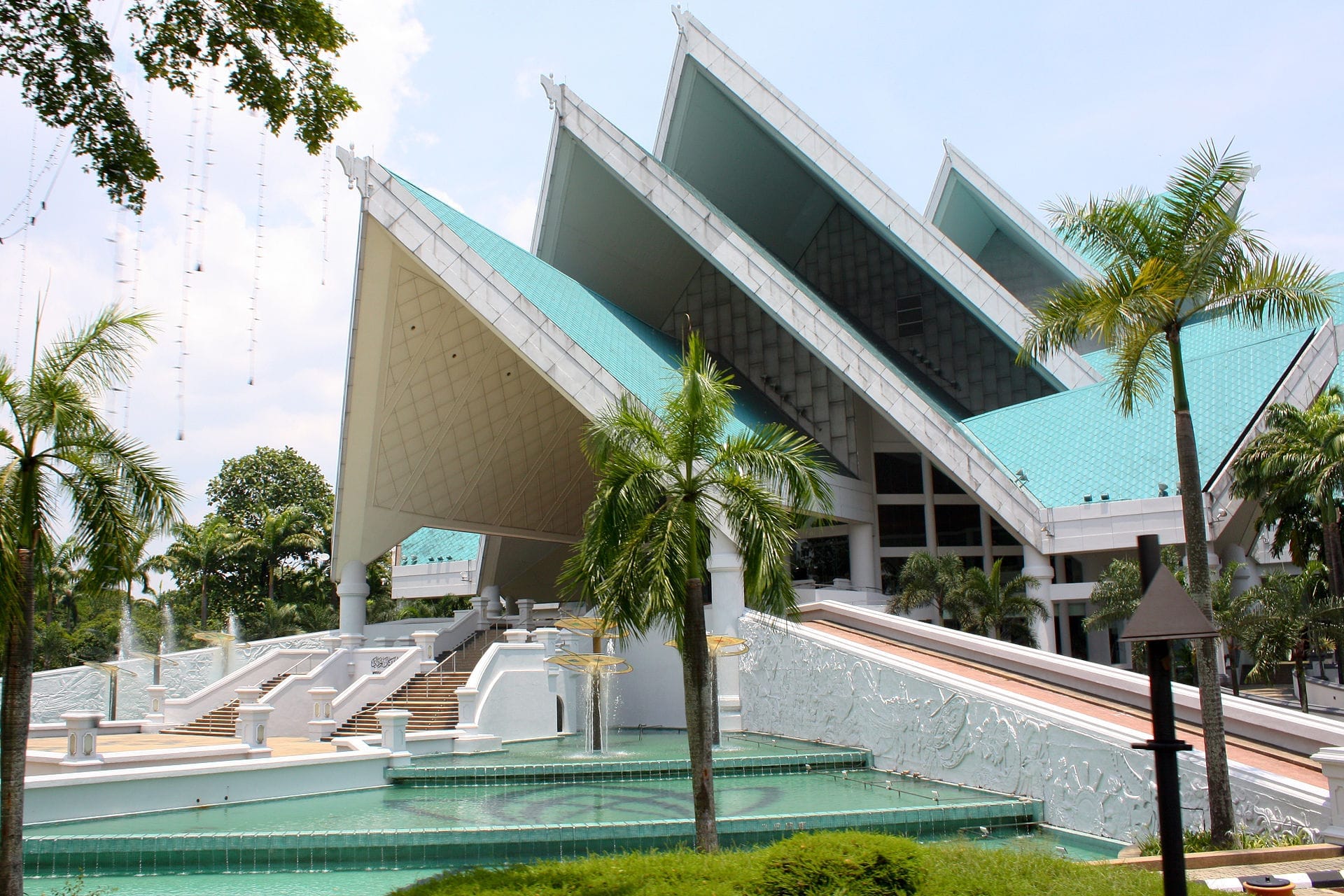
Even if you never catch a performance inside, Istana Budaya earns a look from the outside. The building was designed by Malaysian architect Muhammad Kamar Ya'akub, and it draws heavily on traditional Malay architectural symbolism. The roof is shaped to reference the Sireh Junjung, a ceremonial betel leaf arrangement used in Malay royal and formal occasions. The layered, petal-like panels sweep upward and outward, giving the structure a distinctly organic quality that contrasts with the hard-edged glass towers surrounding it along Jalan Tun Razak.
The building sits on a slightly elevated platform, so approaching from the main gate, you walk up a broad stairway flanked by manicured gardens and reflecting pools. The proportions are designed to feel formal without being cold. At ground level, the facade incorporates intricate geometric motifs drawn from traditional Malay craft patterns, rendered in stone and metal. Up close, the texture of the cladding has a warmth that photographs rarely capture.
At night, when performances are scheduled, the exterior is dramatically lit and the queuing crowds in batik and formal dress add a sense of occasion that daytime visits lack. If you are coming only for the architecture, late afternoon light catches the roof panels particularly well from the south-facing approach path.
ℹ️ Good to know
Photography of the exterior is permitted and encouraged. Interior photography during performances is strictly prohibited. In the lobby before shows, photography is generally allowed but check with staff on the night.
Tickets & tours
Hand-picked options from our booking partner. Prices are indicative; availability and final rates are confirmed when you complete your booking.
Petronas Twin Towers and Kuala Lumpur Tower observation deck tickets
From 34 €Private Taman Negara day trip from Kuala Lumpur with lunch
From 85 €Instant confirmationFree cancellationKuala Lumpur city and Batu Caves tour
From 41 €Instant confirmationFree cancellationKuala Lumpur city exploration private half-day tour
From 42 €Instant confirmationFree cancellation
Inside the Venue: Lobby, Halls, and Scale
The main lobby of Istana Budaya is large enough to feel grand but not so cavernous that it loses atmosphere. The interior continues the traditional Malay design language: carved wooden panels, batik-inspired ceiling patterns, and a colour palette anchored in deep reds, golds, and dark timber. The craftsmanship visible in the lobby woodwork alone is worth a close inspection if you arrive early before a show.
The primary performance hall, the Panggung Sari, seats around 1,408 people and is designed for acoustic performance. The rake of the seating is steep enough that sightlines from most positions are good, though the upper tiers feel distant for intimate productions. For orchestral concerts and large theatrical works, the space works well. There are additional smaller halls used for more experimental or chamber-scale productions.
Non-ticketed visitors can access the lobby and ground floor common areas on most days, though access deepens when there is a performance on. If you arrive without a ticket, you can still walk the gardens, photograph the exterior, and step briefly into the foyer area. Staff are generally helpful about clarifying which spaces are open.
Getting There and When to Go
Istana Budaya sits on Jalan Tun Razak in the Chow Kit area, roughly midway between the KLCC district and Titiwangsa Lake. The easiest public transport option is Titiwangsa station, which is served by the LRT Ampang Line, the MRT Putrajaya Line, and the KL Monorail, making it a genuine multi-line interchange. From the station, the theatre is about a 10-minute walk south along Jalan Tun Razak, with a footpath connecting most of the route.
Taxis and ride-hailing apps like Grab drop off directly at the main entrance. If you are combining a visit with nearby attractions, Titiwangsa Park is a short walk north and worth pairing with an evening performance for a relaxed afternoon beforehand.
The best time to visit depends on your purpose. For architecture alone, come in the late afternoon on a weekday when the light is good and foot traffic is low. For the full experience as a cultural venue, book a performance on a Friday or Saturday night when the programming tends to be highest profile and the building is at its most alive.
⚠️ What to skip
Jalan Tun Razak carries heavy traffic and is unpleasant to walk along for extended stretches. Use the pedestrian underpasses near Titiwangsa station rather than attempting to cross mid-block.
Cultural Context: Why This Building Matters
Malaysia has historically had an ambivalent relationship with state-sponsored high culture, and the construction of Istana Budaya in the late 1990s during the Mahathir administration was a deliberate statement: that Malaysia was a nation with a performing arts tradition worthy of a dedicated national stage. The opening in 1999 coincided with a period of rapid urban development in KL, when major cultural infrastructure was being built alongside economic projects like the Petronas Twin Towers and the new administrative capital of Putrajaya.
That political context still shapes what the venue stages. Traditional Malay performing arts receive prominent billing alongside international touring shows, and the programming reflects an ongoing effort to define and present Malaysian cultural identity. For a visitor, this context enriches a visit: Istana Budaya is not simply a theatre, it is an argument about what Malaysian culture is. If you are interested in exploring more of that argument in physical form, the Islamic Arts Museum Malaysia and the National Museum of Malaysia both address similar questions through their collections.
Practical Details for Performance Nights
Dress code at Istana Budaya leans formal. For major productions, most local patrons arrive in batik shirts, dresses, or smart evening wear. Jeans and casual footwear are not explicitly banned but can feel out of place at high-profile events. For smaller or daytime events the dress code relaxes, but erring toward smart casual is never wrong here.
The box office opens roughly 90 minutes before performances. Tickets can also be purchased online through the official website or authorised ticketing platforms. Seat pricing typically varies significantly by tier: front stalls and dress circle command premium rates while upper tiers are considerably cheaper. If budget matters, the upper circle at Istana Budaya delivers a solid acoustic experience even if the visual angle is steeper.
There is a small café and refreshment area in the lobby that operates on performance nights. Options are limited and not particularly notable, so eating before you arrive is the smarter approach. Several restaurants are available in the Chow Kit area nearby, and the broader KLCC district is accessible within 15 minutes by taxi or Grab.
Accessibility at Istana Budaya is generally good. Ramp access and lifts serve the main hall, and dedicated seating areas for wheelchair users are available. Confirm specific requirements when booking. For more on moving around KL comfortably, the Getting Around Kuala Lumpur guide covers transit options in detail.
Who Should Skip This Attraction
If you have no interest in performing arts and architecture holds limited appeal for you, Istana Budaya without a performance ticket offers a relatively brief experience. The exterior and lobby are impressive but do not take more than 30 minutes to absorb properly. Travellers on tight itineraries who have not booked a show in advance may find the detour to this part of Jalan Tun Razak difficult to justify when KL's more concentrated sightseeing zones are elsewhere.
That said, the Titiwangsa area has enough nearby attractions, including Titiwangsa Park and the lake, that pairing a daytime visit with an evening performance turns the zone into a rewarding half-day without backtracking across the city.
Insider Tips
- Book tickets for shows featuring Bangsawan (traditional Malay opera) if the program includes one: these productions are rarely seen outside Malaysia and offer something no international touring show can replicate.
- Arrive at least 30 minutes before curtain to properly explore the lobby woodwork and architectural details at ground floor level. Once the show starts, these spaces empty out and you will be rushed back to your seat.
- The south-facing garden approach is the best photography angle for the iconic roof structure, especially around 4–5pm when directional light catches the layered panels.
- Upper circle tickets offer surprisingly good acoustics at a fraction of the stalls price. For orchestral and vocal performances in particular, the difference in sound quality between tiers is minimal.
- The venue's official website lists the full seasonal program several months ahead. Cross-referencing your travel dates with the schedule before booking flights can pay off significantly if catching a flagship production matters to you.
Who Is Istana Budaya For?
- Architecture and design enthusiasts drawn to contemporary Malaysian building craft
- Performing arts travellers looking for local theatre, opera, or classical music
- Cultural travellers wanting insight into how Malaysia presents its own identity
- Visitors who want a formal evening out with a sense of occasion beyond restaurants and malls
- Families with older children interested in professional theatrical productions
Nearby Attractions
Combine your visit with:
- Batu Caves
Batu Caves is a series of ancient limestone caverns set inside a 400-million-year-old hill, crowned by a 43-metre golden statue of Lord Murugan and reached by 272 rainbow-coloured steps. It is the most significant Hindu shrine outside India and one of Southeast Asia's most photographed natural landmarks. Whether you come for the temple rituals, the cave ecology, or simply the spectacle, the site rewards visitors who time their arrival carefully.
- Kepong Metropolitan Park
Kepong Metropolitan Park is one of Kuala Lumpur's largest and least-touristed green spaces, built around a large lake with forest-edged trails, cycling paths, and open lawns. It draws locals for morning jogs and weekend picnics rather than international visitors, which makes it genuinely worth exploring.
- Little India (Brickfields)
Brickfields is Kuala Lumpur's officially designated Little India, a compact neighbourhood packed with Tamil temples, textile traders, flower-garland sellers, and some of the city's best South Indian vegetarian cooking. It rewards slow walking and curious noses more than any checklist approach.
- Menara KL (KL Tower)
Standing 421 metres tall on Bukit Nanas hill, Menara KL offers one of the clearest panoramic views of Kuala Lumpur's skyline. Less crowded than the Petronas Towers observation deck and with a wider field of vision, it is a serious contender for the city's best high-altitude experience.